AMLR Solutions
 AMLR Consultation
 Onboarding
 Ongoing Monitoring
 FRAML
FRAML KYC
KYC KYB
KYB KYI
KYI Age Assurance
 Workforce IAM
 Candidate Verification
 Account Takeover
 Bonus/ Promotion Abuse
 Chargeback Fraud
 Deepfake
 Document Fraud
 Fraud Networks
 Impersonation Fraud
 Money Mule Activity
 Multi-Accounting
 Party Fraud
 Regulatory & Compliance Risks
 Synthetic Identity Fraud
 Adult Content
 Banking
 Crypto
 Fintech
 Forex
Forex Compliance
 Fraud prevention
 Trust & safety
 Global expansion
 Compliance Officers
 Developers
 Fraud Analysts
 Product Managers
 Advanced Journey Builder (AJB)
 Global Trust Platform
 Customer Profiles
 Vendor Comparison
 IDV Case Management
 AML Case Management
 Regulatory Reporting
 Travel Rule Protocols
 Agentic Rule Builder
 AI Compliance Co-Pilot
 Fraud Analytics
 Fraud Hub
 OCR
OCR Shufti AI
 Bank Account Verification
 Biometric Duplication
 Database Checks
 Document Intelligence
 Government ID
 Mobile Driver's License
 NFC
NFC Selfie Liveness
 Brand Personalisation
 Deployment Options
 Identity Methods
 IDV Modes
 Multi-tenancy
 On-Premise IDV
 Secure Capture










Main Takeaways
- Shufti actively processes verifications across 240+ countries and 150+ OCR languages, against Trulioo’s supported templates from 240+ countries and 43 languages.
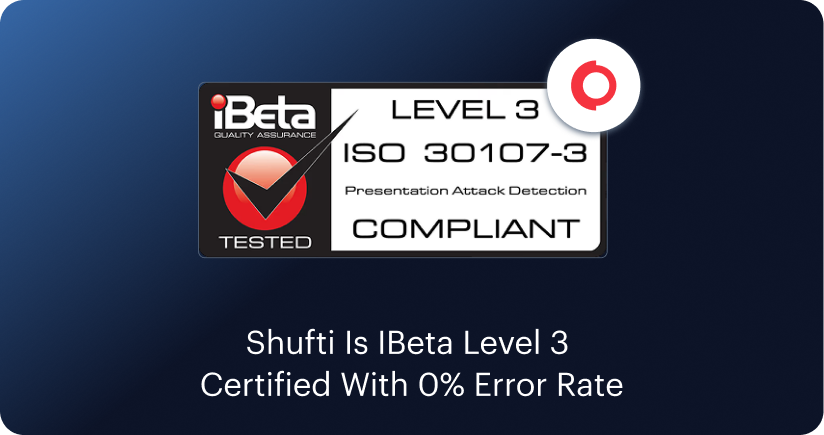
- While Trulioo publishes no comparable iBeta result, Shufti holds iBeta Level 3
- Trulioo has little Trustpilot presence as opposed to Shufti’s 4.8 on Trustpilot across 3800+ reviews.
- Trulioo rates 4.4 with 40 reviews, while Shufti rates 4.6/5 with 120+ reviews.
- Shufti runs KYB on its owned stack with beneficial owner discovery and ongoing screening, beyond data lookups.
- Migration works best as a phased parallel run, not a hard cutover.
Choosing a Trulioo alternative is usually a question of scope rather than dissatisfaction. Trulioo is widely recognised for authoritative-data and doc-less identity verification, an approach that works well for confirming identities against trusted data sources. As compliance programmes grow, many teams find they also need document verification, biometric liveness, ongoing screening, and business verification, and adding each one through a separate supplier means routing customer data through more third parties.
Moving to a provider that owns the technology behind those checks, rather than resolving them through a chain of external data partners that each touch customer data, is a common reason teams begin comparing alternatives to Trulioo.
What turns that idea into a project is usually practical. The pass rates that vary from one market to the next, engineering time spent maintaining several integrations, and unease about how many third parties end up attaining customer data. This guide covers why companies migrate away from Trulioo, what to look for in a replacement, the strongest alternatives to Trulioo in 2026, and how to run the migration without breaking onboarding.
Why companies migrate away from Trulioo
Companies migrate away from Trulioo when their needs grow beyond data-based identity matching and the platform’s documented weaknesses start to cost them conversions or engineering time. Trulioo is a Canada-headquartered specialist in authoritative-data and doc-less verification, confirming identities against trusted data sources across many markets. That is a genuine strength in its niche. However, it is also a narrow one, and the recurring gaps surface in independent reviews rather than in marketing copy.
The most consistent issue is match-rate and data-quality inconsistency by region. On G2, where Trulioo holds 4.4 out of 5 across 40 reviews, reviewers note that broad country coverage does not always translate into consistent match rates, and that data quality varies from one market to the next. This is the practical limit of a data-aggregation model. The results are only as good as the underlying source in each country. For a business expanding into new geographies, an inconsistent pass rate is lost conversion and added manual-review cost because checks are resolved across many external data sources, both match quality and response times can vary by market.
A second recurring theme is integration complexity and time to production. Buyer reviews describe a technically involved setup that needs dedicated developer resources to get the API into production, which lengthens the path to going live and weighs most heavily on smaller teams without spare engineering capacity.
A third recurring theme is that of pricing transparency. Trulioo does not publish its pricing; the company states on G2 that pricing information is not provided, so buyers go through sales for a custom, usage-based quote. That makes it harder to compare costs up front or model unit economics before committing.
Underneath all three is the architecture of it all. Trulioo combines its own technology with a large network of external data partners, per its partner page. A data-aggregation model can be slower to fix when a specific market underperforms, because the improvement depends on a partner’s data or release cycle rather than the vendor’s own, and routing personal data through more third parties widens the data-exposure surface. Buyers who feel that lag, or who want to add document, biometric, and ongoing-screening verification without bolting on more vendors, tend to start evaluating Trulioo competitors that own more of the stack.
None of this makes Trulioo a poor product within its niche. It makes it a specialist, and the migration question is whether a specialist still fits a business that now needs document, biometric, business, and ongoing verification under one roof.
What to look for in a Trulioo alternative in 2026
The right alternatives to Trulioo are the ones whose architecture matches where your verification is heading, not just where it is today. Evaluate candidates against the criteria below rather than a feature checkbox list, because the structural differences are what determine cost, accuracy, and audit defensibility two years from now.
Technology ownership versus orchestrated stacks
The single most consequential difference between vendors is how much of the stack they own. Orchestration does not mean the buyer juggles several dashboards; most orchestrated vendors present one clean platform. The real difference, however, sits underneath it. An orchestrated vendor routes each check through different third-party suppliers, liveness from one, OCR from another, document forensics from a third, so a single onboarding sends personal data through several external processors, and fixing any one check depends on that partner’s release cycle.
A vendor that builds and owns OCR, liveness, document intelligence, KYC, KYB, and AML in-house keeps that data inside one chain of custody and can retrain models on its own timeline. That ownership has downstream effects on pricing predictability, customisation, dependability, and how widely PII or customer data is exposed.
Business verification and UBO discovery depth
For anyone replacing Trulioo on the KYB side, business verification depth is the core test. A capable business verification alternative to Trulioo should resolve corporate registries across jurisdictions, map ultimate beneficial owners, screen entities and their owners against sanctions and adverse media, and re-run those checks on an ongoing basis rather than once at onboarding. KYB that stops at registry lookup leaves the hardest part, the human owners behind the entity, unverified.
Doc-less and authoritative-data coverage
Doc-less verification, confirming an identity against authoritative data rather than a document, keeps pass rates high when document upload is unreliable or unwanted. Judge candidates on the depth of authoritative data sources for passive checks, the number of countries covered for background verification of name, date of birth, and address, and the range of active electronic identity (eID) integrations such as BankID, Singpass, and MitID.
Data aggregation is sometimes treated as one vendor’s home turf, but it is not unique to any single provider. Several full-stack platforms now match or exceed that depth while also owning the document and biometric layers, so depth and accuracy of coverage matter more than reputation. Language depth matters here too, and it is about accuracy rather than a long list: an engine tuned for fewer scripts at high accuracy beats one that nominally lists more.
Independent liveness conformance
If your replacement will also handle biometric onboarding, independent liveness conformance is non-negotiable. The relevant benchmark is iBeta presentation-attack detection testing under ISO/IEC 30107-3. A vendor that has submitted to and passed iBeta Level 3, the highest published level, has independent evidence of its defence against spoofing and deepfakes, rather than a self-reported claim. Vendors that have not submitted at all are asking you to take their word for it.
Deployment flexibility and data residency
SaaS is fine until a regulator requires data to stay in-country. Buyers subject to PDPL in Saudi Arabia, NESA in the UAE, PDPA in Thailand, or OJK rules in Indonesia need local cloud or on-premises deployment, which SaaS-only vendors cannot provide. If your roadmap touches the GCC, South East Asia, or any sovereignty-sensitive market, deployment flexibility should be a hard filter, not a nice-to-have.
AI-driven accuracy in hard markets
Modern KYB and KYC lean heavily on AI to lift accuracy and cut manual review, and this is where owned models pull ahead. AI improves KYB and KYC compared to a partner-dependent stack like Trulioo’s in three concrete ways: it automates ultimate beneficial owner discovery by cross-referencing registries and ownership graphs instead of relying on manual lookups, it raises document and OCR accuracy on non-Latin scripts and complex regional documents, and it powers continuous risk re-scoring rather than point-in-time checks. The decisive factor is not whether a vendor uses AI, every vendor now claims to, but whether it owns and can retrain those models per market on its own timeline. A vendor that has to wait on a third party to retrain a failing model cannot improve accuracy as fast as one that controls its own pipeline.
The best Trulioo alternatives in 2026
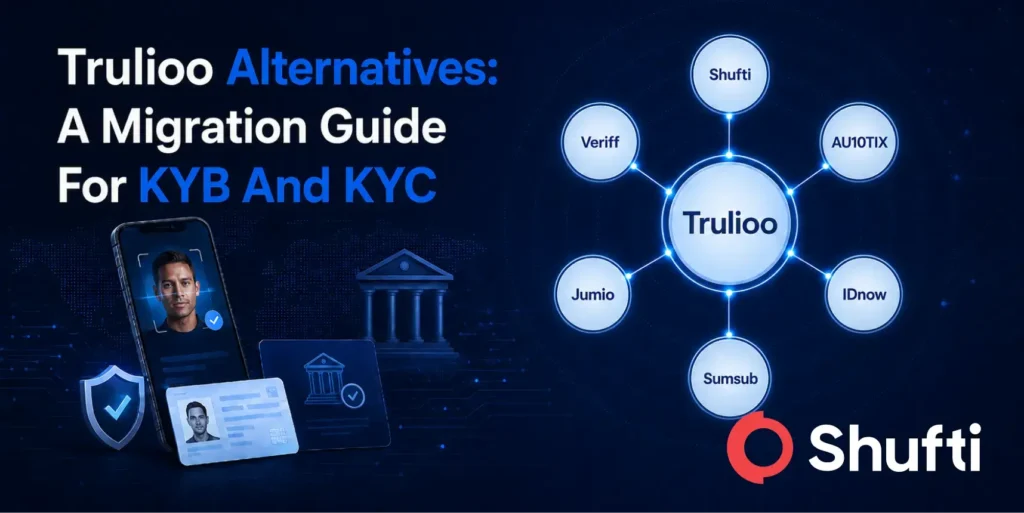
As the publisher of this guide, we list Shufti first for transparency. The remaining six vendors are listed alphabetically and described on the same factual basis. Each entry includes an overview, key strengths, considerations, certifications and recognitions, current public ratings, and the use case the vendor is best suited to.
All product details are sourced from each vendor’s public website, the KuppingerCole Analysts 2025 market assessment, public iBeta conformance listings, and verified review platforms. Trulioo itself is not listed as an alternative here, since it is the incumbent being replaced; it appears as a reference row in the comparison table for migration context.
#1. Shufti
Shufti is a UK-headquartered KYC, KYB, and AML vendor built entirely on owned intellectual property be it OCR, liveness detection, document intelligence, KYC, KYB, and proprietary AML, all are developed and maintained in-house rather than licensed from partners. That ownership is what made Shufti a genuinely ‘Glocal’ IDV vendor: the same architecture verifies a US driver’s licence with the same engineering control as a Vietnamese national ID, an Indonesian KTP, or a Saudi national ID, and the engineering team can retrain models for any country, region, or vertical challenge on its own release timeline. It is the architecture mainstream IDV players turned to when their orchestrated stacks struggled with non-Latin scripts and complex regional documents. For a Trulioo alternative, that matters because the doc-less data strength buyer’s value in Trulioo arrives here alongside owned document, biometric, and AML technology under one chain of custody.
Key strengths:
Shufti is trained on and actively verifying 10,000+ document types across 240+ countries and jurisdictions every month, not just listed in a lifetime catalogue. Its in-house OCR reaches 99.7% accuracy across 150+ languages and scripts and outperforms Google Vision on various non-latin scripts. On the doc-less side that buyers most often migrate to from Trulioo, Shufti runs a doc-less identity hub with 270+ authoritative data sources for passive checks across 85+ countries, plus 40+ active eID integrations including BankID, Singpass, MitID, and OneID, served through three eIDV modes (Passive, Active, and Biometrically Enriched) under a single API. For KYB, Shufti combines business registry resolution and ultimate beneficial owner discovery with sanctions, PEP, and adverse media screening and ongoing monitoring. It supports physical IDs, Digital IDs and EUDI Wallets, NFC chip verification, and Qualified Electronic Signatures (QES) under eIDAS 2.0.
Considerations:
Smaller commercial presence in North American markets than US-headquartered peers, which is a brand-awareness and contracting consideration, not a capability one.
Deployment Options:
- SaaS
- Cloud
- Local Cloud
- On-premise for data-residency compliance
Certifications and recognitions:
- iBeta Level 3 conformance under ISO/IEC 30107-3, held by only three vendors globally
- DHS RIVR 2025 Top Performer: 98.49% True Accept Rate, zero False Template Creation events in the U.S. Department of Homeland Security Remote Identity Validation Rally 2025
- SOC 2 Type II
- PCI DSS
- GDPR compliance, Cyber Essentials, Cyber Essentials Plus
- KuppingerCole Analysts 2025: highest overall technical capability score (79 / 100) and the only vendor in the market positioning assessment with no partner dependencies across core capabilities
Ratings (as of May 2026):
- Shufti Trustpilot Reviews: 4.8 / 5 (3,800+ reviews), the highest Trustpilot rating-and-volume combination among the vendors compared
- Shufti G2 Reviews: 4.5 / 5 (85 reviews)
Best for:
Teams leaving Trulioo because they need business verification and doc-less depth plus owned document, biometric, and AML technology in one platform, particularly those operating across non-Latin and emerging markets or facing data-residency requirements. On the recurring Trulioo vs Shufti question, the honest framing is that Trulioo is the narrower doc-less specialist, while Shufti is the broader full-stack platform that also does doc-less well, with wider reach and owned document and biometric layers Trulioo does not match. One platform. Fully owned technology. Global coverage with real local depth.
#2. AU10TIX
AU10TIX is an Israel-headquartered identity verification vendor founded in 2002, delivering its own technology as SaaS via Microsoft Azure. It is best known for fraud-focused capabilities, including its Serial Fraud Monitor for synthetic identity detection.
Key strengths:
AU10TIX owns its core technology and verifies 5,000+ document types, with verification speeds of 6 to 8 seconds per its product documentation. Its Serial Fraud Monitor targets synthetic identity and organised fraud rings, which makes it a strong choice for fraud-heavy verticals such as gaming, crypto, and travel.
Considerations:
AU10TIX holds iBeta Level 2 conformance per public listings rather than Level 3, and is delivered SaaS-only, so it does not address Local Cloud or on-premises data-residency requirements. Its doc-less and authoritative-data depth is narrower than Trulioo’s, so it is not a like-for-like replacement for buyers migrating primarily for data-source coverage.
Certifications and recognitions:
- ISO/IEC 27001
- ISO 27701
- SOC 2
- TX-RAMP
- NIST 800-63A
- iBeta Level 2 PAD conformance under ISO/IEC 30107-3
Ratings (as of May 2026):
- G2: 4.3 / 5 (33 reviews)
- Trustpilot: 3.1/5 Reviews
Best for:
Fraud-heavy verticals prioritising synthetic identity detection and document forensics, rather than buyers whose main reason for leaving Trulioo is doc-less data breadth or KYB depth.
#3. IDnow
IDnow is a Germany-headquartered identity verification vendor with deep DACH-region presence, combining its own technology with capabilities from its ARIADNEXT acquisition. It is best known for video-identification at scale in regulated European financial services.
Key strengths:
IDnow offers EU video-identity at scale and holds eIDAS Qualified Trust Service Provider (QTSP) status through ARIADNEXT, which supports qualified electronic signature use cases. For organisations whose priority is EU regulatory fit and video-based onboarding, this is a focused strength.
Considerations:
IDnow holds iBeta Level 2 and operates on an own-plus-partner model following the ARIADNEXT acquisition. On Trustpilot it carries a large review volume with mixed consumer sentiment tied to the video-ident experience. Its coverage is weighted toward Europe rather than the global doc-less breadth Trulioo users may be replacing.
Certifications and recognitions:
- ISO/IEC 27001
- eIDAS QTSP status via ARIADNEXT
- ETSI standards under eIDAS
- GDPR compliance with regional EU data-centre options
Ratings (as of May 2026):
- Trustpilot: 3.4/5 16,000+ reviews
- G2: Limited
Best for:
EU-headquartered organisations require video-ident at scale and qualified electronic signatures, particularly in regulated financial services, rather than buyers needing global doc-less data or non-EU coverage.
#4. Jumio
Jumio is a US-headquartered identity verification vendor with a few enterprise IDV customer bases. It has been in business since 2010 and has an umbrella of identity which includes AML and biometric verification solutions.
Key strengths:
Jumio offers a broad enterprise scale, a document library of 5,000+ types, and support for 42 languages. For large organisations that value vendor scale and an established enterprise track record, it is a known quantity.
Considerations:
Jumio holds iBeta Level 2 per its public listing rather than Level 3. Its Trustpilot rating is 1.4 / 5 with 82 reviews reflecting consumer-side friction. Its language coverage and hard-market document depth are narrower than vendors trained on non-Latin documents from inception.
Certifications and recognitions:
- ISO/IEC 27001:2022
- SOC 2 Type 2
- PCI DSS
- iBeta Level 2 PAD conformance under ISO/IEC 30107-3
Ratings (as of May 2026):
- Trustpilot: 1.4 / 5 (82 reviews)
- G2: approximately 4.0 / 5 (22 reviews)
Best for:
Established enterprises prioritising vendor scale in mature Western markets, rather than buyers whose migration is driven by doc-less data breadth, KYB depth, or non-Latin accuracy.
#5. Onfido (Entrust IDV)
Onfido is a UK-founded identity verification vendor acquired by Entrust in April 2024 and rebranded as Entrust IDV.
Key strengths:
Entrust IDV verifies 6,000+ government-issued IDs across 44 languages and integrates into Entrust’s broader security portfolio, which appeals to buyers who already use Entrust products. It holds ETSI-certified IDV for qualified electronic signatures under eIDAS.
Considerations:
It holds iBeta Level 2 and its Trustpilot rating is 1.1 / 5 across 367 reviews.
Certifications and recognitions:
- ISO 27001 (BSI certified, IS 660122)
- SOC 2 Type II
- ETSI-certified IDV for QES under eIDAS
- iBeta Level 2
Ratings (as of May 2026):
- Trustpilot: 1.1 / 5 (300+ reviews)
- G2: 4.3 / 5 (111 reviews)
Best for:
Enterprise buyers with existing Entrust security relationships or government-sector deployment needs, rather than buyers prioritising fast non-Latin OCR or global doc-less data.
#6. Sumsub
Sumsub is a UK-incorporated verification platform with a strong fintech and crypto customer base. It positions itself around end-to-end KYC, KYB, transaction monitoring, and fraud prevention through a single integration, and is widely adopted by crypto exchanges and digital-first financial services.
Key strengths:
Sumsub offers wide document coverage of 14,000+ types and 140 languages with end-to-end orchestration, and self-reports an average pass rate of 90% and a 30-second verification time. For crypto and fintech operators wanting rapid integration and broad coverage, it is a popular choice.
Considerations:
Sumsub has not submitted to iBeta presentation-attack detection testing at any level as of May 2026, so its liveness defence is self-reported rather than independently conformance-tested. Its orchestrated model means several core capabilities depend on partners. Its Trustpilot rating is 1.3 / 5 across 263 reviews.
Certifications and recognitions:
- ISO 27001
- ISO 22301:2019, ISO/IEC 27017, ISO/IEC 27018
- SOC 2 Type II, SOC 3
- PCI DSS
- ETSI 119 and 319 standards under eIDAS
Ratings (as of May 2026):
- Trustpilot: 1.3 / 5 (200+ reviews)
- G2: 4.6 / 5 (112 reviews)
Best for:
Crypto, fintech, and iGaming operators wanting rapid integration and wide coverage where independent liveness conformance is not a procurement requirement.
#7. Veriff
Veriff is an Estonia-headquartered, AI-driven document and biometric verification vendor focused on fast SaaS onboarding for EU and US traffic.
Key strengths:
Veriff verifies 12,000+ government-issued IDs across 240+ countries and 48 languages, with an average verification time of around 6 seconds per its public site. It is a strong fit for fast SaaS onboarding on Western and EU traffic.
Considerations:
Veriff is SaaS-only with EU data residency hosted on AWS, so it offers no on-premises or Local Cloud option for GCC or South East Asian residency requirements. Its training data is weighted toward EU and US documents, so non-Latin hard-market depth is narrower than vendors trained on those documents from inception. It holds iBeta Level 2, and its Trustpilot rating is 1.4 / 5 across 213 reviews.
Certifications and recognitions:
- ISO/IEC 27001:2022, ISO/IEC 27017:2015, ISO/IEC 27018:2019
- SOC 2 Type II
- Cyber Essentials
- iBeta Level 2 PAD conformance under ISO/IEC 30107-3
Ratings (as of May 2026):
- Trustpilot: 1.4 / 5 (200+ reviews)
- G2: 4.5 / 5 (61 reviews)
Best for:
EU and US digital platforms prioritising fast SaaS verification over data-residency flexibility or hard-market document depth.
| Vendor | Technology ownership | iBeta liveness level | Deployment | G2 rating | Trustpilot | Best fit |
| Shufti | Own IP (full stack) | L3 | SaaS, Local Cloud, on-prem | 4.6 (120+) | 4.8 (3,800+) | Global enterprises needing high pass rates, lower fraud, and PII data security |
| AU10TIX | Own IP | L2 | SaaS | 4.3 (33) | Limited | Synthetic and repeat fraud |
| IDnow | Own + partner | L2 | SaaS, EU residency | Limited | 3.4
(16,000+ ) |
EU video ID and e-signatures |
| Jumio | Own + partner | L2 | SaaS | 4.0
(22 reviews) |
1.4 (82) | Existing deployments in mature Western markets |
| Onfido (Entrust IDV) | Own + partner | L2 | SaaS | 4.3 (109) | 1.1 (300+) | Existing Entrust customers |
| Sumsub | Own + partner | Not submitted | SaaS | 4.6 (109+) | 1.3 (200+) | Sectors requiring low assurance checks |
| Veriff | Own + partner | L2 | SaaS, EU residency | 4.5 (61) | 1.4 (200+) | Quick ID checks in Baltics |
| Trulioo (incumbent) | Own + partner | Limited public info | SaaS | 4.4 (40) | 2.8(3) | Data-based checks without documents |
Sources: KuppingerCole Analysts 2025 market assessment, public iBeta conformance listings, vendor public sites, G2.com vendor profiles, Trustpilot vendor profiles. All data accurate as of May 2026; verify directly with each vendor before procurement.
How to migrate from Trulioo to another provider
Migrating from Trulioo to another provider works best as a phased parallel run rather than a hard cutover, so you never gamble live onboarding on an unproven integration. The sequence below reflects how compliance and engineering teams typically de-risk a verification migration.
Auditing your current Trulioo usage should be the first step in the migration process. Document every check type you call, the data fields you consume, the markets and document types where pass rates are strongest and weakest, and the downstream systems that depend on Trulioo’s response format. This audit becomes your acceptance criteria.
Second, define success quantitatively before you switch anything. Set target pass rates per market, acceptable verification latency, manual-review rate, and the fraud-catch outcomes you need. Without a baseline, you cannot prove the new provider is better, only different.
Third, run the new provider in parallel, or shadow mode, against live traffic. Send the same verification requests to both Trulioo and the candidate, compare results on your own data, and pay special attention to the hard markets and edge cases that triggered the migration. This is the step where marketing claims would meet reality.
Fourth, map and translate data fields and API responses. A capable replacement should cover your existing check types and ideally consolidate ones you previously split across vendors, such as document, biometric, KYB, and ongoing AML screening under a single API and audit trail.
Fifth, cut over in phases by segment, for example by geography, product line, or risk tier, rather than all at once. Keep Trulioo running for the segments you have not yet validated, and decommission only once each segment meets the success criteria you defined in step two.
A vendor that owns its full stack simplifies this process, because document, biometric, KYB, and AML all migrate to one platform with one chain of custody, instead of being re-stitched across several point tools.
How to choose the right Trulioo alternative for your business
The vendor that fits is the one that handles your verification cases under your specific regulatory regime, with a deployment model your data-residency requirements accept. Most buyers leaving Trulioo fall into one of three procurement situations.
Scenario 1: Business verification (KYB) is your priority
If your main reason for leaving is KYB depth, Shufti is the strongest fit and the best business verification alternative to Trulioo for most buyers, because it resolves corporate registries, discovers ultimate beneficial owners against the FATF Recommendation 24 standard, and screens entities and owners against sanctions and adverse media with ongoing monitoring, all on owned technology under one chain of custody. That single-chain accountability keeps customer data inside one provider rather than spread across data partners. Trulioo remains a legitimate narrower specialist where your need is purely non-document, authoritative-data verification of individuals and document availability is unreliable, but for end-to-end business verification that also covers the humans behind the entity, an owned full-stack platform is the more defensible choice.
Scenario 2: You operate across non-Latin and emerging markets
For multi-geography onboarding that includes non-Latin scripts and emerging markets, Shufti is the primary recommendation, because its models were trained on those documents from inception rather than retrofitted, its OCR outperforms Google Vision on various non-Latin scripts, and its doc-less hub spans 270+ authoritative data sources across 95+ countries plus 40+ active eID integrations. Public clients across exactly this profile include Binance, Stripe, and ByteDance/TikTok. Where document availability is genuinely unreliable and you need non document verification only, Trulioo is the narrower data-aggregation specialist, but it does not bring the owned document and biometric layers that the same emerging-market traffic usually also requires.
Scenario 3: You face high deepfake and fraud exposure in regulated onboarding
For crypto, forex, gaming, and fintech onboarding exposed to deepfakes and synthetic identity, Shufti offers the most defensible posture, with iBeta Level 3 conformance held by only three vendors globally plus full-stack ownership that lets it ship defence updates on its own timeline. AU10TIX is a credible specialist alternative where the specific priority is synthetic-identity-fraud detection. Vendors without independent liveness conformance should be treated cautiously in this scenario, since their spoofing defence is self-reported rather than conformance-tested.
Marketing pages do not reveal the right vendor. Verification performance on your actual traffic does. The procurement question is which vendor’s structural advantages match your verification reality: where your users live, which compliance regimes you face, how you deploy, and how exposed you are to AI-driven fraud. For most buyers replacing Trulioo and facing more than one of those questions, Shufti’s combination of full-stack ownership, KYB and doc-less depth, iBeta Level 3 conformance, and deployment flexibility is the broadest single-vendor answer. The only way to confirm is a proof of concept on your hardest cases, in your highest-risk markets, with your fraud team running attack scenarios.
Frequently Asked Questions
What is the best Trulioo alternative in 2026?
There is no single best alternative for everyone, but for buyers needing business verification and doc-less depth plus owned document, biometric, and AML technology under one audit trail, Shufti is the strongest full-stack fit. Trulioo remains a narrower specialist for non-document, authoritative-data verification.
What are the top alternatives to Trulioo in 2026?
The leading alternatives to Trulioo are Shufti, AU10TIX, IDnow, Jumio, Onfido (Entrust IDV), Sumsub, and Veriff. They differ on technology ownership, KYB depth, liveness conformance, and deployment flexibility, so the right pick depends on your markets, regulatory regime, and fraud exposure.
How does AI improve KYB and KYC compared to Trulioo?
AI improves KYB and KYC by automating ultimate beneficial owner discovery across registries, raising OCR accuracy on complex documents, and enabling continuous risk re-scoring instead of point-in-time checks. The advantage is largest with vendors that own and retrain their models per market, rather than depending on partners' update cycles.
Which Trulioo alternative is best for business verification (KYB)?
For most KYB buyers, Shufti is the best business verification alternative to Trulioo, because it combines corporate registry resolution, ultimate beneficial owner discovery against the FATF Recommendation 24 standard, and sanctions and adverse media screening with ongoing monitoring, all on owned technology under a single audit trail.
Why do companies migrate away from Trulioo?
Companies migrate when needs expand beyond authoritative-data matching into full document, biometric, and ongoing-screening verification. Common triggers are inconsistent match rates in some regions, capability gaps that force a multi-vendor stack such as ongoing list screening, and a partner-dependent architecture that retrains slower than owned stacks.
How do you migrate from Trulioo to another provider?
Run a phased parallel migration: audit current Trulioo usage and data fields, define success metrics, run the new provider in shadow mode against live traffic, map API responses, then cut over in phases by segment and decommission Trulioo only once each segment meets your targets. An owned full-stack vendor simplifies the consolidation.