



 Face Verification
 Address Verification
 Document Verification
 Age Verification
 VideoIdent
 Fast ID
 Docless Verification
 Consent Verification
 NFC Verification
 Business Verification
 Due Diligence
 Investor Verification
 E-Signature

 QES
QES
 AML Screening
 Transaction Monitoring
 Adverse Media
 Business AML Screening
 PEP & RCA
 Sanctions
 Watchlist
 Behavioural Biometrics
 Device Fingerprinting
 Biometric Face Authentication
 MFA
MFA
 Fraud Hub
 Onboarding
 Ongoing Monitoring
 KYC
KYC
 KYB
KYB
 KYI
KYI
 Age Assurance
 Identity Verification
 Workforce IAM
 Candidate Verification
 Compliance
 Fraud prevention
 Trust & safety
 Global expansion
 Product Managers
 Compliance Officers
 Fraud Analysts
 Developers
 Deepfake
 Bonus Abuse / Promotion Abuse
 Account Takeover
 Synthetic Identity Fraud
 Document Fraud
 Impersonation Fraud
 Multi-Accounting
 Fraud Networks
 Chargeback Fraud
 Money Mule Activity
 Party Fraud
 Regulatory & Compliance Risks
 Fintech
 Crypto
 iGaming
 Forex
Forex
 Social Network
 Marketplace
 Banking
 Gig Economy
 Payments
 Ride Hailing
 Adult Content
 Blind Spot Audit
 Deepfake Detector
 Liveness Spoofs
 Document Originality
 Document Deepfake
 Global Trust Platform
 Journey Builder
 Case Management
 Shufti AI
 Fraud Analytics
 Vendor Comparison
 Brand Personalisation
 AI Compliance Co-Pilot
 OCR
OCR
 Secure Capture
 Deployment Options
 Identity Methods
 API Documentation
 Mobile SDKs
 Service Status
 Help Center
 Contact Us
 Technical Support
 Supported Documents
 Supported Countries
 Content library
 Blogs
Blogs
 News
News
 Reports
 Insights
 Knowledgebase
 ROI calculator
 About
About
 Career
 Press Release
 Certifications
 Partnership
 Awards
 Events & Webinar
 Interactive Demo
 Podcast Studio
 Spotlight Studio
Business Verification in LATAM: A KYB Compliance Guide

- 01 Why Business Verification in LATAM Is Uniquely Complex
- 02 GAFILAT and the AML Framework Shaping LATAM KYB
- 03 KYB Requirements Across Key LATAM Markets
- 04 What LATAM UBO Verification Requires in Practice
- 05 Common Challenges in LATAM Business Onboarding
- 06 How Shufti Makes Business Verification in LATAM Work
TL;DR
- Business verification in LATAM helps organizations meet AML requirements by verifying company registration, ownership structures, and ultimate beneficial owners (UBOs).
- KYB requirements vary across countries such as Mexico, Colombia, Argentina, and Brazil, making localized compliance essential for cross-border operations.
- GAFILAT’s FATF-aligned standards shape regional KYB obligations, with increasing scrutiny on fintechs, financial institutions, and virtual asset service providers.
- Effective UBO verification requires ownership mapping, sanctions and PEP screening, and ongoing monitoring to detect changes in corporate structures.
- Fragmented corporate registries, multilingual documentation, and evolving regulations make manual KYB processes slow and resource-intensive.
- A unified KYB solution with registry access, UBO verification, and AML screening streamlines compliance, reduces onboarding delays, and strengthens cross-border risk management.
Onboarding a business partner in Latin America looks manageable on paper. In practice, compliance teams often spend days stitching together filings from fragmented national registries, chasing documents across Portuguese and Spanish, and manually mapping ownership chains that stop just short of the real beneficial owner. The region’s rapid fintech growth has only raised both the stakes and the scrutiny.
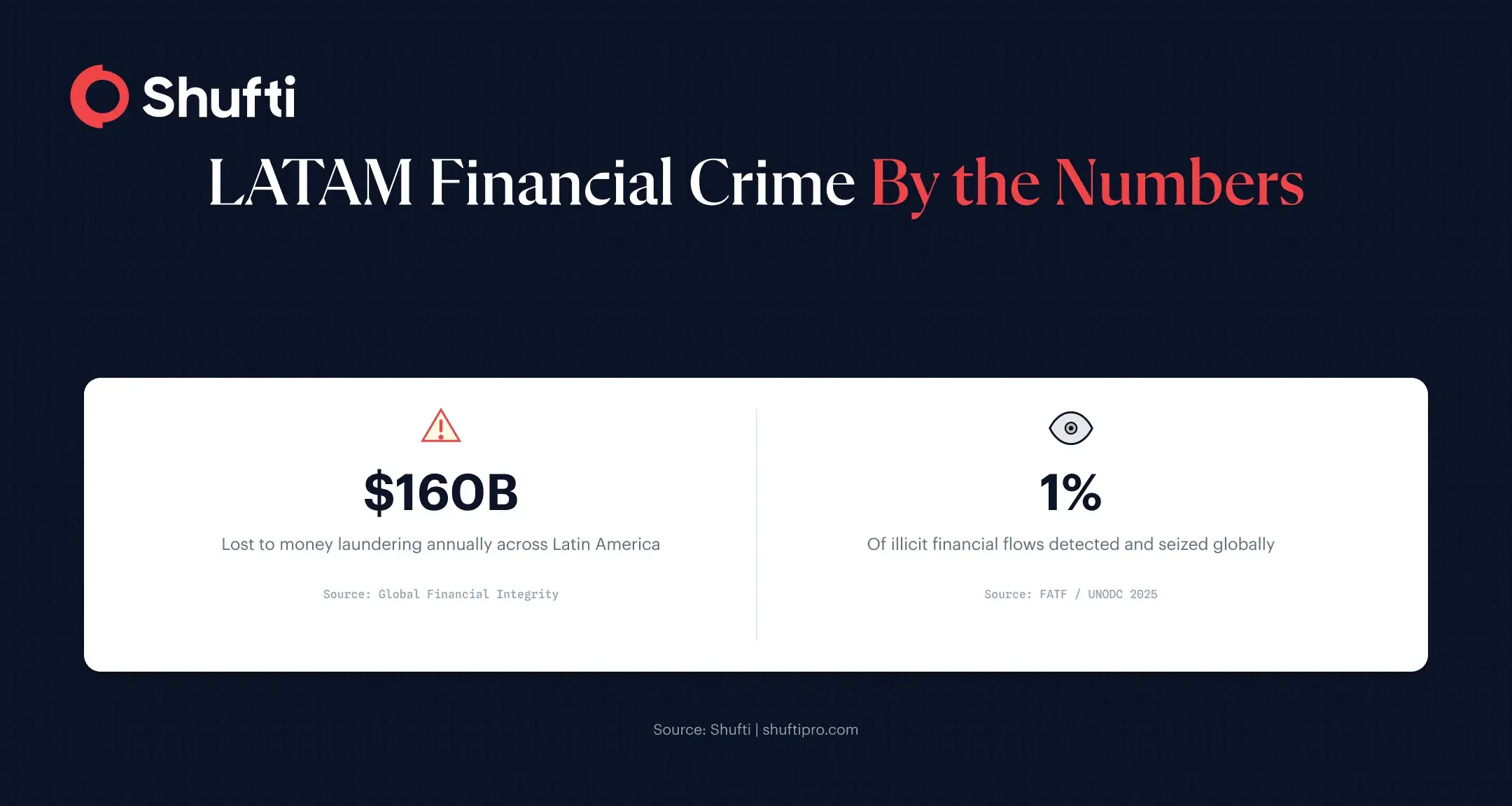
Latin America losses to money laundering are an estimated amount of 2% of regional GDP, according to Global Financial Integrity. And per a 2025 joint statement from FATF, INTERPOL, and UNODC, only 1% of illicit financial flows globally are detected and seized by authorities. Against that backdrop, Know Your Business, the process of verifying a company’s legitimacy, structure, and ultimate beneficial ownership before entering a financial relationship, has shifted from a regulatory checkbox to an operational necessity.
This guide covers what drives business verification requirements across the region, how the rules differ country by country, and where the hardest compliance gaps tend to appear.
Why Business Verification in LATAM Is Uniquely Complex
The LATAM region is not a single compliance jurisdiction. It has 18 or more distinct regulatory environments, each with its own AML laws, corporate registry infrastructure, and enforcement posture. Most countries align with GAFILAT (the Financial Action Task Force of Latin America) recommendations, but implementation varies sharply from one border to the next.
Corporate registries across the region are inconsistently digitised. In several markets, documents are still filed on paper and accessed only through in-person requests. Ownership structures frequently cross jurisdictions, with holding companies in Panama or the British Virgin Islands obscuring the real principals behind a business. Fintech KYB regulations across Latin America are also evolving rapidly, driven partly by crypto licensing mandates and partly by GAFILAT’s 2023 extension of AML obligations to virtual asset service providers.
For fintechs and financial institutions onboarding business clients across multiple LATAM markets, corporate due diligence in LATAM cannot rely on a single workflow. The rules diverge at the level of document requirements, UBO thresholds, and even the definition of which entities carry compliance obligations in the first place.
GAFILAT and the AML Framework Shaping LATAM KYB
GAFILAT is the regional FATF-style body covering 18 Latin American countries, including Argentina, Bolivia, Brazil, Chile, Colombia, Costa Rica, Ecuador, Mexico, Panama, Paraguay, Peru, and Uruguay. Its role is to implement the FATF 40 Recommendations at the regional level through mutual evaluations, technical assistance, and typologies guidance.
The practical consequence for business verification is this: GAFILAT members are expected to require financial institutions and designated non-financial businesses to identify and verify both the legal entity they are dealing with and its ultimate beneficial owners. Since 2023, GAFILAT has also extended these expectations to virtual asset service providers, meaning crypto platforms operating in the region now carry KYB obligations alongside KYC.
Where a country falls short in its mutual evaluation rating directly affects how counterparties in that market are treated during enhanced due diligence. A poor GAFILAT rating means higher-risk treatment in most global compliance frameworks, a real cost for businesses operating across borders in the region.
KYB Requirements Across Key LATAM Markets
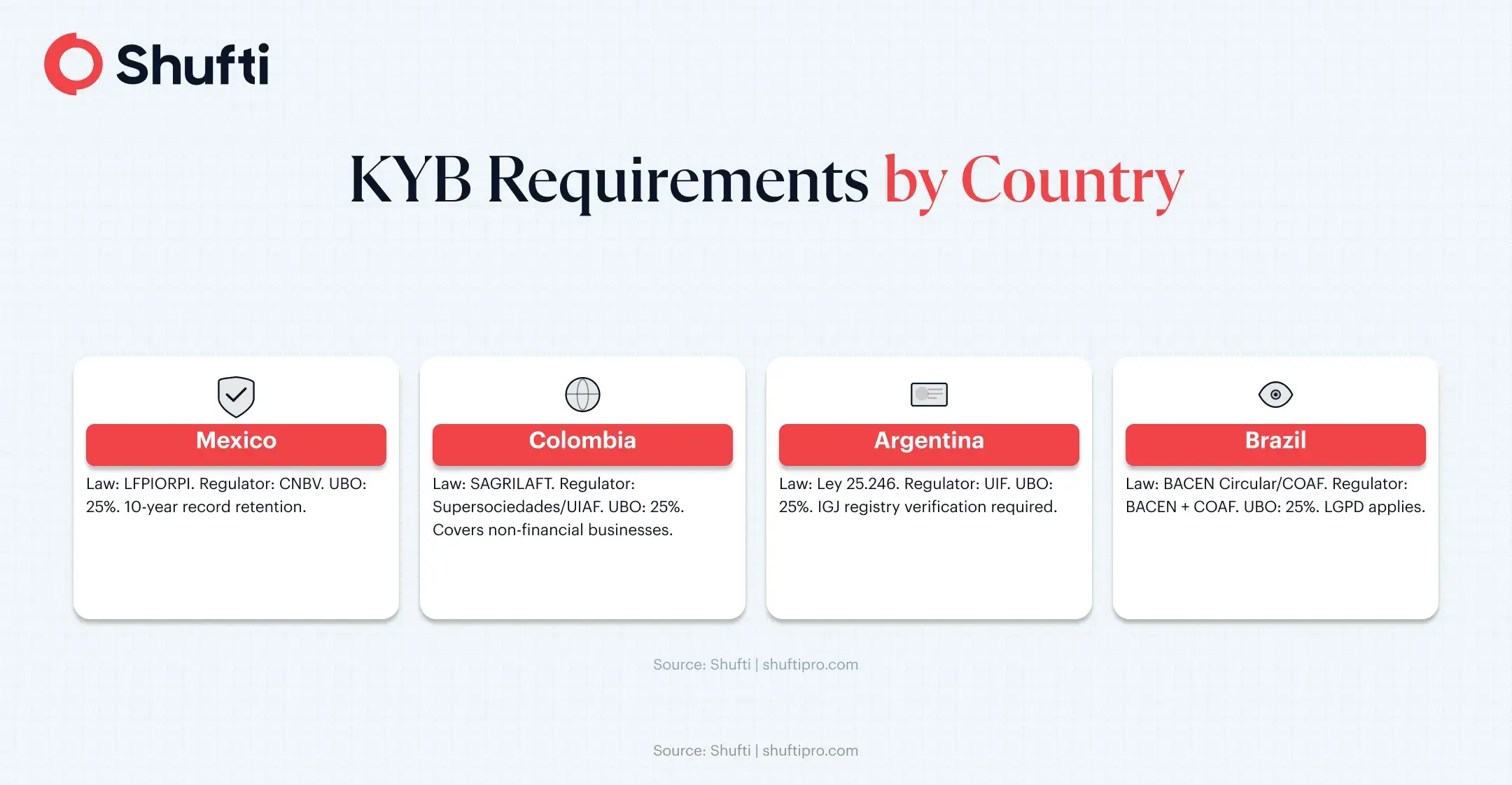
Each country in the region operates under its own legal framework, with varying definitions of obligated entities, document standards, and reporting mechanisms. The four markets below represent the region’s largest compliance footprints and the most active regulatory development as of 2026.
Mexico LFPIORPI and CNBV Obligations
Mexico’s business verification framework is anchored in the Ley Federal para la Prevención e Identificación de Operaciones con Recursos de Procedencia Ilícita (LFPIORPI), commonly known as Mexico’s federal AML law. Financial institutions regulated by the Comisión Nacional Bancaria y de Valores (CNBV) must formally identify business customers, collect ownership records, identify the ultimate beneficial owner, and retain documentation for a minimum of ten years.
For corporate clients, required documents typically include the constitutive act, tax registration (RFC), proof of address, identification of directors and authorised signatories, and beneficial ownership declarations. The CNBV also permits enhanced digital onboarding, including biometric validation and cross-referencing against RENAPO (the national population registry), making Mexico one of the more digitally progressive markets for business onboarding LATAM AML compliance.
Colombia SAGRILAFT and Business-Sector AML
Colombia extends KYB-type obligations beyond financial institutions through SAGRILAFT (Sistema de Autocontrol y Gestión del Riesgo de Lavado de Activos y de la Financiación del Terrorismo), administered by the Superintendencia de Sociedades. Non-financial businesses in real estate, legal services, accountancy, and construction that exceed defined revenue or asset thresholds must implement risk-based due diligence on their business counterparts, identify beneficial owners, and report suspicious transactions to the UIAF (Financial Analysis and Information Unit).
AML business verification in Colombia requires compliance officers to document counterparty identity, verify source of funds, screen against sanctions and PEP lists, and submit periodic absence-of-suspicious-activity reports even when no suspicious activity is detected. Know Your Business obligations in Colombia are not limited to the financial sector. SAGRILAFT was updated in 2025 with new implementation deadlines, and existing compliance manuals must be refreshed at least every two years to remain valid.
Argentina UIF Requirements and Corporate Registry
Argentina’s AML framework, rooted in Ley 25.246, is administered by the Unidad de Información Financiera (UIF). Obligated entities, including banks, fintechs, and exchange houses, must apply customer due diligence to business clients, verify registration through the Inspección General de Justicia (IGJ) or provincial equivalents, and identify beneficial owners consistent with GAFILAT standards.
Know Your Business requirements in Argentina mirror the broader GAFILAT framework: identify the legal entity, verify its registration, identify controlling shareholders and directors, trace ultimate beneficial ownership above the applicable threshold, and screen all principals against sanctions and PEP databases. Argentina’s crypto regulatory framework, strengthened between 2024 and 2025, has brought crypto firms under the same AML rules as banks, extending KYB obligations explicitly into the digital asset sector.
Brazil BACEN Framework and COAF Reporting
Brazil operates under oversight from the Banco Central do Brasil (BACEN) and the Conselho de Controle de Atividades Financeiras (COAF), which functions as the country’s financial intelligence unit. Brazilian KYB obligations align with the country’s relatively mature regulatory infrastructure. The LGPD (data protection law) adds an additional layer of requirements around how business identity data is collected and stored during corporate verification.
Corporate verification in Brazil requires collecting articles of incorporation, the CNPJ (company tax ID), proof of address, director identification, and beneficial ownership records. COAF’s jurisdiction over suspicious transaction reporting is broad, applying to financial institutions, fintechs, real estate operators, and accountants, giving Brazil one of the widest-reaching obligated-entity regimes in the region.
What LATAM UBO Verification Requires in Practice
Beneficial ownership LATAM regulations follow a broadly consistent principle, targeting any natural person holding 25% or more of voting rights or economic interest. Enforcement depth varies significantly by market, however. In jurisdictions with opaque or partially digitised registry systems, ownership chains frequently pass through intermediate holding entities in offshore jurisdictions, making the UBO trace a manual research exercise rather than a registry lookup.
Robust LATAM UBO verification requirements cover ownership chain analysis across direct and indirect holdings, identification of all controlling persons, sanctions and PEP screening of each identified UBO, source-of-funds documentation where risk indicators are present, and ongoing monitoring to capture ownership changes after initial onboarding. LATAM company registry verification systems are improving, particularly in Brazil and Mexico, but real-time access to official filings remains inconsistent across the region as a whole.
Common Challenges in LATAM Business Onboarding
Fragmented registries are the most persistent obstacle. Unlike regions with centralized corporate registry infrastructure, LATAM company registries operate under different agencies, formats, and accessibility standards across 18 jurisdictions. LATAM company registry verification for a single cross-border business group can require pulling filings from five or more national sources.
Language and document format divergence compounds the friction. A business onboarding LATAM AML workflow built for Spanish-language documentation may break against Brazil’s Portuguese-language requirements. Multi-jurisdictional corporate groups create UBO mapping complexity that manual processes handle poorly, and regulatory interpretation shifts frequently. SAGRILAFT compliance manuals must be refreshed every two years, and local enforcement guidance can update faster than compliance programmes are designed to absorb.
The result is what compliance teams describe internally: a fragmented compliance stack where KYB is managed manually through lawyers, AML runs through a separate provider, and no single audit trail ties the two together.
How Shufti Makes Business Verification in LATAM Work
Business verification across fragmented LATAM registries demands coverage that a manually assembled compliance stack cannot deliver at scale. Shufti’s Know Your Business solution spans 250+ jurisdictions, reaching across all major LATAM markets, with direct access to company registry data, beneficial ownership verification, and real-time business AML screening from 100,000+ data sources and 3,500+ global watchlists.
For fintechs managing business onboarding across Mexico, Colombia, Argentina, and Brazil simultaneously, Shufti’s single API replaces the overhead of managing multiple point solutions. Corporate due diligence workflows that integrate document verification, UBO tracing, and AML screening into one audit trail give compliance teams the visibility regulators expect, without the hours-per-client manual burden that slows growth.
See how Shufti handles cross-border KYB in LATAM and request your demo today.
Frequently Asked Questions
What are KYB requirements in Latin America?
KYB requirements in Latin America are shaped by GAFILAT's FATF-aligned standards. Obligated entities must verify business registration, identify directors and authorised signatories, trace ultimate beneficial owners above the applicable threshold (typically 25%), and conduct AML screening. Exact document requirements and covered entity definitions vary by country.
What is GAFILAT and its role in LATAM KYB?
GAFILAT (Financial Action Task Force of Latin America) is a regional body implementing FATF standards across 18 member countries. It conducts mutual evaluations to assess each country's AML effectiveness and issues guidelines that directly inform national KYB laws. Since 2023, its guidance covers virtual asset service providers as well.
How does KYB vary across LATAM countries?
Each country operates under its own legal framework: Mexico relies on LFPIORPI and CNBV oversight, Colombia extends obligations through SAGRILAFT to non-financial businesses, Argentina applies UIF rules with IGJ registry checks, and Brazil runs a dual-agency framework through BACEN and COAF. Document requirements, UBO thresholds, and reporting mechanisms all differ.
How does business verification work in Argentina?
In Argentina, obligated entities must verify a company's registration through the IGJ (or provincial registries), collect constitutive documentation, identify directors and shareholders, trace UBOs above the applicable ownership threshold, and screen all principals against PEP and sanctions databases, reporting findings to the UIF.
What are common challenges in LATAM KYB compliance?
The biggest challenges include fragmented and inconsistently digitised corporate registries, multi-lingual documentation requirements, complex cross-jurisdictional UBO chains, and frequently updated local obligations. Compliance teams managing business onboarding across multiple LATAM markets often find that manual processes cannot keep pace with the regulatory pace of change.