AMLR Solutions
  AMLR Consultation
 EUDI Wallet
 Onboarding
 Ongoing Monitoring
 FRAML
FRAML KYC
KYC KYB
KYB KYI
KYI Age Assurance
 Workforce IAM
 Candidate Verification
 Account Takeover
 Bonus/ Promotion Abuse
 Chargeback Fraud
 Deepfake
 Document Fraud
 Fraud Networks
 Impersonation Fraud
 Money Mule Activity
 Multi-Accounting
 Party Fraud
 Regulatory & Compliance Risks
 Synthetic Identity Fraud
 Adult Content
 Banking
 Crypto
 Fintech
 Forex
Forex Compliance
 Fraud prevention
 Trust & safety
 Global expansion
 Compliance Officers
 Developers
 Fraud Analysts
 Product Managers
 Journey Builder
  Global Trust Platform
 Customer Profiles
 Vendor Comparison
 IDV Case Management
 AML Case Management
 Regulatory Reporting
 Agentic Rule Builder
  AI Compliance Co-Pilot
  Fraud Analytics
 Fraud Hub
  OCR
OCR Shufti AI
 Bank Account Verification
  Biometric Duplication
 Database Checks
 Document Intelligence
 Government ID
 Mobile Driver's License
 NFC
NFC Selfie Liveness
 Brand Personalisation
 Deployment Options
 Identity Methods
 IDV Modes
 Multi-tenancy
 On-Premise IDV
 Secure Capture
 Shufti MCP















TL;DR
- Account takeover (ATO) fraud in Mexico rose 324% between late 2024 and early 2026, the highest rate in Latin America.
- CNBV mandated Fraud Prevention Management Plans by December 2024, with full compliance required by October 2025.
- PLD (Prevención de Lavado de Dinero) is Mexico’s AML framework, requiring KYC, sanctions/PEP screening, and suspicious activity reporting to the UIF.
- SPEI’s real-time settlement gives fraudsters a narrow reversal window, making post-transaction detection too slow on its own.
- Biometric CURP verification, mandatory for bank account opening from 2025, links onboarding directly to Mexico’s RENAPO population registry.
- CNBV, Banxico, and CONDUSEF each govern different parts of fraud and AML compliance; banks need all three covered, not just one.
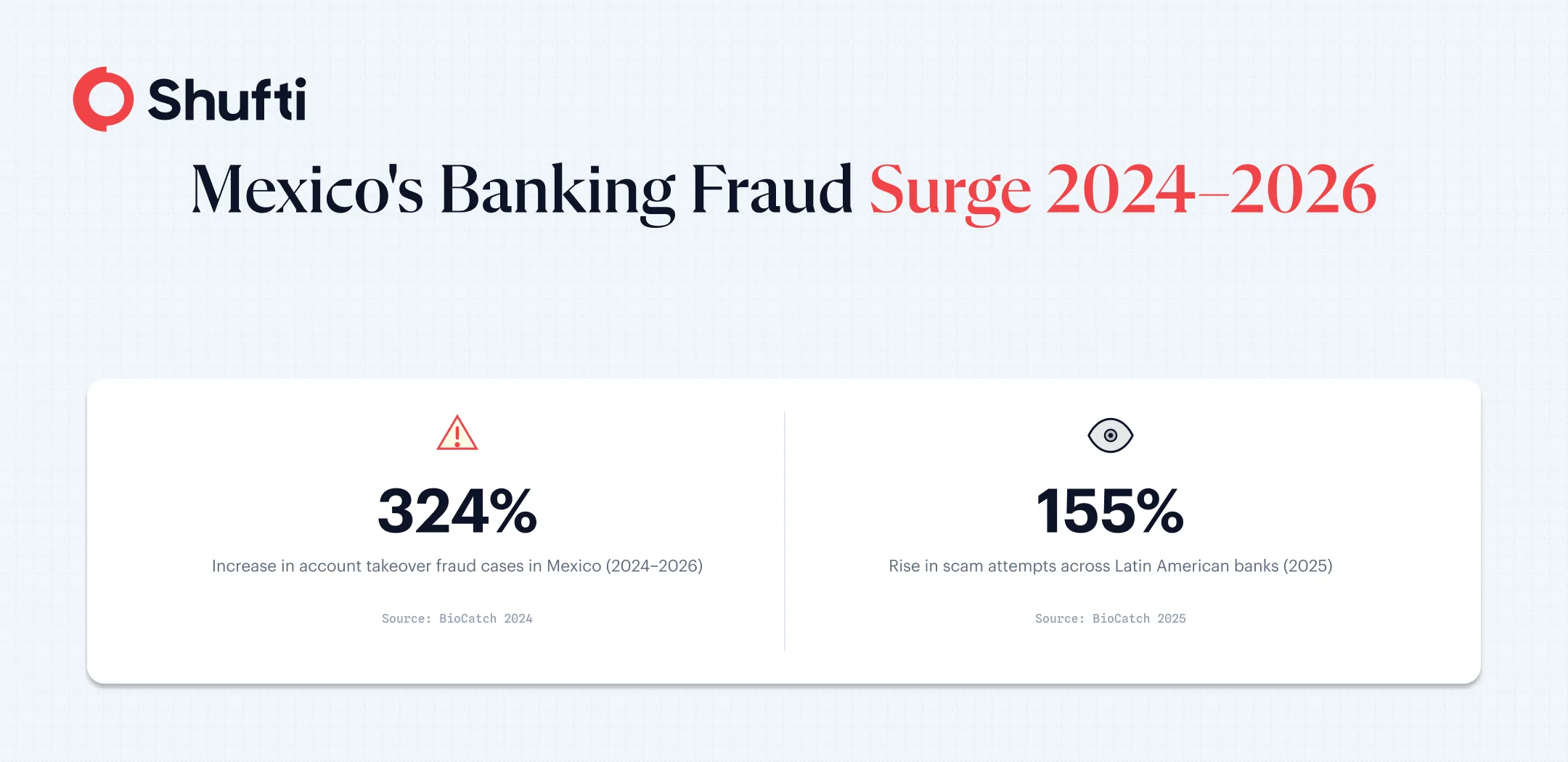
Mexico registered a 324% increase in account takeover fraud between late 2024 and early 2026, the highest growth rate across Latin America. That figure does not capture card fraud, SPEI (Sistema de Pagos Electrónicos Interbancarios) payment manipulation, or the layering of cartel-connected funds through commercial banking channels. It does capture the gap between a fast-moving threat environment and the compliance infrastructure many institutions are still assembling. For compliance officers and risk managers at Mexican banks and licensed fintechs, 2025 and 2026 mark a specific inflection point: the Comisión Nacional Bancaria y de Valores (CNBV) mandated Fraud Prevention Management Plans by December 2024, with full operational compliance required by October 2025. The window to build effective fraud prevention programs in Mexico is narrowing.
Mexico’s fraud landscape: what the numbers reveal
Fraud prevention in Mexican banking is growing harder as criminal networks industrialize attack chains faster than most programs adapt. The BioCatch 2025 analysis of 36 Latin American financial institutions serving more than 300 million customers found a 155% rise in scam attempts across the region, with Mexico leading on nearly every individual metric. Understanding the specific threat vectors explains why generic anti-fraud programs fall short in the Mexican market.
Account takeover and digital fraud surge
Banking fraud prevention Mexico teams track account takeover attacks as the primary volume threat. ATO cases rose 324% in the measured window, while remote-access tool fraud climbed 234% and social engineering attacks rose 150% across the same period. Criminal networks have moved from opportunistic phishing to coordinated, multi-channel campaigns that target onboarding queues, password reset flows, and customer service lines simultaneously. Financial crime prevention programs in Mexico that concentrate only on transaction monitoring miss the upstream identity compromise that enables downstream fraud. Understanding the three stages of money laundering helps compliance teams see where identity fraud feeds into layering.
Cartel-linked money laundering in the banking system
Mexico’s organized crime environment creates a money laundering exposure that few peer markets face at the same scale. Criminal revenues require placement into formal financial channels, including commercial banking, real estate, and cross-border remittances. The Financial Action Task Force (FATF) has assessed Mexico’s compliance across 40 recommendations, finding partial or non-compliant results in several areas directly tied to effective anti-money laundering supervision. Institutions treating AML as a checkbox exercise face regulatory censure alongside layering patterns that FATF assessors explicitly flagged in Mexico’s mutual evaluation.
What does Mexico’s regulatory stack require for AML fraud prevention?
AML fraud prevention Mexico programs operate under a layered regulatory framework that assigns obligations differently by institution type. Banks, neobanks, and licensed technology institutions face overlapping but distinct requirements from the Comisión Nacional Bancaria y de Valores (CNBV), Banco de México (Banxico), and the Comisión Nacional para la Protección y Defensa de los Usuarios de Servicios Financieros (CONDUSEF). Mexico’s fraud risk compliance starts with understanding which body governs which obligation, since each carries separate enforcement consequences.
What PLD compliance requires of financial institutions
PLD (Prevención de Lavado de Dinero) is Mexico’s national Anti-Money Laundering compliance framework. All regulated financial institutions must maintain documented customer due diligence (CDD) and Know Your Customer (KYC) policies, screen against sanctions and Politically Exposed Person (PEP) lists, report suspicious activity to Mexico’s Financial Intelligence Unit (Unidad de Inteligencia Financiera, UIF), and run ongoing monitoring of customer relationships. Enforcement is active. For a broader grounding in AML compliance obligations, the regulatory baseline applies across all institution types.
Ley fintech obligations for neobanks and licensed fintechs
Mexico’s Ley Fintech (Ley para Regular las Instituciones de Tecnología Financiera, 2018) brought digital-first institutions under a compliance regime consistent with CNBV licensing requirements. Licensed fintech institutions must apply Anti-Money Laundering and Counter-Financing of Terrorism (CFT) frameworks, conduct risk-based customer onboarding, and maintain internal controls available for regulatory inspection.
The June 2024 CNBV amendments extended these obligations by requiring institutions to integrate formal fraud prevention management into internal controls, with documentation standards matching the Fraud Prevention Management Plan mandate. Financial risk management Mexico programs that treat fintech and bank obligations as interchangeable will misconfigure their control layers.
CONDUSEF’s role in fraud accountability
CONDUSEF does not regulate institutions directly, but it generates accountability through public complaint data and enforcement referrals. In the first half of 2024, Mexico fraud risk compliance teams that monitor CONDUSEF complaint rates as a leading indicator of control gaps respond to problems before they reach CNBV inspection.
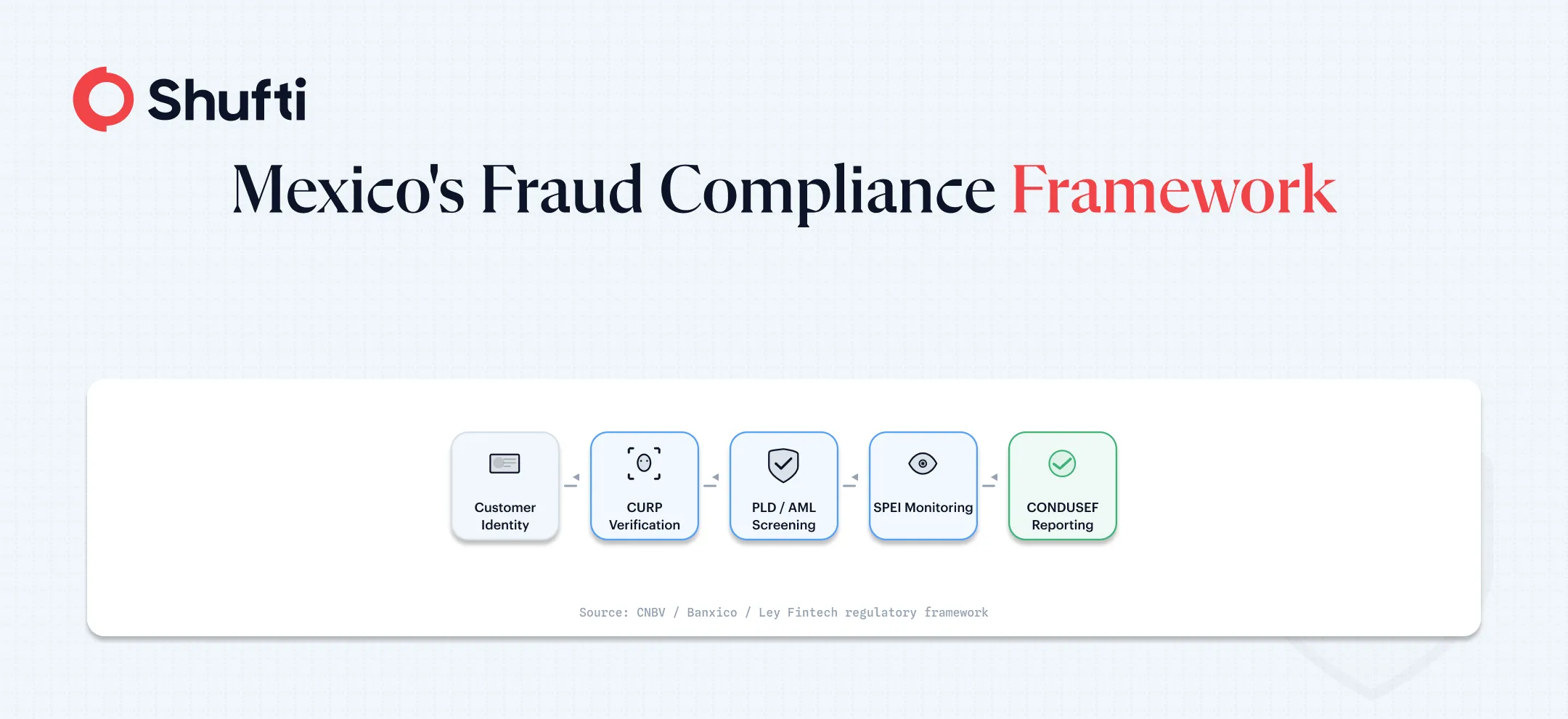
How does SPEI fraud work in Mexico’s payment system?
The Sistema de Pagos Electrónicos Interbancarios (SPEI) is Mexico’s real-time interbank payment infrastructure, and its transaction velocity creates a fraud surface that batch-payment controls do not address. Fraud detection Mexico banks deploy in this environment needs to operate at SPEI’s speed rather than catching problems during end-of-day review. Banxico’s 2024 cybersecurity updates to the SPEI framework changed the compliance baseline for every institution connected to the payment rail.
How fraud exploits SPEI’s velocity
SPEI’s real-time settlement means that once a fraudulent transfer is executed, reversal windows are extremely short. Account takeover attacks that compromise online banking credentials can initiate SPEI transfers within seconds of access. Social engineering attacks, which rose 150% in Mexico during the measured period, are specifically designed to manipulate account holders into authorising SPEI transfers to mule accounts before the victim identifies the fraud.
Financial risk management Mexico programs built around static threshold rules struggle to intercept these attacks without generating false positives that slow legitimate transaction flow. For licensed fintechs facing both Ley Fintech obligations and SPEI fraud pressure, a combined KYC and AML framework addresses the compliance gap at both ends.
Banxico’s 2024 cybersecurity enhancements to SPEI
In 2024, Banxico enacted security updates to SPEI that included cryptographic enhancements to digital signature generation, revised authentication protocols, and mandatory cybersecurity requirements for system participants. These updates also clarify which elements of technological infrastructure fall under SPEI regulatory scope. Institutions connected to the payment rail that have not reviewed their system architecture against the 2024 Banxico standards carry technical compliance gaps alongside their operational fraud exposure. Mexico fraud risk compliance reviews for SPEI participants should treat the 2024 Banxico circular as a mandatory baseline document, not an optional guidance update.
Enterprise Fraud Management Mexico: what effective programs look like
Mexico financial fraud risk management at enterprise scale requires connecting identity verification, transaction monitoring, and AML screening into a unified program rather than operating them as separate functions. Two developments in Mexico’s regulatory and technology environment in 2025 are reshaping how institutions build that connection.
Biometric CURP verification and identity fraud reduction
Mexico’s Clave Única de Registro de Población (CURP) biometric rollout, underway with mandatory implementation for bank account opening and management from 2025, links onboarding identity verification directly to the RENAPO population registry, as documented by Biometric Update. For institutions building enterprise fraud programs, biometric CURP verification reduces synthetic identity risk at the front of the onboarding funnel. Fraudulent account opening using fabricated or stolen identity data is harder to execute against a live registry check than against document inspection alone. Banking fraud prevention Mexico programs that delay integrating biometric CURP verification carry synthetic identity exposure their peers are already closing.
AI-powered fraud detection in Mexican banks
Mexico banks are deploying fraud detection that now covers behavioral biometrics, AI-driven anomaly detection, and deepfake detection alongside rule-based monitoring. The broader shift is from static threshold rules to adaptive models that learn from transaction patterns across a customer’s history. Enterprise fraud management in Mexico programs that rely solely on watchlist screening and static rules are working with a narrower detection layer than the current threat environment demands.
How Shufti helps Mexican banks manage AML fraud risk
The compliance gap that CNBV’s 2024 amendments made visible is not primarily a policy gap. Most institutions understand what PLD requires. The operational gap is in connecting identity verification at onboarding to AML screening that updates continuously, and in surfacing transaction risk signals fast enough to matter in a SPEI environment where reversal windows are measured in seconds.
Shufti’s AML screening runs against 100,000+ data sources and 3,500+ global watchlists, with data refreshed every 15 minutes, a cadence designed for real-time payment environments where a customer’s risk profile can shift between their last session and their next transfer. For institutions building the Fraud Prevention Management Plans that the CNBV mandates, Shufti’s KYC layer connects biometric identity verification to the AML screening stack in a single audit trail, so the compliance record regulators inspect is the same record the fraud team works from.
See how Shufti’s continuous AML screening fits your existing fraud review workflow. Request a demo.
Frequently Asked Questions
What are the main fraud challenges for Mexico's financial sector?
Mexico faces account takeover fraud (up 324% in 2024–2026), SPEI payment manipulation, social engineering attacks, and cartel-linked money laundering. The multi-regulator compliance structure, covering CNBV, Banxico, and CONDUSEF, adds operational complexity to managing these simultaneously.
What is PLD compliance in Mexico?
PLD (Prevención de Lavado de Dinero) is Mexico's AML compliance framework. It requires regulated institutions to implement customer due diligence, screen against sanctions and PEP lists, report suspicious transactions to the UIF, and maintain ongoing customer monitoring. Non-compliance triggers CNBV fines and potential licence action.
How does Mexico's Ley Fintech affect fraud prevention obligations?
The 2018 Ley Fintech extended AML and CFT compliance requirements to licensed fintech institutions under CNBV and Banxico oversight. The June 2024 CNBV amendments required institutions to integrate formal fraud prevention management into internal controls, with full compliance due October 2025.
What is SPEI and how is it vulnerable to fraud?
SPEI is Mexico's real-time interbank payment system. Its real-time settlement means fraudulent transfers can be initiated seconds after account compromise, with narrow reversal windows. Social engineering and account takeover attacks specifically target SPEI authorisation flows, exploiting its speed against the account holder.
What role does CONDUSEF play in fraud cases in Mexico?
CONDUSEF handles complaints from bank customers, tracks fraud-related disputes, and can refer institutions to the CNBV for enforcement. Complaint data is publicly reported, making it a transparency mechanism that reflects each institution's fraud control quality directly in the public record.