





 Face Verification
 Address Verification
 Document Verification
 Age Verification
 VideoIdent
 Fast ID
 Docless Verification
 Consent Verification
 NFC Verification
 Business Verification
 Due Diligence
 Investor Verification
 E-Signature

 QES
QES
 AML Screening
 Transaction Monitoring
 Adverse Media
 Business AML Screening
 PEP & RCA
 Sanctions
 Watchlist
 Behavioural Biometrics
 Device Fingerprinting
 Biometric Face Authentication
 MFA
MFA
 Fraud Hub
 Onboarding
 Ongoing Monitoring
 KYC
KYC
 KYB
KYB
 KYI
KYI
 Age Assurance
 Identity Verification
 Workforce IAM
 Candidate Verification
 Compliance
 Fraud prevention
 Trust & safety
 Global expansion
 Product Managers
 Compliance Officers
 Fraud Analysts
 Developers
 Deepfake Detection
 Bonus Abuse / Promotion Abuse
 Account Takeover
 Synthetic Identity Fraud
 Document Fraud
 Impersonation Fraud
 Multi-Accounting
 Fraud Networks
 Chargeback Fraud
 Money Mule Activity
 Party Fraud
 Regulatory & Compliance Risks
 Fintech
 Crypto
 iGaming
 Forex
Forex
 Social Network
 Marketplace
 Banking
 Gig Economy
 Payments
 Ride Hailing
 Adult Content
 Blind Spot Audit
 Deepfake Detector
 Liveness Spoofs
 Document Originality
 Document Deepfake
 Global Trust Platform
 Journey Builder
 Case Management
 Shufti AI
 Fraud Analytics
 Vendor Comparison
 Brand Personalisation
 AI Compliance Co-Pilot
 OCR
OCR
 Secure Capture
 Deployment Options
 Identity Methods
 API Documentation
 Mobile SDKs
 Service Status
 Help Center
 Contact Us
 Technical Support
 Supported Documents
 Supported Countries
 Content library
 Blogs
Blogs
 News
News
 Reports
 Insights
 Knowledgebase
 ROI calculator
 About
About
 Career
 Press Release
 Certifications
 Partnership
 Awards
 Events & Webinar
 Interactive Demo
 Podcast Studio
 Spotlight Studio
Fraud Prevention in APAC: Trends, Challenges & Best Practices for 2026

-
Add us as a Preferred Source
- 01 The fraud landscape defining APAC
- 02 Why APAC is uniquely vulnerable to digital fraud
- 03 What APAC fraud compliance regulations require from banks
- 04 Best practices for online fraud prevention in Asia Pacific
- 05 How Shufti helps banks and fintechs manage APAC fraud risk
TL;DR
- APAC is the world’s most targeted region for digital fraud, driven by industrialized scam compounds, mule account networks, and AI-generated deepfakes at onboarding.
- Mobile-first adoption outpaced identity infrastructure, leaving inconsistent verification controls across jurisdictions.
- Singapore (MAS Notice 626), Australia (AUSTRAC Tranche 2), Hong Kong (HKMA), and India (RBI) each enforce different AML/KYC requirements, with real-time screening now the baseline expectation.
- FATF currently lists Vietnam, Laos, and Nepal among APAC jurisdictions under increased monitoring; the Philippines exited the grey list in February 2025.
- Effective fraud prevention combines onboarding screening, continuous transaction monitoring, active deepfake detection, sub-hourly watchlist updates, and a documented audit trail.
- Shufti combines document verification, biometric matching, and deepfake detection into a single onboarding pass, with AML screening across 100,000+ data sources and 3,500+ watchlists.
APAC is now the world’s most targeted region for financial fraud. Digital fraud losses across Asia Pacific have been mounting as per UNODC’s Regional Office for Southeast Asia and the Pacific’s 2024 report, “Billion-Dollar Cyberfraud Industry,” which has expanded in SouthEast Asia as criminals adopt new technologies.
According to the Asia Scam Report 2024 by the Global Anti-Scam Alliance, 688 billion USD were reported for scam losses across Asia.
For banks, fintechs, and digital platforms operating across the region, fraud prevention APAC is no longer a back-office checklist item. It is a board-level operational priority.
The pressures come from two directions. Threat actors are industrializing their operations, running investment scams out of organized compounds in Southeast Asia and deploying AI-generated synthetic identities at onboarding.
At the same time, regulators across the region are tightening requirements, grey-listing jurisdictions that fall short of Financial Action Task Force (FATF) standards, and updating AML/CFT frameworks at a pace that outstrips most compliance calendars.
This article covers what is driving those pressures in 2026, what regulators require, and what controls actually work.
The fraud landscape defining APAC
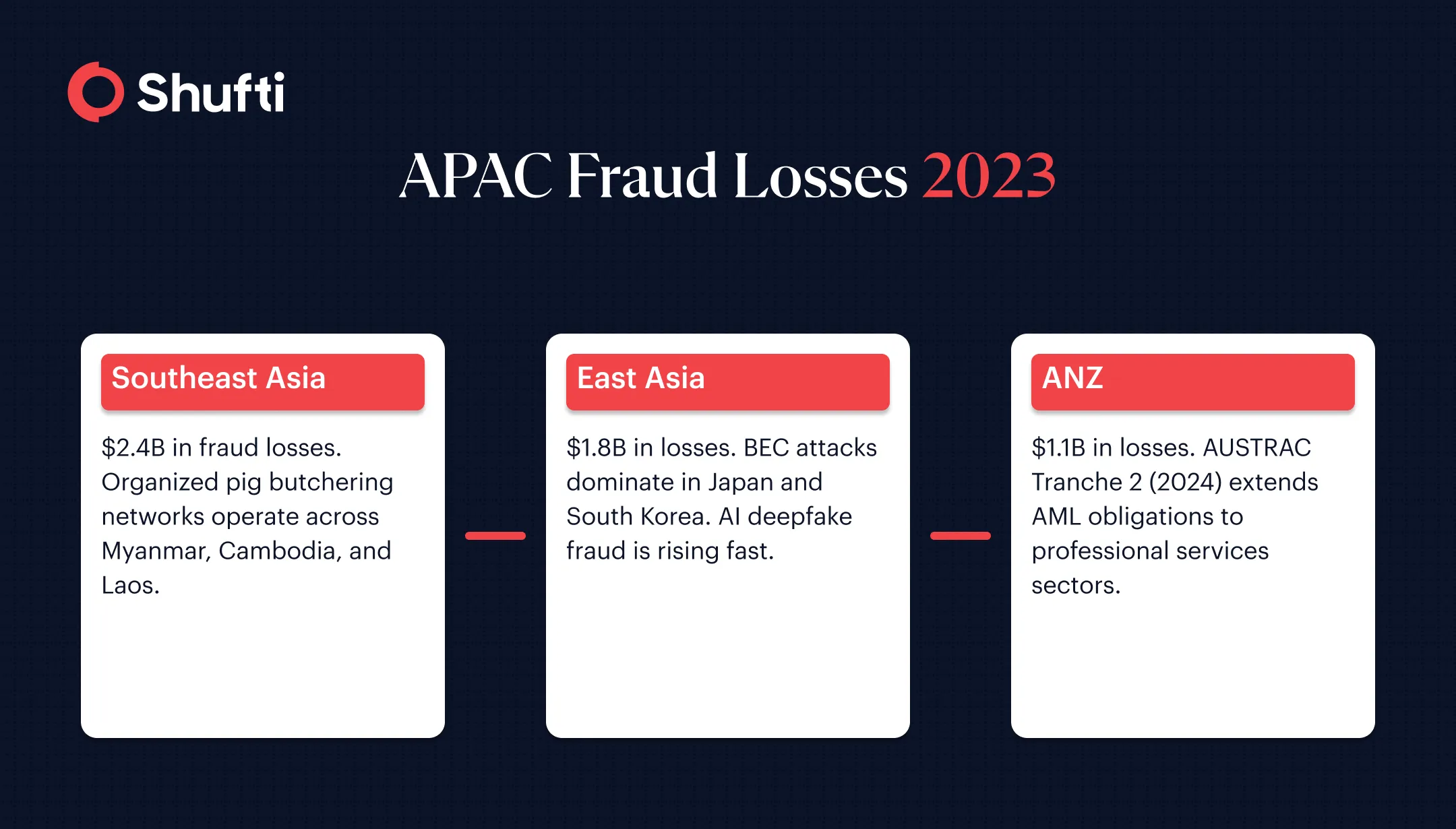
APAC fraud risk management starts with understanding the scale and structure of the threat. Organized crime groups operating out of Cambodia, Myanmar, and Laos have built what law enforcement describes as industrialized fraud compounds.
These are not isolated actors running one-off scams. The criminal networks behind these operations run mule account recruitment at scale, layer funds across multiple jurisdictions, and rotate tactics when any single vector gets flagged. Account takeover, SIM swap fraud, and API injection attacks against mobile payment platforms are all part of the same operational playbook.
The mule account problem is particularly severe. Networks recruit individuals through fake job postings or social media contact, then use their verified accounts to layer fraudulent funds. By the time the trail surfaces in a transaction monitoring system, the funds have often already moved. Effective financial crime prevention in APAC requires controls that catch the mule at onboarding, not three transactions later.
Why APAC is uniquely vulnerable to digital fraud
The conditions that make APAC such a productive market for fintechs also make it a productive market for fraud. The region skipped traditional banking infrastructure in many countries and moved directly to mobile-first financial services. Digital fraud in the Asia Pacific thrives precisely because adoption moved faster than identity infrastructure could keep up.
Mobile payment volumes in APAC are the highest in the world. This accelerating pace reflects both the sheer volume of transactions and the inconsistency of identity verification controls across different platforms and jurisdictions.
The regulatory landscape adds another layer of difficulty. A bank operating across Singapore, Vietnam, the Philippines, and Australia faces four meaningfully different compliance frameworks, each with its own reporting timelines, customer due diligence thresholds, and enforcement priorities. Compliance teams that build for one jurisdiction often find their controls do not translate cleanly to the next.
Deepfake fraud compounds the identity problem. Synthetic faces and AI-generated voices are now used to spoof video KYC sessions, fabricate document images, and create entirely fictitious customer profiles that pass basic liveness checks. Businesses that rely on first-generation biometric verification without active deepfake detection has a visible gap in their onboarding controls.
What APAC fraud compliance regulations require from banks
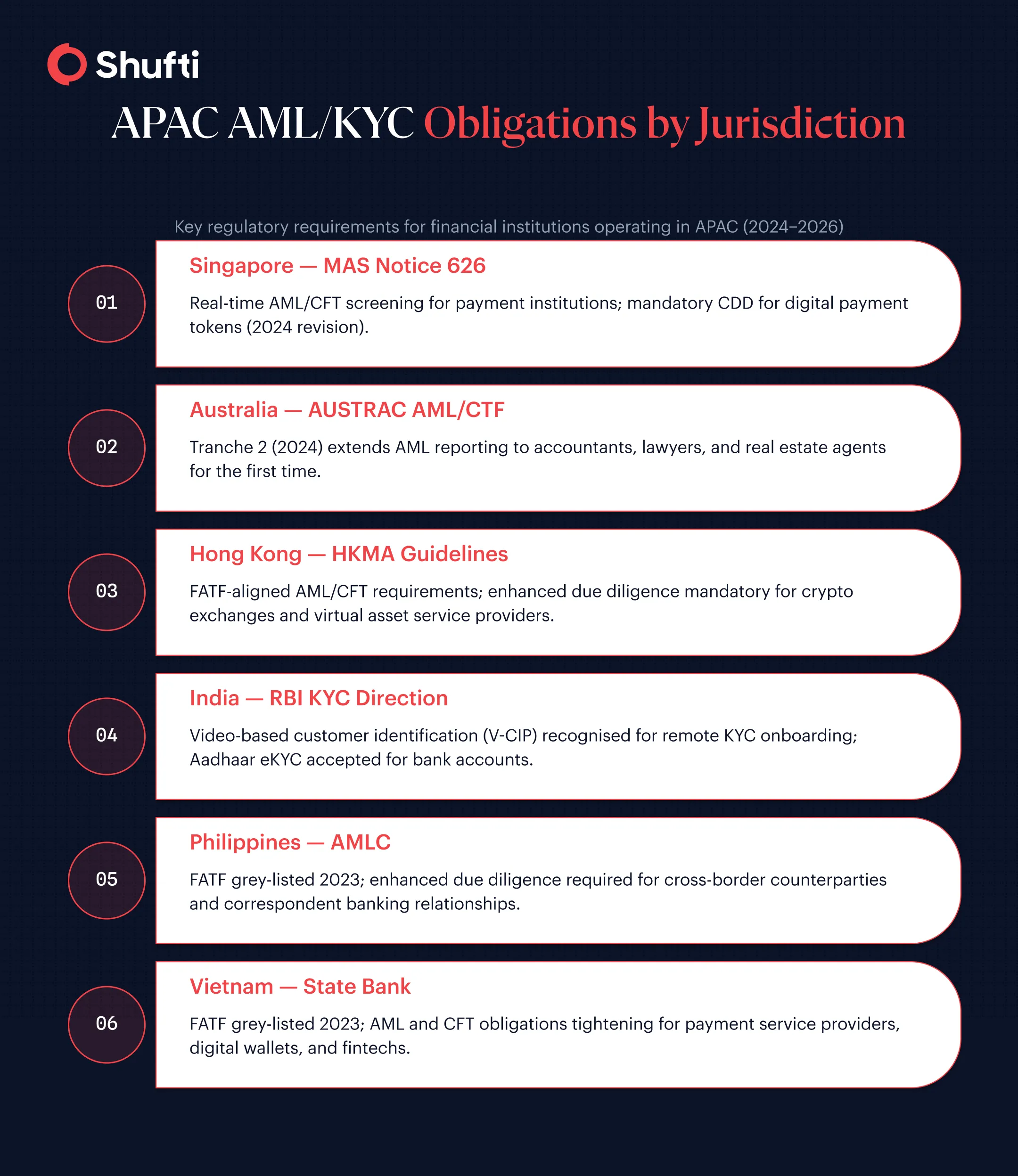
APAC fraud compliance regulations vary by jurisdiction, but several consistent obligations emerge across the major markets.
Singapore’s Monetary Authority of Singapore (MAS) Notice 626, revised in 2024, requires real-time AML/CFT screening for payment institutions and imposes mandatory customer due diligence (CDD) for digital payment token services. KYC AML compliance in Asia, in the Singapore context, means screening at onboarding and ongoing monitoring of transactional behaviour.
Australia’s AUSTRAC expanded its Anti-Money Laundering and Counter-Terrorism Financing Act obligations under the 2024 Tranche 2 amendments, bringing accountants, lawyers, and real estate agents under the AML reporting regime. For financial services firms, the amendments also tighten beneficial ownership disclosure requirements.
Hong Kong’s HKMA maintains AML/CFT guidelines aligned with FATF recommendations, with specific enhanced due diligence obligations for crypto exchanges and virtual asset service providers. India’s Reserve Bank of India (RBI) permits a Video-based Customer Identification Process (V-CIP) for remote KYC, allowing banks and fintechs to onboard customers without in-person verification, provided AML due diligence requirements are still met.
The Financial Action Task Force (FATF) currently grey-lists Vietnam, alongside other jurisdictions in the wider region under increased monitoring, such as Laos and Nepal. The Philippines was removed from the grey list in February 2025 after completing its FATF action plan, though grey-listing history still shapes how correspondent banks price risk in the corridor.
What these frameworks share is a common expectation. APAC fraud compliance regulations are no longer satisfied by periodic batch screening. Real-time checks at onboarding, continuous monitoring post-onboarding, and documented audit trails are the baseline.
Best practices for online fraud prevention in Asia Pacific
The firms that keep fraud losses lowest in APAC share a few structural practices. None of them are novel, but the combination matters.
Screen at the point of onboarding, not after. Identity verification APAC deployments that run document checks, biometric matching, and sanctions/PEP screening as a single pass at account opening cut downstream fraud exposure at the source. Catching a flagged identity before account activation is qualitatively different from catching the flag three days later in a transaction monitoring alert.
Layer identity controls with transaction signals. No single control catches every fraud typology. Anti-money laundering Asia best practice combines identity verification at onboarding with ongoing real-time transaction screening that flags unusual velocity, geography, or counterparty patterns. These two layers catch different threat types. Mule accounts often pass onboarding cleanly but show anomalous transaction behavior within the first 30 days.
Use real-time watchlist coverage, not batch. Sanctions lists, PEP databases, and adverse media sources update continuously. A screening system that batches overnight creates a window where a newly designated individual can transact freely. Fraud prevention solutions APAC that are worth deploying update their underlying data sources on a sub-hourly basis.
Build for deepfake detection from day one. Presentation attack detection and active liveness checks are no longer optional for any platform that uses video or selfie-based verification. The sophistication of AI-generated forgeries in 2026 means passive liveness checks are no longer a reliable control.
Document your controls for regulators. Online fraud prevention Asia Pacific frameworks require firms to demonstrate what controls exist, when they were applied, and what decisions were made. An audit trail that shows screening results, identity verification outcomes, and risk-scoring decisions is as important as the controls themselves when a regulator asks for evidence.
How Shufti helps banks and fintechs manage APAC fraud risk
Shufti’s fraud prevention solutions combine document verification, biometric matching, and deepfake detection into a single onboarding pass. Presentation attack detection runs active liveness checks that flag AI-generated faces and injection attacks that fool passive systems. The platform processes identity checks with a 99.3% true detection rate for confirmed fraud attempts.
On the AML side, Shufti’s AML screening covers 100,000+ data sources and 3,500+ global watchlists, with 2.6 million PEP profiles and 415+ adverse media risk categories updated continuously. Compliance teams get a risk score and the reasoning behind it, not just a pass/fail flag. Ongoing monitoring surfaces risk changes post-onboarding, so a clean customer at signup does not become an invisible liability six months later.
See how Shufti maps these controls to your APAC risk profile. Book a demo now!.
Frequently Asked Questions
What are the biggest fraud risks in the Asia Pacific region in 2026?
Pig butchering investment scams, mule account networks, deepfake identity fraud, and mobile payment fraud are the four dominant threat types in APAC in 2026. Organized crime groups operating in Southeast Asia have industrialized their operations, making the threat more persistent and harder to disrupt at the transaction level alone.
How does KYC and AML compliance help prevent financial fraud in Asia?
KYC and AML compliance screens customers against sanctions lists, PEP databases, and adverse media sources at onboarding and on an ongoing basis. This catches high-risk individuals before they open accounts and flags changes in customer risk profile after onboarding. The combination of identity verification at account opening and continuous transaction monitoring is what regulators across Singapore, Australia, and Hong Kong expect as a baseline.
What fraud prevention regulations apply to banks in APAC countries?
Singapore's MAS Notice 626, Australia's AUSTRAC AML/CTF Act (including 2024 Tranche 2 amendments), Hong Kong's HKMA AML/CFT Guidelines, and India's RBI KYC Master Direction are the primary frameworks. The Financial Action Task Force (FATF) currently lists Vietnam. Laos and Nepal are among jurisdictions under increased monitoring in the APAC region. The Philippines exited the grey list in February 2025.
How do deepfake and AI fraud threats affect businesses in Asia Pacific?
AI-generated synthetic identities and deepfake video are used to spoof onboarding sessions, fabricate documents, and create fictitious customer profiles. Businesses without active presentation attack detection and deepfake-aware liveness checks are exposed at the identity verification layer. The threat has become sophisticated enough that passive liveness detection alone does not reliably catch injection attacks.
What best practices should fintechs follow for fraud prevention in APAC?
Combine document and biometric verification at onboarding with real-time sanctions and PEP screening, layer in continuous transaction monitoring post-onboarding, deploy active deepfake detection, use screening data sources that update sub-hourly rather than in nightly batches, and maintain a documented audit trail of all identity and risk decisions for regulatory purposes.