




 Face Verification
 Address Verification
 Document Verification
 Age Verification
 VideoIdent
 Fast ID
 Docless Verification
 Consent Verification
 NFC Verification
 Business Verification
 Due Diligence
 Investor Verification
 E-Signature

 QES
QES
 AML Screening
 Transaction Monitoring
 Adverse Media
 Business AML Screening
 PEP & RCA
 Sanctions
 Watchlist
 Behavioural Biometrics
 Device Fingerprinting
 Biometric Face Authentication
 MFA
MFA
 Fraud Hub
 Onboarding
 Ongoing Monitoring
 KYC
KYC
 KYB
KYB
 KYI
KYI
 Age Assurance
 Identity Verification
 Workforce IAM
 Candidate Verification
 Compliance
 Fraud prevention
 Trust & safety
 Global expansion
 Product Managers
 Compliance Officers
 Fraud Analysts
 Developers
 Deepfake Detection
 Bonus Abuse / Promotion Abuse
 Account Takeover
 Synthetic Identity Fraud
 Document Fraud
 Impersonation Fraud
 Multi-Accounting
 Fraud Networks
 Chargeback Fraud
 Money Mule Activity
 Party Fraud
 Regulatory & Compliance Risks
 Fintech
 Crypto
 iGaming
 Forex
Forex
 Social Network
 Marketplace
 Banking
 Gig Economy
 Payments
 Ride Hailing
 Adult Content
 Blind Spot Audit
 Deepfake Detector
 Liveness Spoofs
 Document Originality
 Document Deepfake
 Global Trust Platform
 Journey Builder
 Case Management
 Shufti AI
 Fraud Analytics
 Vendor Comparison
 Brand Personalisation
 AI Compliance Co-Pilot
 OCR
OCR
 Secure Capture
 Deployment Options
 Identity Methods
 API Documentation
 Mobile SDKs
 Service Status
 Help Center
 Contact Us
 Technical Support
 Supported Documents
 Supported Countries

 Content library
 Blogs
Blogs
 News
News
 Reports
 Insights
 Knowledgebase
 ROI calculator
 About
About
 Career
 Press Release
 Certifications
 Partnership
 Awards
 Events & Webinar
 Interactive Demo
 Podcast Studio
 Spotlight Studio
How Identity Verification Secures Trust and Stops Fraud in e-Commerce?
-
Add us as a Preferred Source
- 01 Why does IDV matter for the growth of global e-commerce?
- 02 Why is trust in e-commerce a big deal?
- 03 How does IDV reduce fraud and improve conversion in global e-commerce?
- 04 Why is the adaptability of IDV solutions a must-have for cross-border e-commerce?
- 05 How does securing the customer lifecycle ensure continuous compliance and defense against fraud?
- 06 Build Cross-Border Growth with Shufti at the Core
What stands between an online store and the world’s shoppers? Trust. In 2024, consumers reported $12.5B in fraud losses to the U.S. FTC. There was a 25% jump year-over-year, as cyber-enabled scams and account takeovers (ATO) surged. Cross-border e-commerce is soaring, but so are synthetic identities and credential-stuffing, which are leading to financial losses and eroding digital trust. Given this scale of threat, identity verification (IDV) is not merely a compliance need for digital-first businesses but also a growth strategy and a way to ensure security throughout the customer lifecycle.
Why does IDV matter for the growth of global e-commerce?
Global retail e-commerce will total about $6.3T in 2024 and continue climbing toward the $8T mark by 2027 as the number of people shopping online is set to reach 2.77B in 2025. While this scale brings opportunities, it also amplifies exposure to diverse kinds of fraud like account takeover fraud, policy/refund abuse, and first-party fraud, especially across borders, where shipping, tax, and regional AML/KYC rules add complexity.
- Cross-border transactions introduce a burden to comply with region-specific laws and new fraud risks. Fraudsters are increasing attacks and their complexity, challenging the security of digital commerce.
- Buyers expect security and transparency, and their loyalty depends on it.
While vulnerability of social media marketplaces and e-commerce stores to fraud is likely to affect multiple actors, sellers are also likely to be at the receiving end. Invest in layered verification to block returns abuse and ATO without crushing conversion.
Why is trust in e-commerce a big deal?
In short, trust in an e-commerce platform drives conversion, repeats purchases, and lowers chargebacks. When buyers and sellers can reliably verify who’s on the other end, transactions are smoother, fraud drops, and brand reputation grows. Transparent identity, verified details, and strong data protection create the confidence shoppers want, and the resilience merchants need against losses.
What are the different types of fraud in the e-commerce sector?
The best way to nip fraud in the bud is to detect it before it happens. Fraudsters use different techniques and routes to breach security levels, gain access to personally identifiable information (PII), and use deception and impersonation for illegal personal gains.
Account Takeover Fraud
During the pandemic, the world saw a manifold increase in ATO fraud. Attackers hijack customer accounts by using different techniques like credential stuffing, phishing, or SIM-swap. After gaining control, they then change account details, drain loyalty balances, and place high-value orders.
Triangulation Fraud
This scheme involves three parties, namely a fraudster, an online shopper, and an e-commerce store. Online stores created by fraudsters offer goods at heavy discounts. When customers enter their PII and card details to complete the order, fraudsters record these details. Fraudsters use it to place an order on a legitimate e-commerce store. The order is delivered normally, but the shopper finds unauthorized transactions on their account later on. The legit merchant then gets hit by chargeback requests.
Card-Not-Present (CNP) Fraud & Card Testing
CNP fraud is one of the most common types of fraud. Criminals run low-value “tests” to validate PANs and expiry/CVV, then escalate to bigger purchases or reshipping schemes. This type of fraud can be detected from signals like spikes in declines, repeated AVS/CVV failures, and many cards on one device/IP.
Synthetic Identity & First-Party Misuse
Fraudsters stitch together real and fabricated identity data to create “new” personas that pass basic checks. Separately, first-party abuse (refund, return, chargeback, or promo abuse) uses genuine credentials but deceptive intent.
How does IDV reduce fraud and improve conversion in global e-commerce?
First impressions are now digital; that’s why identity verification is more than just a compliance obligation. Across various verticals, from retail and consumer goods to global marketplaces, identity verification helps to reduce fraud, support compliance, and improve conversions.
While IDV proves the customer is really who they claim to be, a high level of assurance in customer authentication ensures only the legitimate account holder can access the account later on. Such a level of security matters the most for ensuring the security of merchants’ accounts on e-commerce platforms.
Why is the adaptability of IDV solutions a must-have for cross-border e-commerce?
Flexibility of the IDV platforms is no longer an additional feature. It’s a requirement for any business expanding internationally, particularly for e-commerce that is not bound by physical borders. When a business enters a new market, it faces new regional laws and compliance obligations. An adaptable IDV solution can satisfy these mandates, ensuring seamless compliance with local KYC regulations and accelerating the growth of the business. The following paragraphs show how regulations change between different industries and regions.
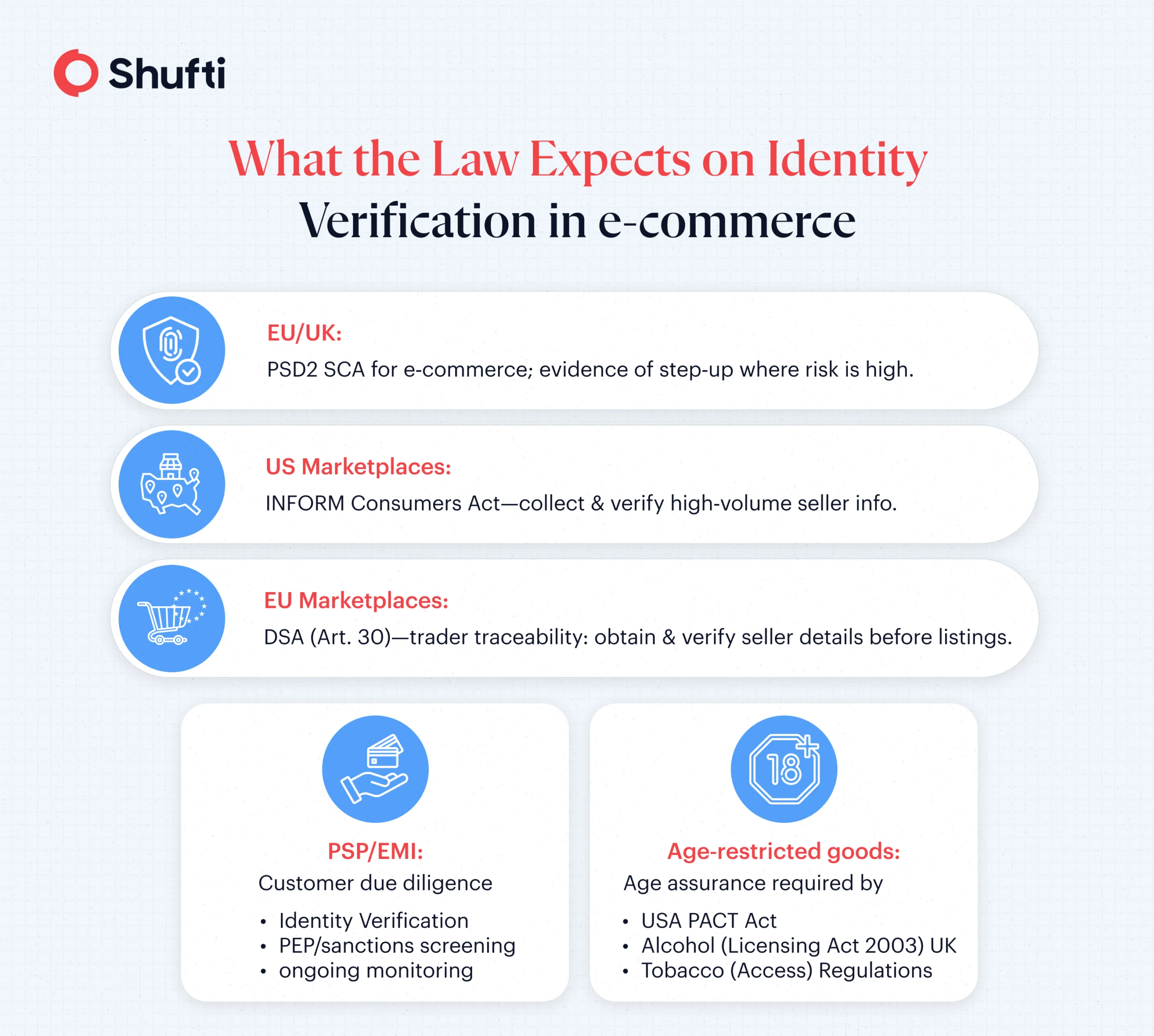
- EU (payments): Payment Service Directive (PSD2) and Regulatory Technical Standards (RTS) on strong customer authentication (SCA) expect high-level assurance or valid exemptions (e.g., transaction risk analysis determines it to be low-risk). According to EU reports, fraud is demonstrably lower when SCA is applied.
- KYB/AML/Sanction: For marketplaces, onboarding sellers, handling payouts or storing balances, or issuing values are required to follow FATF risk-based standards and local transpositions (e.g., EU AML package, U.S. FinCEN rules, UK FCA/MLRs), including PEP/sanctions screening and KYB for merchants and sellers.
- Age-restricted commerce & platforms: Obligations for e-commerce platforms are tightening. In the UK, the Online Safety Act requires robust age checks for pornographic services and child-safety duties across user-to-user services; Ofcom’s guidance began applying in 2025. In the U.S., COPPA sets strict duties for under-13 data collection and parental consent. This regulation is relevant to online shopping and social platforms with youth users.
How does securing the customer lifecycle ensure continuous compliance and defense against fraud?
Think end-to-end, because fraud isn’t a single moment; it’s a sequence. If a business only secures checkouts, the fraudsters will move to other weaker touchpoints in the customer journey, like account recovery, sign-up, returns, etc. The most effective programs spread controls across the lifecycle, with adaptability by risk, region, and action. The following are different stages and security requirements in the customer journey:
- Before sign-up (pre-fraud filters): Device fingerprinting, IP/velocity checks, geolocation, and multi-accounting (multiple accounts on the same device) at the gate.
- Onboarding (prove a real person): Document verification (passports, IDs), face biometrics with liveness, or eIDV (authoritative database checks) to match assurance to risk and market.
- Transactions & account changes (step-up when risk rises): Trigger SCA-grade challenges on anomalies, apply transaction risk analysis, and keep it risk and region-aware.
- Post-onboarding (keep accounts safe): Continuous authentication (periodic liveness), device reputation, and policy-abuse controls to reduce ATO and returns fraud. Behavioral biometrics are also an important passive technique to spot anomalous interaction patterns.
If customers trust that a business actively protects their identity, they’re more likely to come back and recommend it.
Build Cross-Border Growth with Shufti at the Core
As the global e-commerce space becomes more competitive and complex, securing users and payments is no longer optional. Identity verification offers a way to grow with confidence, while keeping fraud out and customers in.
Shufti’s Global Trust Platform delivers multi-layered verification (document + biometric + liveness), eIDV, device fingerprinting, and AML/PEP/sanctions screening. These capabilities, when orchestrated through a no-code Journey Builder, help businesses customize flows by country, product risk, and user segment.
The platform’s waterfall approach to age verification starts with low-friction behavioural biometrics to databases, and escalates to facial age estimation and ID checks if required, ensuring a smooth experience and minimizing client drop rates.
Shufti is trusted by leading social media platforms and marketplaces to verify sellers/merchants, screen businesses, and roll out customized workflows that balance conversion with safety across sign-up, merchant/seller onboarding, and payouts.
Grow your e-commerce business across borders. Verify buyers, onboard sellers/merchants, and meet local KYC/AML obligations in one platform. Book a demo!
Read more on securing e-commerce platforms in our latest blog.