AMLR Solutions
 AMLR Consultation
 Onboarding
 Ongoing Monitoring
 FRAML
FRAML KYC
KYC KYB
KYB KYI
KYI Age Assurance
 Workforce IAM
 Candidate Verification
 Account Takeover
 Bonus/ Promotion Abuse
 Chargeback Fraud
 Deepfake
 Document Fraud
 Fraud Networks
 Impersonation Fraud
 Money Mule Activity
 Multi-Accounting
 Party Fraud
 Regulatory & Compliance Risks
 Synthetic Identity Fraud
 Adult Content
 Banking
 Crypto
 Fintech
 Forex
Forex Compliance
 Fraud prevention
 Trust & safety
 Global expansion
 Compliance Officers
 Developers
 Fraud Analysts
 Product Managers
 Advanced Journey Builder (AJB)
 Global Trust Platform
 Customer Profiles
 Vendor Comparison
 IDV Case Management
 AML Case Management
 Regulatory Reporting
 Travel Rule Protocols
 Agentic Rule Builder
 AI Compliance Co-Pilot
 Fraud Analytics
 Fraud Hub
 OCR
OCR Shufti AI
 Bank Account Verification
 Biometric Duplication
 Database Checks
 Document Intelligence
 Government ID
 Mobile Driver's License
 NFC
NFC Selfie Liveness
 Brand Personalisation
 Deployment Options
 Identity Methods
 IDV Modes
 Multi-tenancy
 On-Premise IDV
 Secure Capture











If you run compliance or security at a bank, you already know the drill. Every new customer onboarding flow gets picked apart by external regulators, internal audit, and increasingly by fraudsters using AI tools that were not publicly available eighteen months ago. A document verification solution for banks sits at the front of that gauntlet. Get it wrong and you are looking at AMLD6 enforcement action, a PSD2 penalty, or a synthetic identity portfolio showing up in a quarterly loss report.
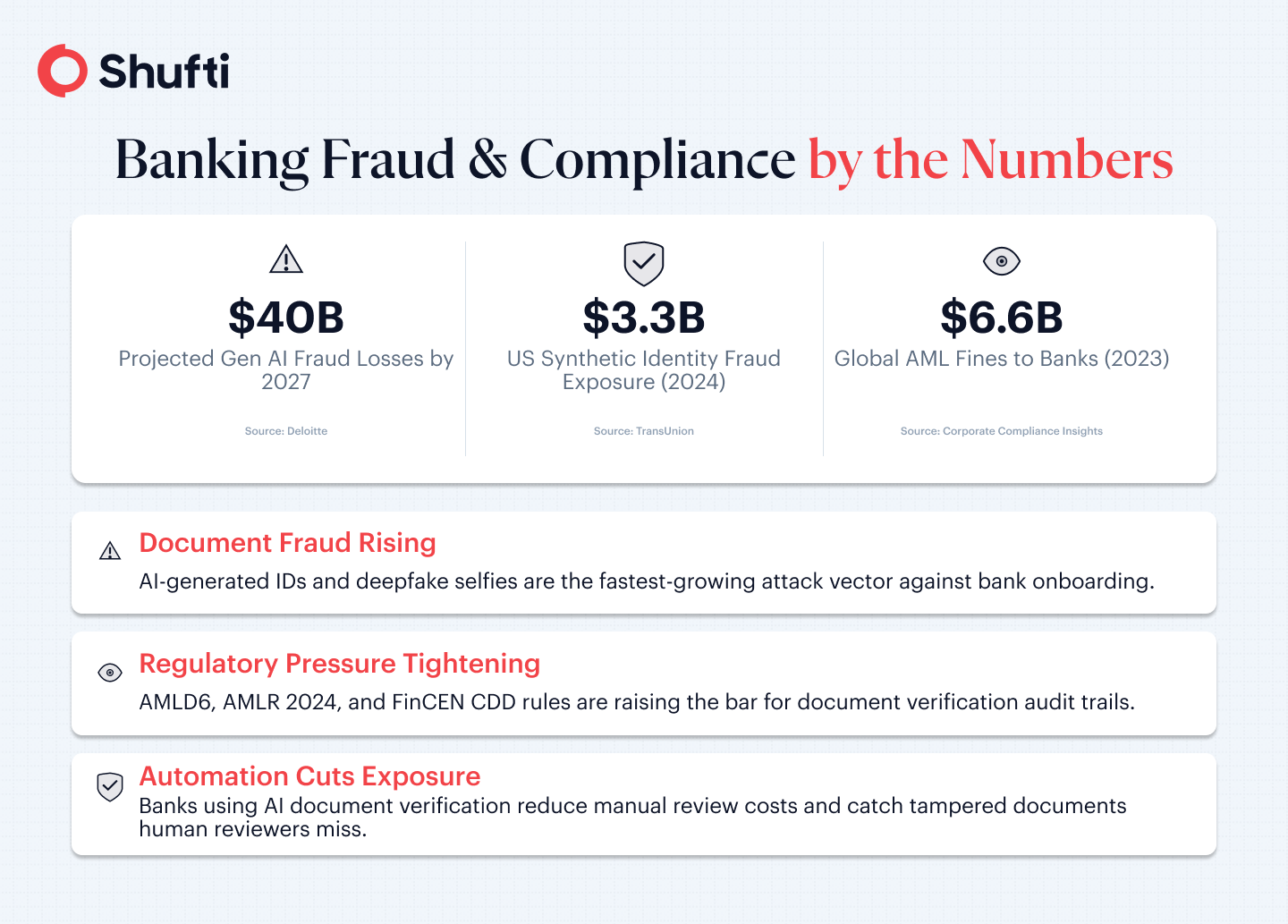
The numbers sharpen the point. Deloitte’s Center for Financial Services projects generative-AI-enabled fraud losses in US banking to reach $40 billion by 2027, up from $12.3 billion in 2023. TransUnion put US synthetic identity fraud exposure at $3.3 billion by the end of 2024. Global AML fines against financial institutions crossed $6.6 billion in 2023, with document-related CDD failures a recurring citation in regulator write-ups.
This guide walks through the regulatory obligations a document verification solution has to satisfy, the document types banks must check, and the implementation choices that separate a defensible programme from one that looks good in a demo and falls apart in an audit.
Why Document Verification Sits at The Centre of Banking Risk
Document verification is not a feature. It is a regulatory control. Every piece of identity evidence a bank collects (a passport scan, a company incorporation certificate, a utility bill) becomes part of the customer due diligence (CDD) file that regulators can demand at any point for up to ten years after account closure.
When that file is thin, stale, or forged, two things happen. The bank becomes a conduit for money laundering, sanctions evasion, or tax fraud. And the control failure shows up on the regulator’s desk. The FATF’s 2023 mutual evaluation cycle has repeatedly flagged weak document authentication as a root cause of CDD gaps in banking. The EBA’s guidelines on remote customer onboarding go one step ahead, they make the bank’s management body explicitly responsible for the effectiveness of the document verification technology it deploys.
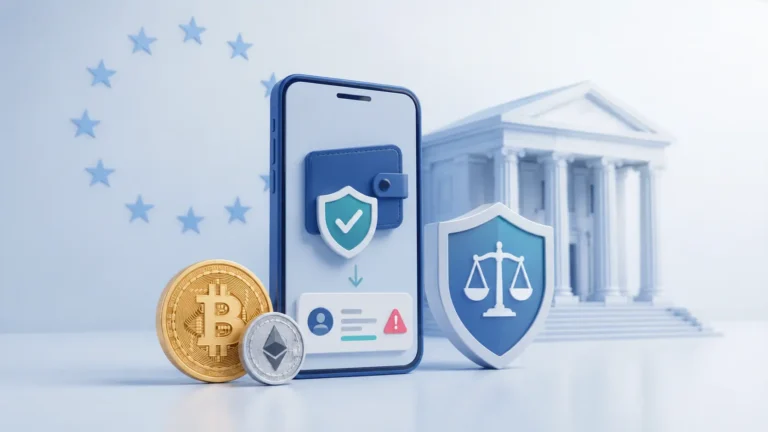
The Regulatory Backdrop Every Bank’s Document Verification Solution Must Satisfy
Document verification sits inside a stack of overlapping regulations. A solution that only ticks the box on one of them will fail the others.
FATF Recommendation 10: the global baseline
The Financial Action Task Force’s Recommendation 10 on Customer Due Diligence requires banks to identify the customer and verify their identity “using reliable, independent source documents, data or information.” For legal persons, the bank has to understand ownership and control structure and identify beneficial owners. Recommendation 10 is not itself law, but it is the template that national regulators translate into binding requirements, which is why its language shows up almost verbatim in EU, UK, and US rules.
The Basel Committee’s guidance on Customer Due Diligence for Banks layers supervisory expectations on top, particularly around ongoing monitoring and higher-risk customer categories.
EU: AMLD5, AMLD6, and the 2024 AML Package
AMLD5 expanded CDD obligations to virtual currency providers, tightened rules on prepaid cards, and required member states to maintain UBO registers. AMLD6, adopted in 2024 as part of the EU AML Package, harmonises supervision under the new Anti-Money Laundering Authority (AMLA) and sets tougher access rules for beneficial ownership information.
The key piece for document verification, though, is the directly applicable AML Regulation (Regulation (EU) 2024/1624). Unlike the directives, the AMLR applies uniformly across member states and tightens CDD, EDD, and record-keeping obligations. Enhanced Due Diligence (EDD) triggers (high-risk third countries, PEPs, complex ownership structures, non-face-to-face onboarding without qualified trust services) now carry prescriptive document and attestation requirements a bank’s verification solution has to produce on demand.
PSD2 and strong customer authentication
The Payment Services Directive 2 sits alongside AML rules and governs payment account access and authentication. PSD2 itself is not a document verification regime, but its Strong Customer Authentication (SCA) provisions pull in biometric and possession factors that many banks now satisfy using the same face-match and liveness checks used during onboarding. Getting this stack to share evidence cleanly across document scan, selfie, and liveness score reduces friction for the customer and gives auditors one trail instead of three.
US: FinCEN’s CIP and CDD Rules
In the US, the FinCEN Customer Identification Program Final Rule under section 326 of the USA PATRIOT Act requires banks to verify customer identity using documentary or non-documentary methods at account opening. The FinCEN Customer Due Diligence Final Rule adds beneficial ownership collection for legal entity customers. Both rules put the documentary trail on the examining regulator’s checklist.
UK: FCA Financial Crime Guide
The FCA’s Financial Crime Guide lays out the supervisory expectations for UK-authorised firms. Its examples of good and poor practice in identity verification are the closest thing regulated UK firms have to a plain-English audit checklist.
Where eIDAS 2.0 fits in
The EU Digital Identity Regulation (eIDAS 2.0) introduces the European Digital Identity Wallet. For banks, this is not a replacement for document verification. It is a parallel channel. A verification solution that cannot accept a qualified wallet attestation in 2026 will be behind the curve. One that only accepts wallet attestations will fail any customer without one.
The Three Document Categories Every Bank Must Verify
1. Personal identity documents
Passports, national ID cards, residence permits, and driver’s licences are the core evidence for natural persons. A competent document verification service for banks has to do more than OCR the data page. It needs to check security features (holograms, microprint, UV patterns), validate the Machine Readable Zone (MRZ) checksum, detect tampering at pixel level, and, for chip-enabled passports and national IDs, read the NFC chip to confirm the document’s cryptographic authenticity.
2. Business registration documents
For corporate customers, banks need to verify the entity exists, where it is registered, who owns it, and who controls it. That means incorporation certificates, articles of association, trade register extracts, tax IDs, and beneficial ownership declarations. Know Your Business (KYB) verification pulls data from official corporate registries and cross-checks it against the documents the customer uploads. The 2024 AMLR tightens UBO verification. Beneficial owners holding 25% or more, or exercising control through other means, must be identified and their identity verified to the same standard as the natural person customer.
3. Proof of address
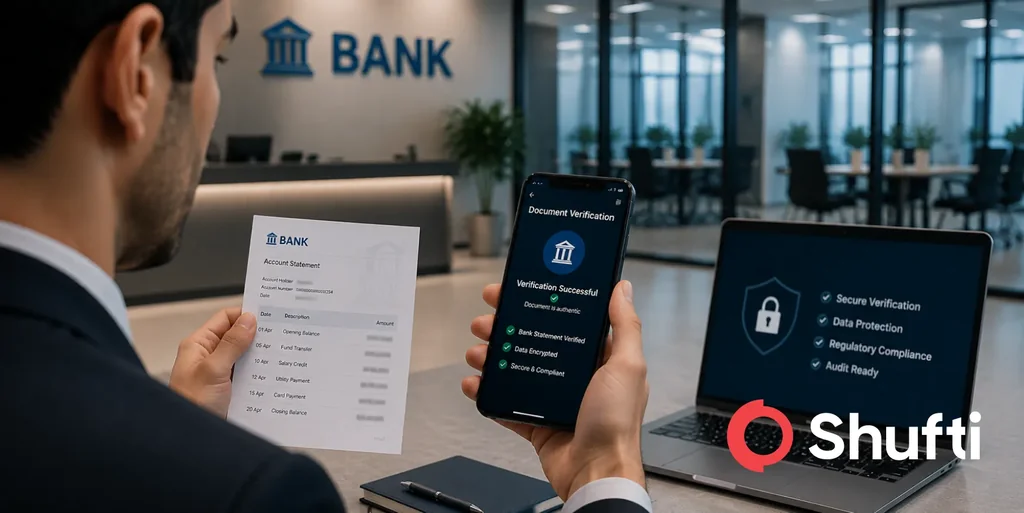
Utility bills, bank statements, council tax letters, and government correspondence are the usual PoA evidence. Address verification is where many document programmes fall short: a regulator reviewing a file will check that the PoA document is under three months old, matches the customer’s stated address, and has been authenticated as a real document. Automated date extraction, layout analysis, and issuer validation against a known template library are what separate a usable PoA check from a box-ticking exercise.
Implementation Guide: What a Document Verification Platform For Banks Actually Needs To Do
A solution that will stand up to audit has to deliver four capabilities in one pipeline.
Authenticity checks
Template matching against a library of real documents. Security feature detection. Tamper detection (cut-and-paste forgeries, re-printed documents, screen-capture attacks). MRZ and barcode validation. NFC chip read for electronic passports and national IDs.
Data extraction and validation
OCR is accurate enough to handle non-Latin scripts and damaged documents. Field-level cross-checks: MRZ versus visible data, expiry date versus issuance date, photo consistency with biometric metadata.
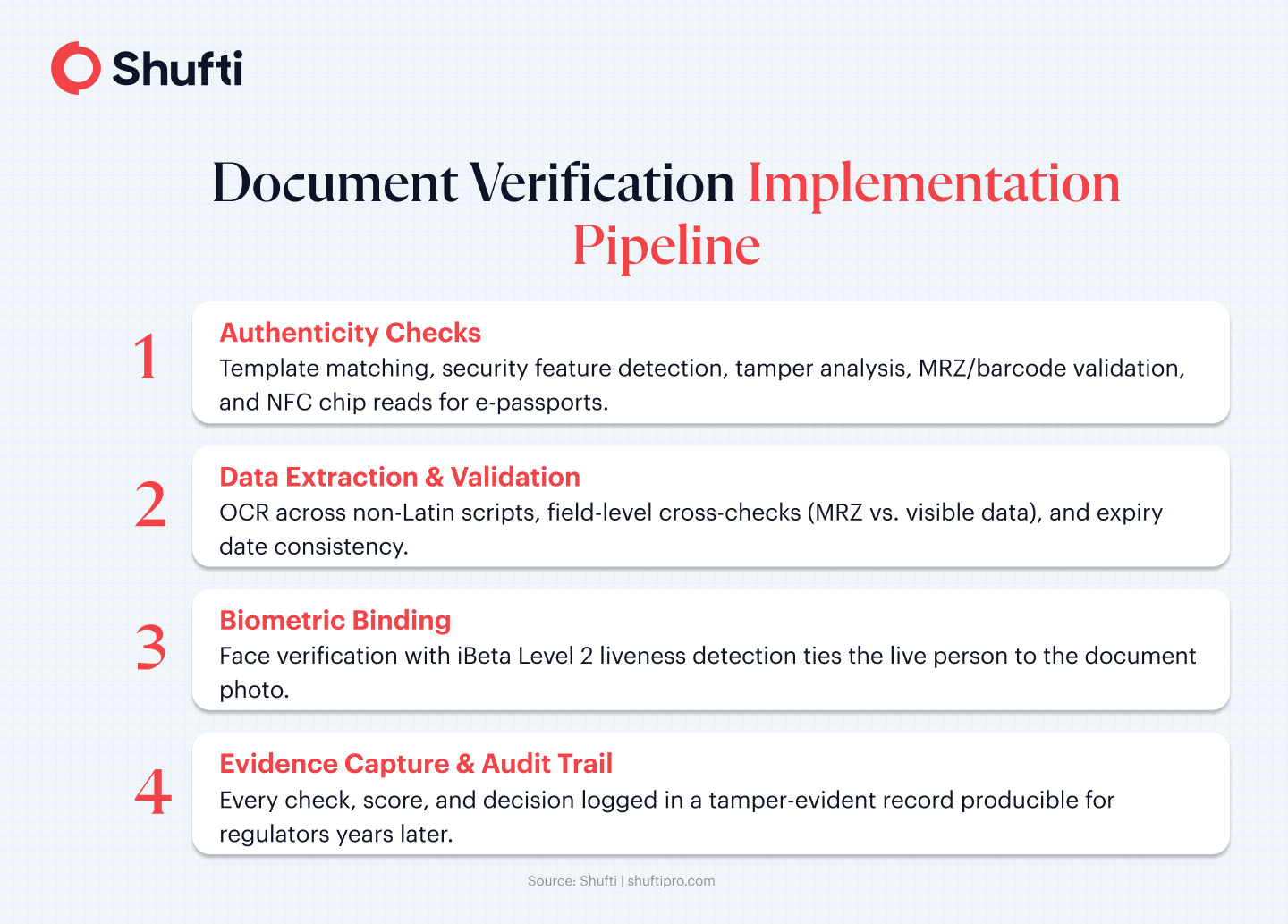
Biometric binding
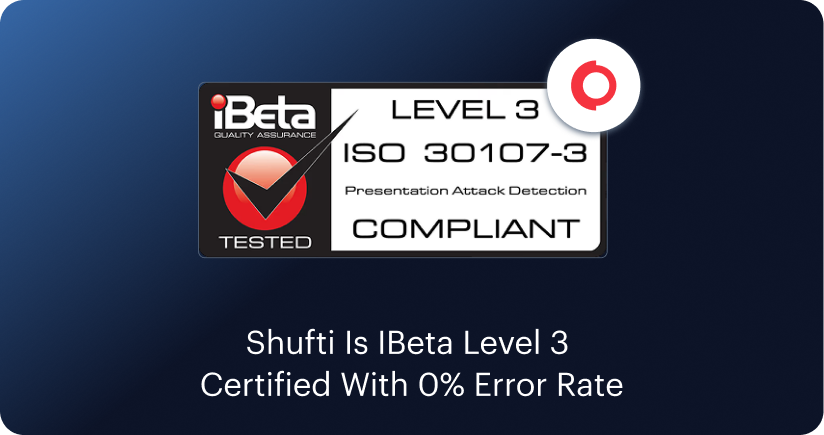
A document on its own proves nothing about the person presenting it. Face verification with liveness detection ties the human in front of the camera to the person on the document. For banking use cases, iBeta Level 2 certification on the liveness model is now the minimum credible standard.
Evidence capture and audit trail
Every check, every score, every decision has to be logged in a tamper-evident record the bank can produce for a regulator years later. The EBA guidelines are explicit: the bank remains accountable for evidence even when the technology is outsourced.
Architectural choice matters as much as the feature list. A cloud-only provider is fine for most neobanks. An incumbent bank with data residency obligations in Germany, the UAE, or Switzerland will need on-premises or hybrid deployment. Ask any prospective document verification platform for banks for all three deployment models (cloud, on-premises, hybrid) in one contract before shortlisting.
The CISO Checklist Before You Sign a Contract
Compliance buys the solution. Security has to live with it. Before procurement closes, confirm: SOC 2 Type II and ISO 27001:2013 certification on the vendor. Clear data residency commitments. Documented incident response and breach notification timelines. Penetration test reports on the SDK and the API. Right-to-audit clause in the contract. Sub-processor transparency. Encryption at rest and in transit, with key management you control where regulation requires it. If any of those are missing, the solution is not enterprise-ready, regardless of what the demo showed.
Where this lands
A document verification software for banks is the control that determines whether a bank’s onboarding programme survives contact with regulators, fraud rings, and its own risk committee. The rules are tightening (AMLD6 transposition, AMLR direct effect, eIDAS 2.0 wallets, FinCEN beneficial ownership) and the attack surface is widening at the same time. Solving for one without the other is a shortcut to the enforcement list.
Talk to Shufti about a document verification deployment built for banking regulatory scrutiny on cloud, on-premises, or hybrid, with the audit trail and biometric binding auditors expect.
Frequently Asked Questions
How often do banks need to re-verify customer documents?
Re-verification frequency depends on the customer's risk rating. High-risk customers (PEPs, those in sanctioned jurisdictions) are typically reviewed annually, while low-risk customers may only require re-verification every 3–5 years. Trigger-based reviews such as a change in transaction behavior or adverse media override scheduled cycles regardless of risk tier.
Can banks use automated document verification for KYC?
Yes. Regulators in most jurisdictions, including the FATF member states, accept automated document verification as part of a compliant KYC process, provided it meets liveness detection, tamper-check, and data extraction standards. Human oversight is still expected for edge cases, escalations, and high-risk onboarding decisions.
How do banks verify documents from high-risk jurisdictions?
Banks apply enhanced due diligence (EDD) — this means cross-referencing documents against international watchlists, corroborating identity through multiple independent sources, and often requiring in-person or video-assisted verification. Additional checks on the document's issuing authority and its authenticity markers (holograms, MRZ data, chip data) are standard practice.
What audit trail must banks maintain for document verification?
Banks must retain copies of the documents collected, the verification outcome and method used, timestamps, the identity of the reviewing officer or system, and any flags or overrides applied. Most regulators require these records to be kept for a minimum of 5 years after the end of the customer relationship.
How does document verification support a bank's de-risking strategy?
Robust document verification gives banks reliable, verifiable data on who they are onboarding — reducing exposure to fraud, money laundering, and regulatory penalties. It allows risk teams to make evidence-based decisions about which customer relationships to accept, monitor, or exit, rather than blanket offboarding entire customer segments out of uncertainty.