AMLR Solutions
 AMLR Consultation
 Onboarding
 Ongoing Monitoring
 FRAML
FRAML KYC
KYC KYB
KYB KYI
KYI Age Assurance
 Workforce IAM
 Candidate Verification
 Account Takeover
 Bonus/ Promotion Abuse
 Chargeback Fraud
 Deepfake
 Document Fraud
 Fraud Networks
 Impersonation Fraud
 Money Mule Activity
 Multi-Accounting
 Party Fraud
 Regulatory & Compliance Risks
 Synthetic Identity Fraud
 Adult Content
 Banking
 Crypto
 Fintech
 Forex
Forex Compliance
 Fraud prevention
 Trust & safety
 Global expansion
 Compliance Officers
 Developers
 Fraud Analysts
 Product Managers
 Advanced Journey Builder (AJB)
 Global Trust Platform
 Customer Profiles
 Vendor Comparison
 IDV Case Management
 AML Case Management
 Regulatory Reporting
 Travel Rule Protocols
 Agentic Rule Builder
 AI Compliance Co-Pilot
 Fraud Analytics
 Fraud Hub
 OCR
OCR Shufti AI
 Bank Account Verification
 Biometric Duplication
 Database Checks
 Document Intelligence
 Government ID
 Mobile Driver's License
 NFC
NFC Selfie Liveness
 Brand Personalisation
 Deployment Options
 Identity Methods
 IDV Modes
 Multi-tenancy
 On-Premise IDV
 Secure Capture











- Hotel and rental bookings spike during FIFA 2026, and so does hospitality fraud.
- Americans reported nearly $65 million in rental-scam losses since 2020, FTC data shows.
- Fake-listing fraud usually starts with a copied real listing and a swapped contact.
- Verifying guest identity at booking stops stolen-ID bookings before the chargeback hits.
When the FIFA World Cup opens on June 11, 2026, 16 host cities across the United States, Canada, and Mexico will draw a wave of visitors booking hotels and short-term rentals months ahead of kickoff. Fraudsters book the same calendar. A major tournament compresses close to a year of travel demand into a few weeks, and that spike is when hospitality fraud finds its widest opening.
Hospitality fraud covers any scheme that exploits hotels, short-term rental platforms, and their guests. The category runs from fake property listings and stolen-identity bookings through payment fraud and chargeback abuse. The common thread is a transaction that looks legitimate when it is booked and unravels later, once the money and the room are both gone.
The 2026 tournament raises the stakes because demand is concentrated and cross-border. Visitors arrive from dozens of countries, many booking properties they have never seen in cities they do not know. For hotels and rental platforms, the FIFA window is both a revenue opportunity and a fraud-exposure test. This guide breaks down how the fraud works and where identity verification closes the gap.
Why does hospitality fraud spike during major sporting events?
Hospitality fraud spikes during major sporting events because demand, urgency, and inexperience peak at the same time. A tournament like the FIFA World Cup pulls millions of casual travelers into the market at once, and casual travelers are easier to deceive than seasoned ones.
Three forces line up. Scarcity comes first. Rooms near host cities sell out early, so latecomers book whatever they can find and stop questioning prices they would normally reject. Urgency comes second. A fan who waited months for a ticket will wire a deposit quickly rather than risk losing the room. Unfamiliarity comes third. Many visitors are booking in a foreign country, on platforms they have never used, in a language that is not their own.
Regulators see the pattern. In March 2026 the Federal Trade Commission (FTC) issued a World Cup scam warning, flagging copycat websites and sellers pushing fake or duplicated bookings through paid ads and social media. Travel booking fraud follows attention, and through mid-2026 attention belongs to the tournament.
How Airbnb fraud and fake listings target FIFA 2026 travelers
Airbnb fraud and fake-listing scams target FIFA 2026 travelers by copying real properties and intercepting the booking. The property may exist and the photos may be genuine. What changes is the contact path, so payment and personal details reach a scammer instead of the real host.
Cloned listings and the swapped-contact trick
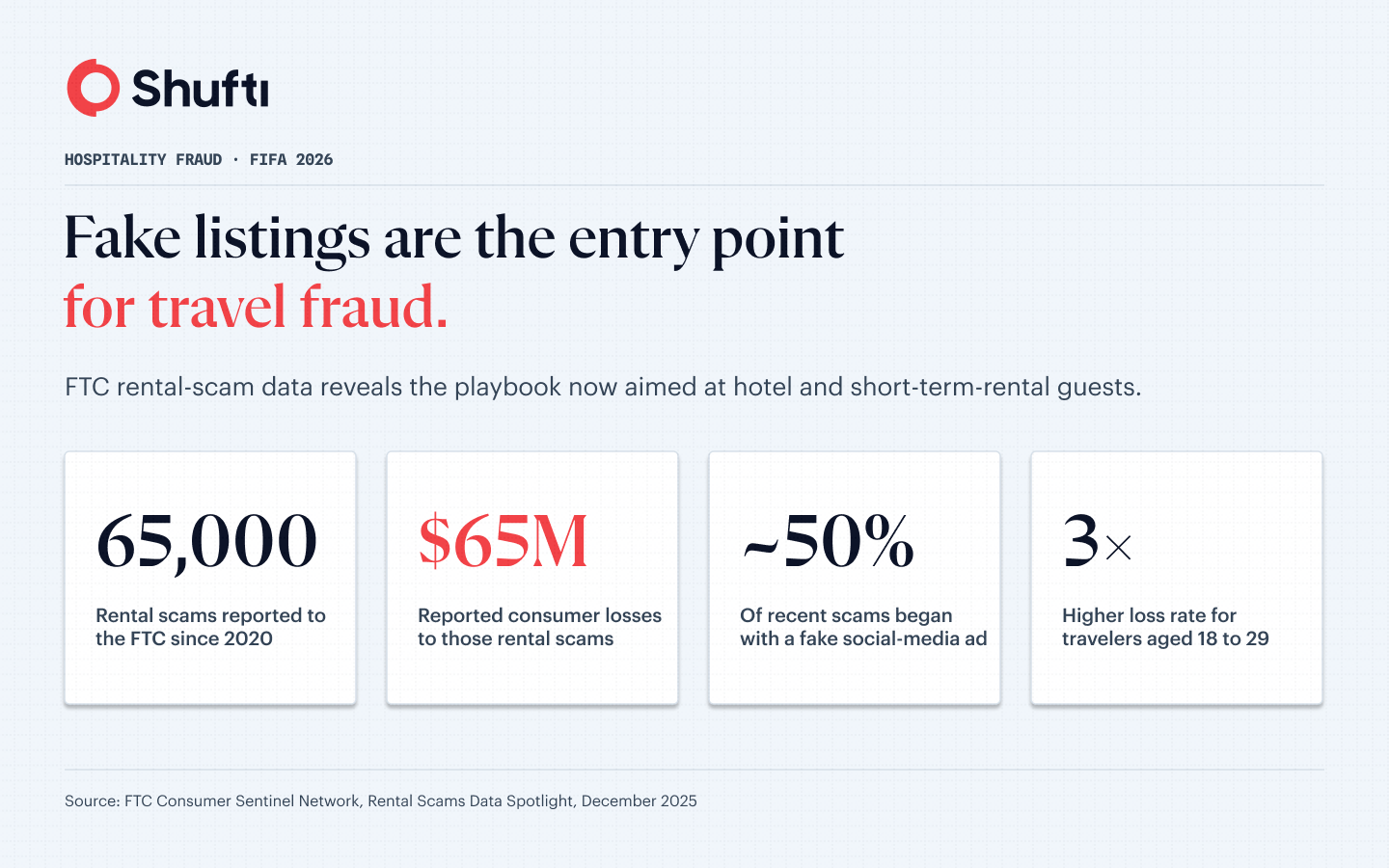
The FTC documents the core method clearly. Scammers copy a legitimate listing, change the contact information so inquiries reach them, and repost it on a different site. Nearly 65,000 rental scams have been reported to the FTC since 2020, with about $65 million in losses and a median loss of $1,000. About half of those scams in the year ending June 2025 started with a fake ad on Facebook. During a tournament, the same playbook moves to holiday lets and vacation rental fraud. The tell stays consistent. A scammer pushes for a deposit before any in-person viewing and steers the conversation off-platform, where buyer protections do not apply.
Stolen-ID and synthetic guest accounts
The second pattern runs in the other direction. Instead of defrauding a guest, the fraudster becomes the guest. Fake listings double as identity-harvesting tools. The FTC notes that scammers ask applicants to upload a driver’s license image, a Social Security number, and pay stubs as part of a bogus rental application. Those documents then fuel stolen-identity and synthetic-identity bookings on legitimate platforms. A synthetic guest account blends a real stolen credential with fabricated details, passes a shallow check, books a property or a block of rooms, and disappears before the chargeback arrives. For a host or a hotel, the loss is the room, the payout, and the cleanup.
|
Fraud type |
How it works |
Who absorbs the loss |
|
Cloned listing |
A real property is copied, the contact swapped, and reposted off-platform |
The traveler, who pays a deposit for a booking that does not exist |
|
Stolen-ID booking |
A harvested identity document is used to book a genuine property |
The host or hotel, through chargebacks and an unrecoverable payout |
|
Synthetic guest account |
A real credential is blended with fabricated details to pass a weak check |
The platform, through fraud losses and reputational damage |
|
Off-platform payment fraud |
The guest is moved to wire transfer, gift cards, or crypto |
The traveler, with little recourse once the money has moved |
How can hotels verify guest identity at booking-volume scale?
Hotels verify guest identity at booking-volume scale by moving the check forward, from the front desk to the moment of booking, and automating it. Manual document review does not survive a tournament-week spike. Verification has to run in seconds, on every booking, without a person in the loop for routine cases.
Identity checks at booking, not at the front desk
Most hotels still confirm identity at check-in, when the guest is already standing at the counter. By then the fraudulent booking has consumed inventory and, often, a refundable deposit. Moving the check to the booking step changes the economics. A guest verifies a government ID document and a live selfie before the reservation is confirmed, which screens out stolen-identity bookings while a property still has time to react. Done well, hotel digital identity verification adds seconds, not friction. It also helps with international guests, where staff cannot reasonably recognize a genuine ID from every one of the dozens of countries sending fans to the 2026 tournament.
Where AI fits in spotting fraudulent reservations
AI for fraud detection in hospitality works on the signals a single document check cannot see. A booking is not only an identity. A booking is a device, an IP address, a payment instrument, a booking velocity, and a behavioral pattern. Machine-learning models score those signals together and flag the reservation that looks ordinary in isolation but anomalous in context, such as one device opening twenty accounts or a foreign IP booking a block of rooms at 3 a.m. AI does not replace identity verification. AI layers on top of it as a fraud prevention capability, catching the synthetic accounts and bulk-booking rings that clear a basic check. Pair the two and fraud detection in the hospitality industry stops depending on a tired clerk noticing something is wrong.
Payment fraud and chargeback risk in the tournament window
Payment fraud and chargeback fraud are where hospitality fraud finally lands on the balance sheet. A fraudulent booking is a future chargeback. When the tournament window concentrates bookings, it also concentrates the disputes that follow weeks later, often after the guest has checked out.
Why card-not-present bookings invite disputes
Hotel and rental bookings are almost entirely card-not-present transactions. The card is never physically present, so the property carries the liability when a charge is disputed. Two kinds of dispute dominate. The first is true fraud, where a stolen card pays for a stay. The second is friendly fraud, where a real guest disputes a legitimate charge, sometimes after a cancellation dispute and sometimes opportunistically. Payment fraud in hospitality blends both, and a tournament crowd of one-time, out-of-town guests is harder to recognize and harder to challenge a dispute against.
Closing the gap between a booking and a chargeback
The defensible position is evidence collected at booking. A verified identity, a matched payment instrument, and a record of consent give a property something concrete to present when a chargeback is filed. The same verification that blocks a stolen-identity booking also builds the audit trail that wins a dispute. A proof of address check adds another layer, confirming that the billing details a guest declares actually belong to them. None of this removes every chargeback. It shifts the genuinely fraudulent ones into a category the property can contest, instead of absorbing them as the cost of a busy June.
How Shufti helps hotels and rental platforms verify guests at scale
A tournament-week booking surge is the worst possible moment to discover that identity verification does not scale. Guests arrive from dozens of countries, each with its own documents, and a check built for one market starts rejecting legitimate travelers while still missing the fraudulent ones.
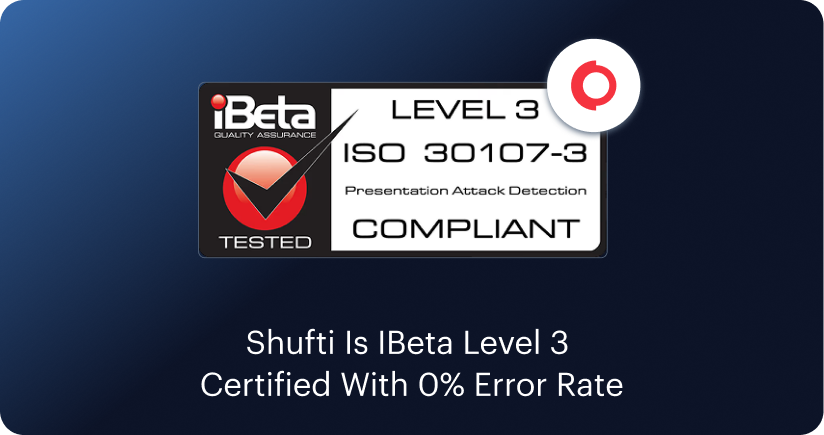
Shufti runs document verification and biometric liveness as one owned flow, so a hotel or rental platform can confirm a guest’s ID and a live selfie in seconds at the point of booking. Because the technology is built and owned end to end, the same check works whether the guest presents a passport from Brazil, a national ID from Indonesia, or a driver’s license from Canada. Shufti’s models were trained natively on 10,000+ document types across 240+ countries, and its liveness holds iBeta Level 3 conformance under ISO/IEC 30107-3.
One platform. Fully owned technology. Global coverage with real local depth.
See how Shufti verifies international guests in seconds without adding booking friction — book a 20-minute demo.
Frequently Asked Questions
What are the most common types of vacation rental fraud during the World Cup?
The most common are cloned listings, where a real property is copied and reposted with a scammer's contact, and stolen-identity bookings, where a harvested ID is used to book a genuine property. Off-platform payment requests, through wire transfer or gift cards, usually accompany both.
What red flags indicate a fake Airbnb listing?
Key red flags include a price well below comparable listings, pressure to pay a deposit before any viewing, and a host who pushes communication and payment off the platform. A listing that appears on several sites with different contact details or prices is almost always a scam.
What identity verification do hotels need for FIFA 2026 bookings?
Hotels need document verification paired with biometric liveness, run at the point of booking rather than at check-in. That combination confirms the guest is real, present, and matches the ID, which screens out stolen-identity bookings before they consume inventory or trigger a chargeback.
How does AI help detect fraud in the hospitality industry?
AI scores the signals a single identity check cannot see, including device, IP address, payment instrument, and booking velocity. Machine-learning models flag reservations that look ordinary alone but anomalous together, such as one device opening many accounts, catching synthetic and bulk-booking fraud.