AMLR Solutions
  AMLR Consultation
 EUDI Wallet
 Onboarding
 Ongoing Monitoring
 FRAML
FRAML KYC
KYC KYB
KYB KYI
KYI Age Assurance
 Workforce IAM
 Candidate Verification
 Account Takeover
 Bonus/ Promotion Abuse
 Chargeback Fraud
 Deepfake
 Document Fraud
 Fraud Networks
 Impersonation Fraud
 Money Mule Activity
 Multi-Accounting
 Party Fraud
 Regulatory & Compliance Risks
 Synthetic Identity Fraud
 Adult Content
 Banking
 Crypto
 Fintech
 Forex
Forex Compliance
 Fraud prevention
 Trust & safety
 Global expansion
 Compliance Officers
 Developers
 Fraud Analysts
 Product Managers
 Journey Builder
  Global Trust Platform
 Customer Profiles
 Vendor Comparison
 IDV Case Management
 AML Case Management
 Regulatory Reporting
 Agentic Rule Builder
  AI Compliance Co-Pilot
  Fraud Analytics
 Fraud Hub
  OCR
OCR Shufti AI
 Bank Account Verification
  Biometric Duplication
 Database Checks
 Document Intelligence
 Government ID
 Mobile Driver's License
 NFC
NFC Selfie Liveness
 Brand Personalisation
 Deployment Options
 Identity Methods
 IDV Modes
 Multi-tenancy
 On-Premise IDV
 Secure Capture
 Shufti MCP









Key Takeaways
- Facial recognition accuracy rests on three separate evidence bases, not one number.
- NIST FRTE measures matching accuracy. iBeta measures presentation attacks. Neither covers injection.
- Most vendors publish best-case averages. Government evaluations publish worst-case results.
- Only 31% of systems met every goal in the DHS 2025 rally.
- 1:1 verification and 1:N search are different tasks with different accuracy profiles.
Nearly every vendor in this market sells facial recognition software on a promise of high accuracy, and very few of them say what they actually measured.
The U.S. National Institute of Standards and Technology runs the largest public benchmark for face matching, and it renamed that programme from FRVT to the Face Recognition Technology Evaluation (FRTE) in July 2023.
FRTE has assessed 1,385 algorithms from 426 developers, and its most recent 1:1 report was published on 30 March 2026. iBeta tests something different: presentation attacks under ISO/IEC 30107-3. A vendor can score well on one of these and hold no public evidence for the other. This guide compares eleven platforms on what each one can actually demonstrate, and points out where the evidence is missing.
The 11 Best Facial Recognition Software Platforms In 2026
As the publisher of this guide, we list Shufti first for transparency. The other ten vendors follow.
- Shufti
- Amazon Rekognition
- Azure Face API
- FACIA
- Idemia
- Incode
- iProov
- NEC
- Innovatrics
- Aware
- Cognitec Systems
Facial Recognition Software Compared
| Vendor | Technology ownership | iBeta PAD conformance | NIST FRTE ranking | 1:N face search | Deployment | Best fit |
| Shufti | Own IP, full stack | Levels 1, 2 and 3 | None published | Yes, 10M+ records | SaaS, Cloud, Local Cloud, on-premise | Regulated onboarding with deepfake exposure |
| Amazon Rekognition | Own IP | Levels 1 and 2 | None published | Yes | AWS cloud only | Developers already on AWS |
| Azure Face API | Own IP | Levels 1 and 2 | None published | Yes, gated access | Azure cloud only | Microsoft-estate enterprises |
| FACIA | Own IP | Levels 1 and 2 | None published | Yes | Cloud and on-premise | Speed-sensitive liveness deployments |
| Idemia | Own IP | None published | Top tier, placements not published by vendor | Yes | On-premise, government-grade | Border control and civil identity |
| Incode | Own IP, full stack | Levels 2 and 3 | Top tier claimed in 1:1 and 1:N | Yes | SaaS | US enterprise and government programmes |
| iProov | Own IP, face and palm | Levels 1 and 2 | None published | No | SaaS | Liveness and injection defence as a component |
| NEC | Own IP | None published | First in Mugshot 12M, top two in all eight main 1:N categories | Yes | On-premise, government-grade | National-scale identification |
| Innovatrics | Own IP | Levels 1 and 2 | First in MUGSHOT: MUGSHOT, second in BORDER: KIOSK (1:1) | Yes | On-premise and SDK | Border control and multimodal ABIS |
| Aware | Own IP | Levels 1 and 2 | None published | Yes | On-premise, cloud, mobile and browser SDK | Mobile and browser authentication |
| Cognitec Systems | Own IP | None published | Submitted to 1:1 and 1:N, no rank published | Yes | On-premise, SDK, eGate hardware | Live video screening and border eGates |
Data sources and date: figures compiled 6th Aug 2026 from public review platforms, independent certification registers, vendor publications and third-party analyst assessments. Ratings and review counts move continuously, so check current sources before making a procurement decision.
Scores and conformance letters look similar on paper. Run Shufti against your own traffic, your own fraud patterns, and your own hardest capture conditions before you decide.
Compare Shufti on your criteria
1. Shufti
Shufti owns every layer of the biometric stack behind its facial recognition, including passive and active liveness, deepfake and injection detection, 1:1 matching, 1:N search, and the document engine a face is matched against. None of it is licensed from a partner.
Ownership matters here because face attacks evolve faster than annual vendor release cycles. A provider that licenses its liveness layer ships countermeasures on somebody else’s timeline. That control is what makes Shufti a genuinely ‘Glocal’ provider, with one face engine retrained per market rather than a Western-trained model extended outward.
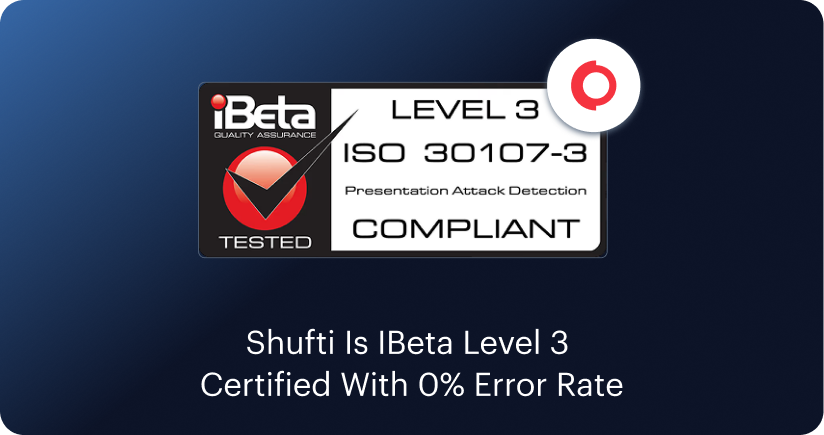
Presentation-attack defence: Shufti holds iBeta conformance at Levels 1, 2 and 3 under ISO/IEC 30107-3, and reached Level 3 for passive face liveness on both iOS and Android using a single-selfie approach. The Level 3 evaluation covered 900 presentation attacks and 100 bona fide presentations, returning a 0% Attack Presentation Classification Error Rate and a 0% Bona Fide Presentation Classification Error Rate. Level 2 has become the category norm, so Level 3 is where independent evidence still separates vendors.
Injection and deepfake defence: ISO/IEC 30107-3 evaluates artefacts presented to a camera. It does not cover streams injected past the camera, which is one of the most pressing problems in the industry right now. Shufti runs a separate detection path for injected content, processing standard RGB inputs alongside high-frequency DCT representations in parallel, so generative artefacts that RGB-only systems miss are caught at the point of capture. Region-based models analyse eyes, nose, mouth, and skin boundaries independently, which catches localised manipulation that full-frame detectors overlook.
Performance on degraded and low-light captures: Shufti trains separate models for low-resolution and high-resolution inputs, so a compressed mobile capture receives the same detection accuracy as a clean image. No minimum quality threshold is applied. Region-based models work on partial and cropped faces, and the image-forensics layer amplifies the traces manipulation leaves behind, such as fake-edge seams, mismatched textures, and unusual noise. Detection reads image content rather than file metadata, so stripping camera signatures does not defeat it.
Demographic performance under worst-case reporting: Shufti was assessed in the U.S. Department of Homeland Security 2025 Remote Identity Validation Rally under the alias MTDS 15, and recorded a worst-case False Non-Match Rate of 0.67% across every tested device and document combination. That placed it among the 31% of systems that met the rally’s goals on all metrics. RIVR reports the worst case rather than the average, so this figure shows performance at the bottom of the distribution across diverse populations, not a headline mean that hides demographic variance.
1:1 verification and 1:N search in one integration: Shufti runs both through the same RESTful API, with 1:N face search across 10M+ records, so duplicate-account detection and repeat-fraud blocking sit in the same contract as onboarding verification.
Explainability and audit evidence: Every flagged image returns a colour-coded attention map highlighting the regions that triggered the alert. Fraud teams get a reviewable reason for a decline instead of a bare score.
Retrospective biometric audit: Shufti rescans records captured during earlier onboarding against current-generation deepfake models to identify selfies that passed then but would fail now. The process runs inside the institution’s own AWS account and VPC via the AWS Marketplace machine image, so face images and video never leave existing cloud boundaries.
The honest trade-off: Shufti has no published NIST FRTE ranking. Buyers who treat that leaderboard as the decisive proof of matching accuracy will find Shufti’s evidence base sits in iBeta and DHS RIVR instead. Its North American commercial footprint is also smaller than that of US-headquartered rivals, which shows up in brand familiarity rather than capability.
Beyond the face stack, Shufti covers 240+ countries and territories, actively verifies 10,000+ document types monthly, and runs OCR across 150+ languages at 99.7% accuracy. That matters because a face has to be matched against a document, and document coverage is where most platforms thin out once you move beyond US and EU markets.
Deployment Options:
- SaaS
- Cloud
- Local Cloud
- On-premise for data-residency compliance
Certifications and recognitions:
- iBeta Levels 1, 2, and 3 conformance under ISO/IEC 30107-3
- DHS RIVR 2025 top performer, Selfie Match to Document track, meeting all defined performance goals
- SOC 2 Type 2, ISO 27001:2022, PCI DSS
- GDPR and CCPA compliance, Cyber Essentials, Cyber Essentials Plus
- Leader in the G2 Summer 2026 Identity Verification Grid, with Momentum Leader status
Ratings (as of July 2026):
- Shufti G2 Reviews: 4.8 / 5 from 148+ reviewers, and a Leader in the Summer 2026 Identity Verification Grid
- Shufti Trustpilot Reviews: 4.8 / 5 (3,909 reviews)
Verdict. Shufti fits organisations that need presentation-attack and injection-attack defence evidenced separately, accuracy proven at the worst case rather than the average, and reliable matching on degraded captures and non-Western documents in one platform. One glocal platform. The full compliance lifecycle, from sign-up to remediation. Every industry, every region, every use case.
2. Amazon Rekognition
Amazon Rekognition is a general-purpose computer vision service covering face detection, comparison and search alongside object and content moderation. It is priced per image or per minute of video and integrates natively with the wider AWS estate.
Presentation and injection defence: Rekognition Face Liveness analyses a short selfie video to detect spoofs presented to the camera, such as printed photos, digital photos, digital videos, and 3D masks, as well as spoofs that bypass the camera, such as pre-recorded or deepfake videos. AWS documentation confirms it passed iBeta Level 1 and Level 2 PAD conformance testing with a perfect PAD score. No Level 3 listing.
Independent matching evidence: No published NIST FRTE ranking, so face matching accuracy rests on Amazon’s own documentation rather than standardised third-party testing.
Video and 1:N: Rekognition Video supports face search against stored collections in recorded and streaming video, which serves video facial recognition use cases directly. Deployment is AWS cloud only, with no on-premises option, and Face Liveness is available in only five AWS regions.
Certifications and recognitions:
- iBeta Levels 1 and 2 PAD conformance under ISO/IEC 30107-3 for Face Liveness
- AWS platform compliance including SOC, ISO 27001 and PCI DSS
Ratings (as of July 2026):
- G2: 4.3 / 5 (28 reviews)
- Trustpilot: no company profile
Verdict. Best for engineering teams already on AWS who need face search and liveness as features inside a wider application, rather than a full identity verification platform.
3. Azure Face API
Azure Face is Microsoft’s face detection, verification, and identification service, sold under gated access. It supports both one-to-one verification and one-to-many identification against a secure repository. Microsoft restricts identification features to approved customers and publishes a Responsible AI standard documenting known limitations, which is more transparency on accuracy boundaries than most vendors offer.
Presentation-attack defence: The Azure Face liveness detection API achieved a 0% penetration rate in iBeta Level 1 and Level 2 PAD tests, conducted by a NIST/NVLAP-accredited laboratory under ISO/IEC 30107-3. No Level 3 listing.
A limitation Microsoft states openly: while both the Web and Mobile solutions conform to Levels 1 and 2, only the Mobile solution includes Runtime Application Self-Protections from GuardSquare. Microsoft notes the Web solution has limitations inherent to browser environments and may be more vulnerable to certain attacks, and recommends the Mobile solution wherever possible. Few vendors publish a caveat of this kind, and it is worth reading before choosing a browser-based deployment.
Independent matching evidence: No published NIST FRTE ranking.
Certifications and recognitions:
- iBeta Levels 1 and 2 PAD conformance under ISO/IEC 30107-3, 0% penetration rate
- Azure platform compliance including SOC 2, ISO 27001, and HIPAA
- Published characteristics and limitations documentation covering accuracy measurement
Ratings (as of July 2026):
- G2: 3.8 / 5 (12 reviews)
- Trustpilot: no company profile
Verdict. Suits Microsoft-estate enterprises that want face verification and identification inside existing governance, with the caveat that browser deployments carry documented additional risk.
4. FACIA
FACIA is a London-headquartered biometrics vendor founded in 2022. It focuses on liveness, deepfake detection and face matching rather than full identity verification, and positions itself on sub-one-second decisions.
Presentation-attack defence: FACIA holds iBeta Levels 1 and 2 conformance under ISO/IEC 30107-3, reporting 0% APCER on Android and iOS. Its DeepLiveness release, announced May 2026, reports a False Acceptance Rate of 0.06% and a False Rejection Rate of 0.03%. No Level 3 listing.
Capture conditions: FACIA’s liveness documentation states the technology works with hats, glasses, and low-light conditions, and claims protection against 56 or more spoofing attack types.
Independent matching evidence: FACIA describes itself as NIST standards compliant, which is a different claim from holding a published FRTE leaderboard position. No published FRTE ranking.
Certifications and recognitions:
- iBeta Levels 1 and 2 conformance under ISO/IEC 30107-3
- ISO 9001 and ISO 14001, GDPR and CCPA compliance, ICAO alignment
Ratings (as of July 2026):
- G2: profile live and vendor-managed, no reviews submitted yet
- Trustpilot: Limited profile
Verdict. A focused option for fast liveness and deepfake detection as a component, where KYC, AML and document infrastructure already exist elsewhere.
5. Idemia
Idemia is a French multinational supplying biometric identity systems to governments, border agencies and law enforcement, with more than four decades of biometric expertise across face, iris and fingerprint.
Independent matching accuracy: Idemia states that the algorithms inside its Multi-Biometric Search Services engine consistently perform at the top of NIST rankings, and it highlights its NIST FRTE 1:1 results for combining fairness with accuracy. Idemia does not publish its specific current placements on its own site, so buyers who need exact ranks should read them directly from the NIST FRTE leaderboard rather than from vendor marketing.
Bias and fairness: Idemia’s biometrics expertise page states that its algorithms are designed with bias removal and liveness detection built in, and validated by recognised authorities.
Deployment and fit: Built for on-premises, government-grade installation. Products such as MFACE capture faces from a continuous flow of people walking through a designated area, aimed at border control, self-boarding, and kiosks. Procurement cycles are sized for national programmes rather than fintech onboarding.
Presentation-attack evidence: No published iBeta conformance listing.
Certifications and recognitions:
- Sustained top-tier placements across NIST FRTE, published by NIST rather than by Idemia
- Government and border-control accreditations vary by contract and jurisdiction
Ratings (as of July 2026):
- G2: no product profile
- Trustpilot: 2.3 / 5 (10 reviews). These describe US enrolment-centre appointments and TSA services, not the biometric software sold to governments, so read them as consumer service feedback rather than a product signal
Verdict. The choice for border control and civil identity at national scale, where NIST leaderboard position is the procurement requirement.
6. Incode
Incode is a US-headquartered identity verification platform that owns its biometric stack end to end.
Presentation-attack defence: In March 2026, iBeta confirmed Incode as the first company in the world to pass Level 3 PAD testing on both iOS and Android. Testers executed 900 presentation attacks using hyper-realistic masks with up to 56 hours of preparation per attack species, and Incode returned 0% APCER and 0% BPCER. It achieved Level 2 in 2023. Verification is completed from a single selfie capture with no challenge prompts.
Independent matching evidence: Incode states its facial recognition models are top-ranked in FRTE benchmarks for both 1:1 verification and 1:N identification, and that they are tested against NIST FRTE benchmarks evaluating demographic fairness. Specific placements are not published on its own site, so verify against NIST directly.
Geographic weighting: Verification volumes concentrate in the Americas, so buyers with heavy APAC, MENA, or African document traffic should benchmark first. G2 reviewers note that pricing sits at the higher end.
Certifications and recognitions:
- iBeta Level 3 PAD conformance under ISO/IEC 30107-3 on both iOS and Android, first in the world
- iBeta Level 2 conformance since 2023
- Kantara Identity Assurance Level 2 (IAL2) compliance
Ratings (as of July 2026):
- G2: 5.0 / 5 (52 reviews), the highest star rating in this comparison
- Trustpilot: 3.2 / 5 (1 review), too small a sample to draw anything from
Verdict. Strong for US-centric enterprises and government identity programmes that want full-stack ownership with the strongest published presentation-attack evidence in this comparison.
7. iProov
iProov is a UK-based specialist in biometric liveness and injection-attack detection. It does not sell a general facial recognition platform, and several vendors have historically embedded its liveness inside their own stacks. Alongside face, it also sells a palm verification product.
How its liveness works: Dynamic Liveness uses patented Flashmark technology, illuminating the device screen with an unpredictable colour sequence during face capture. The reflected light confirms the user is genuinely present at that moment, and because the sequence is one-time, a replay or injected recording cannot reproduce it.
Injection-attack assurance: iProov’s liveness is independently certified under ISO/IEC 30107-3 and has been tested by Five Eyes governments for both presentation and digital injection attacks. It also holds FIDO Face Verification Certification. On injection specifically, that is the strongest published evidence of any vendor in this comparison.
Scope limits: iProov performs 1:1 matching against a document portrait or an enrolled biometric, but offers no 1:N search, no document engine, and no AML layer. It is a component decision rather than a platform decision.
Certifications and recognitions:
- iBeta Levels 1 and 2 PAD conformance under ISO/IEC 30107-3
- FIDO Face Verification Certification
- Five Eyes government testing for presentation and injection attacks
- WCAG 2.2 AA and Section 508 accessibility conformance
Ratings (as of July 2026):
- G2: iProov Face Verifier profile live, no reviews submitted yet
- Trustpilot: no company profile
Verdict. Right where independent injection-attack assurance is the single procurement question and the surrounding stack already exists.
8. NEC
NEC is a Japanese technology group whose NeoFace algorithms have repeatedly topped NIST’s 1:N identification benchmark since it began participating in 2009.
Independent matching accuracy: In its April 2025 announcement, NEC reported the highest performance rating in the FRTE 1:N Identification test, with an error rate of 0.07% against a database of 12 million people. It also ranked first in two aging tests using images taken more than 10 and 12 years earlier, and placed in the top two across all eight major FRTE 1:N categories listed by NIST. The aging results matter for enrolment databases that stay in service for years.
Scale in production: NEC’s face recognition business operates in more than 50 countries and regions, and the technology is deployed at roughly 80 airports for immigration, customs, and boarding.
Deployment: Sold as system integration for government and large infrastructure, not as a self-serve API.
Presentation-attack evidence: No published iBeta conformance listing.
Certifications and recognitions:
- First place in NIST FRTE 1:N Mugshot 12M with a 0.07% error rate, plus first place in both aging tests
- Top two placements across all eight main FRTE 1:N categories
- Accreditations vary by national deployment
Ratings (as of July 2026):
- G2 and Trustpilot: no profile on either platform, which is typical of vendors selling through government tender rather than self-serve
Verdict. The benchmark for national-scale identification and public infrastructure where gallery size runs to millions.
9. Innovatrics
Innovatrics is a Slovakian biometrics vendor covering face, fingerprint, iris, and contactless palm. It is one of the few independent European developers ranking near the top of NIST’s leaderboards across multiple modalities.
How the matching works: Innovatrics describes its facial recognition as detecting a face, extracting key landmarks such as eyes, jawline, and nose, then converting them into a digital template. In its SmartFace Platform, the biometric template of a person is automatically and dynamically updated over time, which the company says keeps accuracy high as someone’s face gradually changes, or when they are wearing a face mask. SmartFace also states that it works in degraded lighting and still recognises people wearing sunglasses and hats.
Real-time video and watchlists: SmartFace processes multiple camera streams at once for real-time identification, handling detection thresholds, template extraction, matching, tracking and age and gender detection, and integrates through a REST API. A separate SmartFace Embedded build runs face detection and template extraction directly on OEM and edge devices, detecting a face in 11ms on an Ambarella CV22 chip, so video never has to leave the camera.
Presentation-attack defence: Innovatrics passive liveness holds iBeta conformance at Levels 1 and 2 under ISO/IEC 30107-3, detecting all 1,500 attempted spoofs while accepting every genuine login. No Level 3 listing.
Injection defence: Innovatrics sells a separate video injection detection module alongside its deepfake detection product, and has published independent testing of its Identity Verification Toolkit against video injection attacks.
Multimodal fit: Because face, fingerprint, iris and palm all come from one developer, agencies building a full ABIS avoid stitching several vendors’ engines together.
Certifications and recognitions:
- iBeta Levels 1 and 2 PAD conformance under ISO/IEC 30107-3
- First place in NIST FATE Age Estimation and Verification on the Mean Absolute Error metric
Ratings (as of July 2026):
- G2: Innovatrics ABIS profile live and vendor-managed, no reviews submitted yet
- Trustpilot: no company profile
Verdict. Strong for border control, ABIS deployments and any programme where low-quality webcam capture has to match against official photographs, particularly under EU supplier requirements.
10. Aware
Aware is a Massachusetts-based biometrics software company and one of the few publicly listed vendors in this category, trading on NASDAQ as AWRE. Its face products centre on Knomi, a mobile and browser authentication framework built around a selfie, supported by the PreFace capture SDK and the Nexa|Face matching SDK.
Presentation-attack defence: Knomi’s passive facial liveness holds iBeta conformance at Levels 1 and 2 under ISO/IEC 30107-3, recording a 0% Attack Presentation Classification Error Rate on both Android and iOS against artefacts including high-quality photos, 2D and 3D masks, videos, mannequins and animation software. That evaluation dates from 2020, so ask for current testing rather than assuming the result still reflects today’s deepfake threat.
Architecture: Knomi splits work between minimal on-device software and server-side processing. Knomi Web performs capture in any browser, while liveness, spoof detection, template storage, and matching run on the server. A separate Face Analyzer module adds image quality checking, which matters where capture conditions are uncontrolled. Voice matching is available as a second factor alongside face.
Independent matching evidence: No published NIST FRTE ranking, so matching accuracy claims rest on Aware’s own documentation rather than standardised testing.
Certifications and recognitions:
- iBeta Levels 1 and 2 PAD conformance under ISO/IEC 30107-3 for Knomi passive liveness
- Publicly listed on NASDAQ, giving audited financial disclosure that most private vendors do not provide
Ratings (as of July 2026):
- G2 and Trustpilot: no profile on either platform
Verdict. Suits organisations wanting face and voice authentication across mobile and browser, particularly where a publicly listed supplier is a procurement requirement.
11. Cognitec Systems
Cognitec is a Dresden-headquartered German vendor that has worked exclusively on face recognition since 2002, with offices in Rockland, Massachusetts and Sydney. Its FaceVACS portfolio covers database search, recorded video investigation, real-time video screening, border eGates, and biometric photo capture. Access control manufacturer SALTO Systems acquired the company in 2022, which is worth factoring into long-term roadmap questions.
Video facial recognition: FaceVACS-VideoScan processes live video streams and recorded footage of people in unrestricted groups, extracts every face, and compares them against image databases to find known persons instantly. It also runs anonymous facial age estimation analysis, people counting and crowd detection, and includes a REST API. For buyers whose requirement is video rather than still-image onboarding, this is the most directly built product in this comparison.
Low demographic bias: Cognitec reports that its 1:1 algorithm shows very low variation in False Match Rates across demographic groups, meaning low risk of a false match to another face of the same sex, age group, and region of birth. It also states that its algorithms are trained only on internal proprietary databases containing no test data, so results should generalise to unseen data. Both points speak directly to the demographic fairness question.
Presentation-attack evidence: No published iBeta conformance listing, although FaceVACS-Entry eGate panels include hardware checks for a live person.
Certifications and recognitions:
- ISO 19794-5 and ISO 39794-5 standards compliance testing in FaceVACS-PortraitAcquisition
Ratings (as of July 2026):
- G2 and Trustpilot: no profile on either platform
Verdict. The specialist choice for live video screening, watchlist matching and automated border control, rather than remote customer onboarding.
What To Look For In Advanced Facial Recognition Software
Facial recognition software identifies or verifies a person by converting facial geometry into a mathematical template and comparing it against another. Every vendor runs a different program behind that process, which is why two solutions in the same category can perform very differently in the same market. That makes choosing between them harder than it looks. Here are five things worth checking before you decide.
1:1 verification and 1:N identification are not the same job
For businesses evaluating facial verification software, understanding the difference between 1:1 verification and 1 identification is essential. A 1:1 check asks whether this face matches this specific reference, which is what KYC onboarding and access control need. A 1:N search asks whether this face matches anyone in a database, which is what fraud-ring detection and duplicate-account blocking need. So if you want to find a person by photo, that is a 1:N task, and it requires an indexed collection rather than a point-to-point comparison. Most platforms optimise for one or the other, so check the benchmarks for each task separately.
Look for independent proof of matching accuracy
NIST FRTE is the largest public benchmark of its kind, and it sorts its leaderboard by false non-match rate on the visa-border dataset. A vendor with a published FRTE position has submitted to standardised testing. A vendor describing itself as “NIST compliant” has not necessarily done so, and marketing frequently blurs the two. Where a vendor claims a top ranking without naming the category, read the placement off the NIST leaderboard yourself.
Know what presentation attack testing does and does not cover
ISO/IEC 30107-3 defines presentation attack detection, and iBeta tests conformance at Levels 1, 2, and 3. This is what answers the question of whether Face ID can be fooled by a photo, since Level 1 covers printed images and screens while higher levels cover masks and high-fidelity replays. Level 2 has become common enough that it no longer separates vendors, and only two platforms in this comparison hold Level 3. More importantly, the standard only tests artefacts held up to a camera. It says nothing about digital injection, where an attacker bypasses the camera and feeds a synthetic stream straight into the application. Ask for that evidence separately.
Check performance on real-world images
Production traffic looks nothing like a test lab, because people verify in dim rooms, on cracked screens, on five-year-old handsets and through heavy compression. Ask whether a vendor trains separate models for low-resolution input, whether detection still works on partial faces, and whether there is a minimum quality threshold below which the system fails outright.
Ask how demographic accuracy is reported
Error rates have historically varied across skin tone, age, and gender, and the way results are reported matters as much as the numbers themselves. An average across a balanced test set hides variance at the edges. That is why worst-case reporting, which the DHS Remote Identity Validation Rally uses, gives a more honest picture.
The criteria above separate a serious shortlist from a marketing one. Shufti evidences presentation-attack and injection defence separately, on owned end-to-end technology across 240+ countries and territories.
Explore the Shufti platform
How To Choose The Right Facial Recognition Software For Your Business
The right platform is the one that handles your capture conditions, under your regulatory regime, on a deployment model your data-residency obligations allow. Most buyers land in one of five situations.
Scenario 1: Regulated onboarding with deepfake exposure
For crypto, forex, iGaming and fintech, the threat is synthetic faces and injected streams, not printed photos. Shufti and Incode are the only two platforms here holding iBeta Level 3, and Shufti pairs that with separate RGB and DCT frequency-domain analysis for generative artefacts, shipping fixes on its own timeline because it owns the stack. Incode is credible where volumes sit in the Americas. iProov is the specialist where injection assurance alone is the question.
Deepfake exposure needs an independent benchmark
Shufti holds iBeta Level 3 conformance under ISO/IEC 30107-3, the highest published presentation-attack detection tier, with defence updates on our own release timeline.
Scenario 2: National-scale 1:N identification
For border control, civil registries and law enforcement, gallery sizes run into the millions and NIST leaderboard position is the procurement standard. NEC holds first place in Mugshot 12M and both aging tests, and Idemia sits in the top tier across categories. Innovatrics is the strongest option for buyers who need face, fingerprint, and iris from one developer. Cognitec is the specialist where the requirement is live video screening against watchlists rather than still-image identification.
Scenario 3: Users on poor devices in poor conditions
For the gig economy, emerging markets, and consumer platforms with older handsets, pass rates collapse when models assume clean input. Shufti trains separate low-resolution and high-resolution models with no minimum quality threshold, and its region-based analysis works on partial faces. Innovatrics is worth benchmarking alongside it, since SmartFace states it works in degraded lighting and recognises people wearing sunglasses and hats.
Test us on your hardest captures, not our marketing
Shufti applies resolution-aware models so a compressed mobile capture receives the same detection accuracy as a high-resolution image, with no minimum quality threshold.
Scenario 4: Data residency and on-premise obligations
For organisations under PDPL Saudi Arabia, NESA UAE, PDPA Thailand or OJK Indonesia, cloud-only architecture is disqualifying. Shufti offers SaaS, Cloud, Local Cloud, and on-premise. FACIA, Innovatrics, Cognitec, and Aware also support on-premise or SDK deployment. Amazon Rekognition and Azure Face API are ruled out by architecture rather than by preference.
Scenario 5: Face search inside an existing cloud estate
Where face detection and search are one feature inside a wider application, Amazon Rekognition and Azure Face API are the pragmatic choices, priced per call and already inside the governance perimeter. Both now carry iBeta Level 1 and 2 liveness conformance, but neither publishes NIST matching evidence, and Microsoft itself flags added risk in browser deployments. This route suits content moderation and internal access control better than regulated KYC.
No vendor’s marketing page will tell you which platform is right for you, but a test against your own traffic will. The real question is which structural advantages match your situation: where your users are, what devices they hold, which regimes you answer to, and how exposed you are to AI-driven fraud. For buyers facing several of those at once, Shufti combines full-stack ownership, Level 3 conformance, separate injection defence, resolution-aware capture handling, and worst-case validated accuracy in a single platform.
Run a proof of concept on your hardest captures, and benchmark the result against any vendor on this list, through a live walkthrough with Shufti.
Frequently Asked Questions
What features should businesses look for in facial recognition software?
Five features matter most: separate 1:1 and 1:N capability, independent matching accuracy from NIST FRTE, presentation attack detection conformance under ISO/IEC 30107-3, injection attack defence tested separately, and resolution-aware handling of poor-quality captures. Deployment flexibility and demographic reporting method follow closely.
What factors should be considered when comparing facial recognition software providers?
Compare the evidence base, not the claim. Check whether accuracy figures come from NIST FRTE, iBeta, a government rally, or the vendor's own testing. Check whether results are worst-case or average. Then check deployment model, data residency, and whether liveness is owned or licensed.
How does facial recognition software perform across different demographics?
Performance varies by skin tone, age, and gender, and the reporting method determines whether you can see it. Averages hide variance at the edges. The DHS Remote Identity Validation Rally publishes worst-case results, where Shufti recorded a 0.67% worst-case False Non-Match Rate across all tested device and document combinations.
How do businesses compare facial recognition software for fraud prevention use cases?
Fraud use cases need three things a standard accuracy figure will not show: presentation attack conformance at Level 3 rather than Level 2, injection attack defence evidenced separately, and 1:N search to catch duplicate and repeat accounts. Ask for explainable decisions your fraud team can review.
Can facial recognition software work in low-light or poor-quality images?
It depends on the architecture. Systems trained only on clean input degrade sharply. Platforms that train separate low-resolution models, analyse facial regions independently and apply no minimum quality threshold hold their accuracy on compressed mobile captures. Ask vendors directly for pass rates on degraded input rather than lab conditions.
What are the advantages of using facial recognition software?
It removes shared-secret weaknesses like passwords, completes verification in seconds rather than days, blocks duplicate and synthetic accounts through 1:N search, and creates an auditable record for regulators. For companies, the practical gain is higher onboarding completion alongside lower fraud loss.