


 Face Verification
 Address Verification
 Document Verification
 Age Verification
 VideoIdent
 Fast ID
 Docless Verification
 Consent Verification
 NFC Verification
 Business Verification
 Due Diligence
 Investor Verification
 E-Signature

 QES
QES
 AML Screening
 Transaction Monitoring
 Adverse Media
 Business AML Screening
 PEP & RCA
 Sanctions
 Watchlist
 Behavioural Biometrics
 Device Fingerprinting
 Biometric Face Authentication
 MFA
MFA
 Fraud Hub
 Onboarding
 Ongoing Monitoring
 KYC
KYC
 KYB
KYB
 KYI
KYI
 Age Assurance
 Identity Verification
 Workforce IAM
 Candidate Verification
 Compliance
 Fraud prevention
 Trust & safety
 Global expansion
 Product Managers
 Compliance Officers
 Fraud Analysts
 Developers
 Deepfake Detection
 Bonus Abuse / Promotion Abuse
 Account Takeover
 Synthetic Identity Fraud
 Document Fraud
 Impersonation Fraud
 Multi-Accounting
 Fraud Networks
 Chargeback Fraud
 Money Mule Activity
 Party Fraud
 Regulatory & Compliance Risks
 Fintech
 Crypto
 iGaming
 Forex
Forex
 Social Network
 Marketplace
 Banking
 Gig Economy
 Payments
 Ride Hailing
 Adult Content
 Blind Spot Audit
 Deepfake Detector
 Liveness Spoofs
 Document Originality
 Document Deepfake
 Global Trust Platform
 Journey Builder
 Case Management
 Shufti AI
 Fraud Analytics
 Vendor Comparison
 Brand Personalisation
 AI Compliance Co-Pilot
 OCR
OCR
 Secure Capture
 Deployment Options
 Identity Methods
 API Documentation
 Mobile SDKs
 Service Status
 Help Center
 Contact Us
 Technical Support
 Supported Documents
 Supported Countries
 Content library
 Blogs
Blogs
 News
News
 Reports
 Insights
 Knowledgebase
 ROI calculator
 About
About
 Career
 Press Release
 Certifications
 Partnership
 Awards
 Events & Webinar
 Interactive Demo
 Podcast Studio
 Spotlight Studio
Fraud as a service: how criminal networks are selling fraud at scale.
-
Add us as a Preferred Source
- 01 What is Fraud as a Service?
- 02 What tools are inside a FaaS kit?
- 03 Which industries does FaaS target most?
- 04 How does FaaS connect to account takeover and credential stuffing?
- 05 How has the FaaS threat landscape shifted in 2026?
- 06 How Shufti fits into your FaaS defense strategy
- Fraud as a Service lets non-technical criminals launch sophisticated attacks for as little as $50 a month.
- FaaS kits bundle phishing tools, stolen credentials, bots, and mule networks into subscription packages.
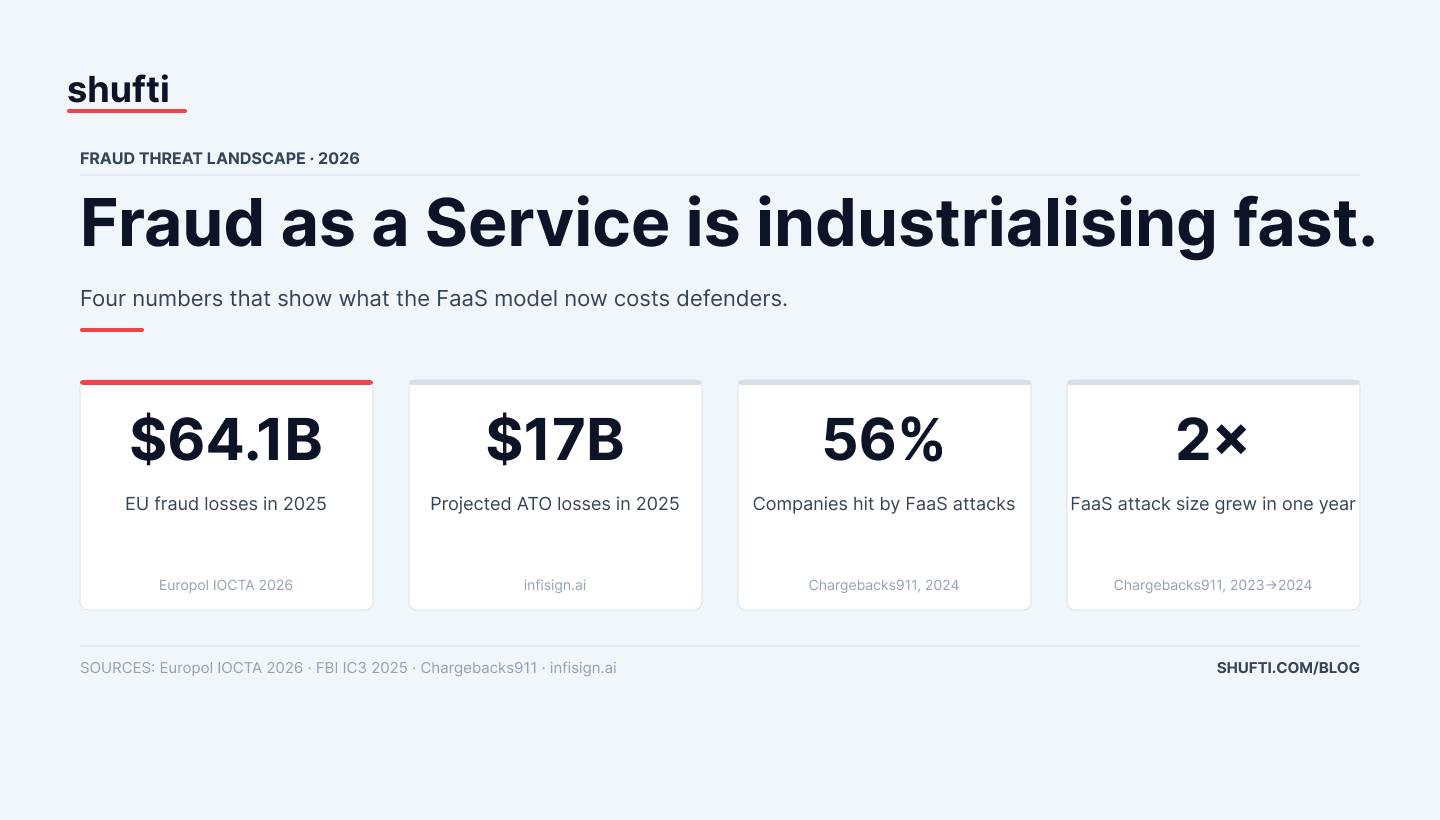
- Account takeover losses tied to FaaS-enabled attacks are projected to reach $17 billion in 2025.
- Europol’s IOCTA 2026 named fraud schemes the fastest-growing area of organised crime in the EU.
- Defending against FaaS requires real-time identity signals at onboarding, not just perimeter controls.
In May 2026, Europol declared fraud schemes the fastest-growing area of organised crime in the EU, with losses reaching $64.1 billion in 2025 alone. That figure was not driven by a new class of criminal mastermind. It was driven by infrastructure: a thriving market on the dark web where criminal networks sell access to ready-made fraud tooling, automated attack frameworks, and stolen credentials, packaged and priced like enterprise software subscriptions.
Fraud as a Service, or FaaS, is how organised crime scaled beyond its own headcount. Understanding how the model works — and where it is structurally vulnerable — is the first step toward building defences that hold.
What is Fraud as a Service?
Fraud as a Service is a criminal business model in which organised networks sell or rent pre-built fraud tooling to third-party buyers, enabling non-technical actors to run sophisticated attacks without building the underlying infrastructure themselves.
The model is the criminal equivalent of Software as a Service: subscription access to attack capabilities, delivered through dark web marketplaces, with pricing tiers, customer support channels, and feature update logs that deliberately mirror the conventions of legitimate software vendors.
How FaaS differs from traditional cybercrime
Traditional cybercrime required technical expertise at every stage: writing malware, building phishing pages, managing bot traffic, recruiting money mules, and laundering proceeds. FaaS separates those functions. Specialist criminal vendors build and maintain the tools, while non-technical buyers purchase access and direct the attacks against chosen targets. This division of labour opened the market to a far larger pool of bad actors.
The FBI received over one million cybercrime complaints for the first time in 2025, with cyber-enabled fraud accounting for $17.7 billion in losses. That volume is only achievable because the technical barrier to entry has effectively collapsed.
The economics: why $50 per month changed the attack surface
FaaS subscriptions typically start at around $50 per month, giving buyers immediate access to phishing kits, credential databases, bot infrastructure, and automated testing frameworks. The entry price is lower than most business software licences.
The average size of detected FaaS attacks doubled between 2023 and 2024, and 56% of companies reported becoming victims of FaaS-style attacks in that period. The doubling of attack size in a single year reflects what happens when operational cost drops to near zero: attackers run larger campaigns, more frequently, against more targets simultaneously, with no marginal cost for scale.
What tools are inside a FaaS kit?
A mature FaaS kit is modular by design. Buyers subscribe to individual components or purchase a full-stack package depending on their target and budget. The table below maps the standard components of a FaaS offering to the attack vector each one enables.
|
FaaS component |
What it does |
Attack vector enabled |
|
Phishing kits |
Pre-built fake login pages and brand-impersonation templates |
Credential harvest, session hijack |
|
Combolists |
Databases of email/password pairs from prior data breaches |
Credential stuffing, account takeover |
|
Credential-stuffing frameworks |
Automated tools that test credentials across multiple platforms in parallel |
Account takeover at scale |
|
Mule networks |
Pre-recruited money-transfer accounts for laundering proceeds |
Financial crime, fraud monetisation |
|
Deepfake-as-a-service |
AI-generated face-swap video and synthetic voice |
Biometric bypass, social engineering |
|
SIM-swap services |
Compromised or bribed telecoms insiders who port a victim’s number |
MFA bypass, account-recovery abuse |
|
Botnets on demand |
Rented networks of compromised devices |
IP rotation, rate-limit evasion |
No single component in this table is new. What FaaS changed is the assembly. Buyers receive a complete, tested attack chain rather than individual parts, delivered alongside customer support, update logs, and occasionally a satisfaction guarantee.
The polish is intentional: it reduces the learning curve for buyers and makes the vendor’s offering competitive against other FaaS providers in the same marketplace. Dark web FaaS vendors have adopted product-management thinking, shipping updates in response to new security controls the same way legitimate software teams respond to user feedback.
Which industries does FaaS target most?
FaaS attacks concentrate wherever account credentials carry direct financial value or where onboarding controls have exploitable gaps. Financial services absorb the largest volume of attacks, but crypto exchanges, gaming platforms, e-commerce, and healthcare each face distinct FaaS attack profiles shaped by the monetisation route available in each sector.
|
Industry |
Primary FaaS attack type |
Why it attracts FaaS buyers |
|
Financial services |
Credential stuffing, synthetic identity fraud |
High-value accounts, direct cash-out paths |
|
Crypto exchanges |
Account takeover, deepfake-assisted onboarding bypass |
Irreversible transactions, pseudonymous environment |
|
Gaming and gambling |
Account hijack, in-game asset fraud |
High transaction velocity, easy asset liquidation |
|
E-commerce |
Card-not-present fraud, stored-credential abuse |
Saved payment methods, no face-to-face friction |
|
Healthcare |
Data harvest, insurance fraud |
High PII resale value, fragmented authentication |
How does FaaS connect to account takeover and credential stuffing?
FaaS is the supply chain behind most large-scale account takeover fraud. The attack chain runs in three steps.
First, a FaaS vendor assembles or purchases a combolist: a dataset of email/password pairs harvested from prior data breaches or purchased from infostealer malware campaigns. Credential stuffing attacks rose 65% in 2024 as combobilists grew larger and more current, fed by a parallel market in infostealer logs that harvest credentials in real time from infected devices.
Second, the buyer loads the combolist into a credential-stuffing framework. These tools automate login attempts across dozens of target platforms simultaneously, rotating through residential proxy networks to defeat IP-based rate limiting and mimicking legitimate browser behaviour to evade bot-detection controls. Third, confirmed logins are sorted by account value, priced, and either sold back into the FaaS marketplace or exploited directly for financial gain.
The failure mode most organisations miss is structural. Credential-stuffing frameworks are engineered specifically to look like legitimate user behaviour at the network perimeter. IP rotation, browser fingerprint spoofing, and paced login timing all defeat firewall-level and rate-limiting controls.
What they cannot defeat reliably is a liveness check that distinguishes a live person from a replay attack, or a behavioural signal layer that detects session anomalies inconsistent with a returning user’s established pattern.The FaaS attack chain is most vulnerable at the identity verification layer, not the perimeter.
How has the FaaS threat landscape shifted in 2026?
Three developments have made FaaS materially more dangerous since 2024.
The first is agentic AI integration. Fraud networks have begun embedding autonomous AI agents into the attack loop, enabling credential-stuffing campaigns, social-engineering sequences, and fraud-monetisation steps to execute with minimal human involvement.
Europol’s IOCTA 2026 identified autonomous cybercrime as the next inflection point in organised crime, noting that agentic systems allow attacks to scale at a velocity no human-supervised operation can match. For defenders, this means attack volume will continue to grow even as the human headcount behind the attacks stays flat or shrinks.
The second is deepfake commoditisation. Deepfake-as-a-service is now a standard line item inside FaaS kits, enabling buyers to generate convincing face-swap video and synthetic voice for biometric bypass without building or training the underlying model. The cost has dropped to the point where deepfake capability is economically viable against low-value account targets, not only high-value financial targets.
The third is coordinated regulatory response. In May 2026, Europol launched the EU Anti-Scam Platform, a dedicated operational hub drawing on both the European Cybercrime Centre and the European Financial and Economic Crime Centre to coordinate cross-border takedowns of industrialised fraud networks. Enforcement actions will disrupt individual FaaS marketplaces, but the structural economics that make FaaS viable will persist.
The platform is most significant as a signal: regulators now treat FaaS as infrastructure-level organised crime, not isolated bad actors, which means compliance obligations for regulated businesses are likely to tighten around onboarding controls in the near term.
How Shufti fits into your FaaS defense strategy
The FaaS attack chain is built to exploit the gap between perimeter security and identity verification. Phishing kits harvest credentials that pass password checks. Credential-stuffing frameworks mimic legitimate login patterns. Deepfake-as-a-service targets onboarding steps that rely on shallow liveness detection.
Shufti’s fraud prevention layer operates at exactly these points. Behavioural analytics flags the anomalous session patterns that FaaS automation reliably generates, including copy-paste sequences in document fields, device reputation mismatches, and IP geolocation inconsistencies across the onboarding flow.
Combined with document intelligence trained on 10,000+ document types and a liveness engine that holds iBeta Level 3 conformance under ISO/IEC 30107-3, the integrated stack catches the signals FaaS kits consistently produce, at the moment they appear. One platform. Fully owned technology. Global coverage with real local depth.
Book a demo to see how Shufti’s fraud prevention layer detects FaaS-driven onboarding attacks on real traffic.
Frequently Asked Questions
Q1: What is Fraud as a Service (FaaS)?
Fraud as a Service is a criminal business model in which organised networks sell subscription access to pre-built fraud tools, including phishing kits, stolen credential databases, automation frameworks, and mule networks, enabling non-technical buyers to launch sophisticated attacks without building any of the underlying infrastructure themselves.
Q2: How do fraud syndicates use automation to scale attacks?
FaaS buyers load stolen credential datasets into automated frameworks that test login combinations across hundreds of platforms simultaneously, using residential proxies to evade rate limiting. The automation converts a single combo list into thousands of account-takeover attempts per hour, with confirmed logins sorted and monetised in near real time.
Q3: What is the relationship between FaaS and account takeover?
FaaS is the supply chain behind most large-scale account takeover fraud. Vendors supply combo lists and credential-stuffing tooling; buyers run automated login attacks against target platforms. Confirmed accounts are either sold back into the FaaS market or exploited directly, making account takeover the primary monetisation path for credential-focused FaaS kits.