



 Face Verification
 Address Verification
 Document Verification
 Age Verification
 VideoIdent
 Fast ID
 Docless Verification
 Consent Verification
 NFC Verification
 Business Verification
 Due Diligence
 Investor Verification
 E-Signature

 QES
QES
 AML Screening
 Transaction Monitoring
 Adverse Media
 Business AML Screening
 PEP & RCA
 Sanctions
 Watchlist
 Behavioural Biometrics
 Device Fingerprinting
 Biometric Face Authentication
 MFA
MFA
 Fraud Hub
 Onboarding
 Ongoing Monitoring
 KYC
KYC
 KYB
KYB
 KYI
KYI
 Age Assurance
 Identity Verification
 Workforce IAM
 Candidate Verification
 Compliance
 Fraud prevention
 Trust & safety
 Global expansion
 Product Managers
 Compliance Officers
 Fraud Analysts
 Developers
 Deepfake
 Bonus Abuse / Promotion Abuse
 Account Takeover
 Synthetic Identity Fraud
 Document Fraud
 Impersonation Fraud
 Multi-Accounting
 Fraud Networks
 Chargeback Fraud
 Money Mule Activity
 Party Fraud
 Regulatory & Compliance Risks
 Fintech
 Crypto
 iGaming
 Forex
Forex
 Social Network
 Marketplace
 Banking
 Gig Economy
 Payments
 Ride Hailing
 Adult Content
 Blind Spot Audit
 Deepfake Detector
 Liveness Spoofs
 Document Originality
 Document Deepfake
 Global Trust Platform
 Journey Builder
 Case Management
 Shufti AI
 Fraud Analytics
 Vendor Comparison
 Brand Personalisation
 IDV Modes
 AI Compliance Co-Pilot
 OCR
OCR
 Secure Capture
 Deployment Options
 Identity Methods
 API Documentation
 Mobile SDKs
 Service Status
 Help Center
 Contact Us
 Technical Support
 Supported Documents
 Supported Countries
 Content library
 Blogs
Blogs
 News
News
 Reports
 Insights
 Knowledgebase
 ROI calculator
 About
About
 Career
 Press Release
 Certifications
 Partnership
 Awards
 Events & Webinar
 Interactive Demo
 Podcast Studio
 Spotlight Studio
Address Verification for Real Estate & Law Firms: AML Compliance Guide

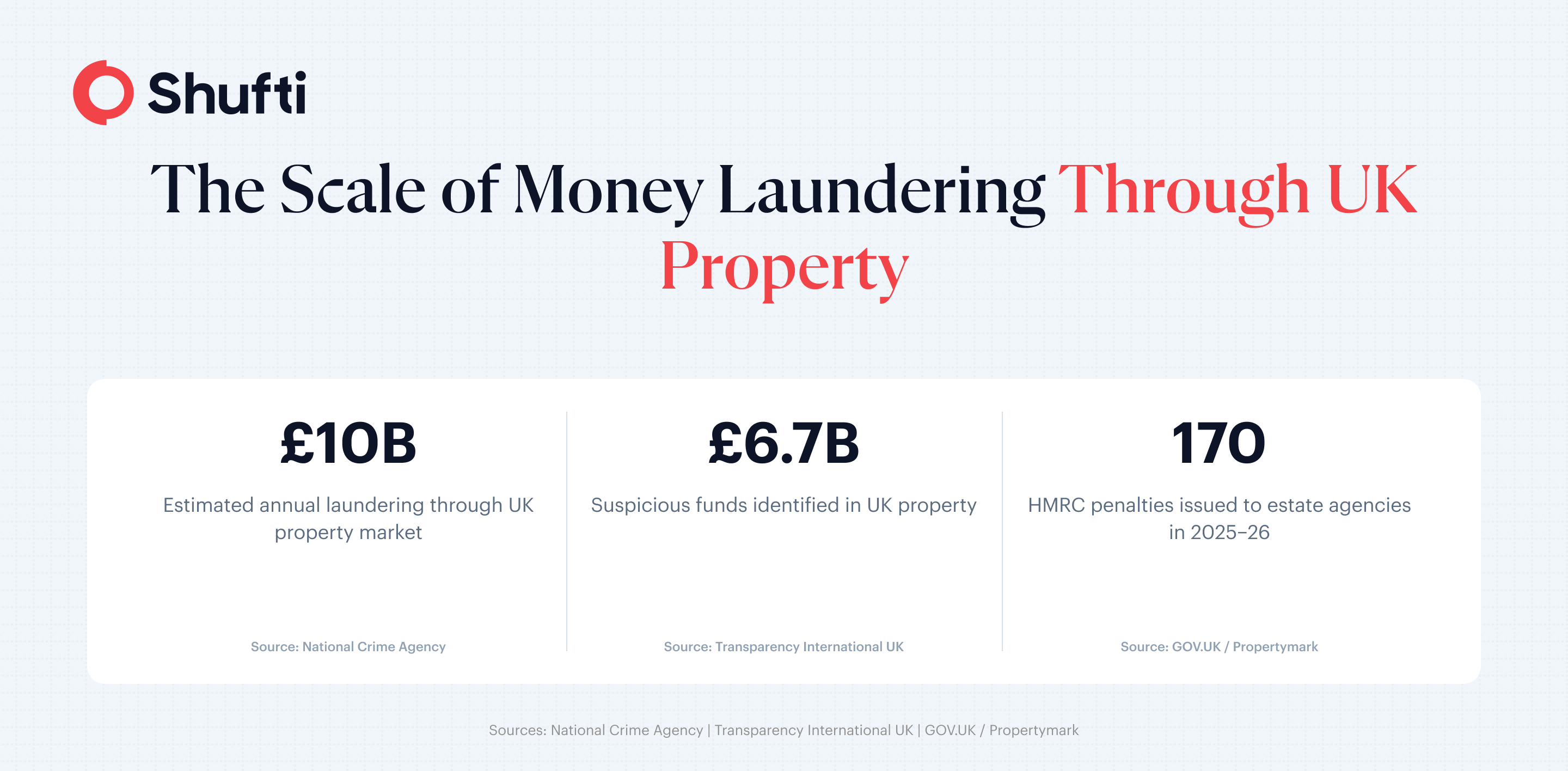
HMRC (His Majesty’s Revenue and Customs) issued 170 penalties to estate agency businesses, totalling more than £835,000, in the 2025–26 enforcement period. Most of those penalties did not come from firms that ignored anti-money laundering rules. They came from firms that thought collecting a passport copy and a utility bill was enough.
Address verification in property transactions sits at the centre of that gap. Estate agents, conveyancing solicitors, and law firms are designated non-financial businesses under anti-money laundering (AML) legislation in multiple jurisdictions. That designation carries obligations beyond document collection. Firms must verify identity, confirm proof of address, review source of funds, and document their methodology for any auditor who reviews the file.
The guide below walks through what compliant address verification for real estate actually requires.
What is address verification in real estate?
Proof of address property verification confirms that a buyer, seller, or client lives at the address they have declared. In property transactions, this step carries regulatory weight. Regulators treat it as part of customer due diligence (CDD), which means the verification method, the document assessed, and the outcome all need to be documented and auditable. A file that simply contains a scanned utility bill does not satisfy that standard.
For estate agents and conveyancing firms
A conveyancing address check typically requires one or more documents linking the client’s name to their current address. Utility bills, bank statements, mortgage correspondence, and official government letters dated within the last three months are widely accepted. Firms should also keep records of which proof of address documents for KYC and AML they accepted and why. The practical challenge is determining when a document is genuine. Forged utility bills and fake address property documents have grown harder to detect, and standard visual inspection misses modern AI-generated forgeries.
For law firms and legal practitioners
Law firm KYC compliance, and identity verification for legal firms more broadly, must meet the Legal Sector Affinity Group (LSAG) guidance approved by HM Treasury in April 2025. Solicitors handling high-value property transactions face a higher scrutiny threshold. Law firm address verification must go beyond surface-level document checks. The Law Society’s source of funds guidance treats verified address as one component of a broader client due diligence workflow, not a standalone box to tick.
What AML obligations apply to estate agents and law firms in 2026?
Property transactions attract money launderers for two reasons. High values move large sums in a single step, and some market segments have historically had limited oversight. According to estimates, £10 billion could be laundered through the UK property market annually. Another analysis by Transparency International UK identified £6.7 billion of suspicious funds invested in UK property. Three regulatory frameworks now require estate agents and law firms to treat AML compliance in real estate as an operational obligation, not a background concern.
UK Money Laundering Regulations 2017 and HMRC enforcement
Estate agents are supervised for AML compliance by HMRC under the Money Laundering, Terrorist Financing and Transfer of Funds (Information on the Payer) Regulations 2017 (MLR 2017). As of 2026, the regulations require estate agents to carry out CDD on buyers and sellers before, or during the early stages of, a transaction. HMRC can issue civil penalties, restrict a firm from trading, and in serious cases, refer matters for criminal prosecution. From December 2025, HMRC also introduced a £2,000 sanctions administration charge on top of every civil penalty issued for MLR breaches, adding further financial cost for firms that fall short of the required standard.
EU 6AMLD and non-financial sector obligations
The EU’s anti-money laundering package adopted by the Council in May 2024 places real estate agencies among the obliged entities required to verify clients and beneficial ownership. Under the 6th Anti-Money Laundering Directive (6AMLD), real estate professionals must apply CDD, report suspicious transactions, and retain records for at least five years. The new EU Anti-Money Laundering Authority (AMLA) will provide direct supervisory oversight of high-risk entities in the non-financial sector, with real estate firms among those in scope.
New Zealand’s risk-based AML/CFT reforms (November 2025)
New Zealand’s Statutes Amendment Act received Royal Assent on 26 November 2025, bringing risk-based changes to the country’s Anti-Money Laundering and Countering Financing of Terrorism (AML/CFT) framework for real estate agents, lawyers, and conveyancers. Reporting entities must now record each client’s risk rating, review that rating during ongoing due diligence, and update it when circumstances change. The move toward a risk-based model means documenting the methodology behind each check has become as important as running the check itself. This pattern mirrors what HMRC and the Law Society already require in the UK.
What does compliant address verification look like in 2026?
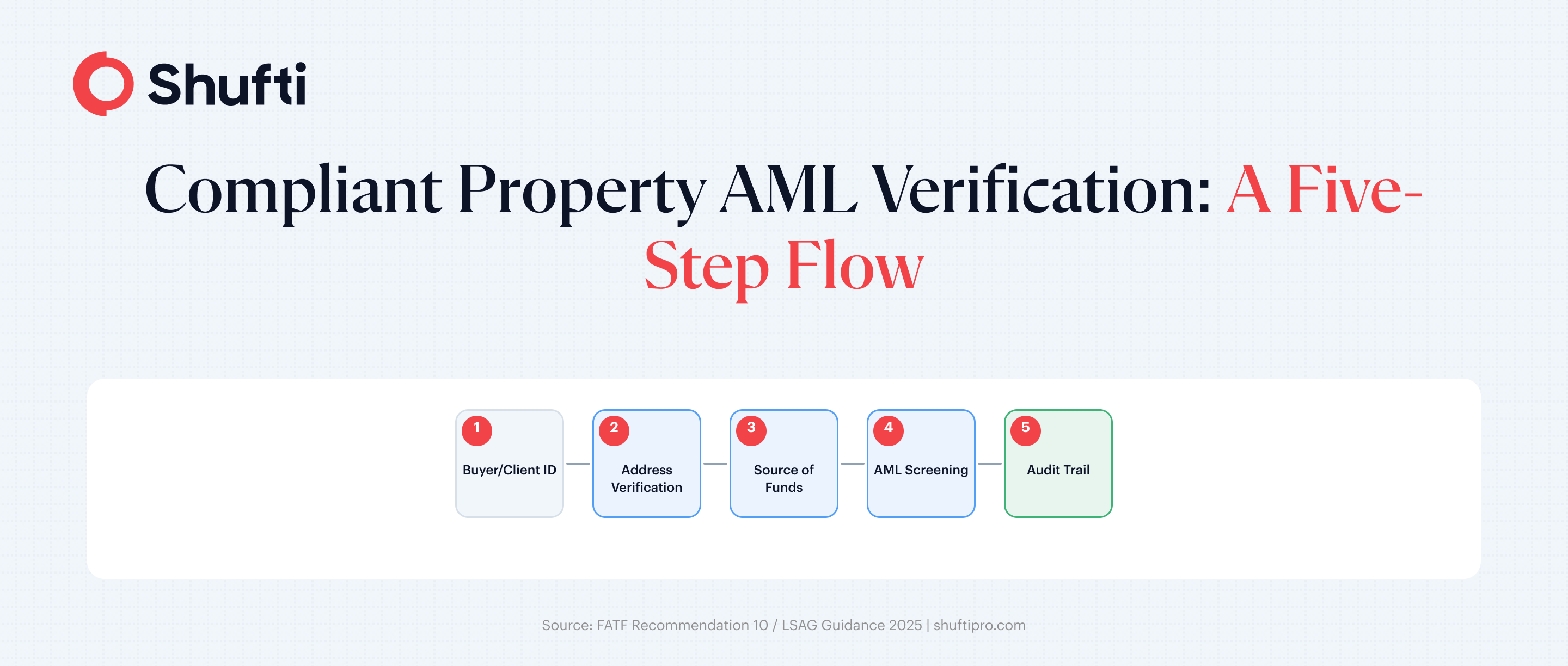
A compliant property buyer verification workflow in 2026 is not a document scan followed by a file note. Regulators from HMRC to the Financial Action Task Force (FATF) require that the method used to verify an address is documented, proportionate to risk, and auditable. FATF’s Risk-Based Approach Guidance for the Real Estate Sector states that effective CDD means understanding who the firm is dealing with, not only which documents it has collected. The real estate AML typologies that regulators focus on most often exploit gaps in exactly this verification sequence.
Identity verification and proof of address
Property AML address verification for standard-risk buyers starts with document-based proof. Utility bills, bank statements, or official government correspondence dated within the past three months are the standard options. The document must be assessed for authenticity and the result recorded. Storing a document without assessing it does not satisfy the verification obligation. KYC software for real estate automates document capture, optical character recognition (OCR), and forensic analysis that flags tampered or AI-generated files. Where the risk profile is lower and data sources are available, doc-less database verification can confirm a client’s address in under three seconds without requiring document upload, reducing the friction that pushes buyers to abandon transactions at the identity stage.
Source of funds verification in real estate
Source of funds verification in real estate is where many conveyancing firms and law firms fall short. The Law Society requires that solicitors make their own assessment of where a client’s purchase funds originate, particularly in high-value property transactions. Acceptable evidence includes mortgage offers, bank statements, investment account records, and inheritance documentation. Proof of address property checks and source of funds documentation must be captured together. The compliance file is only defensible when both are present and the methodology behind each is recorded.
AML screening and fraud prevention in property
AML compliance in real estate does not stop at identity and address verification. Once a buyer or client has been verified, their details need to be screened against sanctions lists, politically exposed persons (PEP) registers, and adverse media sources. Estate agent PoA processes that stop at document collection without AML screening leave a gap that HMRC and Law Society reviewers will find. Fraud prevention in property transactions also requires attention to address-linked signals. Ghost addresses, property AML addresses linked to shell companies, and fake address property entries connected to multiple unrelated buyers are among the typologies FATF highlights in its real estate sector guidance. The money laundering risks most common in real estate map directly to these address and identity signals.
How Shufti helps estate agents and law firms stay AML-compliant
Estate agents and law firms need a workflow that handles real estate address verification, source of funds documentation, and AML screening without separate integrations for each step. Fragmented systems produce fragmented audit trails, and a fragmented audit trail does not hold up under HMRC or Law Society review. Property buyer verification run through a connected platform produces a single compliance file covering identity, address, and screening in one auditable output.
Shufti’s address verification service runs document proof of address and doc-less pathways from a single API. In markets where authoritative databases are available, doc-less verification confirms a client’s address in under three seconds and produces a methodology record aligned to FATF Recommendation 10 and FCA Consumer Duty requirements. Where regulation or risk level requires documentary evidence, the Document Proof of Address pathway accepts utility bills, bank statements, and official correspondence, with forensic Document Intelligence analysis detecting metadata anomalies, AI-manipulation indicators, and layout forgeries that standard OCR checks miss.
For conveyancing address checks at volume, or for identity verification in legal firms across multiple active matters, a connected workflow matters more than point-in-time document storage. Shufti’s AML screening covers 100,000+ data sources across 3,500+ global watchlists, updated every 15 minutes, running in parallel with address verification so the compliance output covers identity, address, and sanctions status in a single auditable record.
Property AML compliance in 2026 requires documented methodology, source of funds evidence, and screening records that stand up to an HMRC or Law Society audit. Shufti’s address verification and AML screening run as a connected workflow from a single API, producing an audit-ready compliance file for every property buyer verification your team processes. Request a demo to see how the full property KYC flow works across your transaction volumes.
Frequently Asked Questions
Q: What is address verification in real estate?
Address verification in real estate confirms that a buyer, seller, or client lives at the address they have declared, using document-based proof such as utility bills and bank statements, or doc-less database checks. It forms part of customer due diligence under UK MLR 2017, EU 6AMLD, and equivalent AML regulations.
Q: Do real estate agents need KYC?
Yes. Estate agents are designated non-financial businesses under UK MLR 2017 and EU 6AMLD, which require customer due diligence on buyers and sellers. This includes identity checks, proof of address verification, and for high-value transactions, source of funds review before the transaction progresses.
Q: What is the source of funds verification in property?
Source of funds verification in real estate requires firms to confirm where a buyer's purchase funds originate. Acceptable evidence includes savings records, mortgage offers, investment account statements, and inheritance documentation. Law firms must document this assessment independently, particularly for high-value property transactions.
Q: What documents are accepted for proof of address in property transactions?
Commonly accepted proof of address documents in property transactions include utility bills, bank statements, mortgage correspondence, and official local authority letters dated within the past three months. For higher-risk transactions, firms may also require forensic document intelligence to confirm authenticity.
Q: How do you prevent fraud in property transactions?
Fraud prevention in property transactions requires layered checks. These include verified identity, document authenticity assessment, source of funds review, and AML screening against sanctions and PEP lists. Ghost address detection and geolocation signals help identify fake address property entries before a transaction completes.