




 Face Verification
 Address Verification
 Document Verification
 Age Verification
 VideoIdent
 Fast ID
 Docless Verification
 Consent Verification
 NFC Verification
 Business Verification
 Due Diligence
 Investor Verification
 E-Signature

 QES
QES
 AML Screening
 Transaction Monitoring
 Adverse Media
 Business AML Screening
 PEP & RCA
 Sanctions
 Watchlist
 Behavioural Biometrics
 Device Fingerprinting
 Biometric Face Authentication
 MFA
MFA
 Fraud Hub
 Onboarding
 Ongoing Monitoring
 KYC
KYC
 KYB
KYB
 KYI
KYI
 Age Assurance
 Identity Verification
 Workforce IAM
 Candidate Verification
 Compliance
 Fraud prevention
 Trust & safety
 Global expansion
 Product Managers
 Compliance Officers
 Fraud Analysts
 Developers
 Deepfake Detection
 Bonus Abuse / Promotion Abuse
 Account Takeover
 Synthetic Identity Fraud
 Document Fraud
 Impersonation Fraud
 Multi-Accounting
 Fraud Networks
 Chargeback Fraud
 Money Mule Activity
 Party Fraud
 Regulatory & Compliance Risks
 Fintech
 Crypto
 iGaming
 Forex
Forex
 Social Network
 Marketplace
 Banking
 Gig Economy
 Payments
 Ride Hailing
 Adult Content
 Blind Spot Audit
 Deepfake Detector
 Liveness Spoofs
 Document Originality
 Document Deepfake
 Global Trust Platform
 Journey Builder
 Case Management
 Shufti AI
 Fraud Analytics
 Vendor Comparison
 Brand Personalisation
 AI Compliance Co-Pilot
 OCR
OCR
 Secure Capture
 Deployment Options
 Identity Methods
 API Documentation
 Mobile SDKs
 Service Status
 Help Center
 Contact Us
 Technical Support
 Supported Documents
 Supported Countries
 Content library
 Blogs
Blogs
 News
News
 Reports
 Insights
 Knowledgebase
 ROI calculator
 About
About
 Career
 Press Release
 Certifications
 Partnership
 Awards
 Events & Webinar
 Interactive Demo
 Podcast Studio
 Spotlight Studio
Identity Verification for iGaming: Compliance, Fraud Prevention, and Player Trust

-
Add us as a Preferred Source
- 01 How the iGaming industry is regulated today
- 02 What identity verification covers on an iGaming platform
- 03 How player identity verification works on an iGaming platform
- 04 Why gaming fraud prevention identity verification matters now
- 05 Which iGaming businesses need an identity verification solution
- 06 How Shufti helps iGaming operators stay compliant
TL;DR
- UKGC’s Rule 17.1.1 (effective May 2025) now requires age and identity verification before any real-money play begins, ending the old model of verifying at first withdrawal
- EU-licensed operators face parallel obligations under 4AMLD/5AMLD, with FATF classifying online gambling as a high-risk money laundering sector
- iGaming verification covers four distinct checks: age verification, document authentication, biometric liveness matching, and ongoing AML screening
- The full verification flow (document capture, OCR, liveness, biometric match) completes in under 15 seconds for most players
- Passive liveness detection removes the primary mobile drop-off spike without changing the compliance outcome
- Multi-accounting and bonus abuse are closed by biometric identity binding at registration, not document checks alone
- Money laundering typologies in iGaming include cash-in-cash-out, parallel even-money betting, chip-dumping, and stolen card exploitation
- Casino operators carry the heaviest compliance load, followed by sports betting platforms and poker rooms, each with distinct fraud exposure patterns
Your compliance team is closing KYC files before the next UKGC audit. Your product team wants to cut sign-up friction. Both are right. The problem is that most iGaming operators treat these two priorities as opposing forces rather than the same system.
Identity verification gaming requirements have tightened sharply since 2023. The UK Gambling Commission’s revised LCCP, Malta Gaming Authority license conditions, and FATF typology guidance now impose a compliance floor that demands real-time verification before first deposit, not after first withdrawal. Weak verification means license risk, chargeback exposure, and fraud losses that compound quarter by quarter. Strong verification means lower operational cost, audit-ready records, and a player base that trusts the platform enough to deposit repeatedly.
How the iGaming industry is regulated today
The regulatory architecture governing online gaming has shifted from principle-based guidance to prescriptive, auditable rule-sets. Operators holding multiple jurisdictional licenses now face obligations that are more granular and harder to satisfy with legacy manual review than they were three years ago. Two frameworks set the compliance terms for most EU and UK-licensed operators.
UKGC and the 2025 LCCP changes
The UK Gambling Commission updated its License Conditions and Codes of Practice in 2025, with Rule 17.1.1 took effect on 7 May 2025. Operators must now verify a player’s age and identity before any real-money play begins. The model of collecting basic registration information and verifying at first withdrawal no longer satisfies the license condition.
The UKGC also updated its AML and CTF guidance in 2024, requiring risk-based customer due diligence driven by player behavior, deposit patterns, and source-of-funds indicators. Age verification gaming regulatory compliance under the UKGC is inseparable from AML obligations in practice. Both apply to the same account lifecycle and both feed the same audit record the Commission expects operators to produce on request.
EU, MGA, and multi-jurisdiction obligations
Operators licensed by the Malta Gaming Authority or EU member states fall under 4AMLD and 5AMLD. These require identity checks at account opening, ongoing CDD at threshold transactions, and enhanced due diligence for high-value or politically exposed players.
FATF designates online gambling as a high-risk sector for money laundering, covering multi-accounting, chip-dumping, and layering through bonus funds. Online gaming AML compliance KYC obligations flow directly from that classification. Operators are treated as reporting entities under most national AML frameworks, with the same disclosure obligations as financial institutions.
What identity verification covers on an iGaming platform
Identity verification on a gaming platform runs across several distinct processes, each triggered by different risk conditions and different moments in the player lifecycle. The initial onboarding check is the most visible, but it is neither the most complex nor the only one that creates compliance exposure.
Age verification and online gaming
Age verification is the first gate. Operators must confirm a player meets the minimum gambling age before any real-money feature activates. A document-based check extracts date of birth from a government-issued ID and cross-references it against a live biometric selfie. For platforms operating under KJM approval in Germany or UKGC regulation, biometric age estimation provides an additional check where document quality is poor. Biometric age estimation accuracy runs at approximately 98.72%, a useful threshold for platforms handling edge cases at the boundary of the minimum age requirement.
AML screening and ongoing monitoring
An iGaming identity verification solution must extend well beyond the initial sign-up check. Sanctions screening, PEP checks, and adverse media monitoring all run at account opening, and ongoing monitoring flags risk changes that emerge post-registration. Under 5AMLD, ongoing monitoring is a license condition, not an optional layer. Source-of-funds changes, unusual deposit velocity, and adverse media hits are all CDD triggers that require operator action regardless of the original onboarding result.
How player identity verification works on an iGaming platform
Player identity verification on an iGaming platform follows a defined sequence of steps. The exact flow varies by risk policy and jurisdiction, but the core logic remains the same throughout. The platform must confirm the document is genuine, confirm the person presenting it is real and present, and tie the two together in a single audit record.
The verification flow from registration to approval
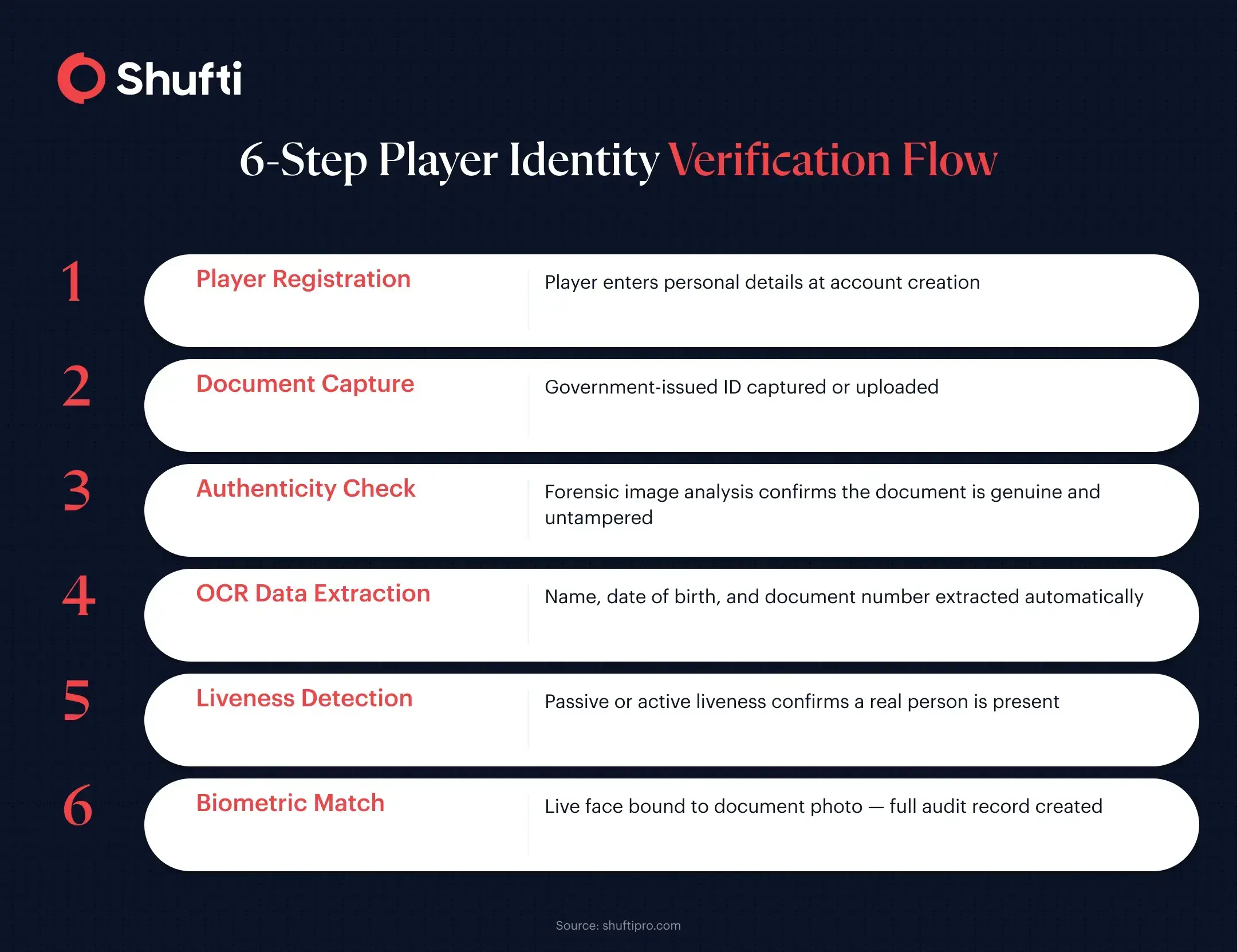
At registration, the player enters personal details. They then capture or upload a government-issued identity document. Forensic document verification confirms the credential has not been tampered with and matches a valid template from the issuing country. OCR extracts name, date of birth, and document number. A liveness check confirms the person presenting the document is physically present. Biometric matching binds the live face to the document photograph.
This online gaming KYC identity verification flow, running on a single integrated platform, completes in under 15 seconds for most players.
Where friction costs operators sign-ups
The failure points are consistent across platforms. Running document verification and liveness through separate vendors creates a seam between the two checks, and fraud exploits that gap. Active liveness prompts, which require visible head turns, blink sequences, or gesture-following, generate higher drop-off on mobile, particularly among players on mid-range devices or in variable lighting. Passive liveness runs silently without visible prompts. That single change removes the primary drop-off spike at the mobile onboarding step without changing the compliance outcome.
Why gaming fraud prevention identity verification matters now
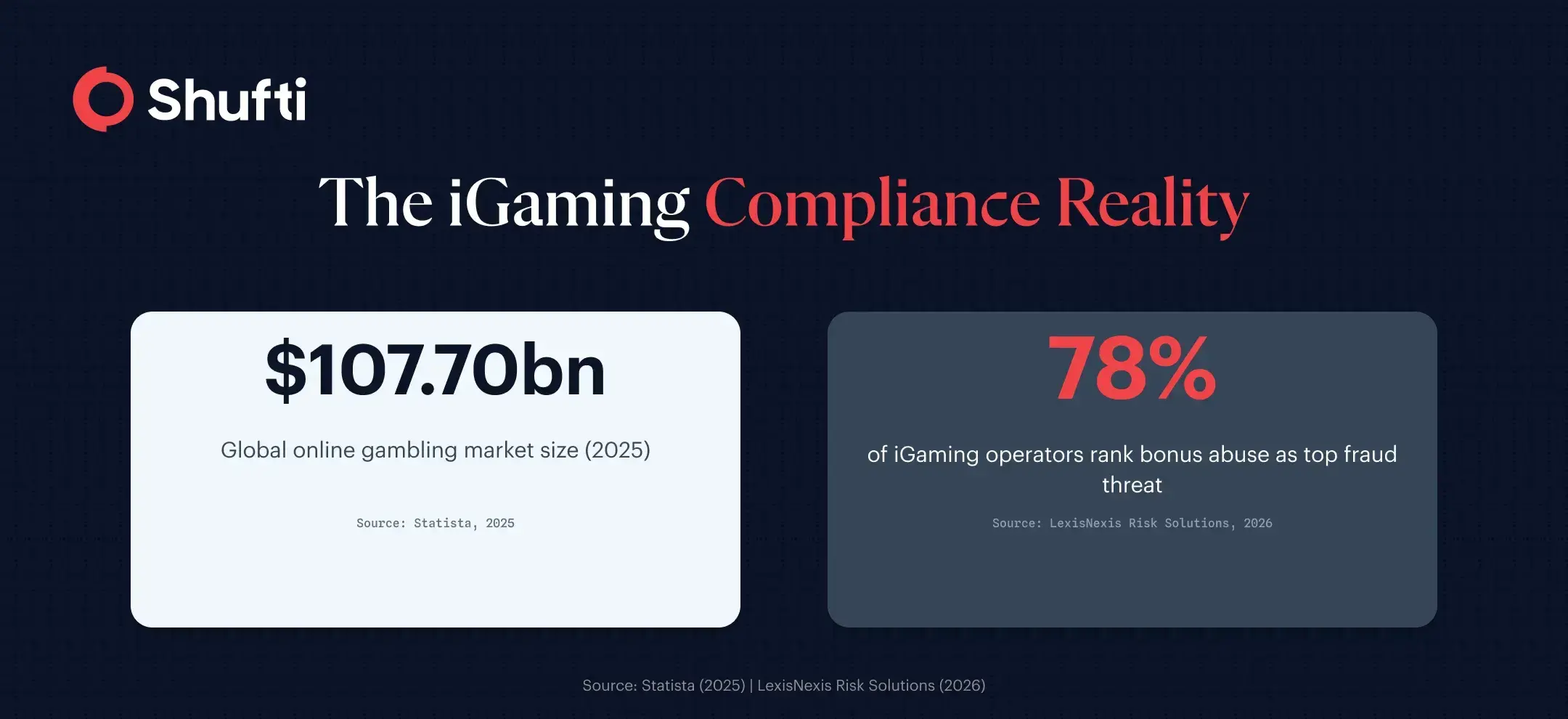
Fraudulent player accounts carry costs well beyond the immediate loss. They inflate bonus budgets, trigger chargebacks, create audit liabilities, and in the worst cases expose operators to regulatory sanctions for facilitating laundering activity on the platform. Two patterns account for the majority of fraud volume that licensed platforms face today.
Bonus abuse and multi-accounting
Multi-accounting, where a single person opens multiple accounts to claim deposit bonuses repeatedly, is straightforward to execute without strong identity binding at registration. Gaming fraud prevention identity verification that links each account to a biometrically verified identity record closes this exposure. Document-only verification without biometric binding leaves the identity spoofing attack surface open.
Money laundering through player accounts
The Isle of Man Financial Intelligence Unit’s 2025 Online Gambling Typology report documents laundering patterns in online gambling. Cash-in-cash-out where a criminal introduces illicit origins of criminal into an online gambling account places a few low-risk bets in order to create legitimate gameplay, and then cashes the money out again. Parallel even money betting where two criminals acting in collusion in the same online game can transform illicit funds into gambling funds by wagering on opposing positions with even odds. Chip dumping is another way where online gambling accounts can also be used by criminal accounts who want to transfer money to others for illegitimate purposes. Similar to the cash-in-cash out method a criminal aims to disguise the fact that they have spent money on an illicit enterprise, the criminal will introduce funds into an online gambling account and engage in minimal low-risk gameplay before cashing out.
Criminals may also use stolen bank cards or card details to credit online gambling and then request that any balance is cashed out to their own bank account through a different payment method. Criminals who are often engaged in sports-fixing, like rigging the outcome of a competition, make money by betting on the competition’s outcome.
Which iGaming businesses need an identity verification solution
Verification obligations differ across iGaming business models. License type, operating jurisdiction, and the risk profile of the player base each influence how deep the required checks must go. Three categories carry distinct compliance profiles and different fraud exposure patterns that shape the verification requirements in practice.
Casino operators
Online casinos handling real-money table games and slots carry the highest compliance standard. Casino KYC identity verification must cover full CDD, meaning document verification, biometric face matching, and AML screening, before real-money access. UKGC-licensed casinos must re-verify players when their risk profile changes materially during the account lifecycle, not only at initial onboarding.
Sports betting platforms
Sports betting operators face lighter initial CDD thresholds in some jurisdictions, but age verification and AML screening still apply from the point of account funding. High-volume micro-betting platforms face particular exposure to layering typologies and require transaction-level monitoring independent of the base identity check.
Poker rooms and skill gaming
Poker platforms face a specific fraud type alongside standard age and identity requirements. Chip-dumping, a laundering technique where one player deliberately loses to a controlled account, requires the verification layer to detect account-linking patterns. An iGaming identity verification solution for this category needs account-linkage detection rather than single-account identity checks alone.
How Shufti helps iGaming operators stay compliant
Most iGaming compliance gaps sit between the systems. A platform running document verification through one vendor and AML screening through another creates audit trails that don’t reconcile. Regulators notice.
Shufti’s document verification, biometric liveness, and AML screening from a single platform, so the evidence trail from onboarding to ongoing monitoring lives in one record. For UKGC-regulated operators facing the post-May 2025 LCCP requirements, that means a single audit-ready record covering age, identity, and financial crime risk in one place. Adverse media screening covers 50,000+ news sources across 415 risk categories, catching a PEP flag or sanctions hit that emerges after account opening, not just at onboarding.
For operators worried about conversion, Shufti’s passive liveness completes silently in under three seconds with a 95% first-attempt capture rate, removing the drop-off spike active liveness creates on mobile
See how Shufti closes the compliance-conversion gap for iGaming platforms — Request a demo.
Frequently Asked Questions
What is identity verification in gaming?
Identity verification in gaming confirms a player's age, identity, and financial risk profile before real-money access. It covers document verification, biometric face matching, and AML screening. These checks are required under UKGC LCCP 2025, EU AML directives, and most national online gambling licensing frameworks.
Why is age verification required for online gaming?
Regulators require age verification online gaming operators perform before allowing real-money access. UKGC Rule 17.1.1, effective May 2025, requires completion of age and identity verification before account funding. Jurisdictions including Germany's GlüStV and the MGA framework carry the same requirement.
How does online gaming KYC identity verification work?
Online gaming KYC identity verification runs a document authenticity check, OCR data extraction, biometric liveness confirmation, and face-to-document matching. AML screening runs in parallel for sanctions, PEPs, and adverse media. A complete flow on an integrated platform typically resolves in under 15 seconds.
What does AML compliance require from iGaming operators?
Online gaming AML compliance KYC obligations cover customer due diligence at account opening, enhanced due diligence for high-value or politically exposed players, and ongoing transaction monitoring. Under 5AMLD and UKGC AML guidance, operators must maintain audit records and report suspicious activity to the relevant financial intelligence unit.
How long does player identity verification take on an iGaming platform?
A complete player identity verification iGaming platform flow covering document capture, liveness check, face match, and AML screening typically completes in under 15 seconds on an integrated platform. Manual review for edge cases adds time, but automated decisions cover the majority of verifications