


 Face Verification
 Address Verification
 Document Verification
 Age Verification
 VideoIdent
 Fast ID
 Docless Verification
 Consent Verification
 NFC Verification
 Business Verification
 Due Diligence
 Investor Verification
 E-Signature

 QES
QES
 AML Screening
 Transaction Monitoring
 Adverse Media
 Business AML Screening
 PEP & RCA
 Sanctions
 Watchlist
 Behavioural Biometrics
 Device Fingerprinting
 Biometric Face Authentication
 MFA
MFA
 Fraud Hub
 Onboarding
 Ongoing Monitoring
 KYC
KYC
 KYB
KYB
 KYI
KYI
 Age Assurance
 Identity Verification
 Workforce IAM
 Candidate Verification
 Compliance
 Fraud prevention
 Trust & safety
 Global expansion
 Product Managers
 Compliance Officers
 Fraud Analysts
 Developers
 Deepfake
 Bonus Abuse / Promotion Abuse
 Account Takeover
 Synthetic Identity Fraud
 Document Fraud
 Impersonation Fraud
 Multi-Accounting
 Fraud Networks
 Chargeback Fraud
 Money Mule Activity
 Party Fraud
 Regulatory & Compliance Risks
 Fintech
 Crypto
 iGaming
 Forex
Forex
 Social Network
 Marketplace
 Banking
 Gig Economy
 Payments
 Ride Hailing
 Adult Content
 Blind Spot Audit
 Deepfake Detector
 Liveness Spoofs
 Document Originality
 Document Deepfake
 Global Trust Platform
 Journey Builder
 Case Management
 Shufti AI
 Fraud Analytics
 Vendor Comparison
 Brand Personalisation
 AI Compliance Co-Pilot
 OCR
OCR
 Secure Capture
 Deployment Options
 Identity Methods
 API Documentation
 Mobile SDKs
 Service Status
 Help Center
 Contact Us
 Technical Support
 Supported Documents
 Supported Countries
 Content library
 Blogs
Blogs
 News
News
 Reports
 Insights
 Knowledgebase
 ROI calculator
 About
About
 Career
 Press Release
 Certifications
 Partnership
 Awards
 Events & Webinar
 Interactive Demo
 Podcast Studio
 Spotlight Studio
Illinois HB2123: Civil Remedies for Non-Consensual Intimate Images
- 01 What Counts as Non-Consensual Intimate Content Under Illinois HB2123?
- 02 What Civil Remedies Does Illinois HB2123 Provide?
- 03 How to File a Civil Claim under Illinois HB2123
- 04 The Scale of Non-Consensual Intimate Image Abuse
- 05 HB2123 in the Federal Legal Context
- 06 How Shufti Helps Platforms Detect AI-generated NCII?
TL;DR
- Illinois HB2123 (effective January 1, 2024) amended 740 ILCS 190 so that civil liability for non-consensual intimate images now covers AI-generated and digitally altered content, not just authentic photos or videos, and treats creation, solicitation, and distribution as equally actionable.
- The depicted person doesn’t need a real source image to have existed, and disclosing that content is AI-generated is not a valid legal defence.
- Victims can recover statutory damages up to $10,000 per defendant (or actual damages, whichever is greater) plus attorney’s fees, and can seek injunctive relief (TROs and permanent injunctions) at the same time.
- The filing window is two years from the discovery of the dissemination, or two years from the date of a threat if the image hasn’t been shared yet.
- HB2123 operates alongside federal law (the 2022 VAWA reauthorisation and the 2025 TAKE IT DOWN Act) rather than replacing it: federal rules add criminal penalties and a 48-hour takedown mandate, but only Illinois’s state law gives victims a direct civil right to sue.
On July 28, 2023, Illinois Governor J.B. Pritzker signed House Bill 2123 into law, making Illinois one of the first states to extend civil legal protection to victims of AI-generated intimate imagery. The law took effect on January 1, 2024, amending the Civil Remedies for Nonconsensual Dissemination of Private Sexual Images Act (740 ILCS 190) to cover digitally altered and synthetically generated images, not just authentic photographs.
If you are navigating what legal options exist in Illinois for non-consensual intimate images (NCII), this article covers the definitions, civil remedies, filing timelines, and federal context in one place.
What Counts as Non-Consensual Intimate Content Under Illinois HB2123?
HB2123 expanded the definition of “sexual image” under 740 ILCS 190 to include any photograph, film, videotape, digital recording, or similar medium that falsely appears to show the unclothed or partially unclothed genitals, pubic area, anus, or female post-pubescent nipple of a real person, or shows that person engaged in sexual conduct. That expansion is the law’s core contribution.
Before HB2123, the statute covered only authentic images captured without consent. After HB2123, it covers digitally altered images, AI-generated images, and deepfakes, regardless of whether the underlying source material ever existed.
Three points matter for anyone assessing an Illinois AI intimate image civil claim. First, the depicted individual does not need to have consented to any underlying source image being captured. Second, disclosing that an image was digitally altered is not a defense to liability.
If the image falsely depicts a real person and was distributed without consent to harass, extort, threaten, or cause harm, the cause of action stands. Third, HB2123 covers not only distribution but also the creation and solicitation of digital forgeries intended for harmful use, closing a gap that existed when only distribution was actionable.
Exceptions to liability apply in four situations: law enforcement activities, court proceedings, medical education, and good-faith reporting of criminal conduct.
What Civil Remedies Does Illinois HB2123 Provide?
The Civil Remedies for Nonconsensual Dissemination of Private Sexual Images Act gives a depicted individual a civil cause of action against any person who distributes, creates, or solicits a digitally altered sexual image without consent and with intent to harm. Illinois courts may award two categories of relief, and a plaintiff may pursue both simultaneously.
Monetary Damages
A plaintiff can recover either actual economic and non-economic damages caused by the dissemination, or statutory damages of up to $10,000 per defendant under 740 ILCS 190, whichever is greater. Courts may also award attorney’s fees and costs to a prevailing plaintiff. The statutory damages option matters most in NCII Illinois civil lawsuit cases where psychological and reputational harm is real but economic loss is difficult to quantify in dollars.
Injunctive Relief
Courts can grant temporary restraining orders, preliminary injunctions, and permanent injunctions ordering the defendant to stop displaying or disclosing the image. Injunctive relief is available in addition to, not instead of, monetary damages.
For victims of an Illinois revenge porn deepfake law violation, the combination of a fast-moving restraining order and statutory damages addresses both the immediate harm of continued circulation and the longer-term reputational impact.
How to File a Civil Claim under Illinois HB2123
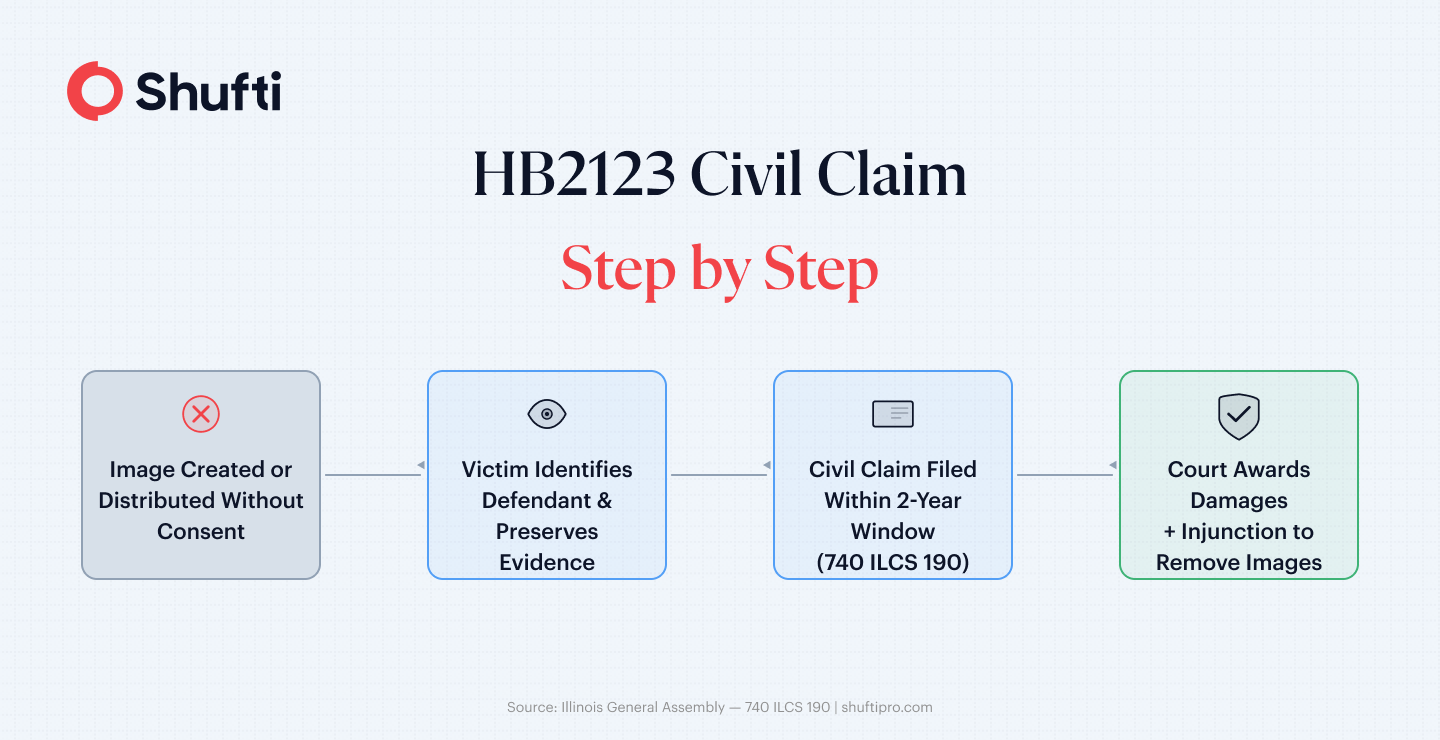
Filing an NCII Illinois civil lawsuit under 740 ILCS 190 follows standard civil litigation procedure in Illinois state courts. The statute of limitations is two years from the date the dissemination was discovered or should have been discovered with the exercise of reasonable due diligence. For threatened dissemination that has not yet been carried out, the two-year clock runs from the date of the threat.
A plaintiff’s claim needs to establish four elements. The defendant must have distributed, created, or solicited a digitally altered sexual image depicting the plaintiff. Acting without the plaintiff’s consent is a required element, as is a demonstrable intent to harass, extort, threaten, or otherwise cause harm. Courts do not require proof that the defendant succeeded in causing harm, only that the intent was present.
Practical steps before filing include documenting the images and their distribution channels, identifying where the content appeared and who distributed it, and preserving digital evidence. Victims should consult a licensed Illinois attorney because digital evidence preservation and service of process on anonymous defendants involve procedural requirements that directly affect case outcomes.
The Illinois NCII compensation law framework is civil, meaning a victim can pursue a claim independently of whether the state or federal government pursues criminal charges.
The Scale of Non-Consensual Intimate Image Abuse
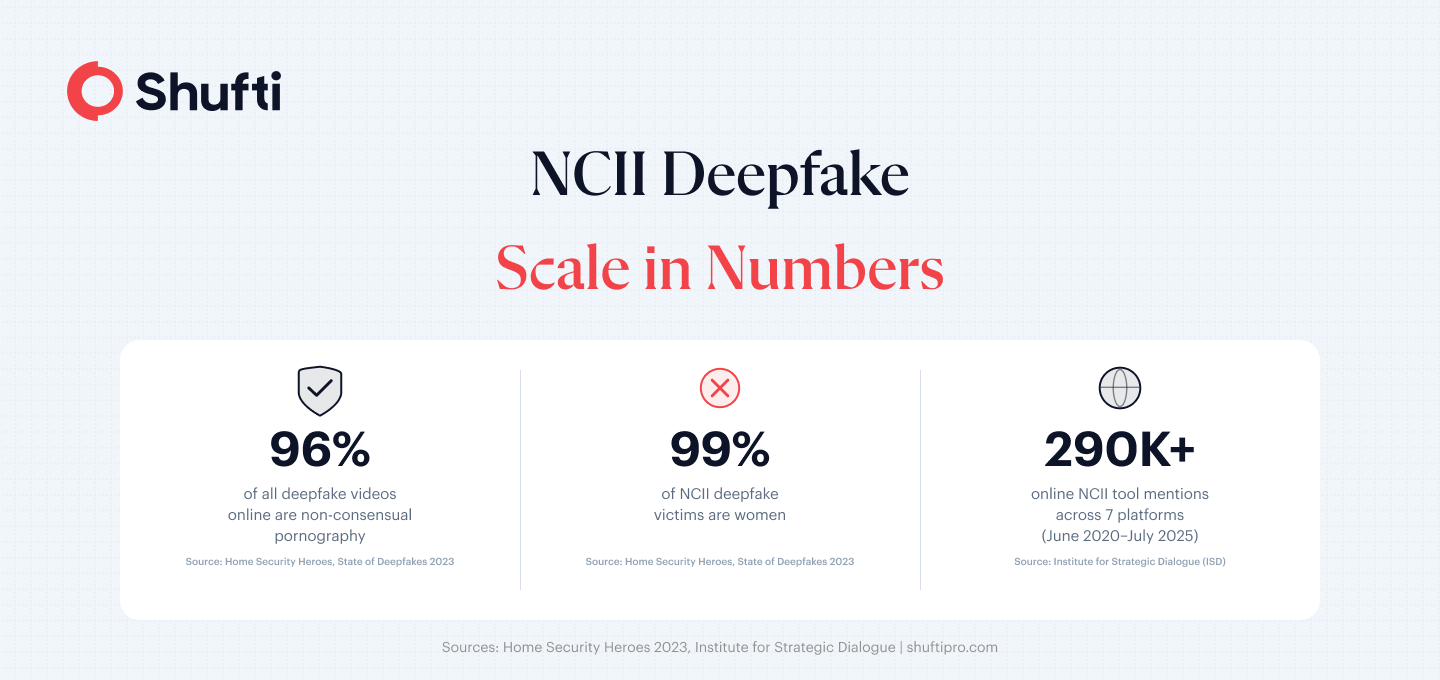
The civil remedies in HB2123 address a problem that has grown faster than legislation historically has. Research published by Home Security Heroes in 2023 found that 96% of all deepfake video content online is non-consensual pornography, with 99% of victims being women.
Those figures predated the current generation of AI image tools, which has lowered the barrier to creation to the point where deepfake NCII no longer requires technical expertise.
The Institute for Strategic Dialogue (ISD) tracked nearly 290,000 mentions of non-consensual intimate deepfake tools across seven major online platforms between June 2020 and July 2025. The volume of tool promotion reflects a sustained, networked supply chain for creating and distributing harmful content, not fringe activity.
The Illinois deepfake civil liability framework treats creation, solicitation, and distribution as equivalent offences because the supply chain connecting tool promotion to victim harm operates across all three.
HB2123 in the Federal Legal Context
Illinois HB2123 operates alongside federal protections that have developed since 2022. The Violence Against Women Act (VAWA) reauthorisation in 2022 created a federal civil private right of action for authentic NCII, though its application to AI-generated deepfakes remains legally unsettled as of April 2026.
The federal TAKE IT DOWN Act, signed on May 19, 2025, added a criminal layer but does not include a private civil right of action. The Act makes it a federal crime to knowingly publish non-consensual intimate imagery, including AI-generated deepfakes, and requires covered platforms to remove reported content within 48 hours.
Platforms had until May 19, 2026, to establish compliant takedown processes. Illinois HB2123 remains distinct because it gives victims a direct civil claim with statutory damages and injunctive relief, independent of whether federal criminal enforcement is pursued.
For anyone evaluating a deepfake civil liability Illinois claim, the state civil route and federal criminal complaint process are not mutually exclusive. Both can proceed in parallel.
How Shufti Helps Platforms Detect AI-generated NCII?
Laws like HB2123 and the TAKE IT DOWN Act define what happens after harmful content surfaces. For platforms that host user-generated content, social networks, and dating applications, the more pressing operational question is how to stop deepfake NCII from being created or distributed through their infrastructure in the first place.
Shufti’s deepfake detection covers 56+ synthetic media attack vectors, including AI-generated face swaps, image injection attacks, and frequency-domain manipulation that bypasses older liveness systems. Department of Homeland Security (DHS) RIVR 2025 top-performer validation provides independent evidence of detection accuracy across diverse user demographics.
For platforms in Illinois or serving US users, proactive deepfake screening at upload and account-creation stages is the operational control that reduces both user harm and platform legal exposure under expanding NCII liability frameworks.
Shufti’s face verification ties biometric identity to each account, which makes accountability possible when synthetic content is traced back to its source account. Platforms building compliant takedown workflows ahead of federal deadlines can integrate both deepfake detection and identity binding through a single API.
For a broader overview of how AI-generated synthetic media is used in fraud across sectors, this guide to deepfake detection covers the attack typology in detail.
Frequently Asked Questions
What civil remedies does Illinois HB2123 provide for non-consensual intimate content?
HB2123 entitles victims to sue for statutory damages of up to $10,000 per defendant under 740 ILCS 190, actual economic and non-economic damages, attorney's fees, and injunctive relief ordering image removal. The civil cause of action covers AI-generated deepfakes, not only authentic photographs or videos.
Can you sue someone for creating a deepfake intimate image in Illinois under HB2123?
Yes. HB2123 covers the creation, solicitation, and distribution of digitally altered sexual images without consent where the intent is to harass, extort, or cause harm. Disclosing that an image is AI-generated is not a defense under 740 ILCS 190.
What is the statute of limitations under Illinois HB2123?
Victims have two years from the date they discovered or should reasonably have discovered the dissemination. For threatened dissemination not yet carried out, the two-year period runs from the date of the threat.
How does Illinois HB2123 define non-consensual intimate content?
The Act covers any digital or recorded medium that falsely depicts a real person's exposed genitals, pubic area, anus, or female post-pubescent nipple, or shows the person engaged in sexual conduct, distributed without consent and with intent to harm.
Does Illinois allow lawsuits for synthetic intimate content created by AI?
Yes. HB2123 expressly extends the civil remedy framework to AI-generated and digitally altered images. The law took effect January 1, 2024, and treats synthetic NCII the same as authentic NCII for civil liability purposes under Illinois state law.