








The global Know Your Business verification market reached $4.8 billion in 2024 (Growth Market Reports), growing at roughly 16% year over year. That growth tracks directly to regulatory expansion.
The EU’s Anti-Money Laundering Regulation (EU 2024/1624) lowers the beneficial ownership identification threshold and mandates interconnected UBO registers across all member states by July 2026. FinCEN, meanwhile, exempted domestic US companies from beneficial ownership reporting in March 2025 but kept the obligation in place for foreign entities registered in the US.
For any platform onboarding businesses across borders, the question isn’t whether to integrate a KYB API. It’s which one won’t break when the underlying registry data gets messy.
This article covers what the API actually returns, where registry data falls apart in production, and what engineering and compliance leads should evaluate before committing to a provider.
What a KYB Verification API Actually Returns
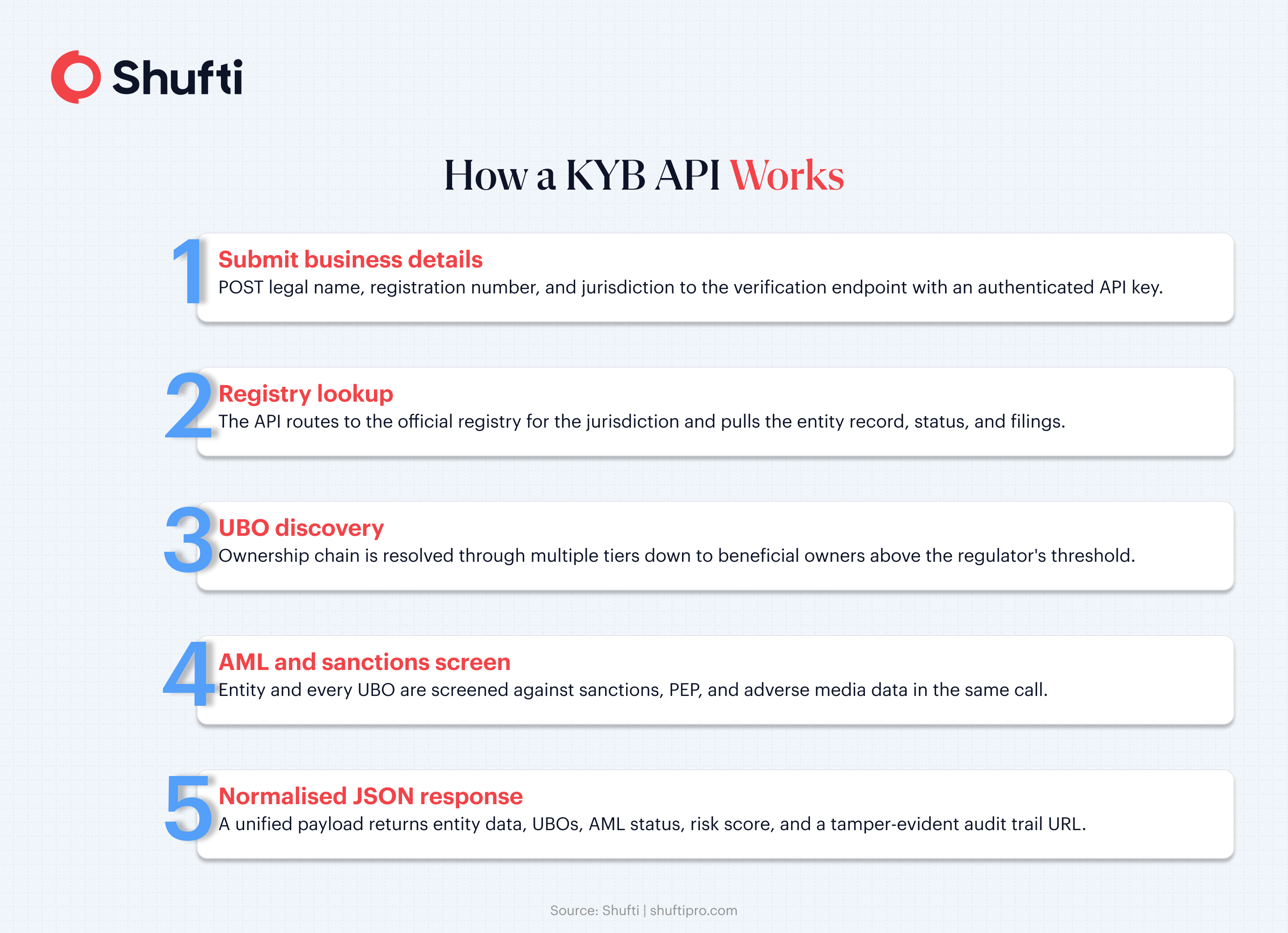
Most KYB API documentation starts with a business lookup endpoint. Enter a registration number or company name, get back structured company data: legal name, registration date, jurisdiction, status, registered address, directors. That’s the first layer, and it’s table stakes.
The second layer is UBO verification. A production-grade KYB verification API doesn’t just return who’s listed on the register. It resolves ownership chains through layered corporate structures, including shell entities, trusts, and nominee arrangements, to identify the natural persons who hold 25% or more of the business. Under the EU AMLR, that threshold applies to voting rights and other forms of indirect control too.
The third layer is where most basic registry APIs stop: AML screening. A business verification API that returns company data without running directors and UBOs against sanctions lists, PEP databases, and adverse media sources hands the compliance team an incomplete picture. They’ll end up feeding those names into a separate screening tool and reconciling results manually. That’s the gap most product teams discover after they’ve already shipped v1.
The Registry Problem That Breaks Production Flows
Country business registries don’t behave like a single, clean database. The UK’s Companies House updates in near real-time and exposes a well-documented REST API. Germany’s Handelsregister requires manual queries in some states. The UAE has separate registries per free zone. Pakistan’s SECP data is available but structured differently from India’s MCA portal.
A KYB REST API provider claiming “200+ jurisdictions” needs to answer a more specific question: what’s the data latency per registry? A company that dissolved three months ago still showing as active in the API response is a compliance risk, not a feature.
For engineering leads evaluating a real-time KYB API, the test isn’t whether the provider returns data. It’s whether the response includes a data freshness timestamp, a confidence score, and a clear distinction between registry-sourced fields and inferred fields.
Endpoints That Matter for B2B Onboarding
A KYB API built for developers typically exposes four categories of endpoints. The first handles business verification lookups: company search by name or registration number, with jurisdiction-specific routing. The second resolves ultimate beneficial ownership chains and returns the natural persons behind the corporate structure.
The third covers screening, where the API runs every director, shareholder, and UBO against sanctions, PEP, and adverse media databases. The fourth, often overlooked in initial scoping, handles document verification for supporting evidence: certificates of incorporation, articles of association, and shareholder registers that arrive as PDFs or scanned images.
Platforms that separate these into four different vendor integrations are building four sets of error handling, four webhook schemas, and four reconciliation processes. A single REST API that covers all four under one authentication layer reduces the integration surface and keeps the audit trail in one place.
Authentication, Rate Limits, and What Goes Wrong
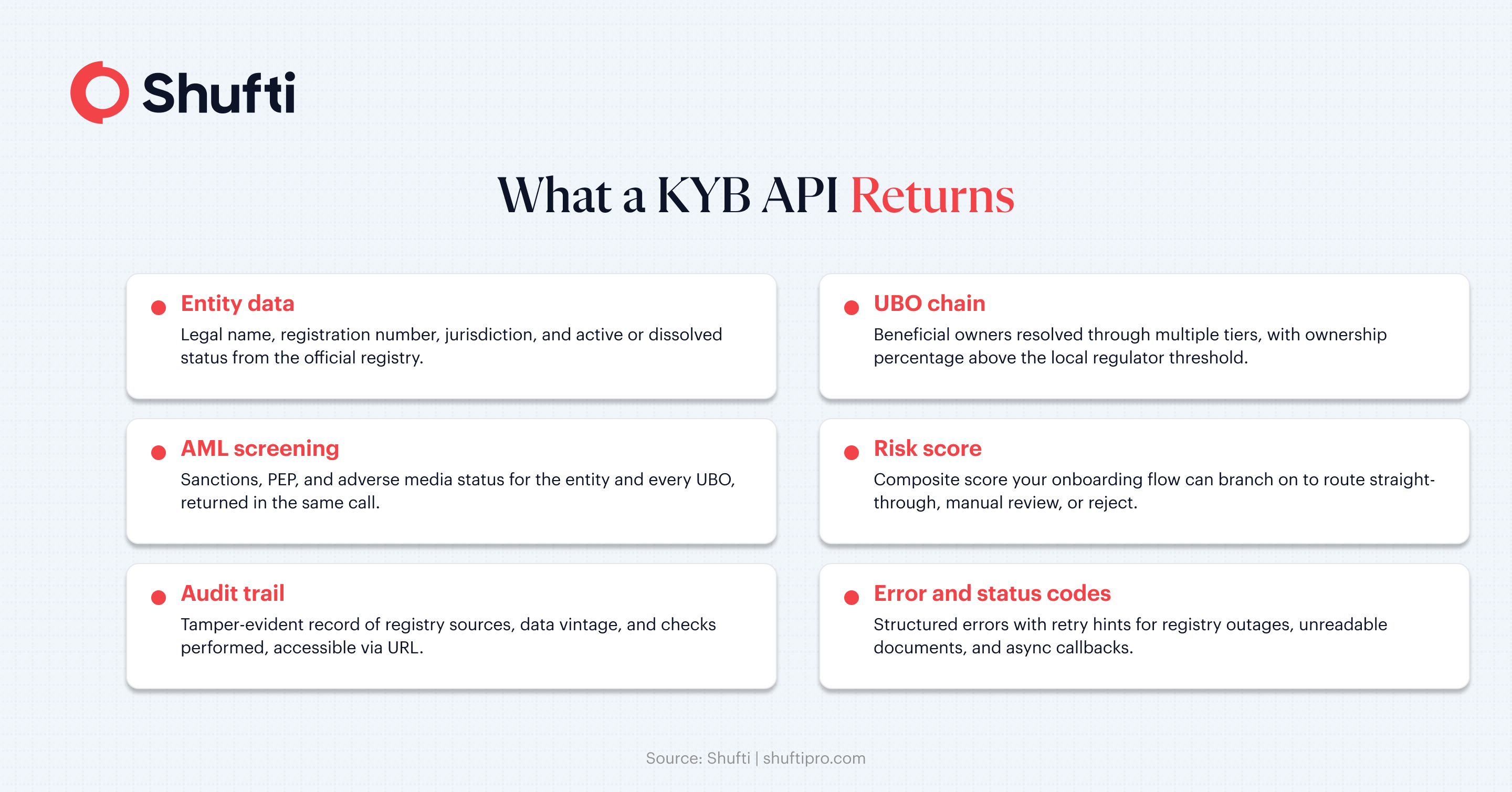
Most providers authenticate via API keys passed in request headers, with OAuth 2.0 available for platforms that need delegated access per client. The more practical question for development teams is what happens when things fail.
Common failure modes include registry timeouts (some national databases have 30+ second response windows), partial data returns where the registry doesn’t hold the requested field, and name-matching ambiguities in markets where transliteration produces multiple valid spellings. A well-documented KYB API for developers returns structured error objects that distinguish between “data not found” and “source temporarily unavailable,” so the onboarding flow can route appropriately instead of blocking the applicant.
Rate limits matter at scale. A marketplace onboarding 500 businesses per week needs to know whether the API enforces per-second, per-minute, or daily caps, and whether screening calls count separately from registry lookups.
What Changes with EU AMLR and UBO Register Interconnection
The EU’s Anti-Money Laundering Regulation introduces several changes that directly affect how business verification APIs must work. The UBO identification threshold drops to 25% ownership or control, and the European Commission can lower it to 15% for high-risk sectors. By July 2026, member states must make their UBO registers accessible through the BORIS interconnection system (Transparency International).
For platforms operating across multiple EU markets, this means the verification provider needs to support real-time queries against individual national registers today, and be ready to route through BORIS when it goes live. KYC and AML compliance obligations don’t pause while the infrastructure catches up.
Choosing a KYB API Provider: What to Evaluate
The comparison isn’t just about endpoint count or jurisdiction coverage. Five factors separate a provider that works in a demo from one that holds up in production.
Registry data freshness: does the provider disclose per-country data latency, or just a total coverage number?
UBO resolution depth: can the API trace ownership through three or more corporate layers, or does it stop at the first registered shareholder?
Screening coverage: is AML compliance bundled, or does the development team need a separate integration?
Audit trail completeness: does every API response include the data source, timestamp, and decision logic for each field?
And deployment flexibility: can the platform run on-premise for data sovereignty requirements, or is it cloud-only?
Shufti’s single REST API covers KYB, KYC, AML screening, document verification, and business identity verification under one integration. Average integration time runs 2-3 days (Shufti benchmark). The platform processes up to 1 million verifications per day with a 99.9% uptime SLA, and supports on-premise deployment for organizations that can’t send business data to a third-party cloud. ISO 27001, SOC 2 Type II, and PCI DSS certified.
Take the Next Step
Product and compliance teams stitching together separate APIs for registry lookups, UBO resolution, and AML screening are carrying integration debt that compounds with every new jurisdiction. Shufti’s KYB API handles all three in a single REST call, with on-premise deployment and jurisdiction-specific data freshness transparency. Request a demo and test it against a live onboarding scenario.
Frequently Asked Questions
What does a KYB API do?
A KYB API verifies a business entity by pulling registry data, resolving beneficial owners, screening the entity and its owners against sanctions and PEP lists, and returning a normalised response. It automates what a compliance analyst would otherwise do manually across multiple portals and spreadsheets.
How do I integrate a KYB verification API into my platform?
Authenticate with an API key or OAuth 2.0 token, POST the business details and jurisdiction to the verification endpoint, and handle the JSON response. Most production integrations also subscribe to a webhook for async status updates and log the audit trail URL against the customer record.
What authentication methods do KYB APIs use?
OAuth 2.0 and signed JWTs are standard, with per-environment keys for sandbox and production. Look for scoped tokens that limit which endpoints a key can call, and for clear documentation on key rotation.
Is there a real-time KYB API for instant business verification?
Yes, for most straightforward cases. Registry lookups in jurisdictions with machine-readable filings return in seconds. Cases that require document parsing, manual registry fetches, or enhanced due diligence usually flip to an async callback. A good API tells you which path a check took in the response.