








A 2025 TransUnion study found that fraud cost Canadian businesses the equivalent of 7.2% of their revenues in 2025, with synthetic identity fraud among the fastest-growing contributors. Deepfakes sit at the centre of that shift. A fraudster no longer needs a stolen identity document. They need a face swap tool and an onboarding process that cannot tell the difference.
Canada has no single deepfake law. What it has is a patchwork of criminal provisions, federal and provincial privacy statutes, copyright protections, and civil torts. Each applies in different circumstances and carries different remedies. Compliance teams and legal counsel need to understand which framework governs a deepfake incident before one occurs, not after.
The analysis below maps the key Canadian deepfake regulations in force as of April 2026, and what each means for businesses operating in this market.
What Laws Currently Apply to Deepfakes in Canada?
As of April 2026, Canada lacks a single statute that explicitly defines and criminalises deepfakes in all contexts. The country relies instead on a set of overlapping legal frameworks, each designed for an earlier era of fraud, privacy, and content liability. Understanding which law applies depends on the type of harm the deepfake causes and who the affected person is.
Criminal Code Provisions
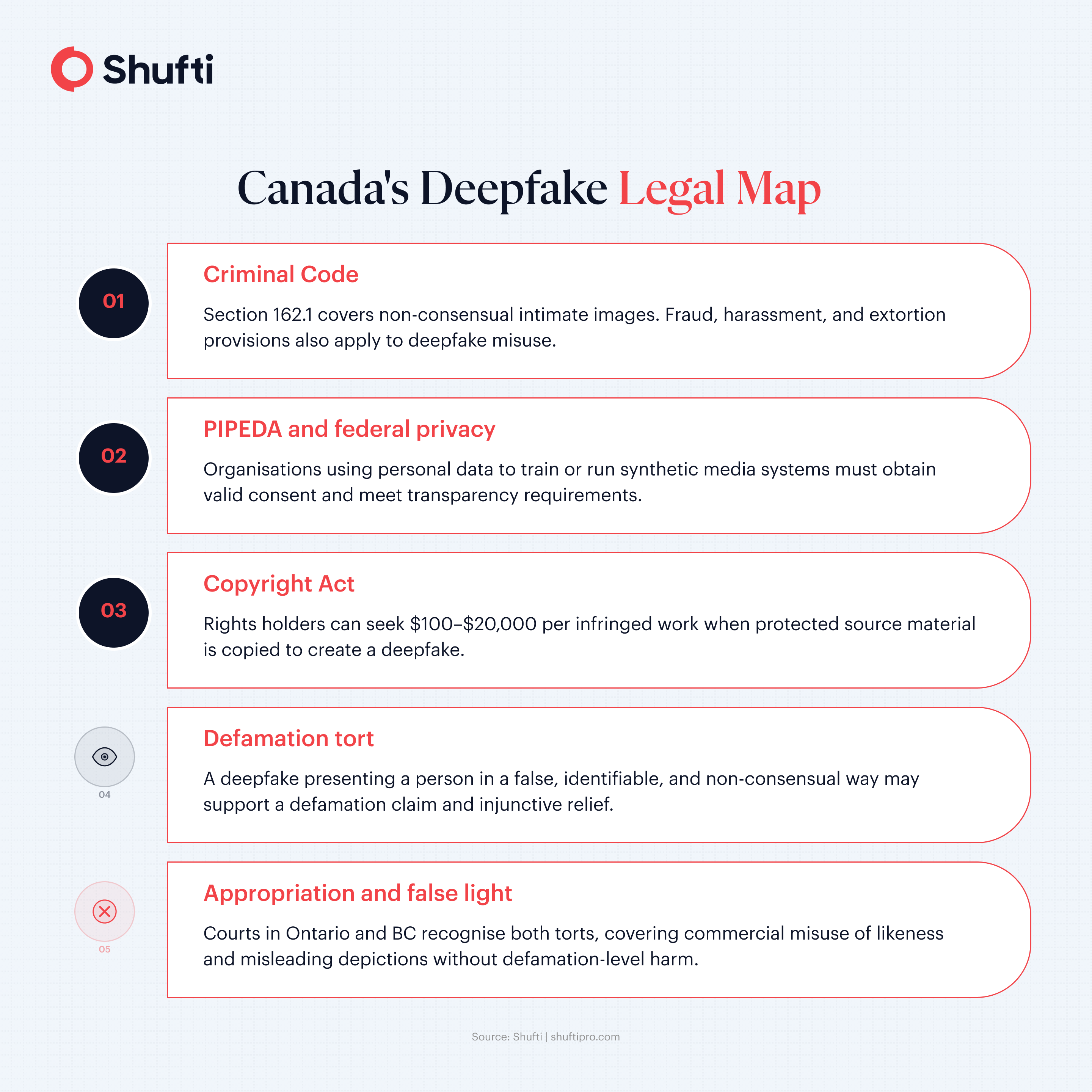
The Criminal Code of Canada contains no specific deepfake offence, but existing provisions reach several common misuse patterns. Section 162.1 criminalises the non-consensual distribution of intimate images, and courts have interpreted “image” broadly enough to capture AI-generated depictions of real individuals. The synthetic origin of the content does not constitute a defence once a prosecutor establishes that distribution was non-consensual and the depiction is recognisably of the victim.
Deepfakes used in fraud also attract liability under the Criminal Code’s fraud and false pretences provisions. The February 2024 incident in which a finance worker was deceived into wiring $25 million via a deepfake video call illustrates the mechanism that Canadian risk teams now treat as a live domestic threat.
A technical review of the deepfake-as-a-service tools lowering the barrier to such attacks shows why the legal exposure has grown faster than most organisations anticipated. Criminal harassment and extortion provisions apply where deepfakes are used as instruments of coercion.
Online Harms Legislation Status
Canada’s legislature attempted to consolidate deepfake protections under Bill C-63, the Online Harms Act, introduced in February 2024. The bill would have created explicit platform duties to remove non-consensual intimate content, including synthetic deepfakes. It died on the Order Paper when Parliament dissolved in January 2025.
The successor government introduced Bill C-16 in late 2025, specifically targeting non-consensual synthetic intimate images as a distinct criminal offence. As of April 2026, Bill C-16 has not received Royal Assent. Businesses relying solely on federal criminal deterrence as their compliance posture are operating on incomplete ground.
How does Canadian Privacy Law Apply to Deepfakes?
The deepfake privacy laws in Canada extend the legal exposure well beyond the Criminal Code. Canada’s federal private-sector privacy law and its provincial equivalents impose distinct obligations on businesses that collect, use, or process content involving real individuals.
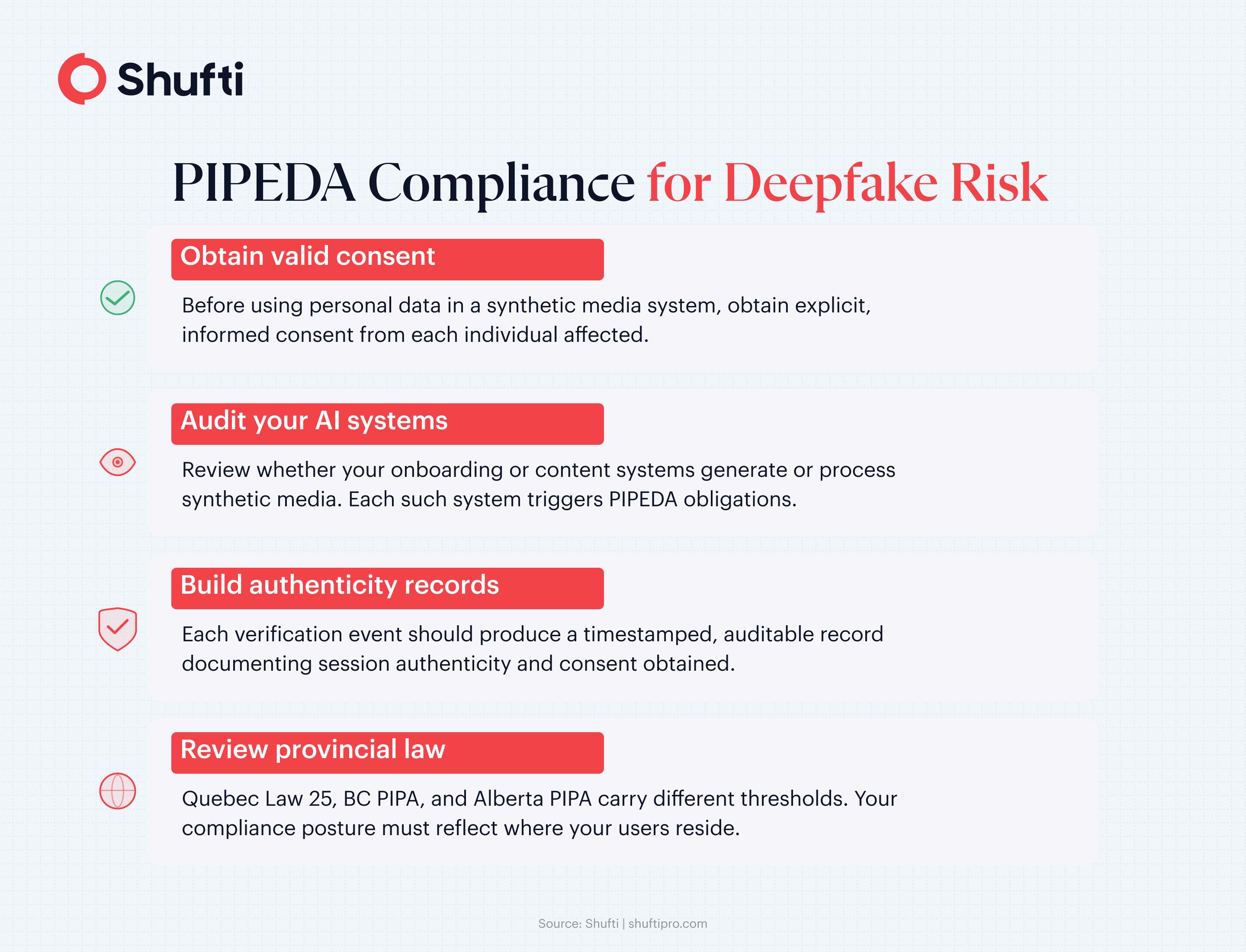
Whether a business is training a synthetic media system, reviewing AI-generated onboarding submissions, or hosting user-generated content, it may have consent, transparency, and data-handling obligations under one or more of these statutes.
PIPEDA Obligations for Businesses
The Personal Information Protection and Electronic Documents Act (PIPEDA) governs how private-sector organisations collect, use, and disclose personal information in the course of commercial activity across most of Canada.
The Canadian Digital Regulators Forum’s September 2025 synthetic media paper confirmed that any organisation using personal information to train or operate a synthetic media system, including one capable of generating deepfakes, is subject to PIPEDA’s consent and transparency requirements.
A widely held misconception is that publicly available images and videos are fair game for AI training datasets. The Office of the Privacy Commissioner of Canada has stated clearly that online availability does not make personal information freely usable for commercial purposes. As of January 2026, the Privacy Commissioner opened an investigation into a major social media platform over AI-generated deepfake images, confirming that regulatory investigation is an active risk, not a theoretical one.
Provincial Privacy Law Variations
Quebec’s Act Respecting the Protection of Personal Information in the Private Sector (Law 25) came into full effect in 2023 and applies stricter consent and transparency rules than federal PIPEDA to any enterprise handling the personal information of Quebec residents.
British Columbia’s Personal Information Protection Act (PIPA) explicitly includes “altered” images in its definition of intimate images as of 2025, covering AI-generated deepfakes within its non-consensual sharing provisions. Alberta’s legislature is expected to announce material amendments to its own PIPA in 2026, including stronger enforcement mechanisms and clearer obligations around de-identified data.
Businesses operating across provincial lines face different consent thresholds and different definitions of harm depending on where their customers reside.
What Civil Remedies are Available When Criminal Law Falls Short?
Many deepfake victims find no criminal provision applies to their situation. The harm may not be sexual in nature. The content may not have been shared with third parties. Canada’s civil law provides several alternative paths to redress, each with a different threshold of proof and a different range of remedies. Businesses that rely on remote identity verification face direct exposure, since civil and regulatory claims both turn on whether the verification process was adequate.
Copyright Act and Defamation
Canada’s Copyright Act protects original works, including videos and photographs. Where a deepfake is created by copying protected source material without authorisation, Canada’s Copyright Act allows the original rights holder to seek damages of $100 to $20,000 per infringed work, or actual proven losses if higher. Courts may also grant injunctive relief preventing further distribution.
Defamation provides a separate pathway. A deepfake that presents a real person as performing an act they did not perform, without any disclaimer establishing the content as synthetic, may constitute a false statement of fact.
Claimants can seek general and special damages, and courts have issued injunctions preventing further distribution of such content. Where a disclaimer is present and the synthetic nature is clearly communicated, a defamation claim is less likely to succeed.
Appropriation of Personality and the Tort of False Light
Ontario and British Columbia courts have recognised the tort of appropriation of personality, which applies when a person’s likeness is used commercially without their consent. A deepfake that uses a real person’s face to endorse products or deliver messages the person never authorised can attract liability under this doctrine. Some provincial privacy statutes also explicitly address commercial exploitation of a person’s image.
Courts in Ontario and British Columbia have also adopted the tort of false light, which protects individuals from content that, while not technically defamatory, casts them in a misleading and objectionable way.
For businesses whose executives have been impersonated in synthetic media, or whose brand has been associated with fabricated statements, this tort provides a distinct route to damages that does not require proof of reputational harm at the level defamation demands.
How Shufti Helps Businesses Manage Deepfake Compliance Risks
The legal obligations above share a practical implication. Businesses that cannot reliably distinguish a real person from a synthetic one cannot demonstrate that their onboarding or identity verification processes meet the standard the law now demands. That gap is technical as much as it is legal.
Shufti’s deepfake detection capability covers 56 anti-spoofing attack vectors, including AI-generated faces, 3D masks, and video replay attacks. Each check produces a timestamped, auditable verification record that documents the authenticity of the person behind the session.
This is a concrete output compliance teams can reference when regulators or civil litigants ask whether the onboarding process met the consent and identity verification standard Canada’s deepfake regulations now expect.
Shufti’s face verification uses active and passive liveness detection to confirm physical presence, not a recorded or synthetic substitute. As the DHS RIVR 2025 top performer, Shufti’s biometric accuracy is government-validated across diverse demographics, not self-reported.
For a compliance team building an audit-ready response to Canadian deepfake laws, that distinction makes the difference between a defensible process and an exposed one.
Canada’s deepfake laws create multiple pathways to liability without providing a unified compliance framework, and the gap between what the law expects and what verification systems can actually demonstrate is where the real risk sits. Shufti closes that gap with deepfake detection and liveness verification that produces an auditable record of every onboarding session. Request a demo to see how the pipeline runs on your own verification volumes.
Frequently Asked Questions
Q: What laws apply to deepfake videos in Canada?
As of April 2026, Canada has no single deepfake law. Relevant frameworks include Criminal Code provisions for fraud, harassment, and non-consensual intimate images, federal and provincial privacy laws for data handling, and civil torts covering defamation, copyright, and appropriation of personality.
Q: How do privacy laws apply to deepfakes in Canada?
Federal privacy law PIPEDA requires valid consent before using personal information to train or operate synthetic media systems. The Office of the Privacy Commissioner confirmed in January 2026 that online availability of images does not make them freely usable for deepfake generation. Quebec's Law 25 adds stricter requirements for Quebec residents.
Q: How are deepfake crimes prosecuted in Canada?
Canada has no specific deepfake criminal offence as of April 2026. Prosecutors use existing provisions covering non-consensual intimate image distribution, fraud, criminal harassment, and extortion. Bill C-16 would add an explicit offence targeting synthetic intimate images, but has not yet received Royal Assent.
Q: What should businesses do to comply with Canada's deepfake regulations?
Audit identity verification processes to confirm they can detect synthetic media. Review data handling under PIPEDA and applicable provincial privacy laws before using personal information in AI systems. Ensure onboarding generates auditable authenticity records that document consent and verification outcomes. CMS Note: FAQPage schema markup.