AMLR Solutions
  AMLR Consultation
 EUDI Wallet
 Onboarding
 Ongoing Monitoring
 FRAML
FRAML KYC
KYC KYB
KYB KYI
KYI Age Assurance
 Workforce IAM
 Candidate Verification
 Account Takeover
 Bonus/ Promotion Abuse
 Chargeback Fraud
 Deepfake
 Document Fraud
 Fraud Networks
 Impersonation Fraud
 Money Mule Activity
 Multi-Accounting
 Party Fraud
 Regulatory & Compliance Risks
 Synthetic Identity Fraud
 Adult Content
 Banking
 Crypto
 Fintech
 Forex
Forex Compliance
 Fraud prevention
 Trust & safety
 Global expansion
 Compliance Officers
 Developers
 Fraud Analysts
 Product Managers
 Journey Builder
  Global Trust Platform
 Customer Profiles
 Vendor Comparison
 IDV Case Management
 AML Case Management
 Regulatory Reporting
 Agentic Rule Builder
  AI Compliance Co-Pilot
  Fraud Analytics
 Fraud Hub
  OCR
OCR Shufti AI
 Bank Account Verification
  Biometric Duplication
 Database Checks
 Document Intelligence
 Government ID
 Mobile Driver's License
 NFC
NFC Selfie Liveness
 Brand Personalisation
 Deployment Options
 Identity Methods
 IDV Modes
 Multi-tenancy
 On-Premise IDV
 Secure Capture
 Shufti MCP















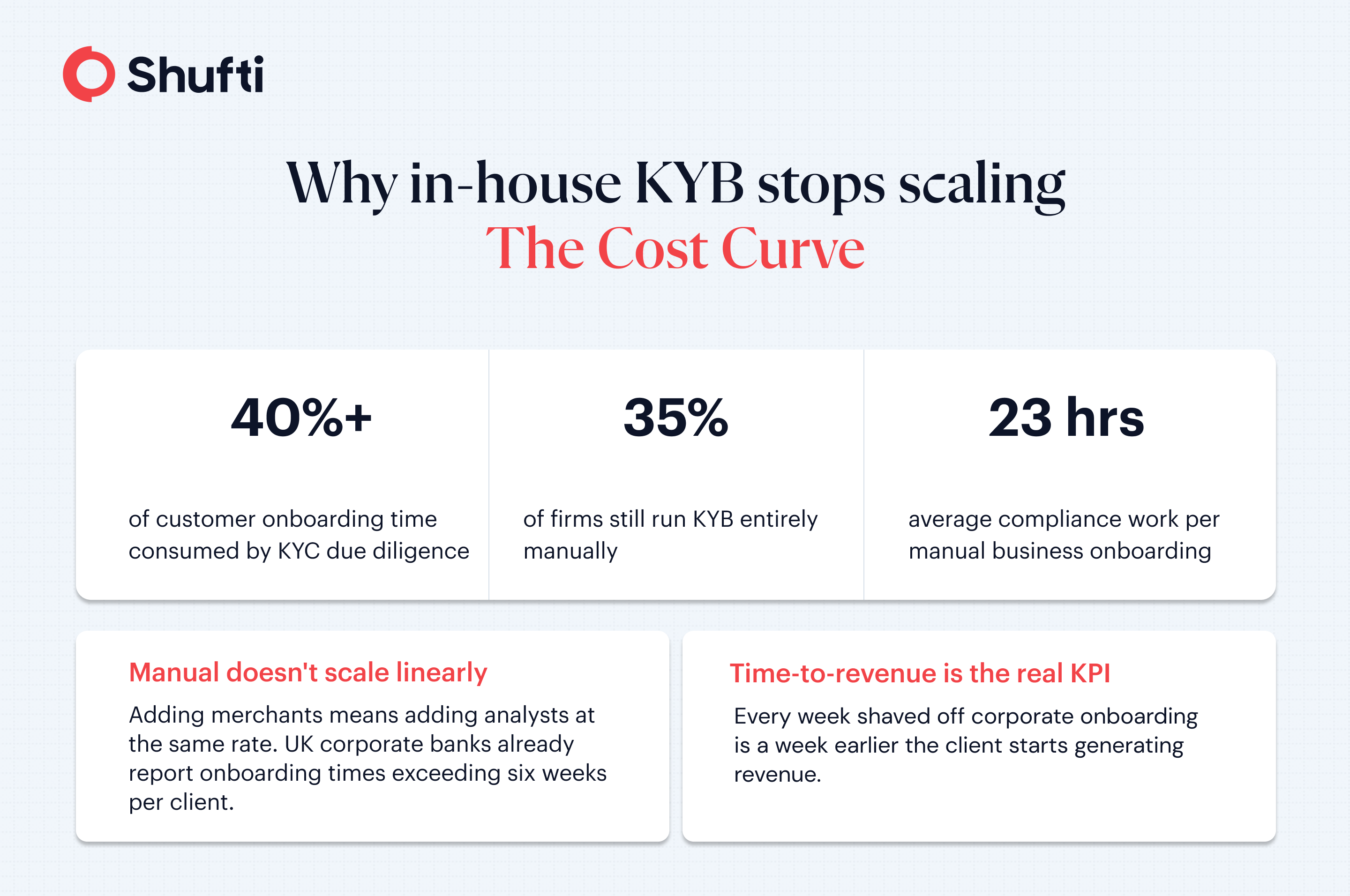
Most compliance leaders don’t go looking for “KYB as a service” because they read a trends report. They go looking because their onboarding backlog has quietly become a client-retention problem. A prospect signs up, the business verification takes three weeks, and by the time the account is live, the merchant has already gone elsewhere. McKinsey’s research on corporate banking onboarding notes that more than 40% of the time a customer spends onboarding is consumed by KYC due diligence and account opening, and that time-to-revenue has become one of the metrics senior banking leaders track most closely. The economics of doing KYB in-house stopped working somewhere on that curve.
This is a practitioner guide to KYB as a Service (KYBaaS): what it actually delivers, why teams move to it after running manual or in-house workflows, what the 2026 regulation is doing to the buy vs. build math, and how to evaluate a provider without getting lost in demo theater.
What is KYB as a Service?
KYB as a Service is a managed model for business verification service where a provider runs the full workflow of company registry lookups, ultimate beneficial owner (UBO) traversal, director and UBO identity verification, business AML screening against sanctions and PEP lists, and ongoing monitoring through a single KYB API or dashboard. The obliged entity keeps regulatory responsibility; the provider keeps the registry integrations, data refresh cadence, and jurisdictional logic maintained.
The practical test: If your compliance team no longer has to know that Italy’s company registry responds differently from Kyrgyzstan’s or that the UK’s Persons of Significant Control register needs reconciling against Companies House filings, you’re using KYBaaS.
KYBaaS is distinct from a point tool (one data feed, one jurisdiction) and from a DIY build (your engineers maintain registry connectors and your compliance analysts reconcile the output). It is also distinct from outsourced manual review. The “as a service” model is automated by default, with human review escalated only on exceptions.
Why teams move off manual or in-house KYB?
The buying trigger is usually not regulation. It’s operational math that stopped adding up.
Manual workflows don’t scale linearly. Industry research covered by fintech global reported that 35% of firms still rely entirely on manual KYB processes, with average business onboarding consuming roughly 23 hours of compliance work per case and UK corporate banks taking more than six weeks per client. Hitting a growth target of 500 new merchants a quarter under that model means hiring analysts at the same rate.
In-house builds hit a different wall. What starts as “we’ll integrate Companies House” becomes a multi-year roadmap once the coverage expands: Handelsregister in Germany, Crossroads Bank in Belgium, BRIS at the EU layer, APAC registries that publish in local scripts, MENA registries that require bilateral agreements. Public-registry APIs are inconsistent, update cadences differ, and UBO ownership chains routinely cross three or four jurisdictions before hitting a natural person.
The signals from compliance teams evaluating Know Your Business solutions are remarkably consistent. One payments platform described UBO and director identification as “the biggest friction point currently,” driven by the lack of automated public registry checks across the jurisdictions they operate in. Another cross-border platform said it bluntly: “Each country has a different set of KYB. For each jurisdiction, we’d like that country’s particular KYB process to be done.” Those are workflow complaints, not regulation complaints, and they are the reason the managed model wins.
What most buy-vs-build analyses miss is that a faster, higher-accuracy KYB workflow doubles as a revenue lever. Every week, shaved-off corporate onboarding is a week earlier, a merchant transacts, a B2B client funds, or a partner goes live. The 40% share of onboarding time lost to Know Your Customer cited above is a growth problem that compliance is accidentally causing.
Regulatory pressure is accelerating the shift
Beneficial-ownership transparency is converging globally, and the compliance obligations are shifting from “collect documents” to “demonstrate continuously verified data.”
FATF Recommendation 24 requires jurisdictions to ensure competent authorities can access adequate, accurate, and up-to-date beneficial ownership information and takes a “multi-pronged approach,” meaning obliged entities cannot rely on a single registry. In the EU, the AMLA Single Rulebook becomes directly applicable on 10 July 2027, with AMLA finalising CDD and KYB technical standards through 2026. The rulebook removes national-transposition variability, so the same KYB standard will apply from Dublin to Sofia.
The US picture is more fragmented. FinCEN’s March 2025 interim final rule removed beneficial-ownership reporting obligations for US-formed companies while preserving them for foreign reporting companies registered to do business in the US. The UK’s Economic Crime and Corporate Transparency Act continues to widen Companies House verification powers on the other side of the Atlantic.
The takeaway for a KYBaaS evaluation: the provider’s value increasingly lives in how fast it absorbs these shifts, so your team doesn’t have to. An in-house build inherits each of them as an engineering ticket.
How to evaluate a KYB service provider?
Five criteria tend to decide deals, based on what compliance teams ask for when they shortlist a KYB compliance solution.
Jurisdictional coverage depth, not just country count: A provider claiming “240+ countries” may only support a primary registry in 40 and fall back to static datasets elsewhere. Ask for the registry refresh cadence by country and which jurisdictions require a document-based fallback.
UBO traversal depth: Does the provider automatically walk the ownership chain to the natural-person layer (including across cross-border holding structures) or stop at the first corporate parent? The 25% threshold is standard, but the engineering behind it varies wildly.
Integrated business AML screening: If business AML screening against sanctions, PEPs, and adverse media is a separate vendor, you’ve swapped one stack for two. Demand one workflow.
SLAs that match your volume shape: A provider built for tier-one banks often has commercial floors that don’t fit a scaling fintech. Likewise, a provider optimised for SME volume may not have SLAs that survive a tier-one RFP. Ask for response time and uptime SLAs and the contract shape (usage-based, tiered, or annual minimum).
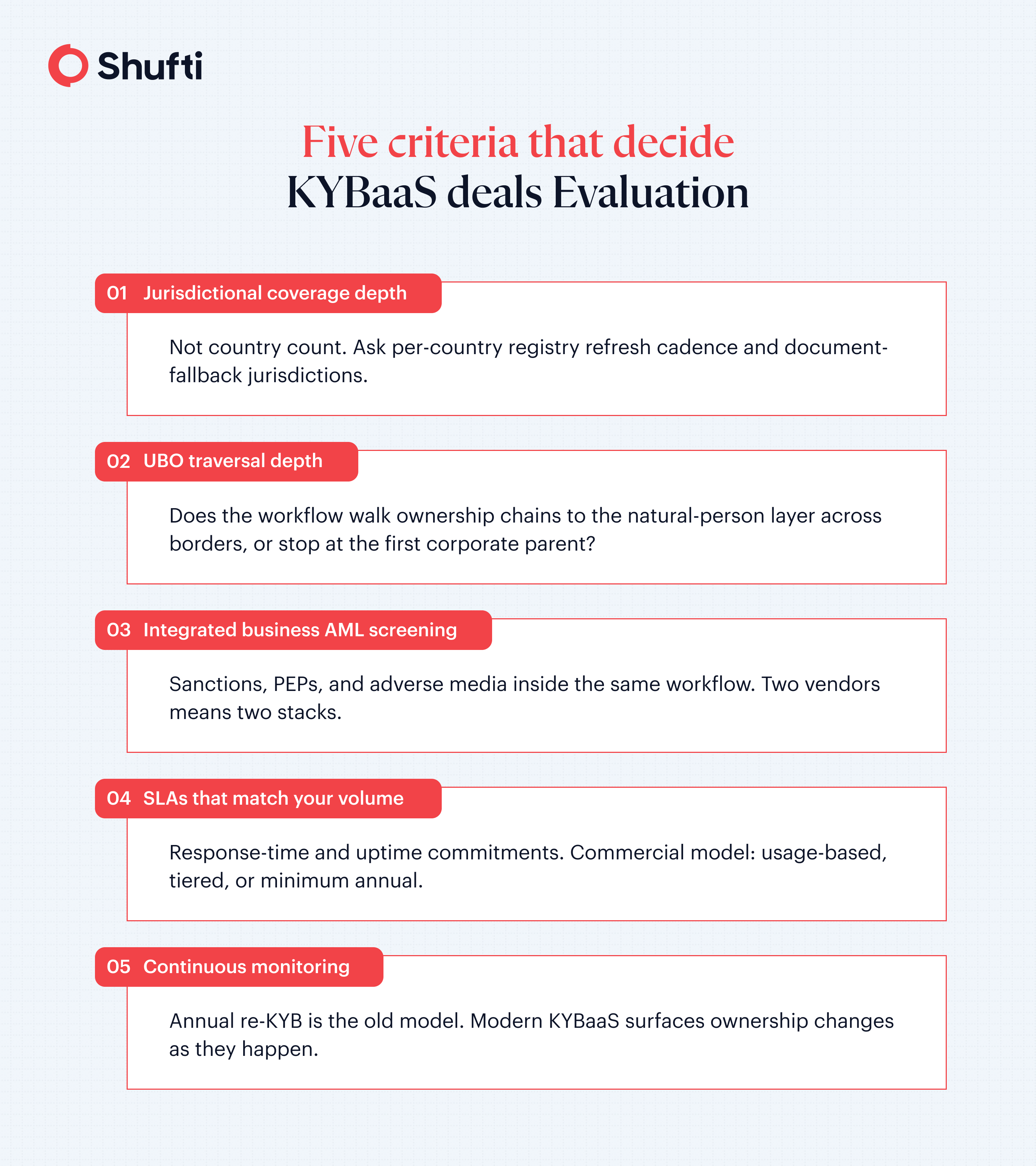
Continuous monitoring, not batch re-verification: Annual re-KYB is the old model. Modern KYBaaS runs continuous checks against registry updates, sanctions changes, and adverse media, surfacing changes in ownership structure as they happen rather than at the next review cycle.
How Shufti deliver KYB as a Service?
Shufti’s Know Your Business solution is built for the multi-jurisdiction reality most of the above criteria describe. Coverage spans 240+ countries through a single API, with automated UBO traversal and the director/UBO KYC step running on the same platform, so identity verification of the natural persons behind the entity doesn’t require a second integration.
Business AML screening, sanctions and PEP checks, and adverse media review run inside the same workflow, with data refreshed every 15 minutes across 3,500+ global watchlists. For fintech platforms onboarding merchants across Europe, APAC, or MENA, that means one contract, one API, and one compliance dashboard rather than a stitched vendor stack. The commercial model is usage-based, which matters for teams validating early-stage volume before committing to enterprise floors.
Ready to replace manual KYB with a managed service?
If your team is spending compliance hours on registry lookups and UBO traversals, that’s time that could be spent on genuine risk review. Request a demo of Shufti’s KYB as a Service and see how a single KYB API covers the jurisdictions, UBO chains, and AML checks your current stack stitches together.
Frequently Asked Questions
How does outsourced KYB verification work?
The provider ingests the business name or registration number, pulls verified data from the relevant company registry, walks the ownership chain to identify UBOs and directors, runs identity verification on those natural persons, and screens the entity and its UBOs against sanctions, PEPs, and adverse media. The result returns through an API call or dashboard record.
Is KYB as a Service suitable for fintechs?
Yes. Fintechs are among the heaviest users. Scale, multi-jurisdiction coverage, and the need to bundle KYB with director/UBO KYC make the managed model especially well-suited to fintechs, neobanks, crypto exchanges, and payments platforms.
What are the benefits of managed KYB over in-house compliance?
Faster onboarding (hours instead of weeks), no registry-integration engineering burden, automatic absorption of regulatory changes like the EU AMLR, built-in continuous monitoring, and a single vendor relationship covering KYB plus business AML plus UBO identity verification.
Can KYB as a Service scale with business growth?
Yes. The usage-based commercial model is specifically designed for that. A platform moving from 10 to 1,000 business checks per month uses the same API, the same dashboard, and the same contract structure. Scaling becomes a capacity question, not a reintegration project.