




 Face Verification
 Address Verification
 Document Verification
 Age Verification
 VideoIdent
 Fast ID
 Docless Verification
 Consent Verification
 NFC Verification
 Business Verification
 Due Diligence
 Investor Verification
 E-Signature

 QES
QES
 AML Screening
 Transaction Monitoring
 Adverse Media
 Business AML Screening
 PEP & RCA
 Sanctions
 Watchlist
 Behavioural Biometrics
 Device Fingerprinting
 Biometric Face Authentication
 MFA
MFA
 Fraud Hub
 Onboarding
 Ongoing Monitoring
 KYC
KYC
 KYB
KYB
 KYI
KYI
 Age Assurance
 Identity Verification
 Workforce IAM
 Candidate Verification
 Compliance
 Fraud prevention
 Trust & safety
 Global expansion
 Product Managers
 Compliance Officers
 Fraud Analysts
 Developers
 Deepfake Detection
 Bonus Abuse / Promotion Abuse
 Account Takeover
 Synthetic Identity Fraud
 Document Fraud
 Impersonation Fraud
 Multi-Accounting
 Fraud Networks
 Chargeback Fraud
 Money Mule Activity
 Party Fraud
 Regulatory & Compliance Risks
 Fintech
 Crypto
 iGaming
 Forex
Forex
 Social Network
 Marketplace
 Banking
 Gig Economy
 Payments
 Ride Hailing
 Adult Content
 Blind Spot Audit
 Deepfake Detector
 Liveness Spoofs
 Document Originality
 Document Deepfake
 Global Trust Platform
 Journey Builder
 Case Management
 Shufti AI
 Fraud Analytics
 Vendor Comparison
 Brand Personalisation
 AI Compliance Co-Pilot
 OCR
OCR
 Secure Capture
 Deployment Options
 Identity Methods
 API Documentation
 Mobile SDKs
 Service Status
 Help Center
 Contact Us
 Technical Support
 Supported Documents
 Supported Countries
 Content library
 Blogs
Blogs
 News
News
 Reports
 Insights
 Knowledgebase
 ROI calculator
 About
About
 Career
 Press Release
 Certifications
 Partnership
 Awards
 Events & Webinar
 Interactive Demo
 Podcast Studio
 Spotlight Studio
The Shift to Digital Proof of Age: What It Means for Online Sellers

-
Add us as a Preferred Source
- 01 What is digital proof of age, and how does it differ from an ID upload?
- 02 What are the three forces reshaping age assurance for sellers?
- 03 What the EU Digital Identity Wallet means for online sellers
- 04 Are you ready for digital proof of age?
- 05 How Shufti helps online sellers handle digital proof of age
On 15 April 2026, the European Commission declared its age verification solution technically ready for national rollout, with seven member states already in the pilot programme and the EU Digital Identity Wallet (EUDI Wallet) required to reach citizens by December 2026. For online sellers in age-restricted categories including alcohol, gambling, adult content, and tobacco, the question is no longer whether digital proof of age is coming. The question is how much of your current verification setup will need to change, and when. Age verification is moving away from document upload and toward cryptographic credentials, and the operational implications for sellers are real and near-term.
Digital proof of age is a cryptographically verifiable credential stored on a user’s device that confirms a person meets a specified age threshold without transmitting their date of birth, ID document number, or any other identifying detail to the seller’s platform.
What is digital proof of age, and how does it differ from an ID upload?
Most sellers verify age today by asking the user to photograph a government-issued ID, which an automated system reads, matches to a live selfie, and returns a pass or fail. The seller’s system receives a copy of the identity data. That creates storage liability, General Data Protection Regulation (GDPR) complexity, and the checkout friction that drives abandonment before a purchase is completed. The data privacy implications of age verification are distinct between a flow that stores identity data and one that receives only a cryptographic confirmation.
Digital proof of age inverts this relationship. The user’s credential lives on their own device, issued by a trusted authority such as a government-approved identity wallet, a bank, or a certified verification provider. When a seller requests proof of age, the device generates a cryptographic response confirming the user is above the required threshold. The seller receives a pass or fail signal. No names, dates of birth, or document scans reach the seller’s systems.
The data liability distinction matters because it changes what your systems touch. Where document upload requires identity data to transit your systems, a credential-based check keeps that data on the user’s side. What your platform receives is a confirmation, not a file. Sellers with GDPR obligations will find this directly relevant as regulators update their compliance expectations around the new technical standards.
What are the three forces reshaping age assurance for sellers?
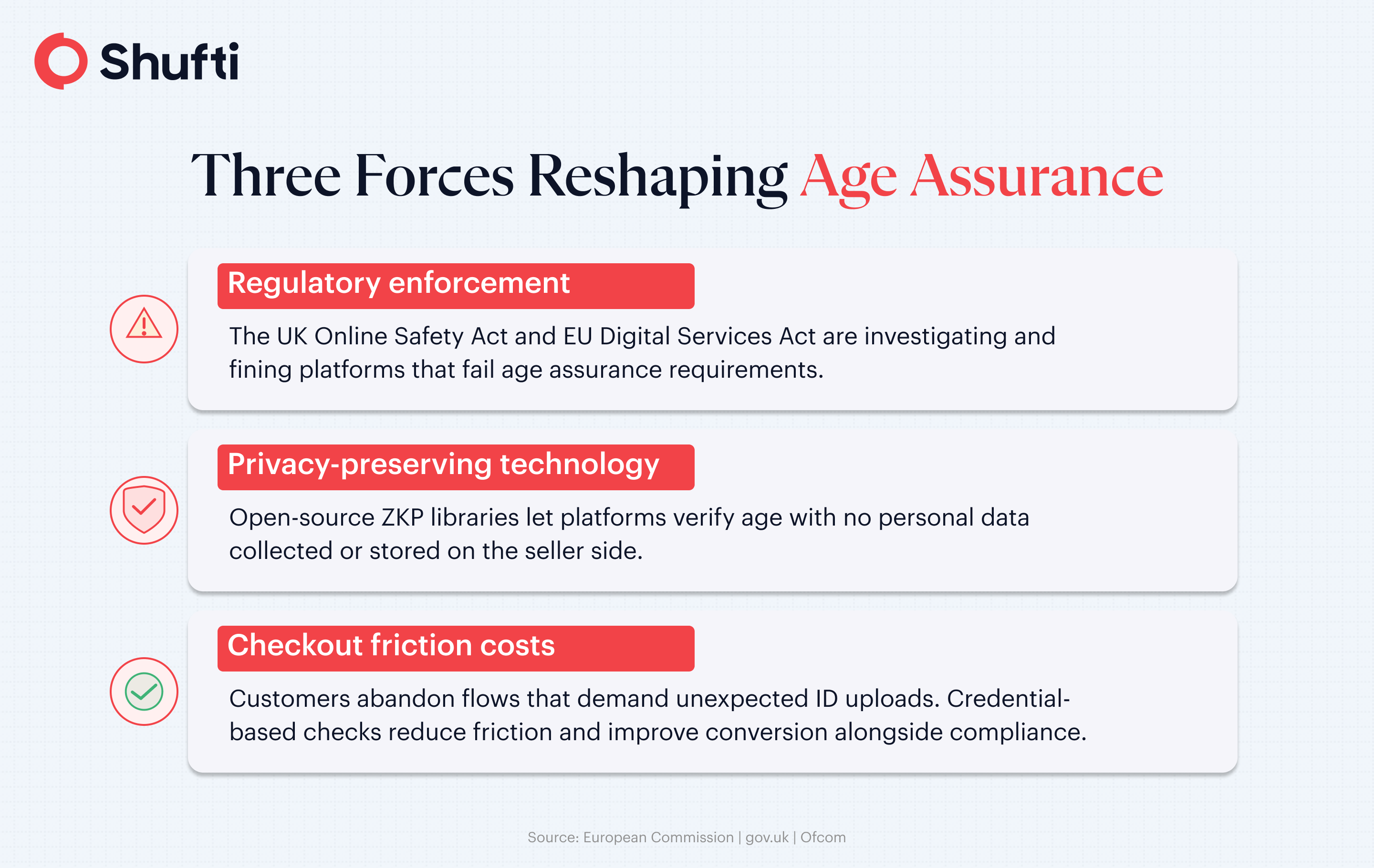
Three pressures are converging in 2026, each moving at a different speed but all pointing toward the same destination. Regulatory mandates are setting hard deadlines. Technology has made privacy-preserving checks deployable rather than theoretical. And buyers are abandoning checkout flows that ask for more data than they think is necessary.
Regulatory pressure tightening from both ends
The UK Online Safety Act required platforms to implement age assurance for harmful content categories from 25 July 2025. By early 2026, Ofcom had opened investigations into 92 online services under the age assurance enforcement programme and fined three providers for non-compliance. The EU Digital Services Act (DSA) runs parallel proceedings, requiring very large platforms to assess and mitigate systemic risks including exposure of minors to harmful content. Both regimes are escalating, and the enforcement gap between early action and widespread compliance is closing.
Technology has made privacy-preserving age checks deployable
Zero-knowledge proofs (ZKPs) allow a user to prove a fact about themselves, such as being over 18, without revealing the underlying data. The concept has existed in research for decades. By 2025, open-source ZKP libraries had made the technology available for platforms and sellers to integrate without building the cryptographic layer from scratch. Age checks that collect nothing beyond a binary confirmation are now a practical option, not a distant roadmap item.
Buyers are pushing back on ID collection at checkout
Consumer friction at traditional age gates is measurable. When a checkout flow asks a user to photograph an ID they were not expecting to provide, abandonment rises. That dynamic gave independent momentum to privacy-preserving alternatives, separate from regulatory pressure. The result is a market where sellers who offer lower-friction, credential-based age checks will see conversion benefits alongside compliance ones.
What the EU Digital Identity Wallet means for online sellers
The EUDI Wallet, mandated under the Electronic Identification, Authentication and Trust Services Regulation (eIDAS 2.0), will hold legally binding identity and age credentials for citizens across all EU member states. Member states must make at least one EUDI Wallet available to their citizens by December 2026. For online sellers, this creates a concrete obligation. Your verification infrastructure will need to accept wallet-based attestations as a legally valid age proof, not only document scans. The seven pilot member states, France, Denmark, Greece, Italy, Spain, Cyprus, and Ireland, are already testing technical integration paths for platforms under real conditions as of April 2026.
The UK parallel: PASS Digital
In the UK, the Proof of Age Standards Scheme (PASS) has launched a digital variant, already being rolled out across UK retail and hospitality. Under amended Mandatory Licensing Conditions, UK sellers can now accept digital proof of age without requiring a physical document bearing an ultraviolet mark or hologram. A user proves their age through a certified app, which generates a signed QR code. The licensee validates it with a reader or till system and receives only confirmation that the user meets the age requirement. Sellers in alcohol, tobacco, and entertainment categories should review UK age verification compliance requirements and verify whether their current vendor supports PASS Digital, since a physical-document-only flow will not satisfy compliance for much longer.
The ISO standard online sellers should reference
ISO/IEC 27566-1:2025, the first international framework for age assurance systems, was published in December 2025. The standard covers effectiveness, privacy, accessibility, security, and interoperability across providers, intermediaries, and the businesses that accept age proofs, a category that includes online sellers. Rather than mandating a specific technology, it provides a structured framework for evaluating whether an age assurance approach meets the threshold regulators are likely to apply. Sellers should check their verification vendor against this standard before the EUDI Wallet deadline arrives.
Are you ready for digital proof of age?
Most sellers in age-restricted categories built their current compliance flow around document upload and manual or automated ID checks. The transition to credential-based verification requires changes at several points in your stack, and the window before EUDI Wallet rollout creates a compliance obligation is narrowing.
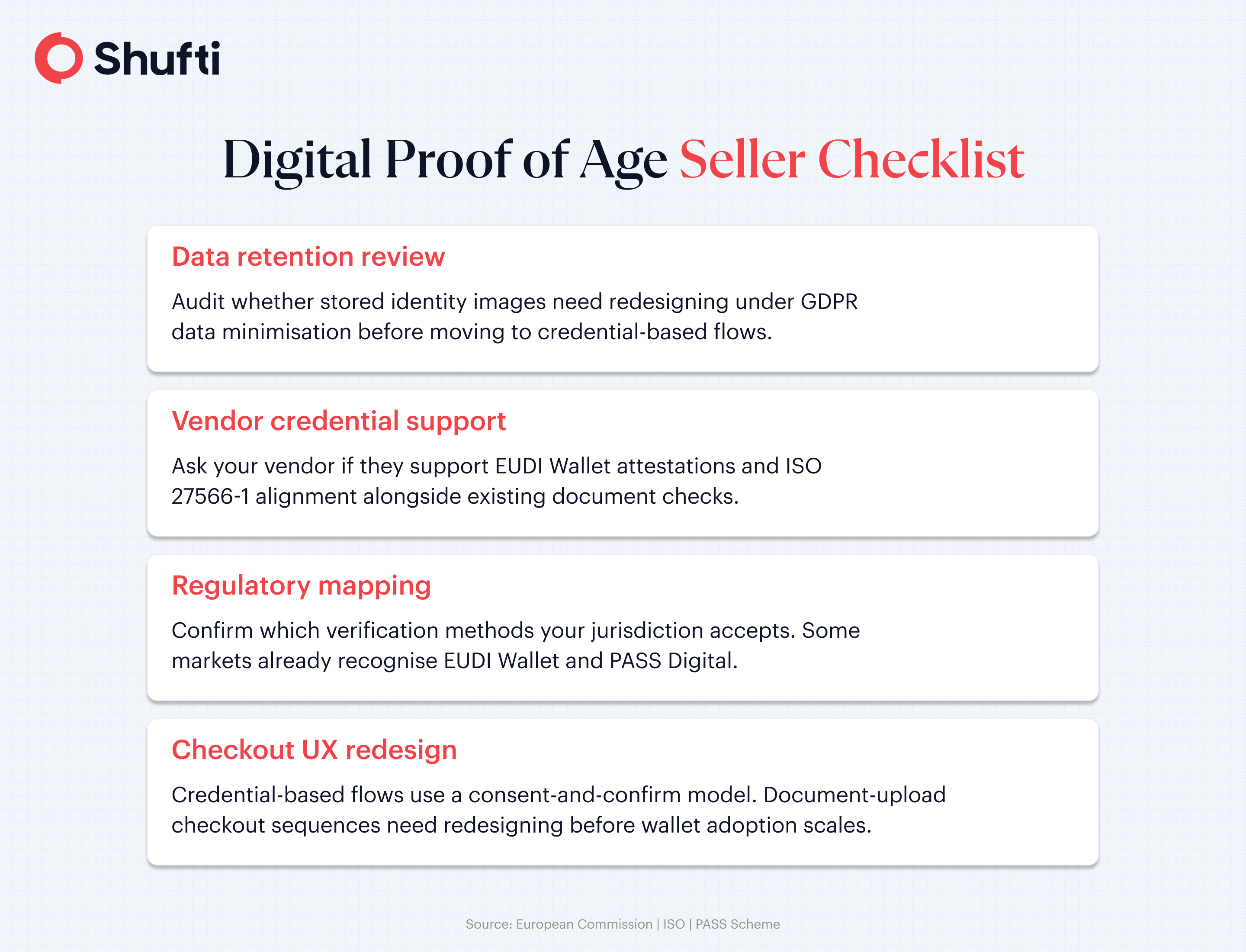
Start with your data retention policy. If your current flow stores identity images or extracted document data, a credential-based system may require you to redesign what your platform holds under GDPR’s data minimisation requirements.
Your verification vendor is the next variable to examine. Document-based vendors that have not added wallet or credential support will leave a gap in your coverage as EUDI Wallet adoption grows across EU member states. Ask specifically whether they support ISO/IEC 27566-1 alignment.
Review the age verification requirements governing your product category and jurisdiction. Some national implementations already reference EUDI Wallet and PASS Digital as accepted methods, while others are still updating their frameworks.
Checkout UX is the final gap most sellers overlook. A credential-based flow asks users to authenticate from a wallet app. If your current checkout assumes a document-upload sequence, the user experience will need redesigning around a consent-and-confirm model.
How Shufti helps online sellers handle digital proof of age
The transition from document-based to credential-based age assurance does not happen overnight. For most sellers, the near-term reality is running both flows in parallel while EUDI Wallet adoption scales and regulators confirm which credential standards they will formally recognise.
Shufti’s age verification covers both sides of that transition. On the document side, the verification library spans over 10,000 document types across 230 countries, with approval from Germany’s Commission for Youth Media Protection (KJM) and iBeta Level 1, 2, and 3 certification for liveness detection. That coverage means sellers meeting today’s document-upload requirements are not left without a compliant option while credential-based flows mature.
For sellers who want to understand how their current setup maps to the 2026 compliance timeline, Shufti has published a detailed guide on reusable age verification covering how credential-based flows interact with existing verification systems and what sellers need to consider before the switch.
Online sellers managing age-restricted products are navigating a window where document-based flows remain mandatory today and credential-based flows are quickly becoming expected. Shufti’s age verification runs across 10,000-plus document types today and is built to support the credential-based standards taking hold across the EU and UK from 2026 onwards. Book a demo to review your current age verification setup against the 2026 compliance timeline.
Frequently Asked Questions
What is digital proof of age and how is it different from uploading an ID?
Digital proof of age is a verifiable credential stored on a user's device that confirms an age threshold without transmitting personal data or identity documents to the seller. Traditional ID upload requires the seller to receive and process identity data. A credential-based check keeps that data on the user's side.
What is the EU Digital Identity Wallet and how does it relate to digital proof of age?
The EU Digital Identity Wallet is a government-issued mobile credential mandated under eIDAS 2.0 and required to be available to citizens across all EU member states by December 2026. It can carry age attestations that online sellers will need to accept as a legally valid form of age proof.
What is a zero-knowledge proof of age?
A zero-knowledge proof of age is a cryptographic method that allows a user to confirm they meet an age threshold, such as being over 18, without revealing their actual date of birth or any other personal data to the party requesting the check.
What is ISO/IEC 27566-1:2025 and does it replace PAS 1296?
ISO/IEC 27566-1:2025 is the first international framework for age assurance systems, published in December 2025 and freely available. It does not directly replace PAS 1296 but provides a broader international standard that regulators across multiple jurisdictions are using as their reference point for compliance assessment.
Does digital proof of age satisfy GDPR data minimization requirements?
A credential-based age check that returns only a pass or fail aligns with GDPR's data minimisation principle because the seller receives no identity data beyond the confirmation itself. Sellers accepting credentials rather than processing identity documents generally carry less data liability than those running document-upload flows.