





 Face Verification
 Address Verification
 Document Verification
 Age Verification
 VideoIdent
 Fast ID
 Docless Verification
 Consent Verification
 NFC Verification
 Business Verification
 Due Diligence
 Investor Verification
 E-Signature

 QES
QES
 AML Screening
 Transaction Monitoring
 Adverse Media
 Business AML Screening
 PEP & RCA
 Sanctions
 Watchlist
 Behavioural Biometrics
 Device Fingerprinting
 Biometric Face Authentication
 MFA
MFA
 Fraud Hub
 Onboarding
 Ongoing Monitoring
 KYC
KYC
 KYB
KYB
 KYI
KYI
 Age Assurance
 Identity Verification
 Workforce IAM
 Candidate Verification
 Compliance
 Fraud prevention
 Trust & safety
 Global expansion
 Product Managers
 Compliance Officers
 Fraud Analysts
 Developers
 Deepfake Detection
 Bonus Abuse / Promotion Abuse
 Account Takeover
 Synthetic Identity Fraud
 Document Fraud
 Impersonation Fraud
 Multi-Accounting
 Fraud Networks
 Chargeback Fraud
 Money Mule Activity
 Party Fraud
 Regulatory & Compliance Risks
 Fintech
 Crypto
 iGaming
 Forex
Forex
 Social Network
 Marketplace
 Banking
 Gig Economy
 Payments
 Ride Hailing
 Adult Content
 Blind Spot Audit
 Deepfake Detector
 Liveness Spoofs
 Document Originality
 Document Deepfake
 Global Trust Platform
 Journey Builder
 Case Management
 Shufti AI
 Fraud Analytics
 Vendor Comparison
 Brand Personalisation
 AI Compliance Co-Pilot
 OCR
OCR
 Secure Capture
 Deployment Options
 Identity Methods
 API Documentation
 Mobile SDKs
 Service Status
 Help Center
 Contact Us
 Technical Support
 Supported Documents
 Supported Countries

 Content library
 Blogs
Blogs
 News
News
 Reports
 Insights
 Knowledgebase
 ROI calculator
 About
About
 Career
 Press Release
 Certifications
 Partnership
 Awards
 Events & Webinar
 Interactive Demo
 Podcast Studio
 Spotlight Studio
Age Verification for Websites: Legal Requirements, How to Add It & Best Solutions

-
Add us as a Preferred Source
- 01 Which websites legally require age verification?
- 02 What the law requires: a region-by-region breakdown
- 03 Age gating vs. age verification: the legal distinction regulators care about
- 04 How to add age verification to your website
- 05 What happens if your website fails to verify ages
- 06 How Shufti helps website owners meet age verification requirements
As of July 2025, Ofcom has investigated more than 92 online services for non-compliance with UK Online Safety Act (OSA) age assurance requirements, with one provider fined £1.35 million. For website operators still relying on a checkbox or a date-of-birth field, the compliance window is narrowing across every major market. This guide covers which sites are legally required to verify user ages, what each jurisdiction demands, and how to deploy a check that satisfies regulators in 2026.
Age verification for websites is the process of confirming a user meets a minimum age threshold before granting access to restricted content or products. Unlike an age gate that asks users to self-declare their age, a legally compliant system uses a technically reliable method that can withstand regulatory scrutiny.
Which websites legally require age verification?
Not every website faces a legal mandate, but the categories of affected sites are broader than many operators realise. Regulators now impose age check obligations on adult content platforms, online gambling and iGaming operators, alcohol and tobacco retailers, vaping and e-cigarette shops, cannabis dispensaries in jurisdictions where the product is legal, online firearms and ammunition sellers, and social media platforms in select markets. The common thread across every category is documented harm risk to minors. If your website operates in any of these verticals and serves users in a regulated jurisdiction, a self-declaration checkbox will not protect you from enforcement action, this is why age verification for websites has become crucial.
What the law requires: a region-by-region breakdown
The legal picture in 2026 varies by market, but the direction of travel is consistent. More jurisdictions are moving from voluntary guidance toward enforceable mandates with meaningful financial penalties attached.
United Kingdom
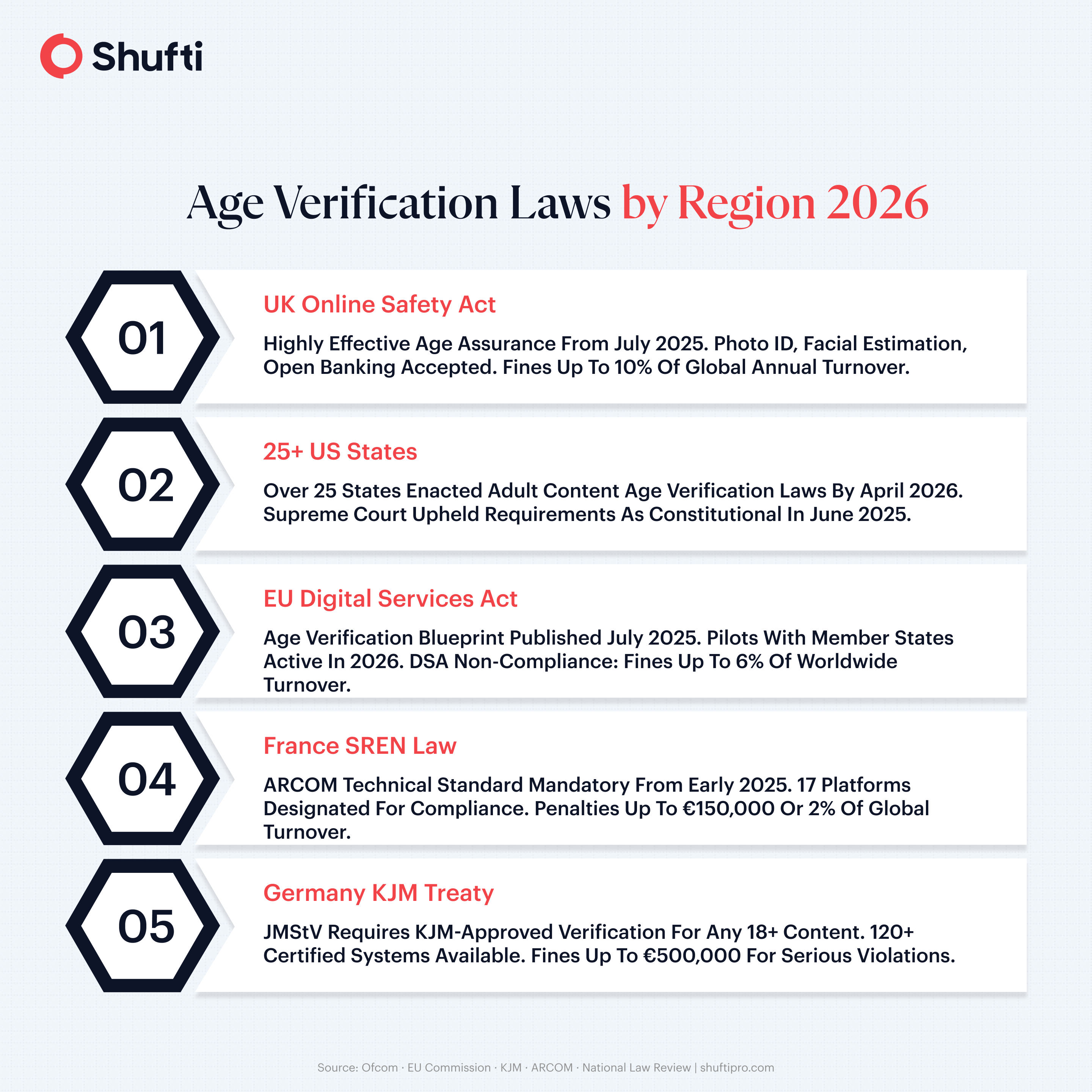
The UK Online Safety Act (OSA) requires all services that publish pornography to deploy highly effective age assurance by 25 July 2025. Ofcom defines “highly effective” as methods including photo ID matching, facial age estimation, open banking verification, and mobile network operator checks. A date-of-birth form does not qualify. Non-compliance carries fines of up to £18 million or 10% of global turnover, and Ofcom can direct internet service providers to block non-compliant platforms. The UK age verification compliance guide covers the Ofcom standards in detail.
United States
As of April 2026, more than 25 US states have enacted age verification laws covering adult content websites, with several extending to social media platforms. Nine states saw their laws take effect in 2025 alone, and the Supreme Court upheld these requirements as constitutional in June 2025. Most state laws accept a range of verification methods, including driver’s licence scanning, digital ID apps, and facial age estimation.
EU
The European Commission’s age verification blueprint, published in July 2025 and updated in October 2025, supports implementation of the EU Digital Services Act (DSA), which requires very large online platforms to take measures protecting minors. A pilot rollout is underway with member states in 2026. Non-compliance under the DSA can trigger fines of up to 6% of worldwide annual turnover.
France
The SREN law, enacted in May 2024, requires pornographic websites to deploy a system meeting the technical standard of France’s Autorité de Régulation de la Communication Audiovisuelle et Numérique (ARCOM). A ministerial order in February 2025 designated 17 platforms subject to mandatory compliance. Penalties reach €150,000 or 2% of prior-year global turnover, whichever is higher.
Germany
The Interstate Youth Media Protection Treaty (JMStV) requires any site with 18+ content to use a Kommission für Jugendmedienschutz (KJM)-approved age verification system. The KJM criteria for evaluated systems are publicly available. The KJM has certified more than 120 mechanisms under its regulated self-regulation model, with fines of up to €500,000 for serious violations.
Age gating vs. age verification: the legal distinction regulators care about
An age gate is a page prompt that asks visitors to confirm their age, typically through a pop-up or a date-of-birth entry form. An age verification check validates that claim using a trusted data source such as a government-issued identity document, a biometric comparison, or a financial or mobile carrier record. Regulators in the UK, France, and Germany have made this distinction explicit in their legislation. Ofcom will not accept any method where users can type in any date of birth without identity backing. The French ARCOM standard requires technical reliability. KJM-approved systems in Germany must confirm identity while minimising data collection. Website operators with only an age gate in place are not legally protected, even if users see a warning before they proceed. If your site falls under any of the regimes above, an age gate alone is a compliance gap.
How to add age verification to your website
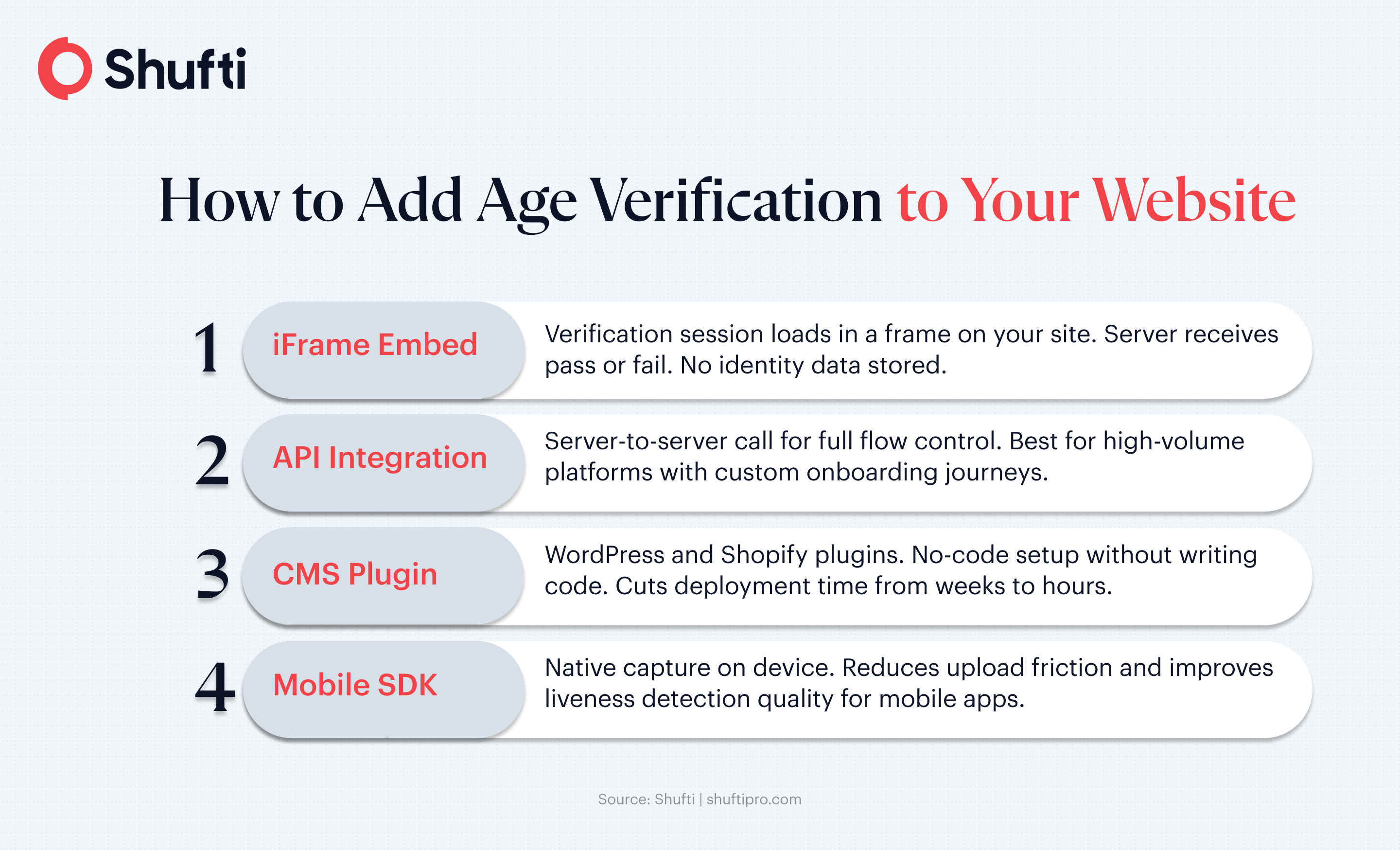
There are four main integration paths for deploying age verification on a website, each suited to different technical environments and compliance requirements.
iFrame embed
The verification provider hosts the session in an iFrame that loads on your site. The user completes the check inside the iFrame and your server receives a pass or fail callback. No identity data is stored on your own infrastructure, which reduces your data protection obligations.
API integration
A server-to-server call sends the verification request to the provider’s API and receives a structured response. This gives full control over the verification flow and supports custom risk decisions, making it the preferred route for platforms with high verification volumes or bespoke onboarding journeys.
Suggested Read: Age Verification API Integration Guide
CMS plugins
WordPress (via WooCommerce) and Shopify both support age verification through dedicated plugins and apps. These are the lowest-friction path for e-commerce operators and can be configured without writing code, cutting deployment time from weeks to hours.
Mobile SDK
For apps and mobile-first websites, an SDK captures document images and biometric data natively on the user’s device, reducing upload friction and improving capture quality for liveness detection.
When selecting an integration path, two questions matter most for compliance: where verification data is processed, and how outcomes are logged for audit purposes. Regulators may request evidence of your age-check process, so a clear audit trail is not an optional extra.
What happens if your website fails to verify ages
The consequences of non-compliance fall across three areas. Financial penalties are the most visible. In the UK, Ofcom has already fined one provider £1.35 million and investigations are active across 92+ services since the July 2025 deadline. In the US, state attorneys general are pursuing non-compliant adult content sites, with several platforms choosing to geo-block entire states rather than implement verification. In Germany, the KJM can require immediate suspension of access to non-compliant content. In France, ARCOM can seek court-ordered platform blocking. Beyond penalties, access restrictions mean portions of your audience disappear overnight in affected markets. The reputational dimension carries its own weight. Thorn’s 2024 Youth Perspectives report found that 1 in 3 boys aged 9 to 12 reported an online sexual interaction with an adult, a figure that places child safety at the centre of why these obligations exist. Proactive compliance carries substantially less cost than a reactive response to enforcement.
How Shufti helps website owners meet age verification requirements
Shufti covers all four integration paths described above, with an age-gate compliance platform that includes iFrame, API, SDK, and a no-code journey builder for operators who do not have dedicated engineering resources available. A sandbox environment is included for pre-launch testing, which matters when regulators may request evidence of your implementation.
Two capabilities are relevant for website compliance use cases specifically. Document verification with liveness detection confirms that the person presenting a government-issued ID is physically present at the session, not replaying a static image or submitting a fabricated document. This combination satisfies Ofcom’s criteria for technical accuracy and resistance to circumvention, two of the four tests applied when assessing whether a method qualifies as highly effective under the UK OSA. Facial age estimation provides a privacy-first path for users who prefer not to submit identity documents. The session captures a selfie, estimates the subject’s age from biometric data, and returns a pass or fail without storing any personally identifiable information. Shufti holds KJM approval for Germany, making it a directly compliant option for operators subject to the JMStV requirements.
Website operators in age-restricted categories now face binding age check requirements across the UK, US, EU, France, and Germany, and enforcement is active in all five. Shufti provides the document-based and biometric verification methods that Ofcom, KJM, and ARCOM accept, deployable via iFrame, API, or CMS plugin with a sandbox for compliance testing. Book a demo to see how the verification flow works on your site.
Frequently Asked Questions
Do all websites need age verification?
No. Age verification is legally required only for websites distributing age-restricted content or products, including adult content, online gambling, alcohol, tobacco, cannabis, and vaping, in jurisdictions where applicable laws are in force.
Is a date-of-birth form sufficient for age verification?
No. Ofcom, France’s ARCOM, and Germany’s KJM regulations all explicitly state that self-declaration forms do not meet legal requirements. Acceptable methods include photo ID matching, facial age estimation, and open banking verification.
What is the fine for not having age verification on an adult content website?
Fines vary by jurisdiction. UK fines reach £18 million or 10% of global turnover under the OSA. Germany’s KJM can issue penalties up to €500,000. France’s ARCOM penalties reach €150,000 or 2% of prior-year global turnover, whichever is higher.
How do I comply with the UK Online Safety Act for my website?
You must deploy a highly effective age assurance method that Ofcom accepts, such as photo ID matching, facial age estimation, or open banking verification. A date-of-birth field or a pop-up checkbox does not qualify under Ofcom’s published guidance.
How do I add age verification to my website?
Most providers offer four integration options: iFrame embed, server-side API integration, a CMS plugin for WordPress or Shopify, and a mobile SDK for app-based flows. Your solution should include audit logging to demonstrate compliance to regulators on request.