


 Face Verification
 Address Verification
 Document Verification
 Age Verification
 VideoIdent
 Fast ID
 eIDV
eIDV
 Consent Verification
 NFC Verification
 Business Verification
 Due Diligence
 Investor Verification
 E-Signature

 QES
QES
 AML Screening
 Transaction Monitoring
 Adverse Media
 Business AML Screening
 PEP & RCA
 Sanctions
 Watchlist
 Behavioural Biometrics
 Device Fingerprinting
 Biometric Face Authentication
 MFA
MFA
 Fraud Hub
 Onboarding
 Ongoing Monitoring
 KYC
KYC
 KYB
KYB
 KYI
KYI
 Age Assurance
 Identity Verification
 Workforce IAM
 Candidate Verification
 Compliance
 Fraud prevention
 Trust & safety
 Global expansion
 Product Managers
 Compliance Officers
 Fraud Analysts
 Developers
 Deepfake
 Bonus Abuse / Promotion Abuse
 Account Takeover
 Synthetic Identity Fraud
 Document Fraud
 Impersonation Fraud
 Multi-Accounting
 Fraud Networks
 Chargeback Fraud
 Money Mule Activity
 Party Fraud
 Regulatory & Compliance Risks
 Fintech
 Crypto
 iGaming
 Forex
Forex
 Social Network
 Marketplace
 Banking
 Gig Economy
 Blind Spot Audit
 Deepfake Detector
 Liveness Spoofs
 Document Originality
 Document Deepfake
 Global Trust Platform
 Journey Builder
 Case Management
 Shufti AI
 Fraud Analytics
 Vendor Comparison
 Brand Personalisation
 IDV Modes
 AI Compliance Co-Pilot
 OCR
OCR
 Secure Capture
 Deployment Options
 Identity Methods
 API Documentation
 Mobile SDKs
 Service Status
 Help Center
 Contact Us
 Technical Support
 Supported Documents
 Content library
 Blogs
Blogs
 News
News
 Reports
 Insights
 Knowledgebase
 ROI calculator
 About
About
 Career
 Press Release
 Certifications
 Partnership
 Awards
 Events & Webinar
 Interactive Demo
 Podcast Studio
 Spotlight Studio
KYB for B2B marketplaces: why supplier verification is your biggest compliance gap

A marketplace onboarding team can process a new buyer in under two minutes. The same team’s average vendor sign-up takes seven to ten days, and a quarter of those applications sit in a review queue behind a compliance analyst who started three weeks ago. That’s the core KYB gap B2B marketplaces carry into every growth quarter, between customer verification you have automated and supplier verification you have not, is where most of your fraud, regulatory, and reputational exposure lives.
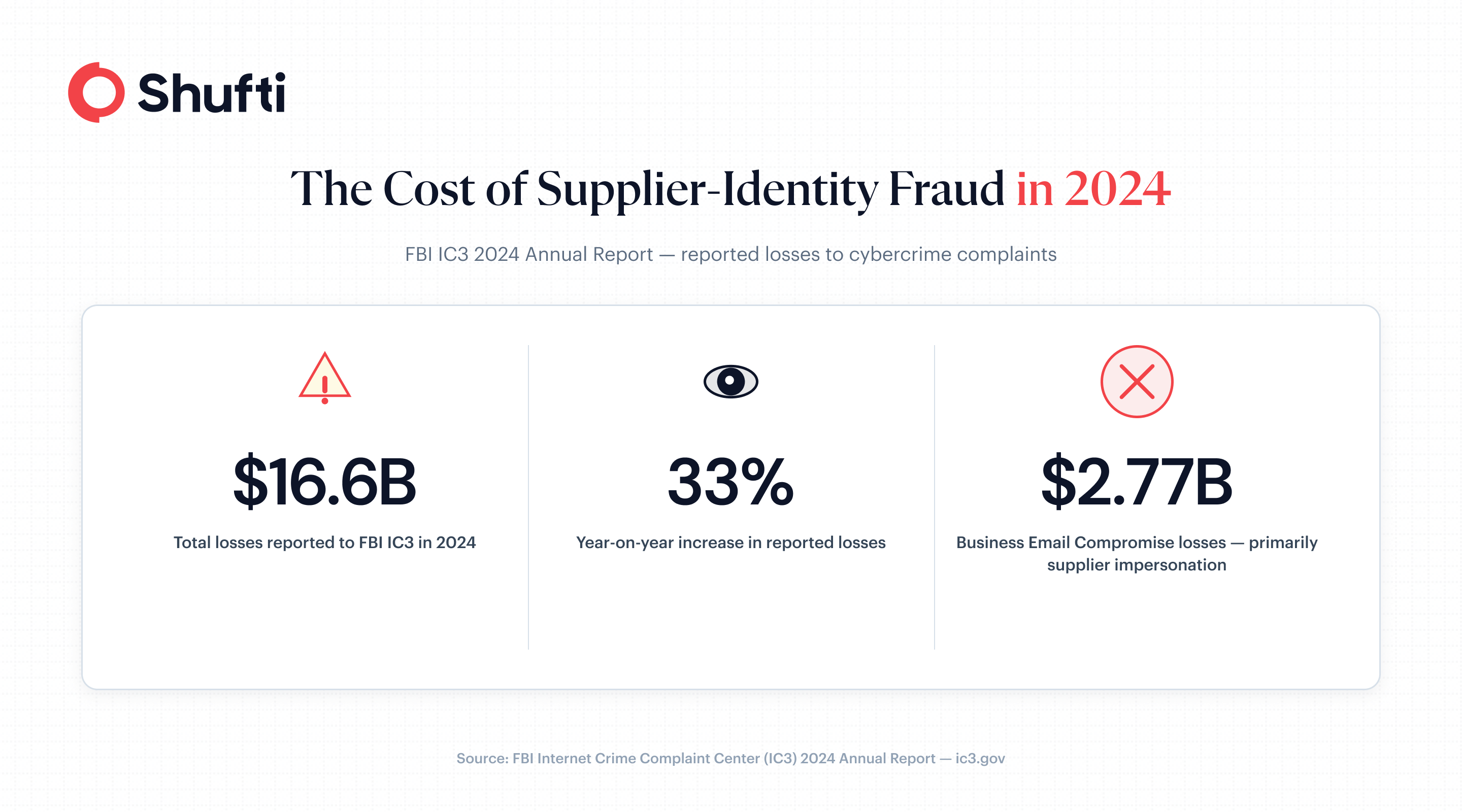
Supplier verification tends to slip down the product roadmap because it does not touch revenue the way buyer onboarding does. Regulators, banking partners, and payment rails are no longer willing to treat it that way. In 2024, reported losses to the FBI’s Internet Crime Complaint Center reached US$16.6 billion, a 33 percent year-on-year jump, with supplier impersonation through Business Email Compromise driving the single largest share of dollar losses. The sections below cover where the marketplace compliance gap sits, the regulatory picture that makes closing it non-negotiable, and what a working supplier onboarding flow looks like.
The marketplace compliance gap, and why it differs from bank KYB
High volume meets a thin compliance bench
A mid-sized marketplace can add four thousand new sellers in a quarter. The equivalent mid-sized bank adds a fraction of that, usually with a compliance function ten times larger. B2B platforms have inherited the fraud surface of a bank without the staffing or the tooling, and the result shows up in a pattern heard often in marketplace risk conversations. One procurement platform described manual seller checks as “very time consuming,” capping how many new vendors the team could bring on each week. That is a growth constraint, not a compliance issue.
The second compounding factor is geographic. Buyers tend to cluster in a handful of markets. Sellers arrive from everywhere. An electronics reseller in Shenzhen, a logistics partner in Lagos, and an industrial supplier in São Paulo all need business-registry coverage on day one. Anything less defaults the workflow to document uploads and human review, which is where the backlog starts.
Supplier as live product risk
On a marketplace, a fraudulent supplier lives inside the product itself. A buyer can transact with them tomorrow. That shifts the maths of supplier verification. A missed shell company on a bank’s corporate customer list shows up, at worst, as a regulatory finding at the next audit. The same miss on a marketplace produces a buyer who receives a counterfeit invoice, a chargeback the platform has to carry, and a trust story that takes years to rebuild. Risk scoring and ongoing monitoring in this context separate the marketplace that scales cleanly from the one that scales its liabilities.
The Regulatory Picture Marketplaces Can’t Ignore
B2B marketplaces often assume KYB obligations apply only to their banking partners. The distinction matters see how KYC, AML, and KYB each carry separate obligations before assuming your current stack covers all three. That assumption has become expensive across the 2024 to 2027 regulatory cycle.
FATF’s strengthened Recommendation 24, amended in March 2022 and reinforced by 2023 guidance, raised the floor on what “knowing” a beneficial owner actually means. Countries are expected to hold adequate, accurate, and up-to-date beneficial ownership information, and regulated entities are expected to run a multi-pronged approach across several data sources rather than a single registry lookup. That standard has cascaded down through the payment processors, banking-as-a-service providers, and acquiring banks that marketplaces depend on to move money.
In Europe, Regulation (EU) 2024/1624 harmonises the beneficial ownership threshold at twenty-five percent or more, with the European Commission holding the power to lower it further for high-risk sectors. Supervision sits with the new EU Anti-Money Laundering Authority (AMLA), and the regime takes effect from 10 July 2027. Parliamentary communications on the package confirm the obligations apply to obliged entities across the board, not only banks. A marketplace handling cross-border flows has to be able to answer who ultimately owns each seller, not just what their trading name is.
The US adds another layer through FinCEN’s beneficial ownership reporting under the Corporate Transparency Act, which most large B2B platforms now build into vendor onboarding rather than treat as a banking-partner concern.
What a Working Supplier KYB Workflow looks like
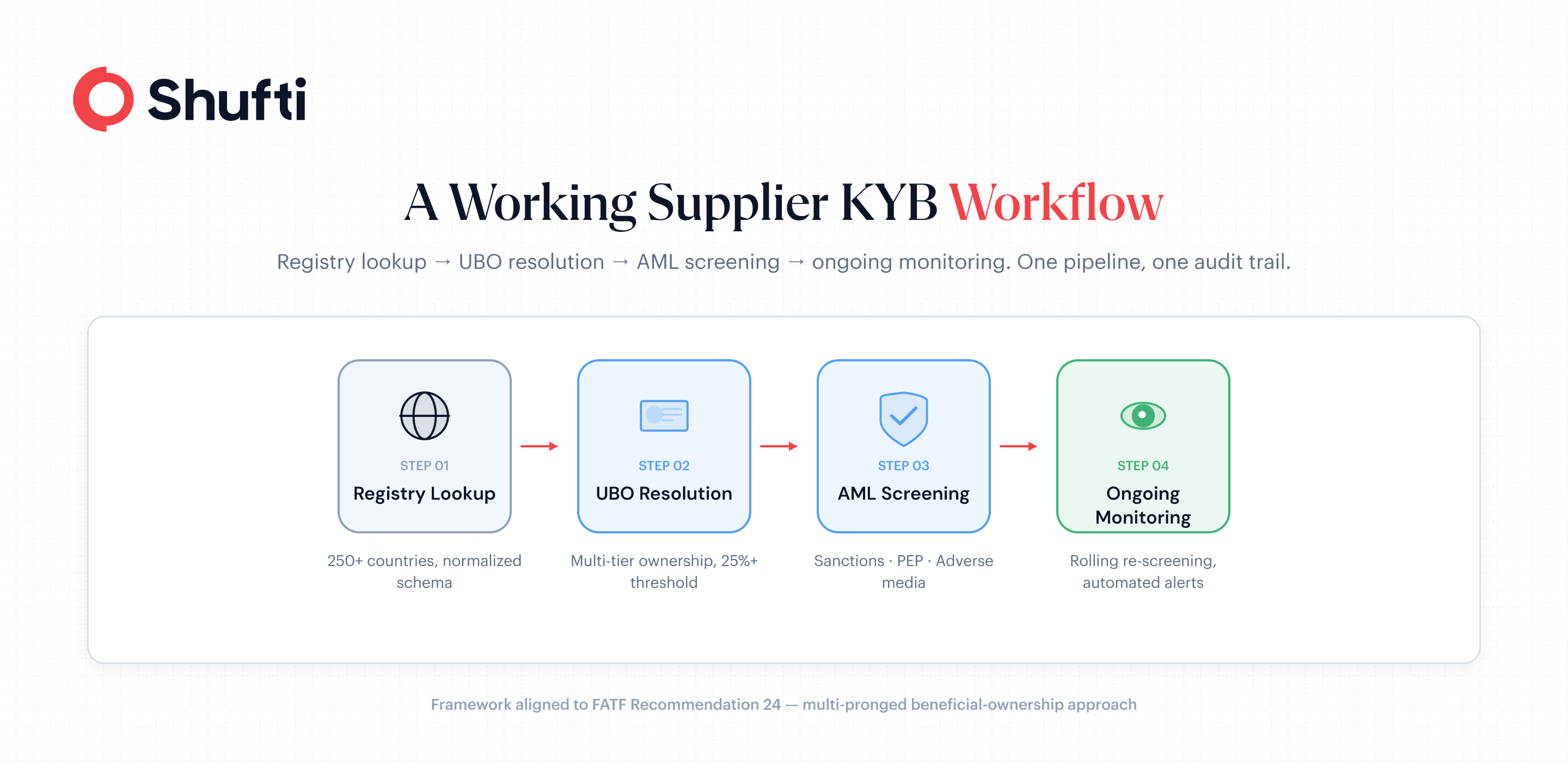
Most of the fix comes down to four things happening in sequence, not five systems duct-taped together.
Registry coverage and UBO resolution
A supplier KYB check starts with an automated lookup in the relevant business registry. For a platform taking sellers from forty countries, that means registry connections in forty countries, with data normalised into a consistent schema so that a Brazilian CNPJ, a UK Companies House filing, and a Singapore ACRA record all resolve into the same fields. Above the company record is the beneficial ownership layer. Here the ACFE’s 2024 Report to the Nations is worth a close read. It found that organisations lose roughly five percent of revenue to fraud each year, and billing schemes, the fraudulent invoices that shell or impersonated suppliers push through, are the second most common occupational fraud type, with a median loss of US$100,000 per case. Shell-company structures are what make those schemes hard to unwind, and UBO resolution is what catches them before they reach the checkout.
Screening, scoring, and ongoing monitoring
Once the company and its UBOs are resolved, the workflow screens each entity and each named individual against sanctions lists, PEP databases, and adverse media. A risk score emerges from that pass, and the score decides whether onboarding proceeds automatically, escalates to enhanced due diligence, or stops. Ongoing monitoring is the part most marketplaces skip. A supplier who cleared screening in March can end up on a sanctions list in September, and if no system is watching on a rolling basis, the bad news arrives from a banking partner instead of the platform’s own telemetry. Those conversations rarely end well.
Practical next steps for closing your vendor KYB compliance gap
Three implementation choices tend to decide whether a supplier KYB project lands cleanly or stalls mid-build.
The first is committing to one source of truth for business identity. A fragmented stack, one registry provider, a separate sanctions tool, a PDF workflow for UBOs, a spreadsheet for ongoing monitoring, cannot produce an auditable trail. A regulator asking who approved a particular seller wants one record, not five.
The second is automating the high-confidence cases end to end. Roughly seventy to eighty percent of seller applications on most B2B marketplaces are low-risk entities in well-covered jurisdictions, and those should clear in minutes without human touch. Analyst time belongs on the remaining cases, where judgement actually matters.
The third is treating ongoing monitoring as a product requirement rather than a compliance bolt-on. A supplier caught going bad in week six costs a fraction of one caught in month eight, and product teams tend to grasp that framing faster than a compliance memo.
Manual KYB was workable when supplier onboarding meant a few hundred entities a year. At four thousand a quarter, it is where compliance debt builds and banking partners start asking questions that are expensive to answer.
Supplier verification at marketplace volumes is where manual review stops scaling, and where most platforms discover their compliance gap only after a bank-partner audit or a buyer complaint. Shufti’s Know Your Business check returns verified company records, resolved UBOs, and sanctions, PEP, and adverse media screening through a single API across 250+ countries of registry coverage, so supplier onboarding finishes in minutes instead of days. Book a walkthrough to see the flow run against a sample of your own seller data.
Frequently Asked Questions
Why is supplier verification important for B2B marketplaces?
Supplier verification is the control that keeps a marketplace from onboarding shell companies, sanctioned entities, or impersonated vendors that then transact with paying buyers. On a marketplace the consequences arrive in days, as chargebacks, reputational damage, and pressure from banking partners the platform has to absorb directly.
What is the biggest compliance gap in B2B marketplace onboarding?
The gap sits between automated buyer verification and manual, under-resourced supplier verification. Buyer flows get product investment while supplier flows inherit a ticket queue. At moderate volumes the queue becomes the bottleneck, and the gap shows up as a risk the platform never consciously signed off on. That accumulated exposure is the vendor KYB compliance debt most platforms only discover during a banking partner audit.
How do marketplaces conduct KYB on third-party vendors?
A working flow pulls the registry record for the supplier entity, resolves beneficial owners across multi-tier ownership structures, screens both the entity and named individuals against sanctions, PEP, and adverse media sources, and then monitors for changes on a rolling basis. Done well, routine cases clear in minutes and analyst time focuses on exceptions.
Can KYB be automated for high-volume B2B supplier onboarding?
Yes, and for marketplaces moving thousands of sellers a quarter it has to be. Roughly seventy to eighty percent of applications are low-risk entities in well-covered jurisdictions and can clear without human review given the right API-driven setup. The point of automation is not to remove the analyst but to move their attention to the decisions that warrant it.