AMLR Solutions
 AMLR Consultation
 Onboarding
 Ongoing Monitoring
 FRAML
FRAML KYC
KYC KYB
KYB KYI
KYI Age Assurance
 Workforce IAM
 Candidate Verification
 Account Takeover
 Bonus/ Promotion Abuse
 Chargeback Fraud
 Deepfake
 Document Fraud
 Fraud Networks
 Impersonation Fraud
 Money Mule Activity
 Multi-Accounting
 Party Fraud
 Regulatory & Compliance Risks
 Synthetic Identity Fraud
 Adult Content
 Banking
 Crypto
 Fintech
 Forex
Forex Compliance
 Fraud prevention
 Trust & safety
 Global expansion
 Compliance Officers
 Developers
 Fraud Analysts
 Product Managers
 Advanced Journey Builder (AJB)
 Global Trust Platform
 Customer Profiles
 Vendor Comparison
 IDV Case Management
 AML Case Management
 Regulatory Reporting
 Travel Rule Protocols
 Agentic Rule Builder
 AI Compliance Co-Pilot
 Fraud Analytics
 Fraud Hub
 OCR
OCR Shufti AI
 Bank Account Verification
 Biometric Duplication
 Database Checks
 Document Intelligence
 Government ID
 Mobile Driver's License
 NFC
NFC Selfie Liveness
 Brand Personalisation
 Deployment Options
 Identity Methods
 IDV Modes
 Multi-tenancy
 On-Premise IDV
 Secure Capture










If your product sells to both consumers and businesses, your compliance team is probably running two onboarding flows that don’t quite talk to each other. One for individuals, one for companies. Two vendors, two case-management queues, and an audit trail that has to be stitched together whenever a regulator asks.
That’s the real question behind KYB vs KYC. Compliance leaders already know what the acronyms mean. What they’re wrestling with is why they have two stacks for what should be a single onboarding decision.
This piece covers both sides: the definitional differences (what each check actually collects, which regulations demand it, and when to run it), and the practical side of how compliance teams now run KYC and KYB from a single API so they stop paying twice to do one job.
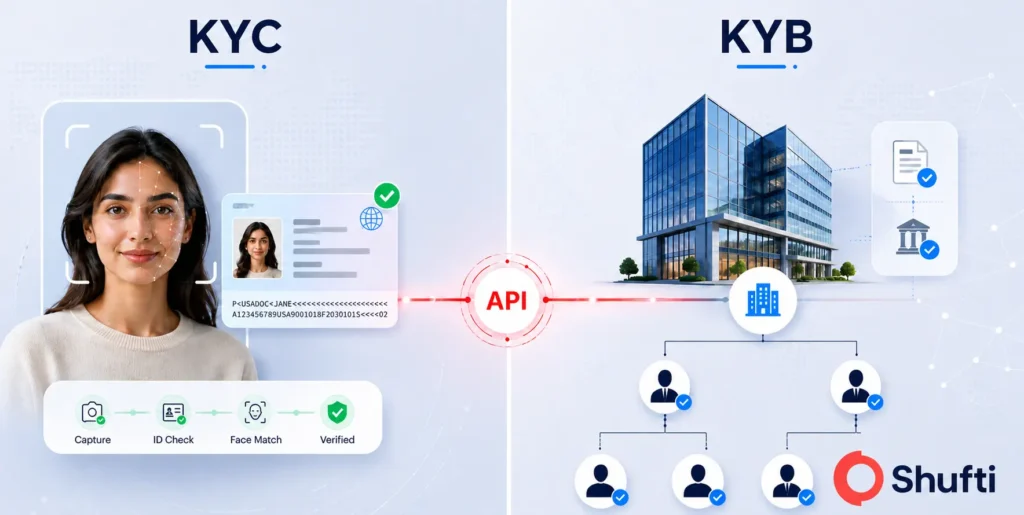
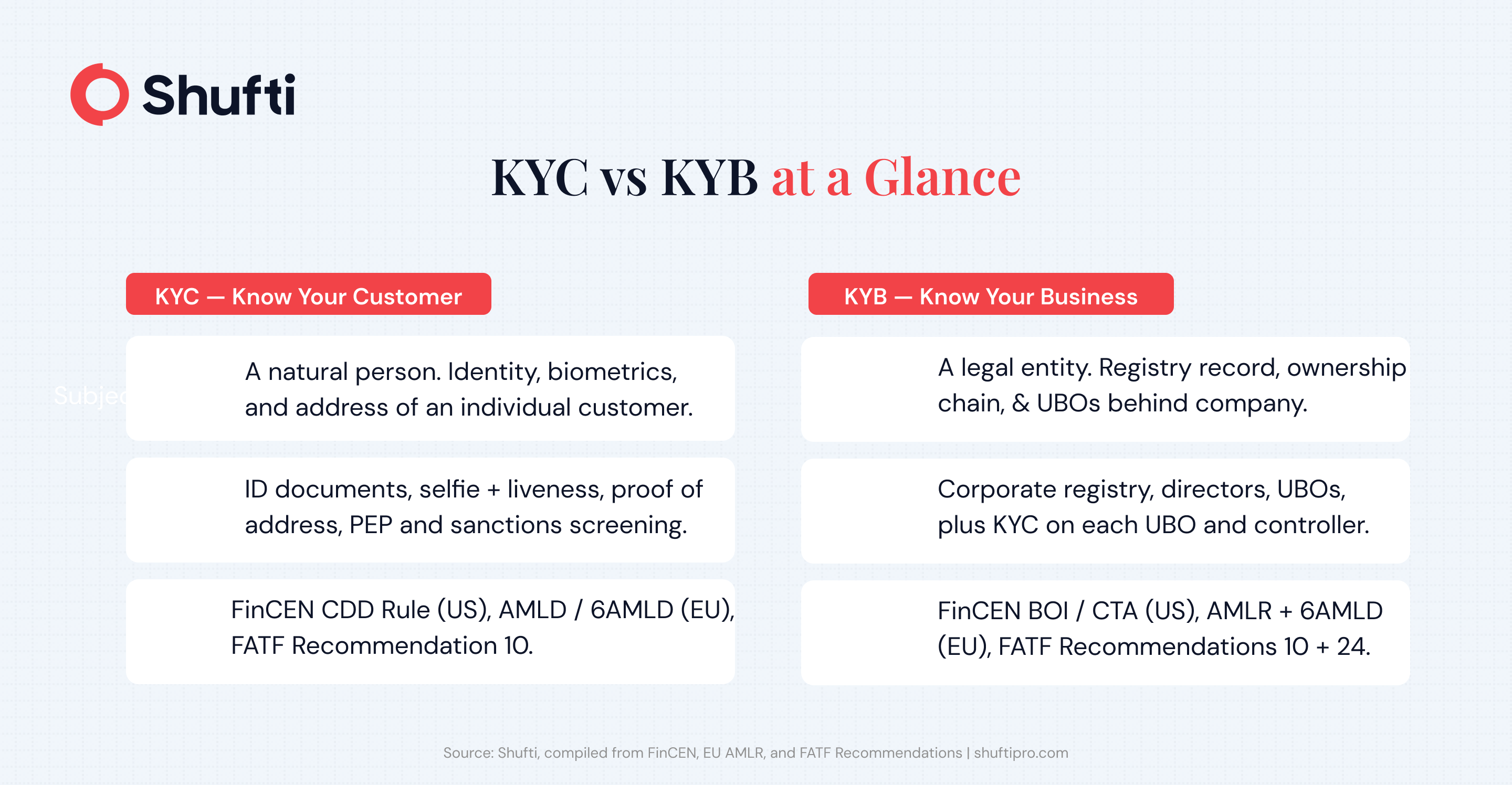
KYC (Know Your Customer) verifies a natural person. You confirm the human in front of you is who they say they are, check their ID, screen them against sanctions and PEP lists, and assess their risk.
KYB (Know Your Business) verifies a legal entity. You confirm the company is real, pull its registry record, identify who actually owns and controls it (the Ultimate Beneficial Owners, or UBOs), and then screen both the company and those owners.
The overlap is what trips teams up: KYB almost always contains KYC. You can’t finish a business verification without verifying the humans behind it.
What KYC actually covers
KYC is the process regulators built around a simple question: do you know who your customer is before you let them move money, access credit, trade securities, or open an account?
A standard KYC check collects four things:
- Identity data: name, date of birth, nationality, residential address, government-issued ID number.
- Document verification: a scan or photo of a passport, driver’s license, or national ID, checked for authenticity, expiry, tampering, and MRZ/NFC chip integrity where applicable.
- Biometric verification: a selfie or short video matched against the ID photo, plus a liveness check to rule out a printed photo, screen replay, or a deepfake.
- AML screening: the person is run against sanctions lists, PEP databases, watchlists, and adverse-media sources, then assigned a risk score.
The legal anchors vary by jurisdiction. In the US, KYC on individual customers sits inside the FinCEN Customer Due Diligence Rule (31 CFR 1010.230). In the EU, it’s the AMLD / AMLR package and 6AMLD. The UK leans on the FCA’s Financial Crime Guide. Singapore uses MAS Notice 626. All of them trace back to FATF Recommendation 10, which defines CDD obligations for every FATF member.
Done well, KYC clears a new customer in around 15 seconds for straightforward cases, with manual review reserved for elevated-risk profiles. Shufti’s Identity Verification workflow supports 10,000+ document types and nearly 100 OCR languages, which matters when your customers aren’t all from one country.
What KYB actually covers
KYB is the business-entity counterpart. The legal subject is a company, partnership, trust, or other legal person. The checks are more complex because a business hides behind paper, and often behind other businesses.
A complete KYB check pulls five layers:
- Entity verification: Legal name, registration number, incorporation date, registered address, and current operating status, pulled from the official corporate registry of the jurisdiction.
- Ownership structure: the corporate tree, including parent companies, subsidiaries, and cross-holdings.
- UBO discovery: identification of every natural person who owns or controls the business, typically over a 25% threshold, though stricter rules apply in higher-risk sectors.
- KYC on each UBO and key controller: Because at the end of the chain, there is always a human, and regulators want that human verified.
- Business AML screening: The company, its directors, and its UBOs are all screened against sanctions, PEP lists, and adverse-media sources.
The regulatory demand for KYB has intensified. In the US, the FinCEN Beneficial Ownership Information Reporting Rule, enacted under the Corporate Transparency Act, requires most US legal entities to report their UBOs. The EU’s AMLR creates a directly applicable single rulebook and strengthens beneficial-ownership transparency across all 27 member states. 6AMLD extended criminal liability to legal persons and expanded the list of predicate offences to 22, meaning a company can now be prosecuted for money-laundering failures its employees committed.
The consequence for compliance teams: KYB isn’t a one-time check you run at onboarding and forget. UBOs change. Corporate structures shift. A clean record at signup can go stale within months, and continuous monitoring is no longer optional for any regulated industry onboarding business customers.
When to run KYB vs KYC
Real onboarding doesn’t pick between the two; it sequences them. Three patterns cover most cases:
Pattern 1: Consumer-only product
A neobank onboarding retail customers runs KYC on every signup. No KYB required.
Pattern 2: Business-only product
A B2B payments platform onboarding corporate customers runs KYB on the company, which internally triggers KYC on every UBO and authorised signatory. No standalone consumer flow.
Pattern 3: Mixed customer base
Fintech apps, marketplaces, crypto exchanges, payment platforms, and B2B SaaS with payouts onboard both individuals and businesses. They need both flows, triggered conditionally by account type at the start of onboarding.
The third pattern is where most compliance teams feel the pain. Two verification engines. Two audit trails. Two vendor contracts. Two reviewer workflows. And a risk picture that never fully comes together.
Running KYB and KYC on one stack
The cost of running two vendors isn’t just line-item pricing. It’s the hours your team spends reconciling two case files when one customer has both a personal and a linked business account. It’s the integration debt of maintaining two SDKs and two webhook formats. It’s the audit risk of discovering, late, that a KYC check on a UBO in System A never triggered the business-level AML re-screen in System B.
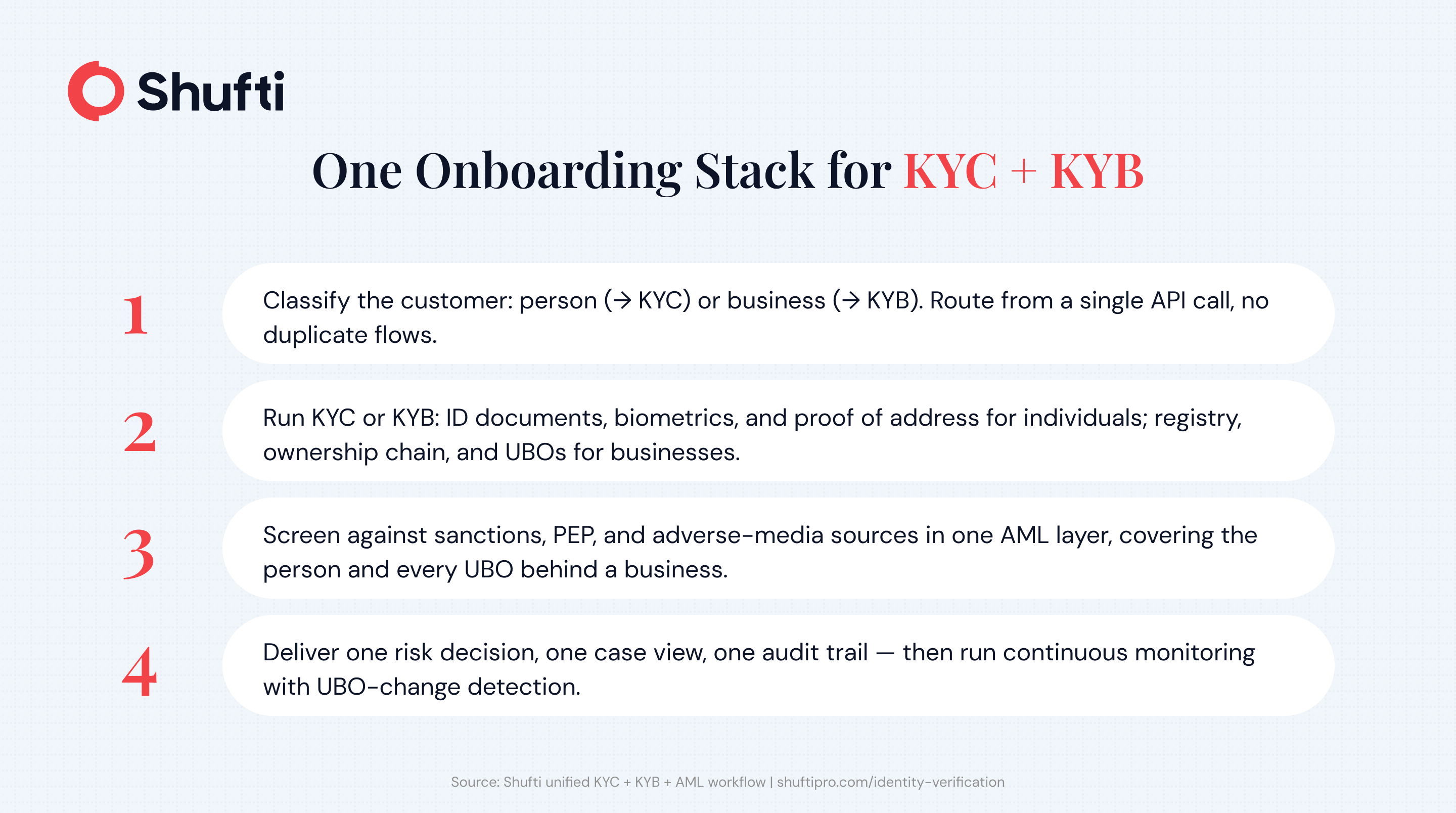
Shufti runs KYC and KYB through one API, with AML Screening and Business AML Screening hanging off the same call, orchestrated through a no-code Journey Builder.
What that gives a compliance team in practice:
- One audit trail per customer, whether the customer is a person or a business with five UBOs.
- Shared screening. If a UBO gets sanctioned next month, the same engine re-screens them for KYB.
- Country coverage that works for both: 230+ for document verification, 250+ for business verification.
- Decisions in seconds for standard KYC and minutes for typical KYB, not the hours some corporate-registry integrations still require.
The UNODC estimates that 2–5% of global GDP, between USD 800 billion and 2 trillion, is laundered each year. Most of the headline enforcement failures behind that number come down to data gaps: a UBO missed here, a sanctions hit not refreshed there. Those gaps widen when the person and the business live in different systems.
How Shufti Helps Business Manage Both KYB and KYC
If you’re running separate vendors for people and businesses and you’re tired of stitching the audit trail together, put the problem in front of us. Shufti’s Identity Verification platform covers KYC, KYB, AML screening, and continuous monitoring through one API and one case view. Request a demo and we’ll show you how to run both from one integration.
Frequently Asked Questions
What is the main difference between KYB and KYC?
KYC verifies a natural person. KYB verifies a legal entity, and it almost always includes KYC on the humans behind it.
Do businesses need both KYB and KYC?
If you onboard both individuals and business customers, yes. If you only onboard one, you only need that side. KYB inherently contains KYC on UBOs and controllers.
When should a company use KYB instead of KYC?
Whenever the customer of record is a legal entity: a company opening a corporate account, a marketplace seller registering as a business, or a partner integrating for payouts.
Can KYB and KYC be integrated into one compliance workflow?
Yes. Modern IDV platforms run both through a single API with one case-management view. That's the model Shufti's KYB and KYC products are built around.
Is KYB harder to implement than KYC?
Usually yes. KYB depends on corporate-registry coverage that varies by jurisdiction, and UBO discovery requires multi-level entity resolution. That's why registry breadth and automated UBO extraction matter when choosing a vendor.
Which regulations require KYB vs KYC?
KYC sits inside CDD obligations: FinCEN's CDD Rule in the US, AMLD/6AMLD in the EU, and FATF R.10 globally. KYB is anchored by beneficial-ownership rules: FinCEN BOI in the US, AMLR in the EU, and FATF Recommendation 24 globally.
Does KYC apply to business entities?
The term refers to natural persons, but KYC checks on UBOs and controllers are part of any credible KYB process. In practice, the two are inseparable.