AMLR Solutions
 AMLR Consultation
 Onboarding
 Ongoing Monitoring
 FRAML
FRAML KYC
KYC KYB
KYB KYI
KYI Age Assurance
 Workforce IAM
 Candidate Verification
 Account Takeover
 Bonus/ Promotion Abuse
 Chargeback Fraud
 Deepfake
 Document Fraud
 Fraud Networks
 Impersonation Fraud
 Money Mule Activity
 Multi-Accounting
 Party Fraud
 Regulatory & Compliance Risks
 Synthetic Identity Fraud
 Adult Content
 Banking
 Crypto
 Fintech
 Forex
Forex Compliance
 Fraud prevention
 Trust & safety
 Global expansion
 Compliance Officers
 Developers
 Fraud Analysts
 Product Managers
 Advanced Journey Builder (AJB)
 Global Trust Platform
 Customer Profiles
 Vendor Comparison
 IDV Case Management
 AML Case Management
 Regulatory Reporting
 Travel Rule Protocols
 Agentic Rule Builder
 AI Compliance Co-Pilot
 Fraud Analytics
 Fraud Hub
 OCR
OCR Shufti AI
 Bank Account Verification
 Biometric Duplication
 Database Checks
 Document Intelligence
 Government ID
 Mobile Driver's License
 NFC
NFC Selfie Liveness
 Brand Personalisation
 Deployment Options
 Identity Methods
 IDV Modes
 Multi-tenancy
 On-Premise IDV
 Secure Capture














KYC data breaches are one of the most consistent and predictable security failures in financial services. If you’ve been following the news cycle for the past few years, you’ve likely noticed the pattern where PII records are exposed, systems are compromised, and customer identity data is surfacing where it shouldn’t be.
What most coverage misses is the architecture underneath. The real reason KYC data breaches keep happening isn’t some sophisticated hacking operation. It’s how identity verification data moves through systems in the first place, and understanding that is the only way to prevent a KYC data breach rather than just respond to one.
Why KYC Data Breaches Keep Happening?
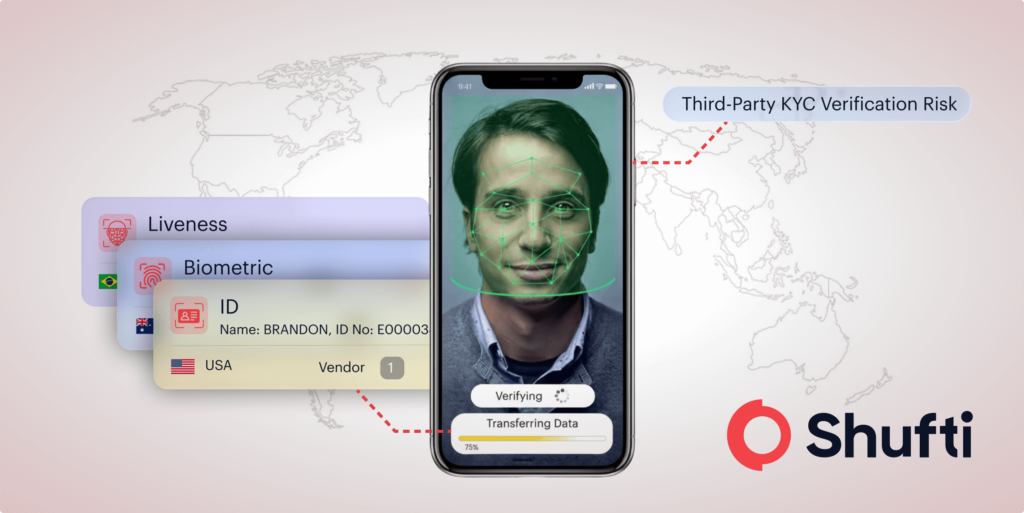
Most identity verification doesn’t actually happen inside the platform you’re interacting with. It happens somewhere else entirely, passed along through a chain of systems most people never think about.
What nobody tells you is that the company you’re dealing with probably isn’t the one actually verifying you. They take your documents and pass them to a verification vendor. That vendor might send your biometric data somewhere else; liveness detection gets handled by yet another party, and by the time your identity is confirmed, your data has touched three, four, maybe five different systems that you never agreed to share with directly.
Every one of those handoffs carries real risk. Your data is sitting somewhere, copied, stored, and potentially exposed at every stop along the way, and the frustrating part is that the company you originally trusted doesn’t fully control any of it. They’re essentially middlemen who passed your information down a chain, hoping everyone else was doing their job properly. Better encryption doesn’t fix that, and neither does a stronger firewall.
Third-Party KYC Verification Risks Nobody Discusses
Supply chain breaches roughly doubled between 2021 and 2025, and it had nothing to do with hackers suddenly getting smarter. The real reason is that verification infrastructure became more tangled over time, with more vendors, more dependencies, and more places for a KYC security breach to quietly originate without anyone noticing.
Think about what happens when your data has to leave one system to reach a validation service somewhere else. You’re not just trusting the company you signed up with anymore; you’re trusting every single vendor in that chain, and all it takes is one misconfigured database or one vendor who treats security as an afterthought to put everything at risk.
The thing is, most providers won’t bring this up because their entire business is built around aggregation. They don’t actually own the verification technology; instead, they stitch together third-party tools, routing your data through a handful of specialized vendors who each handle one small piece of the process. It moves fast, it scales well, and it works right up until it doesn’t.
What it also does is create a layer of exposure that sits outside their control. This is the identity verification supply chain risk that no compliance framework currently on the market fully accounts for, and it is the core reason third-party KYC breach risk is so difficult to audit or contain.
KYC Data Breaches and The Third-Party Problem
When a KYC data breach happens, it almost never originates inside the company you initially trusted. It originates inside a KYC vendor that the company was routing your data to, often a vendor you’ve never heard of, operating under security standards you never agreed to, holding data you never explicitly consented to share with them.
This is the third-party KYC breach problem; in plain terms, every vendor in the verification chain is a potential KYC vendor breach point. These third-party verification security gaps are much wider than any compliance certificate suggests because most KYC providers are aggregators that stitch together external tools. The solution isn’t better vendor management. It’s eliminating the vendor dependency entirely.
A 100% in-house verification stack means no supply chain vulnerability because there is no supply chain.
How Proprietary KYC Verification Technology Changes the Equation?
There’s another way to build verification systems. Instead of routing data to third parties, you keep everything internal and own the stack end to end.
Document analysis happens in-house using models your team developed. Biometric matching runs on your own infrastructure with algorithms you actually understand and can adjust. Fraud detection is trained on your own data rather than whatever a vendor decides to feed into a shared model. Nothing leaves your environment for verification work, which means you are not crossing your fingers and hoping the next vendor in the chain has their security in order.
This is not about being overly cautious or difficult to work with. It’s about controlling variables to ensure security, rather than relying on everyone else in your supply chain to do their job correctly. When you own the full pipeline, you know exactly where data lives and who has access.
The operational benefits follow naturally from that. Verification is faster because nothing is waiting for an external API response. Accuracy improves because you are tuning your models to the specific document types and fraud patterns you encounter. And compliance becomes considerably more straightforward because your data never crosses a boundary you can’t audit.
If you want to understand what true ownership of identity infrastructure looks like in practice, watch the breakdown here:
Here’s the full walkthrough:
Identity Verification Breach Prevention Through Architecture
Most companies approach security backward. They lock down their perimeter, implement access controls and encryption, get through their audits, and then assume their vendors are doing the same on their end. It feels like a strategy, but it is really just optimism with a compliance certificate attached.
Real prevention starts much earlier, at the architectural level, before a single line of code is written. The questions that actually matter are whether you own your verification technology or rent it from aggregators, whether your customer data stays within your infrastructure or travels to third-party systems, and how to protect against KYC breach at the source rather than the perimeter. The fundamental choice is between in-house KYC and third-party verification, and that choice determines your entire risk exposure.
If the answer is not immediately clear to you, you’re probably exposed.
The companies that consistently stay out of breach headlines did not get there by having better incident response plans. They built systems from the ground up where customer data simply never had to leave their controlled environment in the first place.
How Shufti Protects KYC Data: Why In-House Architecture Eliminates Breach Risk
Here’s what we built at Shufti. Full-stack proprietary verification where every component, from document capture to final decision, runs inside our infrastructure. That means 100% in-house processing with zero supply chain vulnerability, as no customer data ever leaves our environment for verification work.
No third-party handoffs for verification work. No external APIs for biometric matching. No vendor dependencies for fraud detection, since we trained our own models on patterns we’ve observed.
The data enters our system, gets analyzed by our models, generates a decision, and stays contained throughout. Nothing depends on vendors with different security standards.
This means sub-second verification times because we’re not waiting on external services. It means accuracy tuned to specific document types and fraud patterns. It means on-premises KYC verification for organizations that can’t send identity data to the cloud. As a secure KYC provider, our entire architecture is designed to protect customer data. KYC processes touch everything, from capture to decision, with no external handoffs and no KYC provider data breach surface to worry about.
Building this way required significantly more investment than licensing third-party tools, but when you look at where breaches actually originate and how consistently they trace back to vendor dependencies, it is difficult to argue for any other approach.
PII Verification Data Protection Through Ownership
Compliance doesn’t equal security. You can be fully compliant with GDPR, SOC 2, and ISO 27001 while still getting compromised if your architecture depends on external verification providers you don’t control.
Most regulatory frameworks focus on access controls, encryption, and data retention, which cover the basics but do not go nearly far enough. They don’t penalize aggregator models or require end-to-end ownership of verification pipelines.
Companies optimize for what gets measured in compliance audits rather than for what keeps data safe. They pass assessments and then route customer data to vendors operating under different standards. Real KYC data protection requires addressing supply chain vulnerability. KYC creates frameworks that ignore vendor dependencies, which simply do not measure the right things.
That space in between is where the risk lives.
What to Ask Your Identity Verification Provider?
If you’re evaluating KYC vendors or auditing your current provider, these questions will tell you more than any compliance certificate ever will.
- Do you own your verification stack, or do you aggregate third-party services?
- When customer documents enter your system, where do they physically go?
- How many external systems interact with the data during verification?
- If one of your vendors gets compromised, are we exposed?
- Can you deploy entirely on-premise if we require it?
If a provider struggles to answer any of these clearly, that hesitation is your answer. A vendor who cannot walk you through their own data flow almost certainly does not have full visibility into it, which means you are taking on risk that neither of you can properly see.
The KYC Infrastructure Question That Actually Matters
KYC data breaches are not random bad luck. They are predictable outcomes of architectural choices made years ago when companies optimized for speed to market rather than long-term security. Every KYC provider data breach and identity verification data breach in recent years can be traced back to the same root cause: data leaving controlled infrastructure to reach a vendor that wasn’t held to the same standards.
When you design systems that require data to travel outside your direct control for verification to happen, you inherit every vulnerability in that supply chain. When you use aggregators instead of building proprietary technology, you’re betting that vendors three layers deep remembered to configure their databases correctly.
The companies avoiding exposure didn’t get lucky. They built systems where customer data never has to leave controlled infrastructure for verification, eliminating entire categories of risk.
This is the fundamental decision that determines whether you’re actually protected against a KYC data breach or just compliant enough to pass audits, while the real risk lives in your vendor chain.