




 Face Verification
 Address Verification
 Document Verification
 Age Verification
 VideoIdent
 Fast ID
 Docless Verification
 Consent Verification
 NFC Verification
 Business Verification
 Due Diligence
 Investor Verification
 E-Signature

 QES
QES
 AML Screening
 Transaction Monitoring
 Adverse Media
 Business AML Screening
 PEP & RCA
 Sanctions
 Watchlist
 Behavioural Biometrics
 Device Fingerprinting
 Biometric Face Authentication
 MFA
MFA
 Fraud Hub
 Onboarding
 Ongoing Monitoring
 KYC
KYC
 KYB
KYB
 KYI
KYI
 Age Assurance
 Identity Verification
 Workforce IAM
 Candidate Verification
 Compliance
 Fraud prevention
 Trust & safety
 Global expansion
 Product Managers
 Compliance Officers
 Fraud Analysts
 Developers
 Deepfake Detection
 Bonus Abuse / Promotion Abuse
 Account Takeover
 Synthetic Identity Fraud
 Document Fraud
 Impersonation Fraud
 Multi-Accounting
 Fraud Networks
 Chargeback Fraud
 Money Mule Activity
 Party Fraud
 Regulatory & Compliance Risks
 Fintech
 Crypto
 iGaming
 Forex
Forex
 Social Network
 Marketplace
 Banking
 Gig Economy
 Payments
 Ride Hailing
 Adult Content
 Blind Spot Audit
 Deepfake Detector
 Liveness Spoofs
 Document Originality
 Document Deepfake
 Global Trust Platform
 Journey Builder
 Case Management
 Shufti AI
 Fraud Analytics
 Vendor Comparison
 Brand Personalisation
 AI Compliance Co-Pilot
 OCR
OCR
 Secure Capture
 Deployment Options
 Identity Methods
 API Documentation
 Mobile SDKs
 Service Status
 Help Center
 Contact Us
 Technical Support
 Supported Documents
 Supported Countries
 Content library
 Blogs
Blogs
 News
News
 Reports
 Insights
 Knowledgebase
 ROI calculator
 About
About
 Career
 Press Release
 Certifications
 Partnership
 Awards
 Events & Webinar
 Interactive Demo
 Podcast Studio
 Spotlight Studio
KYC for Insurance Companies: Identity Verification, AML and Fraud Prevention 2026

-
Add us as a Preferred Source
- 01 What is KYC for insurance companies?
- 02 What are the insurance AML requirements in 2026?
- 03 How does policyholder identity verification work?
- 04 How does KYC prevent insurance fraud and financial crime?
- 05 How Shufti help insurers meet KYC and AML compliance requirements?
TL,DR
- KYC is now mandatory and rule-based for insurers, life insurers, annuity providers, and fund-handling intermediaries, who are obliged entities under FATF Recommendations and EU AMLA, with the compliance boundary now sitting earlier in the sales process via the IDD.
- EU AMLA is the dominant deadline. Regulation 2024/1624 takes direct effect on July 10, 2027 (no national transposition), with AMLA oversight beginning in 2026; the article frames firms treating this as a future problem as already behind.
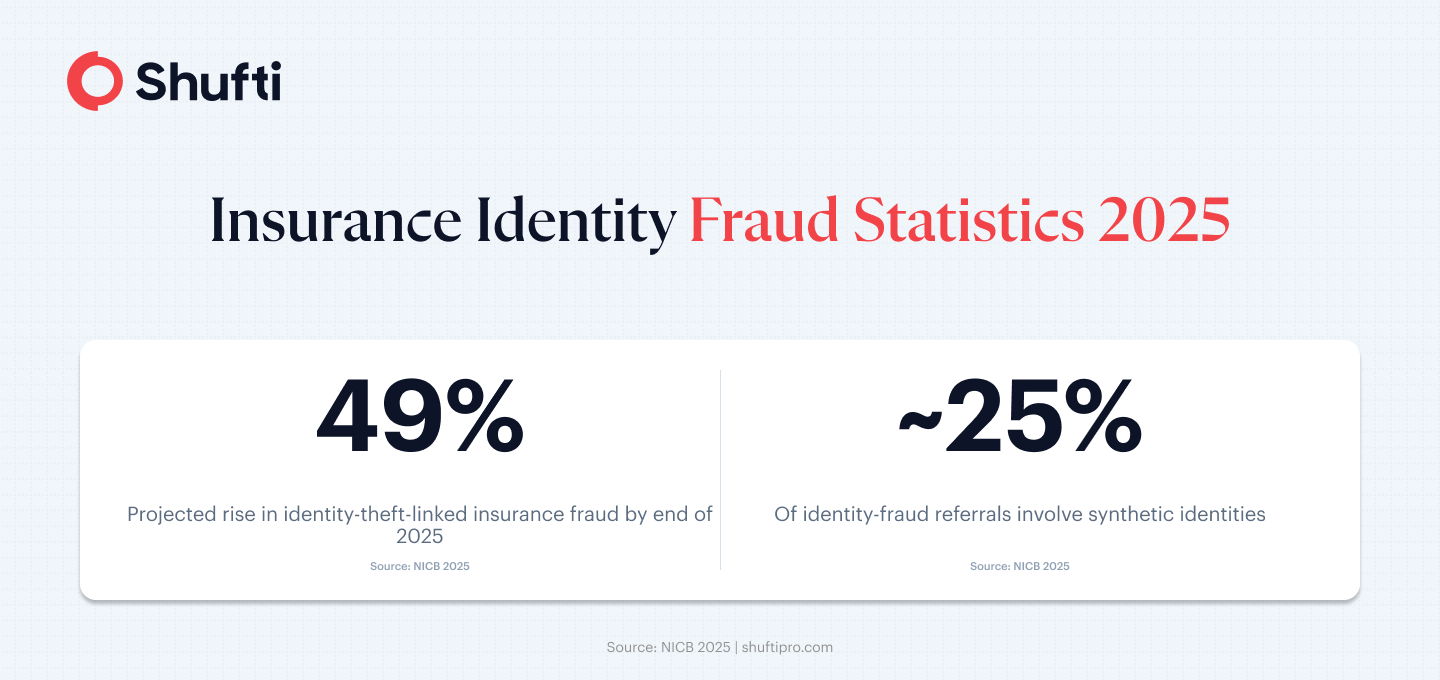
- Synthetic identity fraud is the headline threat. NICB projects a 49% rise in identity-theft-linked fraud, with synthetic IDs in roughly a quarter of referrals and 11% of global frauds now synthetic.
- Document-only checks fail against synthetic identities because the underlying credentials can be genuine; you need layered verification: document authentication, biometric liveness, cross-database validation.
- AML is continuous, not point-in-time, risk profiles change post-issuance (new sanctions, PEP designation, premium-layering patterns), so ongoing monitoring and SAR obligations apply for the life of the policy.
- High-risk product focus, FATF flags four elevated-risk life products: single-premium, investment-linked, high-surrender-value, and high-value endowments.
The National Insurance Crime Bureau projects that insurance fraud linked to identity theft will rise 49% by the end of 2025, with nearly a quarter of those fraud referrals involving synthetically generated identities. For insurers, that gap lives at the front of the policyholder onboarding process. The standard in 2026 is a single documented workflow that treats identity verification, AML screening, and fraud detection as connected steps, not separate responsibilities spread across different teams.
What is KYC for insurance companies?
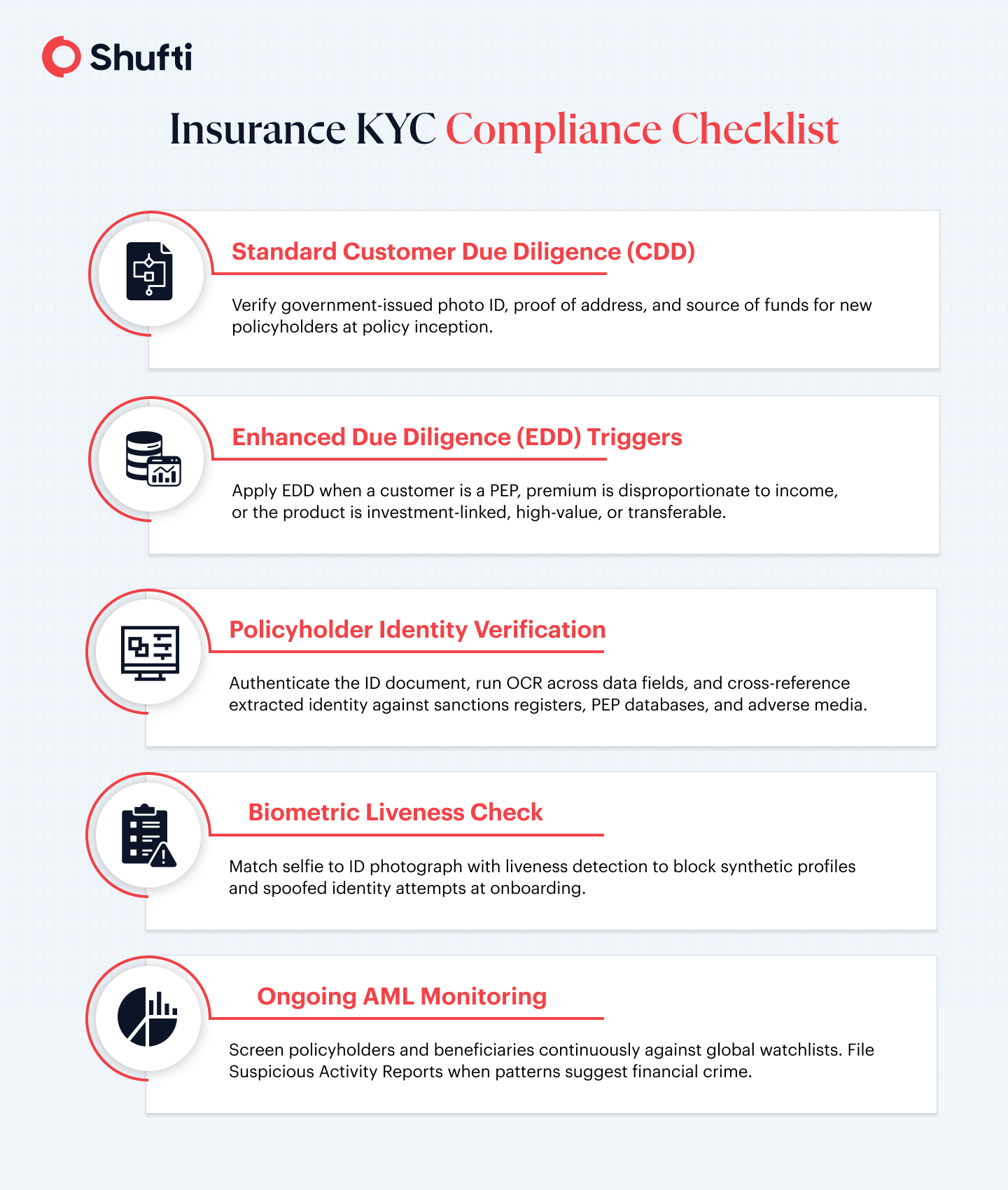
KYC for insurance companies is the process of confirming who a policyholder, beneficiary, or premium payer actually is before a policy is issued, and monitoring that relationship for risk signals throughout its duration. Insurance KYC compliance covers more than document collection. It includes customer risk classification, customer due diligence thresholds, and the triggers that move a customer from standard checks to enhanced scrutiny. Regulators across the EU, UK, and US now classify life insurers and annuity providers as obliged entities under the same AML frameworks that govern banks, which means the compliance standard has risen sharply and continues to move.
Who needs to comply with insurance KYC requirements?
Insurance KYC requirements fall most directly on life insurers, annuity providers, and intermediaries handling investment-linked policies. These products carry meaningful money laundering and terrorist financing (ML/TF) risk because of their cash value, early-surrender features, and the ability to transfer ownership to a third party. General insurers face a lighter regulatory footprint, but brokers and intermediaries who handle client funds are now brought into compliance scope under the Insurance Distribution Directive (IDD). IDD compliance requires distributors to verify customer identity and suitability before recommending any product, so the compliance boundary now sits earlier in the sales process than it once did.
What is customer due diligence in insurance?
Customer due diligence in insurance means collecting and verifying core identity data at policy inception, including a government-issued photo ID, proof of address, and beneficial ownership information for policyholders operating through a corporate vehicle. Standard customer due diligence insurance procedures apply to most retail customers. Enhanced due diligence applies when a customer is flagged as a politically exposed person (PEP), when the premium level is disproportionate to their stated income, or when the product type falls into one of the four elevated-risk categories the Financial Action Task Force (FATF) Recommendations identify for life insurance. These are single-premium policies, investment-linked products, high-value endowments, and transferable policies.
What are the insurance AML requirements in 2026?
Insurance AML compliance requirements have moved from a principles-based exercise to a directly applicable rulebook. Two frameworks are reshaping what insurers and intermediaries must have in place by 2027, and preparations for both are already overdue for a large share of the market.
EU AMLA Regulation 2024/1624 and what it means for insurers
EU Regulation 2024/1624 takes direct effect across all EU member states on July 10, 2027, and explicitly lists insurance undertakings as obliged entities under the full anti-money laundering and counter-terrorist financing (CFT) framework. Unlike earlier directives, this regulation requires no national transposition. The same customer due diligence standards, suspicious activity reporting obligations, and ongoing monitoring requirements will apply uniformly across the single market. The regulation transfers supervisory responsibility for the largest cross-border financial institutions to the European Anti-Money Laundering Authority (AMLA), which begins operational oversight in 2026. Insurers treating the July 2027 date as a future problem rather than a current preparation task are already behind schedule.
FATF guidelines, IDD compliance, and high-risk product types
The FATF’s risk-based guidance for the life insurance sector identifies four product types as carrying elevated ML/TF exposure. These are single-premium policies, investment-linked products, policies with meaningful surrender value, and high-value endowments. These are the categories where insurance AML requirements are tightest, not because every customer is high risk, but because the product features create exploitable financial channels. IDD compliance layers a second obligation on top for distributors and intermediaries. They must document the customer identification process and demonstrate that the product recommended was appropriate for the verified customer profile. Together, FATF guidance and IDD compliance mark the outer boundaries of an adequate insurance KYC programme.
How does policyholder identity verification work?
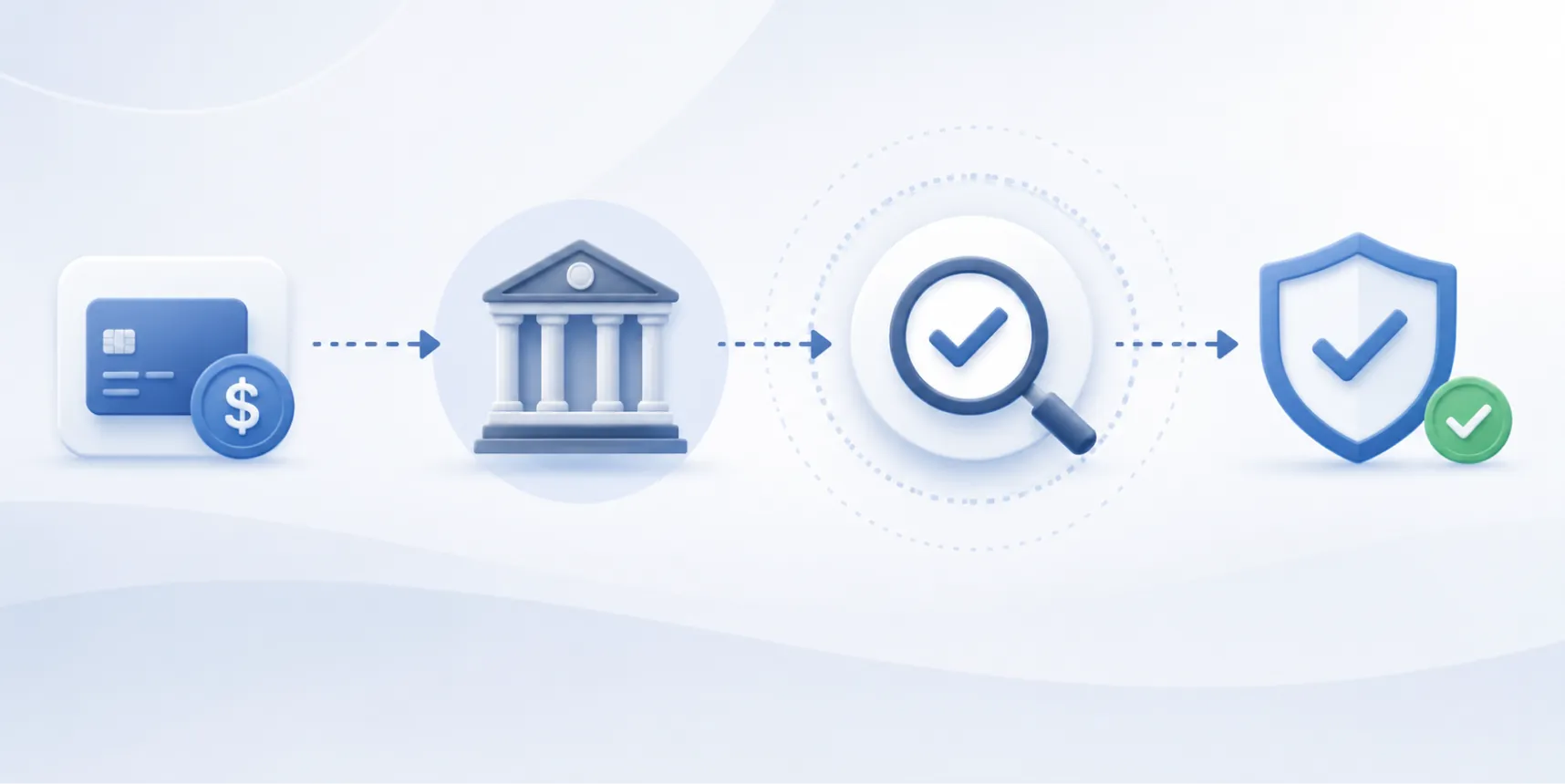
Policyholder identity verification has moved well beyond accepting a scanned copy of an ID. The insurance onboarding process now combines document authentication, biometric matching, and database validation, with each layer catching a different fraud type that the previous step alone would miss. Getting the sequence right matters as much as having all three elements in place.
Document verification and policyholder identity checks at onboarding
Document verification in insurance starts by authenticating the government-issued ID the applicant presents, checking for tampering indicators, machine-readable zone (MRZ) data consistency, and a match between the document photograph and the person submitting it. Automated KYC for insurance captures the document image via mobile SDK, runs optical character recognition (OCR) across the data fields, and cross-references the extracted identity against sanctions registers, PEP databases, and adverse media sources. The step that most commonly fails in practice is address matching, particularly for customers who recently relocated or whose residential address does not appear in the expected format on official records.
Biometric liveness and the insurance onboarding process
Biometric verification adds a selfie match against the document photograph and a liveness detection step that confirms the applicant is physically present rather than presenting a printed image or a screen replay. April 2026 industry analysis shows that 11% of frauds globally now involve a synthetic identity, an eight-fold increase compared to 2024. The best KYC tools for insurance treat biometric liveness as a non-negotiable step in the onboarding flow. An insurance onboarding process that relies on document capture alone offers no defence against a well-constructed synthetic profile, because the underlying credentials can be entirely authentic and still belong to a person who does not exist.
How does KYC prevent insurance fraud and financial crime?
Insurance fraud KYC is the first line of financial crime insurance defence. KYC does not stop every scheme, but it closes the cheapest entry points before a fraudulent policy can reach claims stage. Identity verification at onboarding is where most preventable losses begin, and it is where the most cost-effective fraud prevention insurance measures sit.
Synthetic identity fraud and insurance fraud KYC
Synthetic identity fraud in insurance combines a real data point, typically a Social Security number, a date of birth, or a passport number, with fabricated supporting information to create a person who does not exist but who passes basic document checks because the underlying credential is genuine. NICB analysis shows that nearly a quarter of identity-theft-related insurance fraud referrals involve synthetic identities. Insurance fraud KYC that layers biometric liveness with cross-database identity validation catches these cases before they become life insurance claims, medical billing fraud, or premium layering schemes. All three of those categories saw documented synthetic identity growth across 2024 and 2025.
AML screening, SAR obligations, and ongoing monitoring
Policyholder identity verification at onboarding is a point-in-time check. AML screening must continue for the life of the policy because a customer’s risk profile can change after the contract is signed. A beneficiary may appear on a newly updated sanctions list. An insured customer may be designated a PEP following a change in government. A series of premium payments may show a pattern consistent with layering proceeds through the policy’s cash value.
Suspicious Activity Reports (SARs) must be filed when a transaction or behaviour suggests financial crime, and the obligation applies to insurers just as it applies to banks. Ongoing AML monitoring against databases refreshed in near-real time ensures a policy that was compliant at inception does not become a regulatory liability six months later.
How Shufti help insurers meet KYC and AML compliance requirements?
Manual review is the compliance gap that leaves most insurers exposed. When analysts hand-check onboarding documents, the insurance onboarding process slows, inconsistency enters the workflow, and the biometric and data signals that flag synthetic identities go undetected. Shufti’s identity verification for insurance combines document authentication, biometric liveness, and AML screening through a single API, so every policyholder moves through the same standardised checks regardless of the channel they arrive through.
On the document side, the KYC software for insurance covers 10,000+ document types across 240+ countries and supports nearly 100 OCR languages, so global policyholder verification does not require separate regional solutions. On the AML side, Shufti screens against 3,500+ global watchlists and 2.6 million PEP profiles, with data refreshed every 15 minutes. For insurers building toward EU AMLA readiness, document verification and AML screening share a single audit trail in the same platform, which is what regulators want to see when reviewing a firm’s customer due diligence programme. Insurance companies managing financial crime insurance exposure need KYC software for insurance that covers the full compliance cycle of onboarding, screening, and monitoring without requiring a separate vendor for each step.
Frequently Asked Questions
Is KYC required for insurance companies?
Yes. Life insurers, annuity providers, and most insurance intermediaries are classified as obliged entities under FATF Recommendations and, from July 2027, under EU AMLA Regulation 2024/1624. KYC is mandatory before issuing policies that carry ML/TF risk.
What documents are needed for insurance KYC?
Standard insurance KYC requires a government-issued photo ID and proof of address. Enhanced due diligence adds source-of-funds documentation when the premium level or product type raises the risk profile. Corporate policyholders also require beneficial ownership verification.
How does AML apply to insurance?
Insurers must screen policyholders and beneficiaries against sanctions lists, PEP databases, and adverse media sources. They must file Suspicious Activity Reports when transactions suggest financial crime. Ongoing monitoring, not just onboarding checks, is required under FATF guidelines and the EU AMLA Regulation.
How can insurance companies prevent identity fraud during onboarding?
Document verification combined with biometric liveness detection closes the gap that document-only checks leave open. Synthetic identities carry authentic documents. Biometric matching against the ID photograph plus a liveness step confirming physical presence, is what separates a genuine applicant from a synthetic one.
What are the penalties for non-compliance with insurance AML requirements?
EU regulators can impose fines up to 10% of annual turnover or €5 million for serious AML failures under EU AML Regulation 2024/1624. The FCA has issued multi-million pound penalties for inadequate customer due diligence. Regulatory sanctions can also include suspension of operating licences, which represents an existential risk for insurance firms.