


 Face Verification
 Address Verification
 Document Verification
 Age Verification
 VideoIdent
 Fast ID
 Docless Verification
 Consent Verification
 NFC Verification
 Business Verification
 Due Diligence
 Investor Verification
 E-Signature

 QES
QES
 AML Screening
 Transaction Monitoring
 Adverse Media
 Business AML Screening
 PEP & RCA
 Sanctions
 Watchlist
 Behavioural Biometrics
 Device Fingerprinting
 Biometric Face Authentication
 MFA
MFA
 Fraud Hub
 Onboarding
 Ongoing Monitoring
 KYC
KYC
 KYB
KYB
 KYI
KYI
 Age Assurance
 Identity Verification
 Workforce IAM
 Candidate Verification
 Compliance
 Fraud prevention
 Trust & safety
 Global expansion
 Product Managers
 Compliance Officers
 Fraud Analysts
 Developers
 Deepfake Detection
 Bonus Abuse / Promotion Abuse
 Account Takeover
 Synthetic Identity Fraud
 Document Fraud
 Impersonation Fraud
 Multi-Accounting
 Fraud Networks
 Chargeback Fraud
 Money Mule Activity
 Party Fraud
 Regulatory & Compliance Risks
 Fintech
 Crypto
 iGaming
 Forex
Forex
 Social Network
 Marketplace
 Banking
 Gig Economy
 Payments
 Ride Hailing
 Adult Content
 Blind Spot Audit
 Deepfake Detector
 Liveness Spoofs
 Document Originality
 Document Deepfake
 Global Trust Platform
 Journey Builder
 Case Management
 Shufti AI
 Fraud Analytics
 Vendor Comparison
 Brand Personalisation
 AI Compliance Co-Pilot
 OCR
OCR
 Secure Capture
 Deployment Options
 Identity Methods
 API Documentation
 Mobile SDKs
 Service Status
 Help Center
 Contact Us
 Technical Support
 Supported Documents
 Supported Countries
 Content library
 Blogs
Blogs
 News
News
 Reports
 Insights
 Knowledgebase
 ROI calculator
 About
About
 Career
 Press Release
 Certifications
 Partnership
 Awards
 Events & Webinar
 Interactive Demo
 Podcast Studio
 Spotlight Studio
Transaction Monitoring for Neobanks: Reducing False Positives Without Missing SAR Triggers
TL;DR:
- Neobank transaction monitoring differs from bank monitoring: real-time rails and fast-changing customer cohorts break batch-era rule libraries.
- False positives, not software cost, are the real expense: industry research puts false-positive rates above 90% at most banks.
- Alert fatigue hits hardest at Tier-2 review, where rushed enrichment lets real suspicious activity get dismissed.
- Four behavioural patterns drive most legitimate SAR filings: rapid fund movement through new accounts, structured deposits below reporting thresholds, cross-border spikes to high-risk corridors, and rapidly dispersed accounts.
- The fix is segment-aware tuning (cohort and peer-group baselines), not raising thresholds across the board, which protects the SAR detection floor regulators expect.
In July 2025, the Financial Conduct Authority (FCA) fined Monzo £21.1 million for inadequate customer checks and ineffective transaction monitoring that let high-risk accounts open and operate freely. Four months later, the FCA hit a UK building society with a separate £44m penalty for monitoring gaps that let through £27.3m of COVID furlough fraud in a single case.
The pattern in the FCA’s 2025 enforcement record is consistent. Neobank transaction monitoring AML controls are being judged on whether they actually catch the things they were configured to catch, not on alert volume. This piece walks through why neobank monitoring is structurally different from incumbent-bank monitoring, why false positives are the dominant operational cost, what behaviours actually trigger a Suspicious Activity Report (SAR) filing, and how compliance teams can tune alerts without dropping their detection floor.
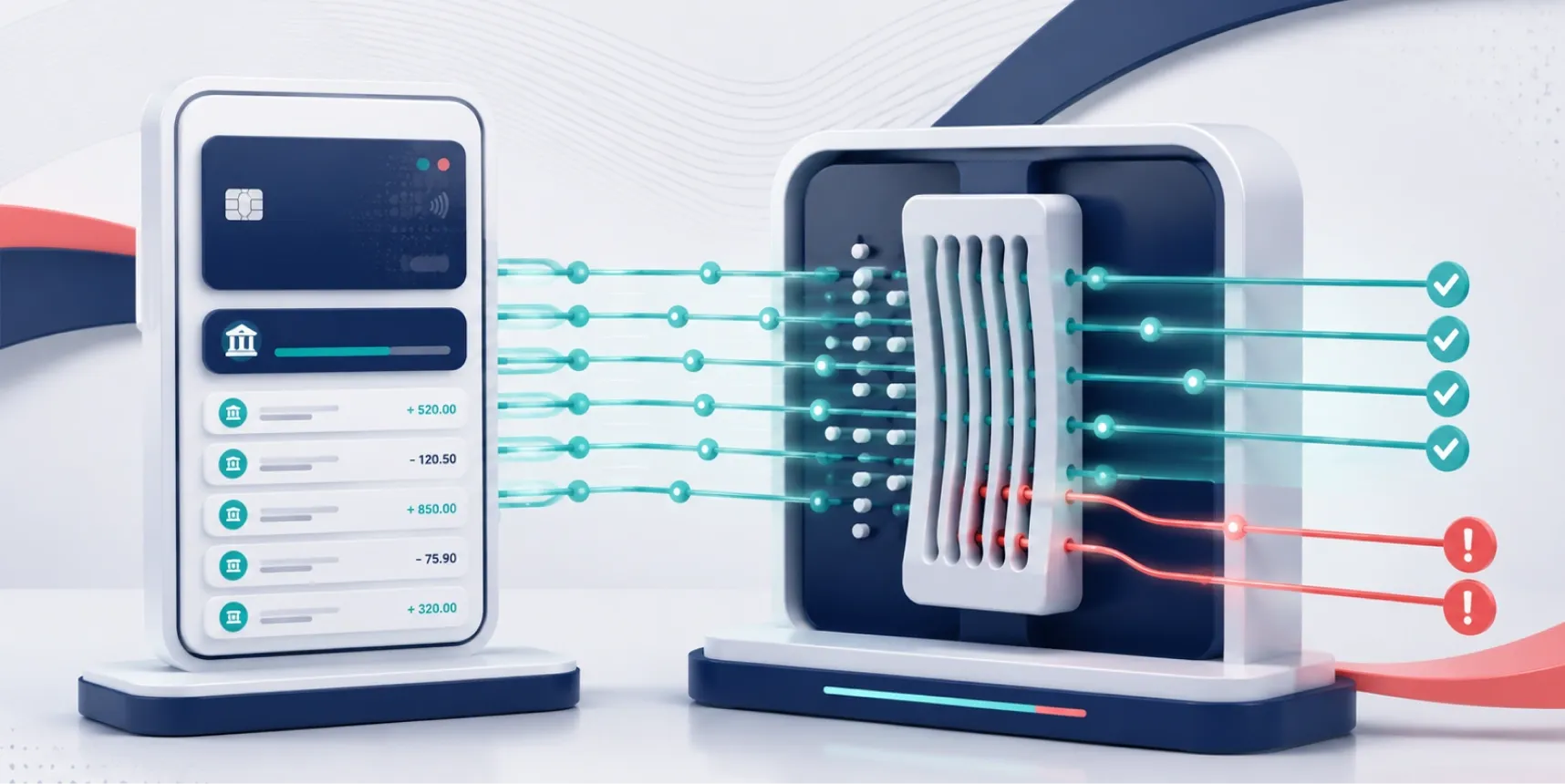
Transaction monitoring in a neobank context covers the real-time and post-event screening of customer payments, transfers, and balance movements against a behavioural baseline and a set of typology rules. The output is a stream of alerts that compliance officers triage, escalate to investigation, and decide whether to file as SARs with the relevant national Financial Intelligence Unit (FIU).
Why neobank transaction monitoring isn’t bank monitoring at scale
Incumbent banks built their monitoring stacks around end-of-day batches, branch deposits, and customer relationships measured in years. Neobanks operate on instant rails, mobile-only onboarding, and customer cohorts that grow by the tens of thousands per month. The same rule libraries do not work in both environments. Three structural differences explain why neobank AML compliance teams need a different alert philosophy from their high-street peers.
Real-time rails, batch-era rule libraries
When a payment hits a neobank account, settlement happens in seconds. Under the Financial Action Task Force (FATF) risk-based approach guidance for the banking sector, monitoring needs to be commensurate with the speed and channel of the transaction. The legacy approach of running overnight batches and reviewing alerts the next morning leaves a fast-moving neobank with hours of exposure on every flagged account. Real-time scoring, automated holds on the highest-risk patterns, and tighter escalation Service Level Agreements (SLAs) are the operational consequences. They also generate more alerts per analyst hour, which feeds directly into the false-positive problem the next section unpacks.
Velocity, volume, and customer cohorts that change weekly
A challenger bank that adds 30,000 customers a month is constantly retraining what “normal” looks like. A behavioural baseline calibrated to last quarter’s user base over-flags the new cohort and under-flags the seasoned one. Risk segmentation needs to be cohort-aware, not just customer-aware. Compliance leads at neobanks repeatedly describe this as an inability to keep customer risk ratings current, which is one of the explicit themes in the FCA’s 2025 enforcement notes against named high-street and challenger institutions. The remedy is rules that age out and recalibrate against a moving population, not more rules.
How false positives crush neobank compliance teams
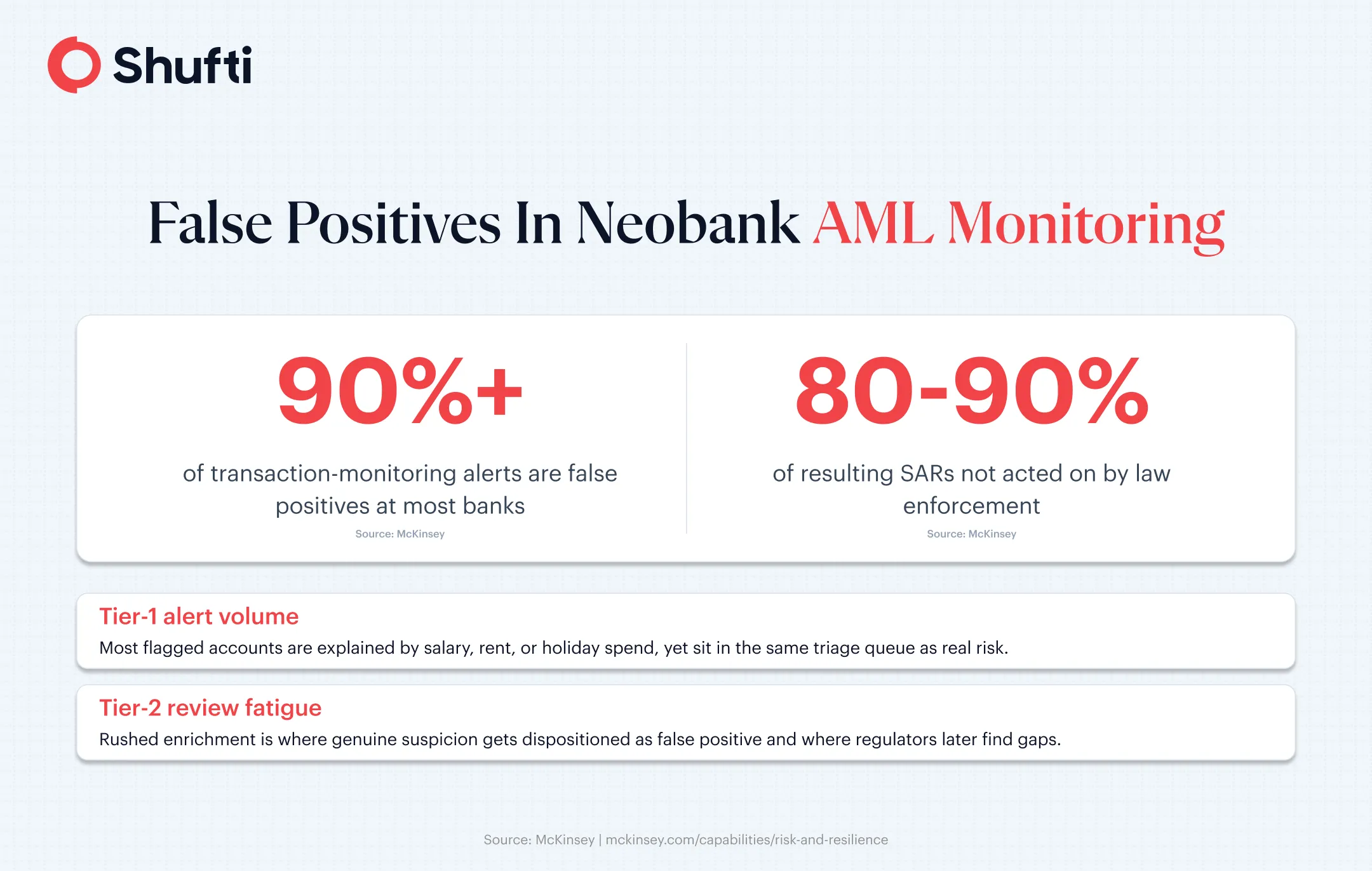
The most expensive thing about a neobank monitoring stack is not the software cost. It is the analyst hours spent clearing alerts that turn out to be nothing. Independent research from McKinsey puts the false positive rate for transaction monitoring above 90% at most banks and above 98% for some customer-risk and monitoring models. For a neobank with a lean compliance team and a growing customer base, that ratio determines whether the team can also do the work that actually matters. False positives in neobank AML are not a tuning nuisance. They are the operational cost driver.
The 90%+ false positive rate problem
The same McKinsey work also finds that of the alerts that do produce a SAR filing, 80 to 90% of those SARs are not acted on by law enforcement either. The chain of low-signal compounds. A neobank running a Tier-1 rules engine that throws 50,000 alerts a quarter against a 12-person compliance team will spend most of its review capacity on patterns that are already explained by salary deposits, recurring rent payments, or holiday spending. Real suspicious behaviour sits in the same queue and gets triaged by the same fatigued reviewers.
Tier-2 review queues are where alert fatigue actually lands
The sharpest pain point in a lean neobank compliance team is not at Tier-1 alert generation. It is at the Tier-2 enrichment layer, where analysts pull KYC data, payment context, and historical behaviour into a coherent picture before deciding whether to escalate. When alert volume runs ahead of analyst capacity, Tier-2 reviews get rushed. Rushed Tier-2 reviews are where genuinely suspicious behaviour gets dispositioned as “false positive, no further action” and where regulators later find the gaps. Reducing alert volume at Tier 1 without sacrificing recall is the single highest-impact move a neobank monitoring team can make.
What triggers a SAR filing in neobank transaction monitoring systems
A SAR is filed when a regulated financial institution forms a reasonable suspicion that a transaction or pattern of transactions involves the proceeds of crime, terrorist financing, or sanctions evasion. The bar is not certain. The bar is a documented suspicion that a reviewer can defend in front of a regulator. For neobanks, a small number of behavioural families drive the bulk of legitimate SAR filings, and another small group of explainable patterns drives the bulk of the false ones.
Behavioural patterns regulators consistently care about
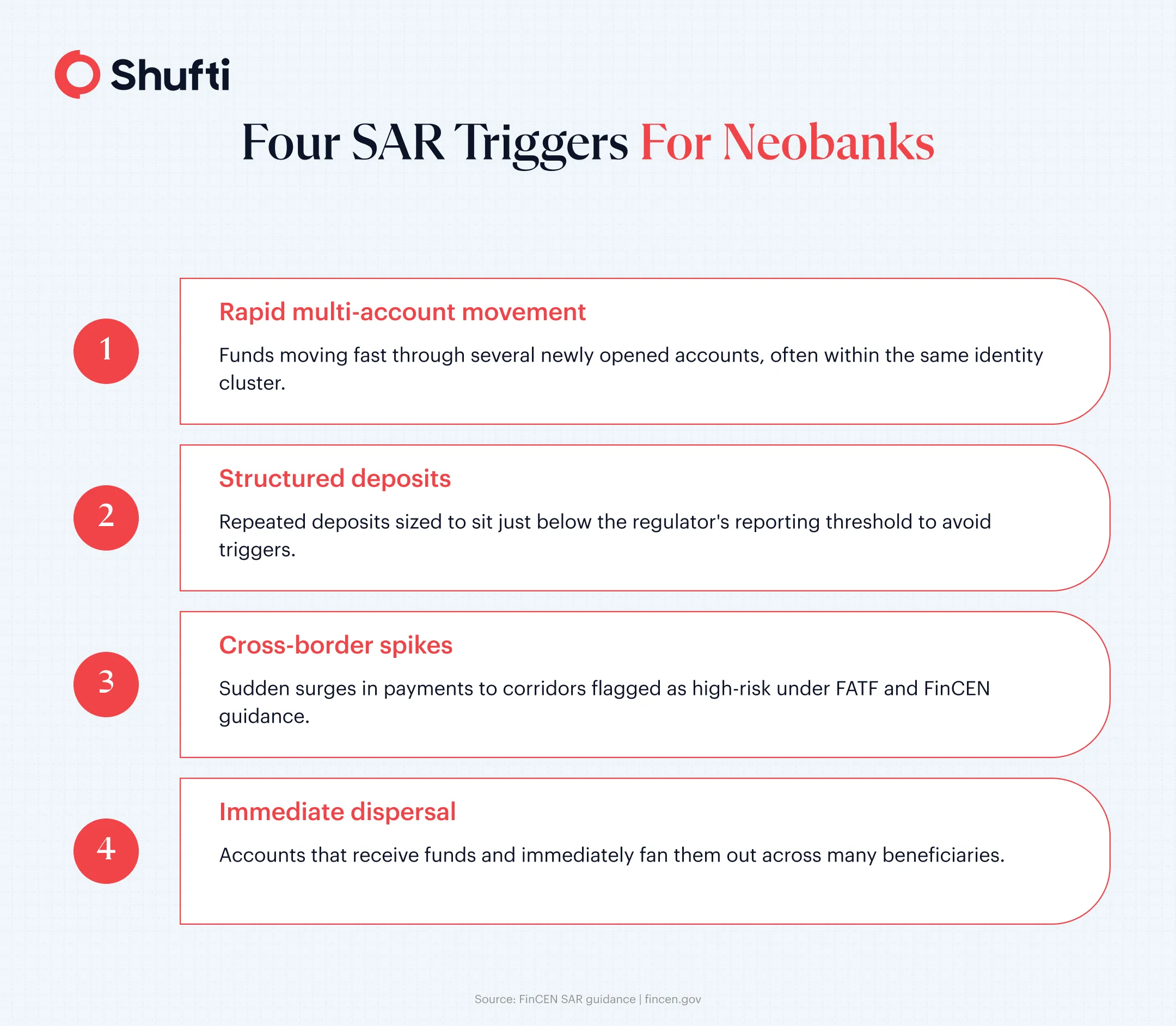
The Financial Crimes Enforcement Network (FinCEN) guidance on what triggers a SAR is built around behavioural typologies, not transaction sizes. FinCEN’s published SAR guidance and the SAR statistics released annually (more than 2.193 million SARs filed by US depository institutions in 2025, per FinCEN SAR Stats) consistently surface the same four patterns.
- Rapid movement of funds through multiple new accounts.
- Structured deposits that sit just below reporting thresholds.
- Sudden spikes in cross-border payments to high-risk corridors.
- Accounts that receive funds and immediately disperse them across many beneficiaries.
For SAR filing fintech operators and neobanks, these typologies are the tier-1 detection floor that cannot be tuned away in the name of false-positive reduction.
Tuning monitoring models without dropping the SAR floor
The right way to reduce false positives is segment-aware tuning, not threshold-raising across the board. AML alerts neobank compliance teams generate the most noise on accounts whose behaviour is variable but explainable: gig workers, frequent travellers, and people with split household finances.
Calibrating the rule library against these segments, layering peer-group baselines on top of customer-level baselines, and using machine-readable typology libraries to enrich Tier-1 alerts with context all reduce volume without lowering recall on the typologies regulators expect. The objective is fewer alerts, a higher hit rate, and a SAR pipeline that an investigator can defend.
How Shufti helps neobanks tune AML alerts without missing SAR triggers
Shufti combines AML Screening with identity verification inside a single audit trail, which lets neobank compliance teams reduce false positives at the enrichment layer rather than at the rule layer. Instead of raising thresholds and risking the SAR floor, the platform enriches every alert with the customer’s identity confidence, KYC document validation status, and behavioural risk score before the alert lands in the Tier-2 review queue.
The 100,000-plus AML data sources and 415-plus risk categories Shufti monitors mean that adverse media, sanctions hits, and PEP profile changes are surfaced against the same alert, not in a separate workflow. For a lean neobank compliance team, that consolidation is the difference between an analyst spending 12 minutes on a clean disposition and 45 minutes on the same alert across three systems. The result is fewer manual lookups, faster Tier-2 cycle time, and a documented decision trail that the FCA, FinCEN, or any other regulator can review without surprise.
Neobank compliance teams are being audited on whether their transaction monitoring stack actually catches what it claims to catch, while the cost of every false positive falls on the same handful of analysts. Shufti’s combined AML screening and identity verification platform reduces alert volume at the enrichment layer without lowering the SAR detection floor regulators expect. Book a demo to see how a neobank-shaped configuration can be deployed against your current alert pipeline.
Frequently Asked Questions
How do neobanks reduce false positives in AML transaction monitoring?
By tuning models by customer segment rather than raising global thresholds. Cohort-aware baselines, peer-group benchmarks, and enrichment of Tier-1 alerts with KYC and behavioural context cut alert volume without dropping recall on the typologies regulators expect to be caught.
What transaction behaviours trigger SAR filing for neobanks?
Rapid fund movement through multiple new accounts, structured deposits below reporting thresholds, sudden cross-border payment spikes to high-risk corridors, and accounts that receive and immediately disperse funds across many beneficiaries. Behavioural typology, not transaction size, is the trigger.
How does real-time monitoring differ from batch monitoring for neobanks?
Real-time monitoring scores transactions at settlement and can apply automated holds before funds leave the account. Batch monitoring runs overnight and surfaces alerts the next morning, leaving fast-moving neobank accounts exposed for hours after a flagged event.
What do FCA and FinCEN expect from neobank transaction monitoring systems?
Risk-based, calibrated, and tested controls that can demonstrably catch the typologies in regulator guidance. The FCA's 2025 enforcement actions cited inadequate monitoring, outdated risk ratings, and overreliance on manual processes as recurring failure modes. FinCEN expects equivalent diligence under the Bank Secrecy Act (BSA).