


 Face Verification
 Address Verification
 Document Verification
 Age Verification
 VideoIdent
 Fast ID
 Docless Verification
 Consent Verification
 NFC Verification
 Business Verification
 Due Diligence
 Investor Verification
 E-Signature

 QES
QES
 AML Screening
 Transaction Monitoring
 Adverse Media
 Business AML Screening
 PEP & RCA
 Sanctions
 Watchlist
 Behavioural Biometrics
 Device Fingerprinting
 Biometric Face Authentication
 MFA
MFA
 Fraud Hub
 Onboarding
 Ongoing Monitoring
 KYC
KYC
 KYB
KYB
 KYI
KYI
 Age Assurance
 Identity Verification
 Workforce IAM
 Candidate Verification
 Compliance
 Fraud prevention
 Trust & safety
 Global expansion
 Product Managers
 Compliance Officers
 Fraud Analysts
 Developers
 Deepfake Detection
 Bonus Abuse / Promotion Abuse
 Account Takeover
 Synthetic Identity Fraud
 Document Fraud
 Impersonation Fraud
 Multi-Accounting
 Fraud Networks
 Chargeback Fraud
 Money Mule Activity
 Party Fraud
 Regulatory & Compliance Risks
 Fintech
 Crypto
 iGaming
 Forex
Forex
 Social Network
 Marketplace
 Banking
 Gig Economy
 Payments
 Ride Hailing
 Adult Content
 Blind Spot Audit
 Deepfake Detector
 Liveness Spoofs
 Document Originality
 Document Deepfake
 Global Trust Platform
 Journey Builder
 Case Management
 Shufti AI
 Fraud Analytics
 Vendor Comparison
 Brand Personalisation
 AI Compliance Co-Pilot
 OCR
OCR
 Secure Capture
 Deployment Options
 Identity Methods
 API Documentation
 Mobile SDKs
 Service Status
 Help Center
 Contact Us
 Technical Support
 Supported Documents
 Supported Countries
 Content library
 Blogs
Blogs
 News
News
 Reports
 Insights
 Knowledgebase
 ROI calculator
 About
About
 Career
 Press Release
 Certifications
 Partnership
 Awards
 Events & Webinar
 Interactive Demo
 Podcast Studio
 Spotlight Studio
Non-Document Verification Explained: How It Works and When to Use It
TL;DR
- Non-document verification confirms identity using data other than a scanned ID — database lookups, biometrics, carrier checks, or behavioural signals.
- Most stacks combine two or more methods together (e.g., biometric matching plus a database lookup) rather than relying on a single signal.
- It’s gaining traction in digital wallets, e-commerce, gig platforms, and low-value crypto/forex onboarding, where regulatory risk stays manageable.
- It doesn’t exempt teams from KYC/AML obligations — it just satisfies them through a different evidentiary path, and the routing decision must be documented.
- It works best as a complement to document verification: non-document checks for low-risk flows, with an automatic escalation path to document verification when risk signals appear.
Not every identity check needs a scanned passport or driver’s licence. A growing share of onboarding flows digital wallets, e-commerce accounts, gig platforms now verify who someone is without ever asking for a physical document.
That’s non-document verification (sometimes called non-documentary verification or docless verification): a way of confirming identity using data sources other than an ID document. Here’s how it actually works, where it’s used, and what compliance teams need to know before relying on it.
What Is Non-Document Verification?
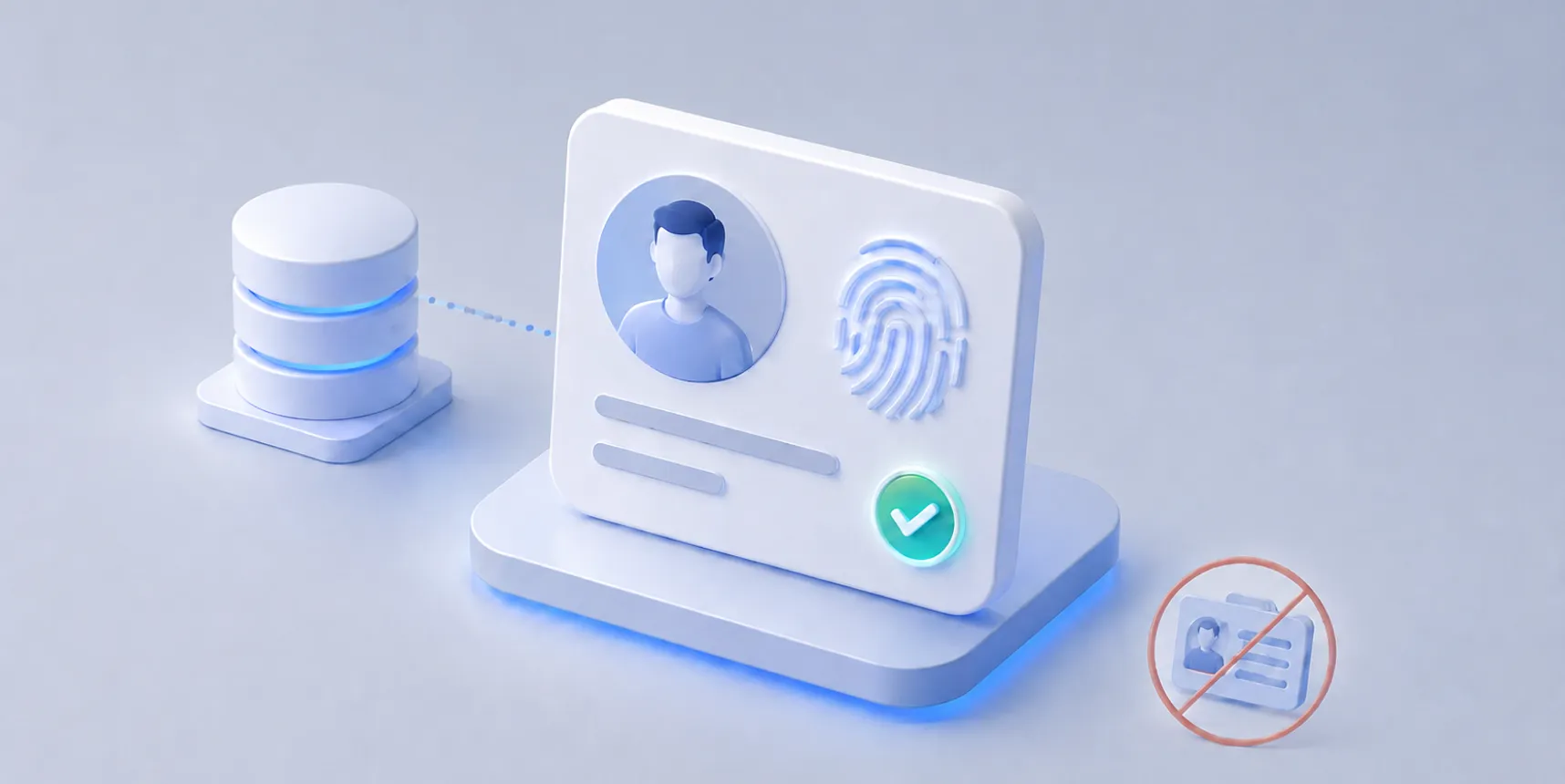
Non-document verification confirms a person’s identity using alternative data things like phone records, biometric signals, or database lookups instead of a scanned or photographed ID document.
It’s not a lesser form of verification. It’s a different evidence type, built for situations where speed and friction matter as much as certainty. Done well, it can be just as defensible as a document check; done poorly, it’s an easy target for fraud. The method matters more than the label.
Methods of Non-Document Verification
1. Database and Registry Lookups
The system cross-references the information a user provides (name, date of birth, address) against authoritative third-party databases, credit bureaus, government registries, or utility records to confirm the person exists and the details match.
2. Biometric Verification
A selfie or short video is matched against a previously verified biometric template, or checked for liveness to confirm a real person is present (not a photo, mask, or deepfake). This is one of the strongest non-document methods when paired with proper liveness detection.
3. Mobile and Carrier Data Checks
The system verifies that a phone number is active, registered to the claimed individual, and hasn’t recently been ported or swapped a useful signal against SIM-swap fraud and synthetic identities.
4. Knowledge-Based Authentication (KBA)
The user answers questions only they (in theory) would know drawn from credit history or public records. KBA is fast but increasingly weak on its own, since data breaches have made much of this information accessible to fraudsters too.
5. Behavioural and Device Signals
The system analyses typing patterns, device fingerprints, and session behaviour to flag anomalies bots, emulators, or known fraud devices without asking the user anything at all.
In practice, most non-document verification stacks combine two or more of these methods rather than relying on a single signal biometric matching plus a database lookup, for example, giving a stronger result than either alone.
Benefits of Non-Document Verification
Faster Onboarding
Without the steps of locating an ID, photographing it, and waiting for review, the entire process can complete in seconds rather than minutes.
Lower Abandonment.
Every extra screen or upload step in an onboarding flow is a chance for a legitimate customer to give up. Removing the document step removes that friction point entirely.
Reduced Document-Fraud Exposure.
Without an ID document in the flow, there’s nothing for a fraudster to forge, edit, or deepfake in the first place — the attack surface shifts rather than simply shrinking, but it removes one of the most common fraud vectors.
Lower Operational Cost
Automated checks against databases or biometric templates need far less manual review time than document verification, which often requires human judgement on edge cases.
Better Accessibility
Not every customer has a passport or driver’s licence on hand, or one that’s easy to photograph clearly. Non-document methods open onboarding to people who’d otherwise stall at the document-upload step.
Easier Re-Verification
Once a customer is verified once, confirming it’s still them later (login, high-value action, etc.) is far simpler with a biometric or OTP check than asking them to resubmit a document.
These benefits come with a condition: they hold up only when the method is matched to the right risk level. That’s the difference between non-document verification done well and non-document verification used as a shortcut covered in the Compliance Considerations section below.
Use Cases for Non-Document Verification
Digital Wallets and Neobanks: Fast account opening matters for conversion, and transaction limits at sign-up are often low enough that the regulatory risk is manageable without a full document check.
E-commerce Account Creation: Most online retail accounts carry no meaningful AML exposure, so non-document checks keep signup frictionless while still screening out bots and fake accounts.
Returning Customer Re-Authentication: Once identity has been verified once, biometric or OTP-based re-authentication confirms it’s still the same person without repeating document checks every session.
Gig Economy and Marketplace Onboarding: Platforms onboarding large volumes of workers or sellers use non-document checks for an initial fast pass, often layering in document verification later for higher-risk actions (e.g., payouts).
Low-value Crypto and Forex Onboarding: For accounts under regulatory thresholds, non-document verification supports faster onboarding while compliance teams reserve document checks for higher-tier accounts.
Compliance Considerations
Non-document verification isn’t exempt from KYC and AML obligations – it just satisfies them through a different evidentiary path. A few things compliance teams should confirm before relying on it:
- Check your Regulatory Tier: Many AML/KYC frameworks (and region-specific rules like the US BSA/FinCEN CIP requirements or the EU’s AML directives) set different evidentiary expectations by risk level and transaction size. Non-document methods are more defensible at lower risk tiers, less so at higher ones.
- Document the Decision Logic: Regulators and auditors will want to see why a given customer was routed through non-document verification rather than a document check risk-based segmentation needs to be explicit and recorded, not assumed.
- Match the Method to the Risk, Not the Other Way Around: Choosing non-document verification because it’s faster, without a documented risk justification, is a compliance gap waiting to surface in an audit.
- Reassess Periodically: A customer’s risk profile can change (larger transactions, flagged behaviour, sanctions list updates). Build in triggers that escalate a non-document-verified customer into a document check when warranted.
Non-Document vs. Document Verification: The Short Version
Non-document verification isn’t a replacement for document verification — it’s a complementary tool for the parts of onboarding where full document checks add friction without adding meaningful risk reduction. For a full breakdown of when to use which (and how to combine both in one onboarding flow), see our guide on choosing between document and non-document verification.
How Shufti Helps
Running non-document verification well means having the right methods available and the ability to prove, when asked, why a given customer was routed through one path and not another.
- Identity Methods: Combine biometric matching, database lookups, and mobile checks in whatever stack fits a given risk tier, rather than relying on a single signal.
- Journey Builder: Set the escalation logic upfront: customers start with non-document checks, and risk signals (transaction size, flagged behaviour, sanctions hits) trigger an automatic move into a document check.
- Behavioural Biometrics and Device Fingerprinting: Layer in passive fraud detection on top of any non-document method, with nothing extra for the user to do.
- KYC: Keeps the underlying regulatory obligation covered and documented, so the routing decision holds up under audit regardless of which method was used..
Final Thoughts
Non-document verification isn’t about skipping identity checks — it’s about matching the verification method to the actual risk in front of you. Used well, alongside a clear risk-based policy, it cuts friction for the customers who don’t need a full document check, while keeping document verification in reserve for the ones who do.
Book a Free Demo to see how Shufti applies the right verification method automatically, per customer.
Frequently Asked Questions
What is non-document verification?
Non-document verification confirms identity using data sources other than a scanned or photographed ID document such as database lookups, biometric matching, or mobile carrier checks.
Is non-document verification legal for KYC compliance?
Yes, in most jurisdictions provided the method and risk-based justification meet the applicable AML/KYC standard for that customer's risk tier. Requirements vary by region and industry, so this should always be confirmed against the specific regulatory framework that applies.
What's the difference between non-document and non-documentary verification?
They're the same thing "non-documentary verification" is simply the more formal/regulatory phrasing, often used in US compliance contexts, while "non-document verification" is the more common everyday term.
Can non-document verification be combined with document verification?
Yes. Most effective compliance programs use a hybrid, risk-based approach - non-document methods for low-risk onboarding, with an automatic escalation path to document verification when risk increases.
Is non-document verification less secure than document verification?
Not inherently. Security depends on which methods are used and how they're combined. Biometric-led non-document verification, for example, can be harder to spoof than a forged paper document. The right choice depends on the risk level of the use case, not a fixed security ranking between the two categories.