AMLR Solutions
  AMLR Consultation
 EUDI Wallet
 Onboarding
 Ongoing Monitoring
 FRAML
FRAML KYC
KYC KYB
KYB KYI
KYI Age Assurance
 Workforce IAM
 Candidate Verification
 Account Takeover
 Bonus/ Promotion Abuse
 Chargeback Fraud
 Deepfake
 Document Fraud
 Fraud Networks
 Impersonation Fraud
 Money Mule Activity
 Multi-Accounting
 Party Fraud
 Regulatory & Compliance Risks
 Synthetic Identity Fraud
 Adult Content
 Banking
 Crypto
 Fintech
 Forex
Forex Compliance
 Fraud prevention
 Trust & safety
 Global expansion
 Compliance Officers
 Developers
 Fraud Analysts
 Product Managers
 Journey Builder
  Global Trust Platform
 Customer Profiles
 Vendor Comparison
 IDV Case Management
 AML Case Management
 Regulatory Reporting
 Agentic Rule Builder
  AI Compliance Co-Pilot
  Fraud Analytics
 Fraud Hub
  OCR
OCR Shufti AI
 Bank Account Verification
  Biometric Duplication
 Database Checks
 Document Intelligence
 Government ID
 Mobile Driver's License
 NFC
NFC Selfie Liveness
 Brand Personalisation
 Deployment Options
 Identity Methods
 IDV Modes
 Multi-tenancy
 On-Premise IDV
 Secure Capture
 Shufti MCP
















Regulators no longer accept vendor self-certification on age verification. The UK’s Ofcom Age Assurance Standards (effective January 2025) and the EU’s Digital Services Act both require providers to demonstrate that their methods work, not just claim it. For compliance buyers, that creates one practical question: which vendors have faced independent scrutiny, and which haven’t?
Shufti recently entered the National Institute of Standards and Technology (NIST) Face Analysis Technology Evaluation (FATE) for Age Estimation and Verification (AEV). NIST FATE for age estimation is the most rigorous publicly available benchmark for facial age estimation technology. This post breaks down what the results show, where the limits are, and what they mean for your age assurance decisions.
What Is the NIST FATE Age Estimation Evaluation?
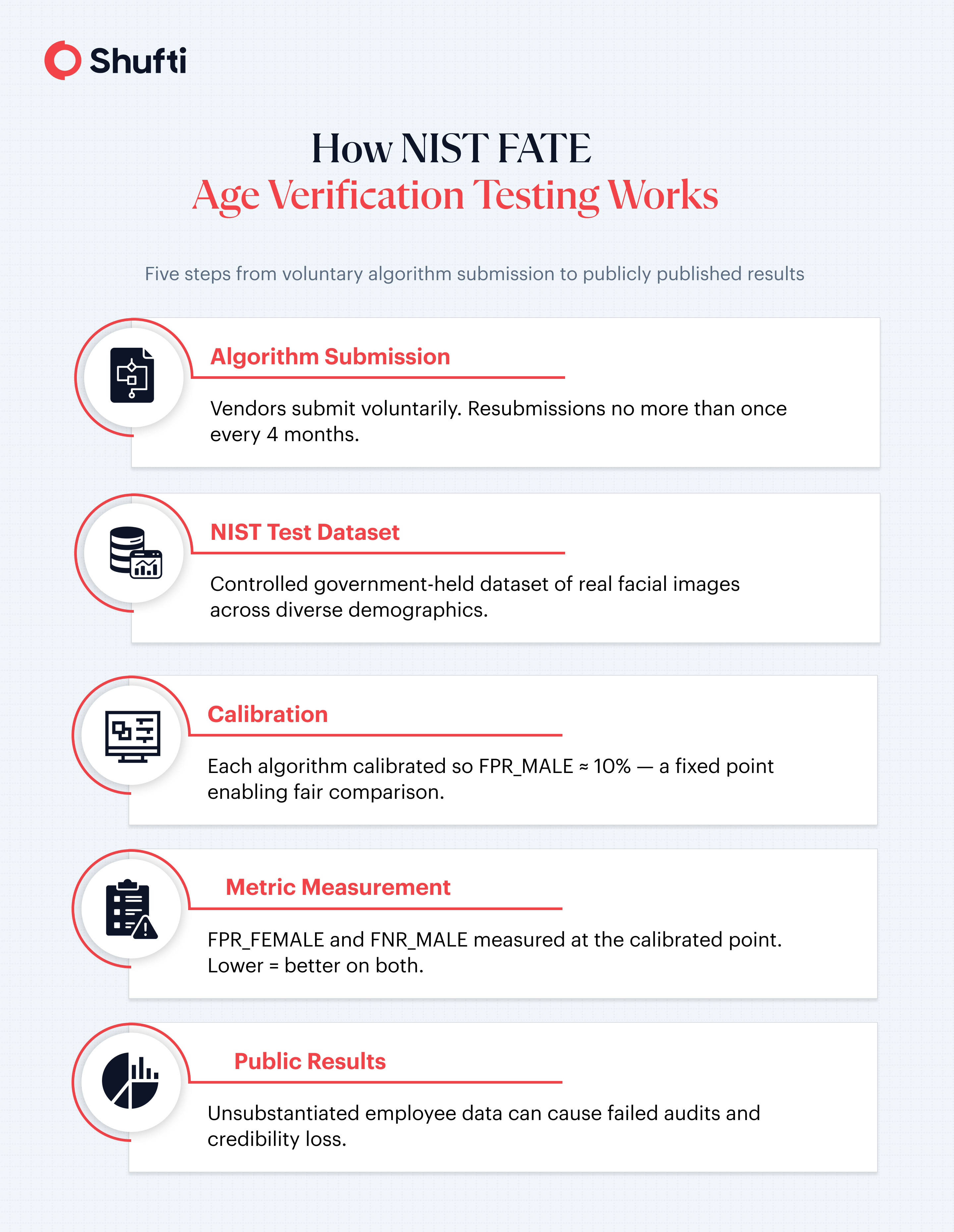
The NIST FATE Age Estimation and Verification (AEV) evaluation is an ongoing, vendor-neutral assessment run by the National Institute of Standards and Technology. Vendors submit algorithms; NIST tests them on controlled datasets and publishes results publicly, with no commercial relationship to any participant.
The evaluation runs several challenge tracks. The two most operationally relevant for regulated industries is Age Verification and Challenge 25, which measures how accurately an algorithm distinguishes whether a person is above or below a legally significant age threshold. Whether a user passes Challenge 25 or not is the kind of decision an online alcohol retailer, a gaming operator, or a social platform actually needs to make.
Unlike absolute age prediction tests, Challenge 25 maps directly to real deployment: a wrong decision in either direction carries regulatory or liability consequences.
Why Does an Independent Benchmark Matter for Buyers?
The age assurance market has no shortage of vendor claims. Accuracy figures quoted in sales decks are self-reported, tested on proprietary datasets, and rarely reproducible. NIST changes that.
A vendor who has submitted to NIST FATE AEV has accepted independent evaluation on a dataset they did not curate, agreed to public disclosure of results, including where performance falls short, and committed to ongoing submission as the evaluation continues.
For a compliance team defending its vendor selection to a regulator or legal counsel, that distinction carries weight. A vendor who has not submitted to any independent benchmark cannot offer the same level of documented assurance.
How Did Shufti Perform in NIST FATE AEV?
Shufti’s first submission (algorithm identifier: shufti_000) placed in the top 15 for Challenge 25, competing against established vendors who had previously submitted to the evaluation. For age verification accuracy, Shufti performed even better, ranking 3rd on some metrics and 6th overall.
Shufti Challenge 25 Results
That result matters because Challenge 25 is the track closest to production use. A top-15 placement on a first submission, against vendors with multiple prior submissions and larger optimisation cycles, is a credible performance signal.
The full results picture is more nuanced. Like all algorithms in the current evaluation cycle, Shufti’s model shows higher variance at the extremes of the age distribution that is for very young individuals and older adults. NIST notes that performance across all submitted algorithms varies by age group, image quality, demographic factors, and environmental conditions. Shufti’s results are consistent with that broader pattern.
The honest read: strong on the threshold decision that matters most for compliance, with room to improve on absolute age estimation accuracy at the tails. Both observations are published, verifiable, and available in the NIST results tables.
Shufti Age Verification Results
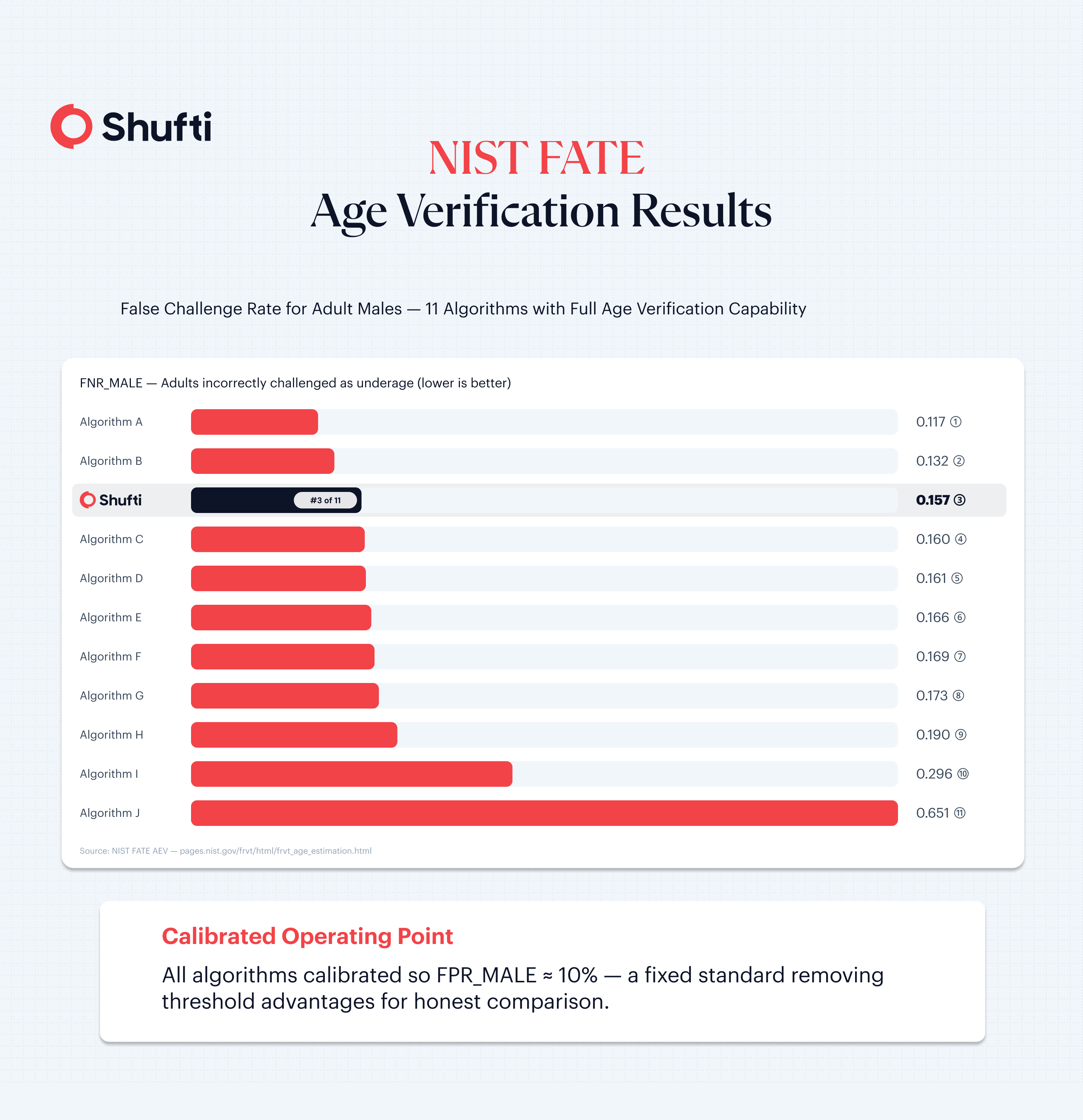
NIST ranked Shufti’s algorithm third on FNR_MALE among the eleven algorithms with full age verification capability, scoring 0.157. At the calibrated operating point, 15.7% of adult males in the government test dataset were incorrectly flagged as potentially underage, the third-lowest rate among all evaluated algorithms with the full binary age verification function.
On FPR_FEMALE, Shufti’s algorithm scored 0.202, ranking sixth lowest among the same eleven algorithms. At the calibrated threshold, 20.2% of underage females in the test dataset were incorrectly passed as adults. Both rankings were produced using NIST’s controlled test dataset, not Shufti’s internal benchmark.
For regulated platforms evaluating age verification options under Online Safety Act obligations or equivalent national requirements, NIST FATE results represent the kind of third-party evidence auditors and procurement teams can point to directly. A vendor’s self-reported accuracy figures, however strong, cannot substitute for an externally controlled benchmark administered by a government testing authority and published with no suppression option
What Does “Ongoing Evaluation” Mean in Practice?
The NIST FATE AEV is not a one-time certification. Vendors can resubmit improved algorithms as they update their models, and NIST publishes updated results continuously. Shufti’s debut is a starting point, not a final score.
That structure has two implications for buyers. First, a vendor’s current NIST standing reflects their most recent submitted model, not a static snapshot from a certification date. Second, vendors not listed in NIST FATE AEV results either have not submitted or had their submission rejected. Absence from the results table is itself a data point.
How Shufti Handles Age Assurance at the Threshold That Matters
Facial age estimation is one method among several. For a regulated deployment, it works best as part of a layered approach rather than a standalone gate.
Shufti’s age verification solution combines three methods.
AI-based age estimation, the model now independently benchmarked by NIST. Applies at the point of entry. Low friction, no document required for users who pass the confidence threshold.
Authoritative database lookup, cross-references age claims against third-party identity databases where regulatory requirements or risk appetite call for higher assurance.
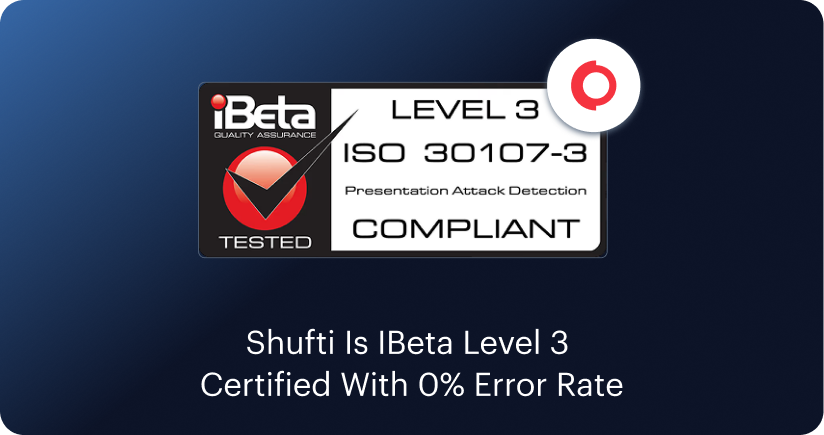
Document verification with optional liveness, the highest-assurance path, used when estimation or database checks fall below the required confidence level. Shufti’s face verification and liveness detection are iBeta Level 1 and Level 2 certified.
The layering logic is configurable. A gaming operator in a jurisdiction with a strict age threshold can route borderline estimation results directly to document verification without manual review. A social platform with lighter regulatory obligations can set a broader estimation confidence band before escalating.
This approach means your compliance posture is not defined by the weakest method in isolation. Where estimation is confident, it acts. Where it isn’t, a more authoritative check takes over. The NIST results give you documented evidence that the estimation layer performs at the threshold decision which is the one your legal team will ask about.
For the broader onboarding context, Shufti’s KYC infrastructure carries age assurance as part of a full identity workflow, not a bolt-on.
Shufti’s NIST submission is open to scrutiny, that’s the point. If you’re evaluating age assurance methods and want to see how the benchmark translates to a production deployment, request a demo and we’ll walk through the results and the layering logic with your team.
Frequently Asked Questions
What is the NIST FRTE 1:1 verification evaluation?
The NIST FRTE (Face Recognition Technology Evaluation) 1:1 verification test independently measures how accurately a face-matching algorithm can confirm that two images belong to the same person. NIST uses real-world datasets from border crossings, visa applications, mugshots, and kiosks, making it the most credible benchmark for face verification accuracy.
What does FNMR mean in face verification?
FNMR (False Non-Match Rate) is the percentage of genuine image pairs that the algorithm fails to match correctly. A lower FNMR means fewer legitimate users get incorrectly rejected. FNMR is always measured against a specific FMR (False Match Rate) threshold, which controls how strict the system is about preventing impostors.
How does Shufti's NIST score compare to its production accuracy?
NIST tests the face-matching algorithm in isolation, comparing single image pairs. In production, Shufti adds liveness detection, document forensics, injection attack prevention, and 500+ signals from its Fraud Probability Engine. The combined system catches fraud that a standalone face match would miss, and reduces false rejections through multi-signal decision logic.
Do all identity verification companies submit to NIST?
No. NIST participation is voluntary, and several major identity verification vendors have not submitted their face-matching algorithms for independent testing. If a vendor claims high biometric accuracy without a NIST report card, that claim has not been independently verified.