AMLR Solutions
  AMLR Consultation
 EUDI Wallet
 Onboarding
 Ongoing Monitoring
 FRAML
FRAML KYC
KYC KYB
KYB KYI
KYI Age Assurance
 Workforce IAM
 Candidate Verification
 Account Takeover
 Bonus/ Promotion Abuse
 Chargeback Fraud
 Deepfake
 Document Fraud
 Fraud Networks
 Impersonation Fraud
 Money Mule Activity
 Multi-Accounting
 Party Fraud
 Regulatory & Compliance Risks
 Synthetic Identity Fraud
 Adult Content
 Banking
 Crypto
 Fintech
 Forex
Forex Compliance
 Fraud prevention
 Trust & safety
 Global expansion
 Compliance Officers
 Developers
 Fraud Analysts
 Product Managers
 Advanced Journey Builder
  Global Trust Platform
 Customer Profiles
 Vendor Comparison
 IDV Case Management
 AML Case Management
 Regulatory Reporting
 Agentic Rule Builder
  AI Compliance Co-Pilot
  Fraud Analytics
 Fraud Hub
  OCR
OCR Shufti AI
 Bank Account Verification
  Biometric Duplication
 Database Checks
 Document Intelligence
 Government ID
 Mobile Driver's License
 NFC
NFC Selfie Liveness
 Brand Personalisation
 Deployment Options
 Identity Methods
 IDV Modes
 Multi-tenancy
 On-Premise IDV
 Secure Capture
 Shufti MCP















Every bank, financial institution, and business that still relies on free-text address fields for international payments is about to hit a hard wall. From November 2026, every cross-border payment processed through SWIFT must carry fully structured (or hybrid) postal addresses. Free-text address entries will be rejected outright.
Any business sending or receiving international payments has a chain of address data (customer records, counterparty details, and beneficiary) that was captured from databases that were never designed to store address data in a structured format. That data now needs to be read, parsed, validated, and restructured to meet Swift’s ISO 20022 data standard.
For institutions operating across borders, Swift’s migration to ISO 20022 by November 2026 creates a data quality crisis.
What does the ISO 20022 November Deadline Mean?
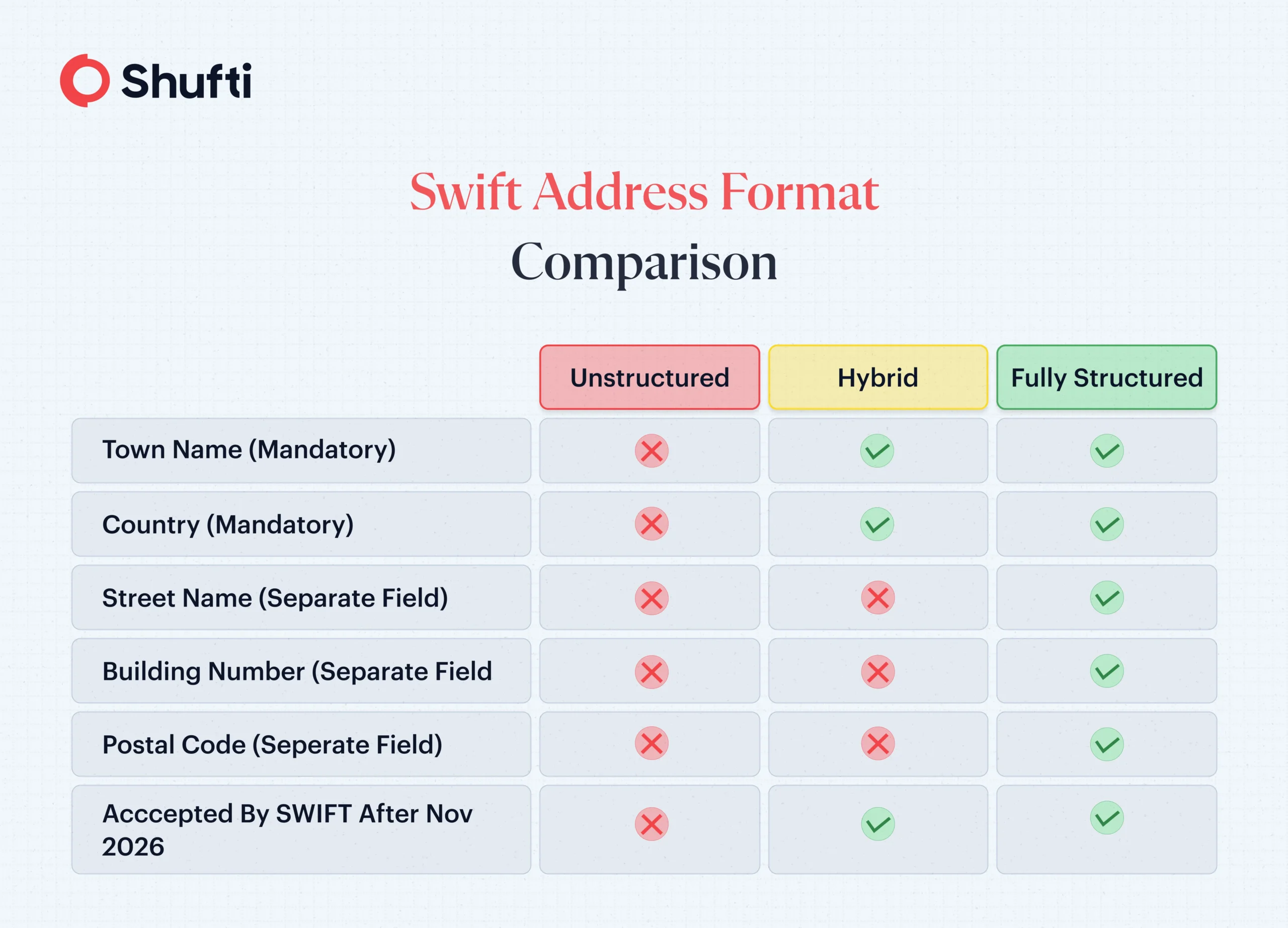
The Society for Worldwide Interbank Financial Telecommunication (SWIFT) is essentially a secure messaging network that carries instructions for fund transfers between banks. ISO 20022 is the data standard Swift has adopted to carry address information. Currently, there are three accepted address formats under ISO 20022:
1. Unstructured:
Unstructured addresses are simply crammed into free-text fields used by most businesses. An unstructured address looks like:
“Flat 5, AL Olaya District, Riyadh, Saudi Arabia”
All in one straight line, without any structured columns or spaces. While this may be readable to the human eye, computer systems struggle with identifying where the street name ends and the city name begins.
2. Hybrid:
The hybrid format is a compromise between an unstructured address and a fully structured address. It contains one free-text line with two mandatory structured fields for Town and Country. A hybrid address may look like this:
| Address Line: | Flat 5, xyz street, Al Olaya District |
| Town: | Riyadh |
| Country: | Saudi Arabia |
A hybrid address format shall be the minimum viable compliance with ISO 20022 after November 2026.
3. Fully Structured:
This is Swift’s preferred format. A fully structured address may use up to 14 distinct fields from street name to postal code. Every single component of an address lives in its own labeled XML tag.
Here’s what a structured address format looks like:
| Building Number: | 5 |
| Street Name: | XYZ |
| District: | Al Olaya |
| Town Name: | Riyadh |
| Postal Code: | 12211 |
| Country: | Saudi Arabia |
Every component of the address has its own distinct location, allowing computers to read and store address information clearly.
Unstructured postal will no longer be accepted by the Swift network after the deadline, resulting in a mandatory transition from free-text address fields to hybrid or fully structured ISO 20022 Cross-border Payments and Reporting Plus (CBPR+) formats, with mandatory fields for Town and country.
Why is Swift migrating?
Swift’s simple postal address format was built in the 1970s, an era of manual processing and correspondent banking relationships. The global payment system has since significantly outgrown that time, with payments now moving across 240+ countries and processed end-to-end by machines. With unstructured free-text address data, what is readable by human workers cannot be reliably interpreted by modern machines.
The new ISO 20022 standard solves this issue by requiring a mandatory structure in postal addresses.
Other factors supporting this decision include:
1. Global AML Standards:
The FATF’s 2025 Revision and the revised interpretive note introduce a strong directional requirement to Recommendation 16 (Payment Transparency). The revision suggests that information accompanying payments should be structured to comply with ISO 20022 standards to the extent possible, with cross-border payments and value transfers in excess of $1000 USD/EUR to include the beneficiary’s name, account number, country, and town name as the minimum required information.
This suggests that structured ISO 20022-aligned pan-network data is becoming the global standard.
2. Fraud Detection:
Discrete address fields feed directly into machine learning models that score transactions in real time, which enables faster, more accurate fraud detection across the payment chain.
3. Interoperability:
ISO 20022 is already mandatory for other regional/domestic payment systems such as SEPA in the EU, CHAPS in the UK, and RTP/CHIPS in the US, creating pressure on payment systems to adopt the same widely used structure.
Why Most Banks Are Not Ready For the ISO 20022 Deadline?
Shifting unstructured postal address data is not simply a reformatting task. Banks and other financial institutions with legacy databases containing unstructured addresses will have to undertake the complex task of restructuring every address to align with ISO 20022 standards.
Banks and other financial institutions need an address verification platform that can differentiate between regional complexities to restructure data as per the ISO 20022 standard.
Common problems include:
1. Limited Coverage:
Generic OCR tools have a Latin-first bias. Most verification systems were trained on Western document formats. For businesses with non-Western client postal addresses, scripts such as Arabic, Kanji, Cyrillic, and Devanagari are difficult for OCR engines to extract data from. When addresses are misread, incorrectly transliterated, or dropped entirely, payments may fail routinely.
2. High Error Margins:
In complex emerging markets, generic providers achieve around 82% accuracy on address extraction. Though that may sound like a high percentage, an 18% error margin results in several misread addresses and compliance roadblocks when thousands of cross-border payments are involved.
3. Address Variations:
Regional format changes make it worse. Address conventions vary enormously across markets. In Vietnam, administrative reforms in July 2025 restructured the entire national address hierarchy, with millions of proof of address records still reflecting the old system, and generic verification tools cannot interpret both.
4. Poor Document Quality:
In Brazil, many government-issued IDs are faded, paper-based, and printed with overlapping fields, causing automated systems to misread the CPF number that links an address to a verified identity. In Mexico, over fifty official ID formats are in active use, many with holographic overlays that obscure essential address fields. These are not edge cases. They are some of the world’s fastest-growing payment corridors.
Here’s Where Shufti Changes the Game
Shufti’s address verification platform was built for the exact complexity that ISO 20022 compliance demands. From reading, validating, and structuring addresses from source documents across every script, format, and region in which businesses may operate.
Shufti’s in-house OCR is trained on 10,000+ document types across 150+ languages, with native support for Arabic, Kanji, Cyrillic, Devanagari, Ge’ez, and more. Benchmarked against Google OCR across nine languages, Shufti matches or exceeds it in six of them. In complex markets like Vietnam, Brazil, and the Middle East, Shufti achieves ~96.79% extraction accuracy versus ~82% with generic providers.
It achieves this by structuring data at the point of verification, by decomposing the address into discrete labeled fields (house, street, region, and postal code) in ISO 20022-compliant format.
Don’t let an address field block international payments. Book a demo with Shufti and see exactly where address data stands against the ISO 20022 standard before Swift enforces it.