AMLR Solutions
  AMLR Consultation
 EUDI Wallet
 Onboarding
 Ongoing Monitoring
 FRAML
FRAML KYC
KYC KYB
KYB KYI
KYI Age Assurance
 Workforce IAM
 Candidate Verification
 Account Takeover
 Bonus/ Promotion Abuse
 Chargeback Fraud
 Deepfake
 Document Fraud
 Fraud Networks
 Impersonation Fraud
 Money Mule Activity
 Multi-Accounting
 Party Fraud
 Regulatory & Compliance Risks
 Synthetic Identity Fraud
 Adult Content
 Banking
 Crypto
 Fintech
 Forex
Forex Compliance
 Fraud prevention
 Trust & safety
 Global expansion
 Compliance Officers
 Developers
 Fraud Analysts
 Product Managers
 Journey Builder
  Global Trust Platform
 Customer Profiles
 Vendor Comparison
 IDV Case Management
 AML Case Management
 Regulatory Reporting
 Agentic Rule Builder
  AI Compliance Co-Pilot
  Fraud Analytics
 Fraud Hub
  OCR
OCR Shufti AI
 Bank Account Verification
  Biometric Duplication
 Database Checks
 Document Intelligence
 Government ID
 Mobile Driver's License
 NFC
NFC Selfie Liveness
 Brand Personalisation
 Deployment Options
 Identity Methods
 IDV Modes
 Multi-tenancy
 On-Premise IDV
 Secure Capture
 Shufti MCP












Reportedly, 68% of EU consumers abandoned a financial application during digital onboarding in 2021. While there could be different reasons for this, friction due to inefficient identity verification is one of them. That’s where an innovative approach to identity verification that provides the required level of trust with minimal friction becomes essential.
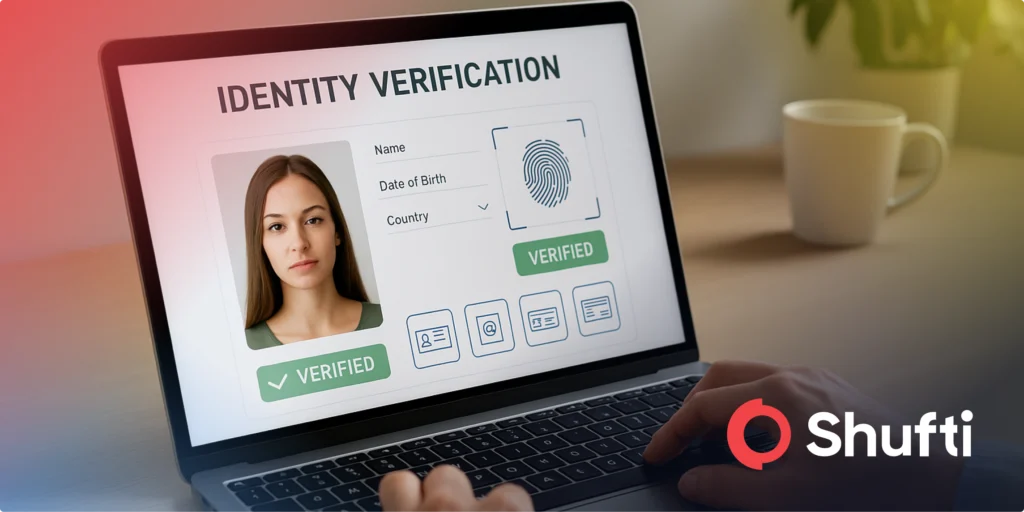
Identity verification (IDV) is a core pillar of trust in many industries. From financial institutions and online services to healthcare and government, IDV solutions are utilized to help achieve security, prevent fraud, and stay compliant. The process of verifying a person’s identity through legal documentation is augmented by matching a user’s selfie to a picture of the person during the verification process and using liveness detection features. While it is essential to verify identity accurately, this must also be done seamlessly from the customer’s perspective.
Businesses should implement identity verification that not only prevents revenue loss from customer drop-offs caused by friction in onboarding but also protects against fraud.
Let’s explore how to choose the best identity verification software that can help your business automate the IDV process without compromising the user experience.
What is Identity Verification Software?
In the digital-first world, where face-to-face interactions are declining, identity verification software acts as a core pillar to build trust. An identity verification software that verifies persons using identity documents, facial biometrics, government eID, and private databases is a need of the hour.
FinTechs and a number of other digital-first businesses heavily count on these technologies to simplify remote customer onboarding. By deploying the IDV solution, companies automate customer onboarding, enabling customers to be validated remotely, promptly, securely, and at scale.
To choose the right identity verification vendors, businesses need to be aware of their regulatory obligations, needs, and their impact on end users.
Why Do Different Sectors Need Identity Verification?
Numerous industries that have exposure to fraud, regulatory scrutiny, or high-value transactions rely on identity verification for maintaining trust and protecting customers. Failure of the robust IDV in these regulated sectors results in financial loss and compliance breaches, reputational damage, and disrupted operations.
Fintechs: Businesses operating in the Fintech industry must meet global regulatory expectations. However, the fact that these businesses usually operate remotely and digitally makes them vulnerable to fraud like synthetic identities and account takeover. Therefore, Fintechs may need an Identity Verification solution that provides a higher level of assurance in digital onboarding. It can help regulated businesses not only meet strict Know Your Customer and AML requirements but also secure onboarding and support expansion across the marketplace.
Public Sectors: Digital Identity Verification is at the core of the government’s digital public infrastructure programs. Governments are using the verify once, verify for all approach to enable access to government services such as online tax portals, welfare benefits, and healthcare systems. However, identity verification solutions that don’t offer privacy-friendly integration, have higher verification response times, or are not inclusive enough, are not ideal for the public sector.
Corporate: Businesses that deal with customers need to verify individuals and companies to validate suppliers, contractors, and partners. This is because opaque ownerships and fraudulent vendors can expose organizations to regulatory, reputational, and financial risks. Hence, the right IDV solution for organizations should include Know Your Business checks, UBO verification, along with AML and Sanctions Screening. The software should also be able to seamlessly integrate with the procurement and onboarding systems of a business.
E-commerce: While Banks and FinTechs need Identity verification to comply with KYC laws, e-commerce platforms need a solution that can secure users throughout their journey and prevent fraud. This is because of their higher vulnerability to phishing. The Optimal IDV solution for e-commerce shouldn’t only have document verification and liveness detection, but also device fingerprinting and behavioral biometrics.
Crypto and gaming: Crypto exchanges and gaming platforms need to verify real users, enforce age limits, and prevent fraud. Apart from regulatory requirements, these sectors face abuse of referral programs and sign-up bonuses with the creation of fake accounts. With the innovative IDV solution, businesses in these sectors can ensure age checks, biometric verification, global document coverage, and automated AML screening while keeping the onboarding experience smooth and frictionless for the end users.
Features to Look for When Selecting Identity Verification Software
When finding the best identity verification software for your business, you should look for features that align with your business goals and regulatory needs.
-
Document Verification
One of the must-haves of an IDV solution is the ability to verify diverse identity documents. This includes but is not limited to:
- Driver’s license
- Birth certificates
- ID cards
- Passports
- Utility bills
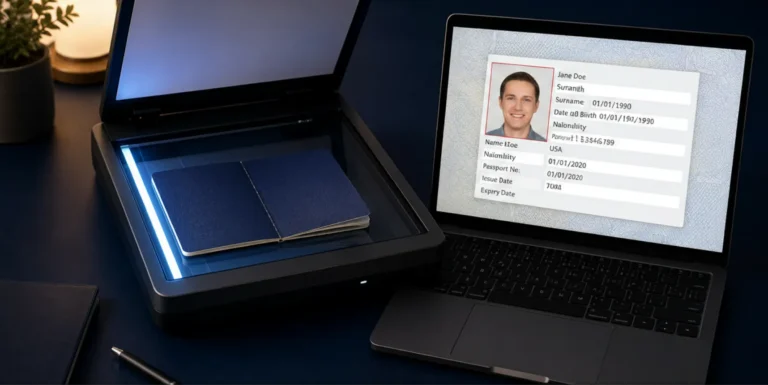
What this means is that an IDV software should have the ability to capture an ID and extract information accurately through OCR technology, along with validating security features and machine-readable zones.
To ensure accurate document verification across diverse regions and languages, the system must be able to handle more than just standard Latin-based characters.
-
OCR Support for Non-Latin Documents
For businesses to expand across the globe, choosing an identity verification solution to verify documents in non-Latin languages with OCR capabilities is imperative. Enterprises engage in multilingual, multicultural contexts, yet choosing the solution with limited Latin language document capabilities means they require third-party vendors.
-
Customizable User Workflows
Every business has its unique verification challenges based on the industry and regulations. A one-size-fits-all verification approach, therefore, does not work. Businesses need customized user verification workflows built to support their unique needs. Your IDV solution must have the ability to customize user verification workflows to lead to smoother operations, a better user experience, and meet regulatory requirements.
-
Electronic Identity Verification (eIDV)
Globally, governments are implementing digital IDV programs, including national digital IDs and bank IDs, with the aim of easing and securing identity verification. Digital identities allow for instant, frictionless onboarding without any manual uploads, redirects, or logins.
With eIDV, customers provide their information (name, address, and date of birth), and their identity is verified within seconds through the respective digital ID. It makes the process faster and easier.
From an organization’s perspective, it is imperative that the IDV solution not only authenticates traditional documentation, such as driver’s licenses or passports, but also offers non-doc Identity verification by integrating with digital IDs.
-
Facial Biometrics with Liveness Detection
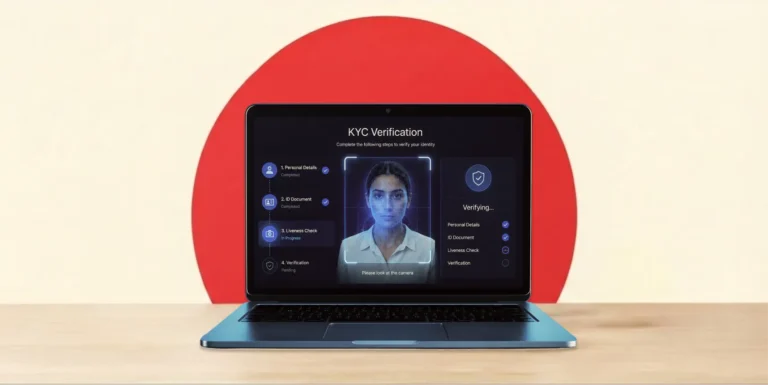
Sectors using identity verification for remote onboarding must choose a vendor with robust liveness detection for a higher level of assurance in onboarding. Fraudsters attempt face swaps, replayed videos, and printed images as a way to defeat selfie checks. Liveness verification confirms that the capture is of a real, present individual. It is not only for secure onboarding but also to minimize account takeovers and chargebacks.
-
Know Your Business
Apart from onboarding businesses for AML-regulated services, companies today also need to verify their partners, vendors, and suppliers to ensure they are transparent and legitimate. This involves implementing due diligence to verify the key details about the business itself and its key individuals (UBOs, directors, and managers). An identity verification software must have an effective Know Your Business feature to verify business details and screen a business and its key personnel against watchlists, regulatory enforcement, and adverse media.
-
AML and Sanctions Screening
Regulators worldwide require businesses to block sanctioned entities and apply enhanced due diligence when dealing with PEPs and other risky entities with negative media coverage. Any misses can create legal risk and fines. On the other hand, over-flagging the wrong people can create backlogs and customer churn. Getting AML right is both a compliance and a growth concern for firms.
-
Case management and reporting
Businesses need to resolve edge cases quickly and prove to auditors what happened when and why. After initial identity verification and AML risk assessment, case management is another important task. Ensuring and verifying whether a flagged identity is actually high risk in line with the Customer Identification Program or AML is essential to prevent unnecessary customer offboarding and to prevent the boarding of high-risk customers.
An IDV software that doesn’t have strong case tools can cause teams to drown in screenshots and email threads, which slows onboarding and increases error rates.
Choosing the IDV Software that is Best for Your Business
An IDV software may claim to be the best in the market, but is it best for your business? In the business ecosystem, every company has different needs and resources to determine the choice that suits them. That said, on top of required features, there are some important factors to consider when picking a suitable IDV vendor and making decisions regarding a new implementation.
-
Global Coverage and Accuracy
Identity document formats vary across the globe. The IDV vendor’s ability to support the documents and countries you actually serve is paramount. Conversely, if it can’t accurately verify multiple identity documents, the software will become more of a liability than a company’s asset.
-
Good User Experience
Businesses should choose software that scales with their growth. If this doesn’t happen, it can be another bottleneck. For any client, hundreds of error messages or loading screens are a frustrating experience, let alone the potential risks of security issues due to overwhelmed IDV software. Additionally, if a customer doesn’t possess a physical ID to prove their identity, it’s a lose-lose situation for both the business and the end user. Therefore, the IDV software should be able to adapt and switch to alternative methods, like verification via online databases.
-
Data Protection and Privacy
Since identity verification solutions use sensitive customers’ data, it is important to consider strong security measures. Firstly, make sure the data is encrypted both when it is sent and stored. Secondly, a solution should be able to set strict access controls to limit who can view or handle the information. Finally, an IDV solution should also set and enforce data retention and deletion timelines according to your company’s policies.
-
Continuous Innovation for Fraud Prevention
The best IDV solutions are proactive, adapting quickly to new and emerging fraud tactics. Detecting fraud, deepfakes, and synthetic identities early in the process ensures that your verification system is a strong fraud prevention tool throughout the customer journey. Always choose a provider that continuously improves its solution to stay ahead of evolving threats. This is only practicable when a solution is built from scratch with its in-house team of experts.
-
Integration and Time to Value
Technology that takes a month to wire up isn’t good. Before choosing the IDV software, make sure to consider whether it can easily connect with current systems for a smooth transition. This can also be done by asking some questions, such as how many employees are needed to implement the solution? How long will it take until it is available for clients? These questions may help determine if an IDV software is right for your business.
-
Reliability and Tech Stack Ownership
You are selecting a partner, not a product. Meet with your partner to discuss historical uptime, incident response processes, and the frequency of model and list updates. Ask for references in your space, and agree on your partner’s roadmaps that align with the markets you are planning to enter.
Additionally, the reliability of IDV software is affected by its ability to handle unique verification requirements. IDV solutions that lack an in-house tech stack are outsourced to third parties for features like non-Latin OCR or for verification of documents that do not meet the ICAO requirements. While this may seem cheaper, it creates additional risk and delays, ultimately leading to higher costs. It’s always best to select an IDV solution that provides a consistent, frictionless onboarding experience.
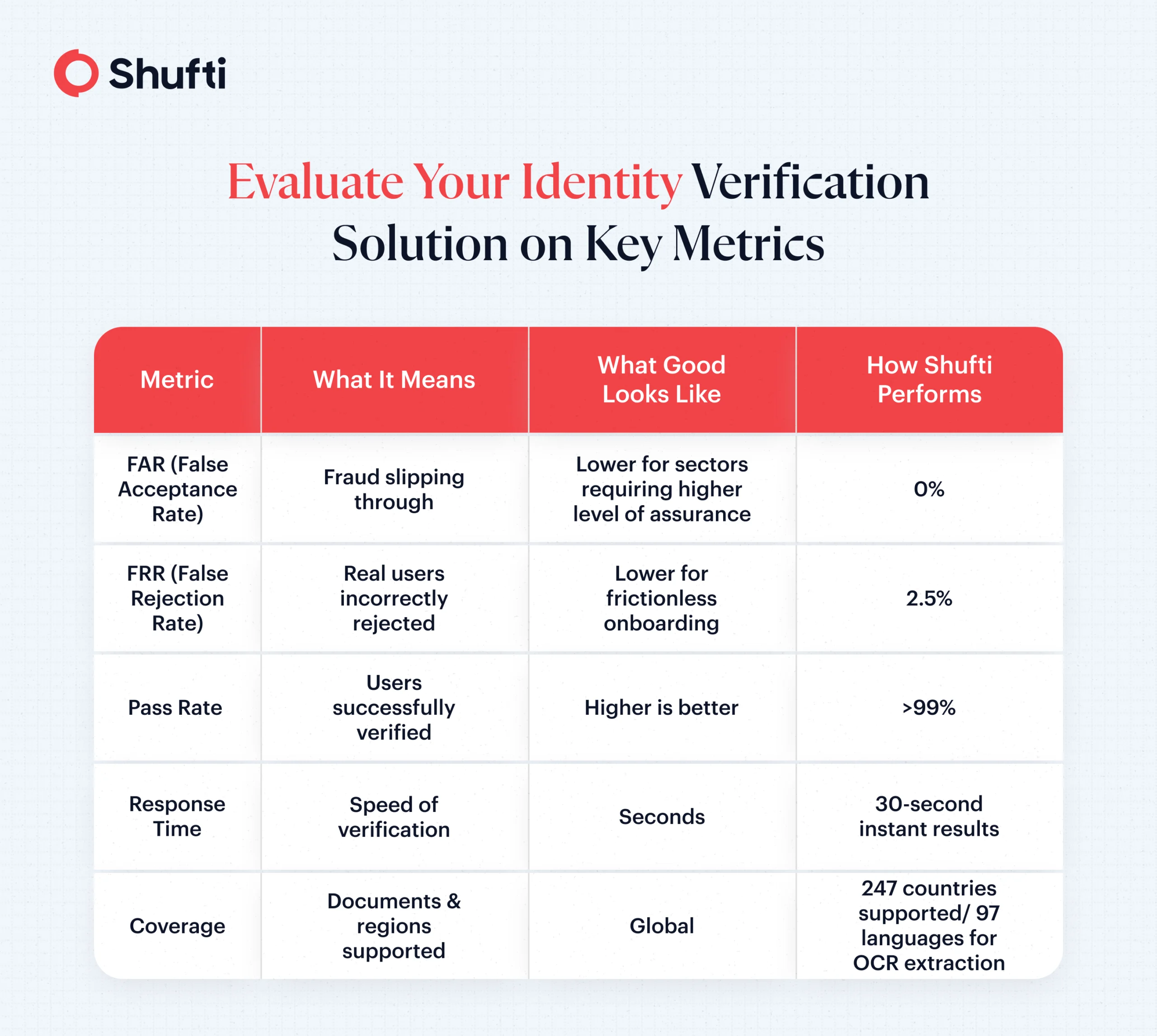
How Shufti Secures Digital First Enterprises Against Fraud?
Digital-first companies need identity verification software to onboard users securely while providing a smooth, scalable experience. This is because fraud today has evolved beyond document tampering to deepfakes, synthetic identities, device spoofing, and account takeovers. Therefore, the right identity verification platform must go beyond basic checks and include real-time fraud signals, biometric liveness, eID verification, and behavioral intelligence to protect users end-to-end.
Shufti is an Identity Verification Solution tailored to the needs of Digital First Enterprises. It provides businesses with an edge in fighting fraud because of its in-house technology built from scratch.
Our solution empowers businesses with:
- Custom verification workflows that fit the industry’s needs and risk level
- Latin and non-Latin document support with native OCR accuracy
- Verification of diverse identity documents and proof of wealth
- Standardized name and DOB matching for clean screening
- AI-powered verification strengthened by human intelligence
- eID interoperability for fast and secure onboarding
- Device fingerprinting and behavioral analysis for proactive fraud defense
- Account takeover protection and bot-detection capabilities
To discover how Shufti’s identity verification solution can be the best fit for your business as well as the end-users, request a demo.
Frequently Asked Questions
What is ID Verification Software?
ID verification software is a digital tool that automates the process of verifying a person's identity using documents, biometrics, and trusted databases to enhance security and ensure compliance.
What features should businesses prioritize when selecting the best ID verification software?
Businesses should focus on accuracy, fast processing, multi-channel support (documents, biometrics), compliance with KYC/AML regulations, and strong security features to prevent fraud.
How is identity verification software different from manual checks?
Identity verification software is faster, more accurate, and reduces human error by automating the verification process, ensuring reliable and consistent results.
What makes Shufti’s identity verification solution unique?
Shufti’s identity verification solution offers advanced AI-driven technology, real-time document and facial recognition, and global data access, making it a highly accurate and secure choice for businesses.