


 Face Verification
 Address Verification
 Document Verification
 Age Verification
 VideoIdent
 Fast ID
 eIDV
eIDV
 Consent Verification
 NFC Verification
 Business Verification
 Due Diligence
 Investor Verification
 E-Signature

 QES
QES
 AML Screening
 Transaction Monitoring
 Adverse Media
 Business AML Screening
 PEP & RCA
 Sanctions
 Watchlist
 Behavioural Biometrics
 Device Fingerprinting
 1:1 Authentication
 MFA
MFA
 Fraud Hub
 Onboarding
 Ongoing Monitoring
 KYC
KYC
 KYB
KYB
 KYI
KYI
 Age Assurance
 Identity Verification
 Workforce IAM
 Candidate Verification
 Compliance
 Fraud prevention
 Trust & safety
 Global expansion
 Product Managers
 Compliance Officers
 Fraud Analysts
 Developers
 Deepfake
 Bonus Abuse / Promotion Abuse
 Account Takeover
 Synthetic Identity Fraud
 Document Fraud
 Impersonation Fraud
 Multi-Accounting
 Fraud Networks
 Chargeback Fraud
 Money Mule Activity
 Party Fraud
 Regulatory & Compliance Risks
 Fintech
 Crypto
 iGaming
 Forex
Forex
 Social Network
 Marketplace
 Banking
 Gig Economy
 Blind Spot Audit
 Deepfake Detector
 Liveness Spoofs
 Document Originality
 Document Deepfake
 Global Trust Platform
 Journey Builder
 Case Management
 Shufti AI
 Fraud Analytics
 Vendor Comparison
 Brand Personalisation
 IDV Modes
 AI Compliance Co-Pilot
 OCR
OCR
 Secure Capture
 Deployment Options
 Identity Methods
 API Documentation
 Mobile SDKs
 Service Status
 Help Center
 Contact Us
 Technical Support
 Supported Documents
 Content library
 Blogs
Blogs
 News
News
 Reports
 Insights
 Knowledgebase
 ROI calculator
 About
About
 Career
 Press Release
 Certifications
 Partnership
 Awards
 Events & Webinar
 Interactive Demo
 Podcast Studio
 Spotlight Studio
What Sets Top Identity Verification Providers Apart
TL;DR
-
Feature checklists alone won’t reveal whether you’ll regret a provider in 18 months.
-
Seven deeper criteria separate reliable IDV partners from risky ones.
-
In-house AI gives one provider control over training data, updates, and accuracy.
-
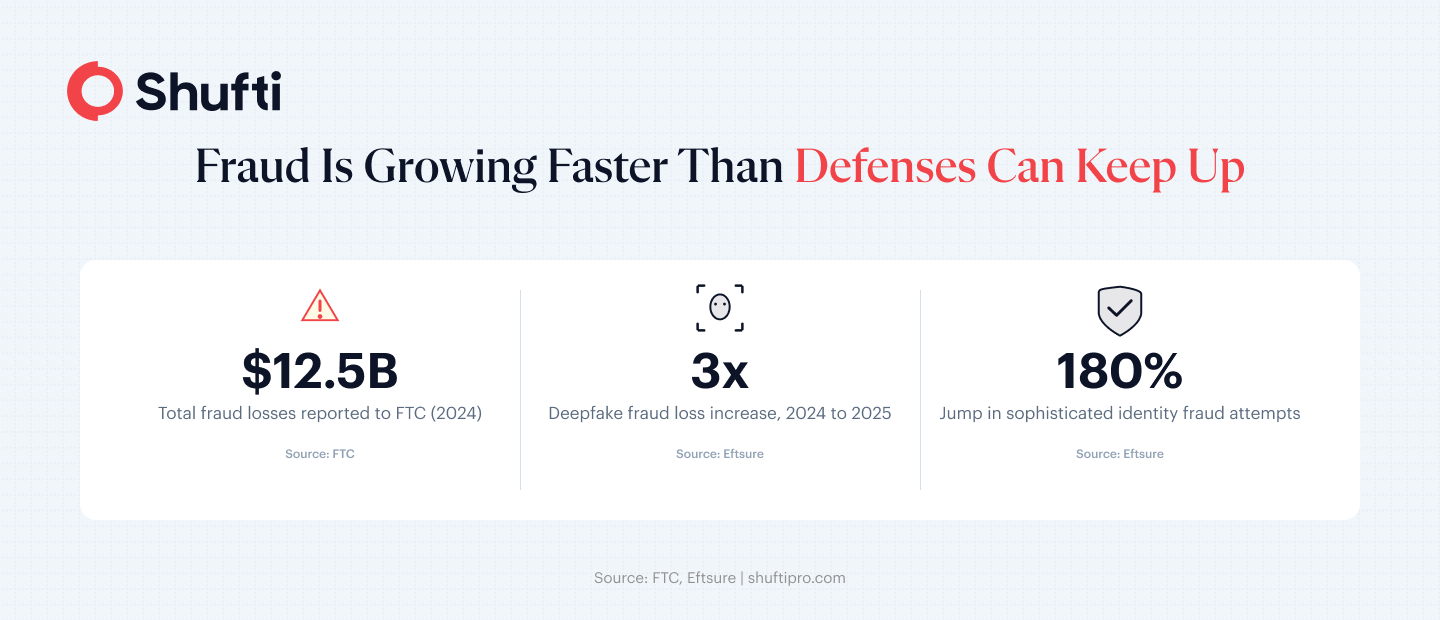
Fraud losses reported to the FTC exceeded $12.5 billion in 2024, up 25%.
-
Ask about FAR/FRR, deepfake resilience, deployment, certifications, support, and pricing.
Fraud losses reported to the FTC exceeded $12.5 billion in 2024, up 25% from the year before. Deepfake-related fraud alone tripled to $1.1 billion in 2025. For businesses building or rebuilding their onboarding stack, the pressure to pick the right identity verification provider has never been higher.
The problem is that most vendor evaluations stop at the feature checklist: document types supported, biometric accuracy, API response time. Those are table-stakes. The things that actually determine whether you’ll regret a provider decision 18 months from now are harder to spot on a sales deck. This article covers seven of them.
Why Feature Lists Alone Won’t Protect You
Every identity verification provider on the market can show you a slide with impressive numbers. High pass rates, broad document coverage, fast response times. But the identity verification market is projected to reach $29.32 billion by 2030, which means the vendor market is crowded and growing. More options doesn’t mean better options. The real differentiators show up in how a provider built their technology, how they handle edge cases, and what happens when something goes wrong on a Friday night.
Here’s what to look for beyond the feature matrix.
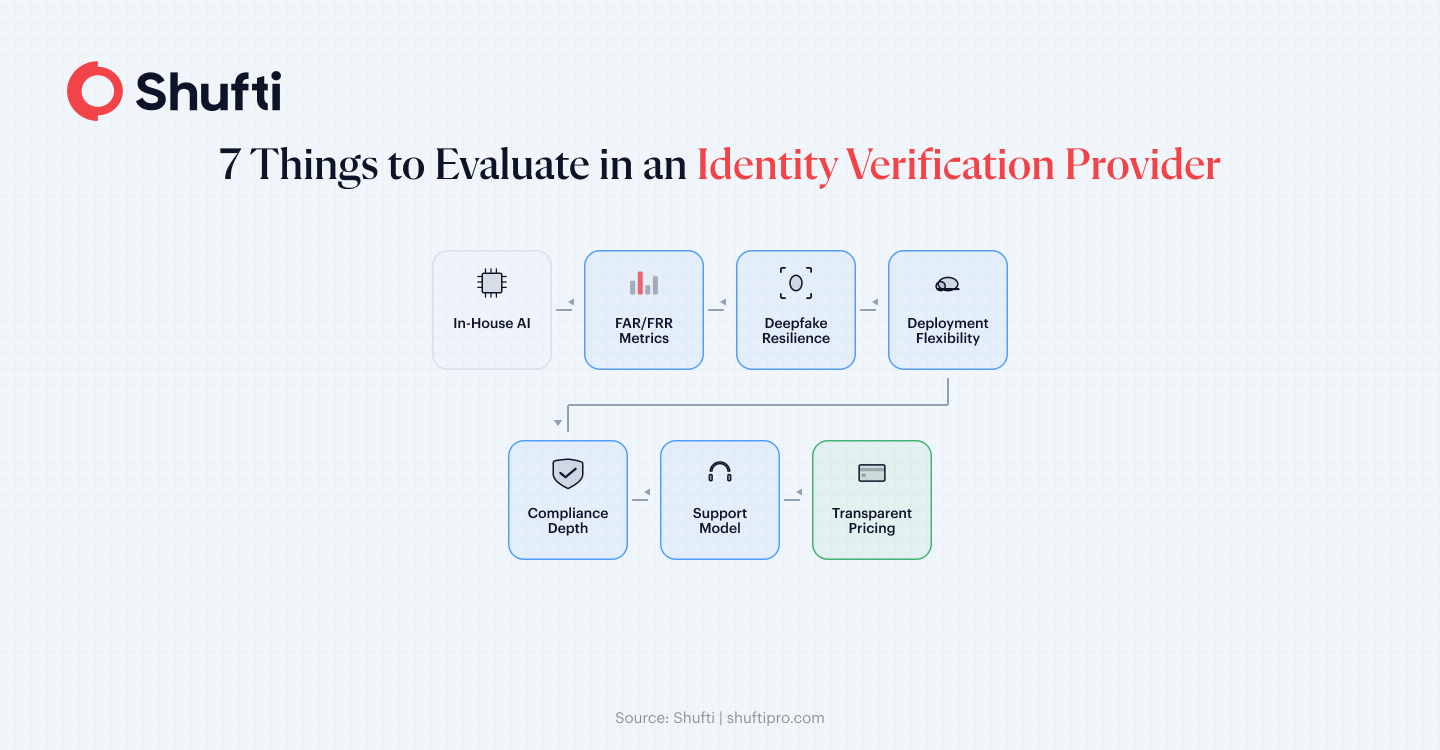
7 Things to Evaluate in an Identity Verification Provider
1. In-House AI vs. Third-Party Patchwork
Some identity verification providers build their own machine learning models from scratch. Others stitch together third-party APIs for OCR, biometrics, and liveness detection from separate vendors. The difference matters more than most buyers realise.
When a provider owns their AI pipeline end-to-end, they control training data, model updates, and accuracy tuning. When they outsource, each component has a different update cycle, a different SLA, and a different failure mode. Ask your shortlisted vendors directly: “Which parts of your verification stack are built in-house, and which are licensed from third parties?”
2. FAR and FRR: The Metrics That Actually Matter
Pass rates get the headline, but false acceptance rate (FAR) and false rejection rate (FRR) tell you what’s actually happening. FAR measures how often the system lets a fraudulent identity through. FRR measures how often it wrongly rejects a legitimate user.
NIST uses Detection Error Tradeoff (DET) curves as the industry standard for measuring this trade-off. A provider quoting a 99% pass rate without context could be accepting too many bad actors. Ask for FAR and FRR numbers at specific thresholds, and ask how they benchmark against NIST’s biometric evaluation standards.
3. Deepfake and Injection Attack Resilience
Deepfakes are no longer an edge case. The most sophisticated identity fraud attempts jumped 180% in 2025, and NIST SP 800-63A-4 now explicitly requires controls for injection attacks and forged media.
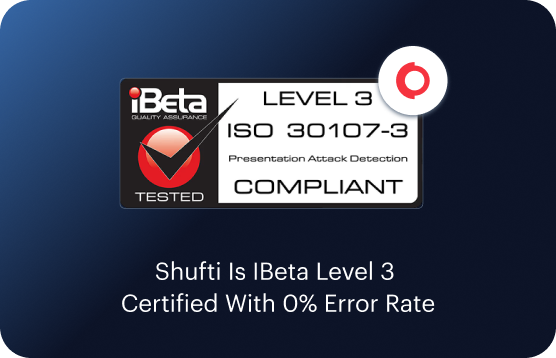
Your identity verification provider should be able to explain their specific approach to detecting presentation attacks (printed photos, screen replays), injection attacks (manipulated video feeds), and AI-generated synthetic faces. If the answer is “we use liveness detection,” push harder. Ask what kind, how it’s tested, and whether it’s certified by a lab like iBeta.
|
Criterion |
What to look for |
|
AI ownership |
In-house pipeline, not third-party patchwork |
|
FAR and FRR |
Numbers at specific thresholds, NIST DET benchmarks |
|
Deepfake resilience |
Presentation, injection, and synthetic-face detection |
|
Deployment |
Cloud, on-prem, or hybrid options |
|
Compliance |
PCI DSS, SOC 2, ISO 27001, iBeta Level 1,2 and 3 |
|
Support |
24/7 human review and escalation paths |
|
Pricing |
Transparent total cost of ownership |
4. Deployment Flexibility: Cloud, On-Prem, or Hybrid
Regulated industries like banking, healthcare, and government often can’t send biometric data to a shared cloud. If your provider only offers cloud-based verification, you may hit a compliance wall the moment your legal team or a regulator asks where facial data is processed.
Look for providers that offer on-premises deployment, hybrid models, or both, alongside a cloud option. A single API that supports multiple deployment modes saves you from re-platforming later when regulatory requirements shift. This is especially relevant for organisations operating under GDPR, where data residency requirements can dictate architecture decisions.
5. Compliance and Certification Depth
Certifications aren’t marketing badges. They’re evidence that a provider’s security controls have been independently audited. At minimum, your identity verification provider should hold PCI DSS, SOC 2, and ISO 27001 certifications. For biometrics, iBeta Level 1 and Level 2 testing confirms that liveness detection meets NIST’s presentation attack detection standards.
Beyond certifications, check whether the provider actively tracks regulatory changes in your operating regions. A provider serving gambling platforms in Germany should understand KJM requirements. One serving banks in the EU should be fluent in the Anti-Money Laundering Authority (AMLA) and the regulatory changes it brings.
6. Support Model: What Happens at 2 AM?
Automated verification handles the majority of checks, but a percentage of sessions will always need human review: damaged documents, unusual lighting conditions, rare ID formats. What matters is what happens to those sessions.
Ask whether your provider offers 24/7 human review support or routes unclear cases to a queue that gets checked during business hours. For high-volume businesses, a four-hour delay on manual reviews means four hours of onboarding friction for real customers. Also ask about dedicated account management, integration support during implementation, and escalation paths when something breaks.
7. Transparent Pricing and Total Cost of Ownership
Identity verification pricing models vary wildly: per-verification, per-user, tiered, or bundled with other compliance products. The sticker price per check rarely tells the full story.
Ask about costs for additional features that some providers charge separately: document verification, face matching, AML screening, and ongoing monitoring. Ask about volume discounts, minimum commitments, and what happens to your per-unit cost if verification volumes spike. A provider that bundles core verification services under a single contract often delivers better long-term value than one that nickel-and-dimes each capability.
How Shufti Meets These Criteria
Shufti was built to address exactly the gaps described above. The platform runs on 100% proprietary AI, with no third-party dependencies across the verification pipeline, from auto-capture SDKs to forensic document analysis.
On accuracy, Shufti delivers a 99.3% true detection rate and 98.72% facial biometrics accuracy, backed by iBeta Level 1 and Level 2 certification. The platform supports 10,000+ document types across 230+ countries and processes verifications in under 15 seconds.
For deployment, Shufti offers cloud, on-premises (zero-trust), and hybrid options through a single API. Certifications include PCI DSS, SOC 2, ISO 27001:2013, GDPR, and CCPA compliance. The platform was also recognised as a Top Performer in the DHS RIVR 2025 evaluation.
If you’re currently evaluating identity verification providers and want to see how these criteria apply in practice, request a demo.
Frequently Asked Questions
What makes a great identity verification provider?
A great identity verification provider combines proprietary AI, certified biometric accuracy (including iBeta and NIST benchmarks), flexible deployment options (cloud, on-prem, hybrid), deep compliance coverage, transparent pricing, and responsive support. The best providers own their full technology stack rather than assembling third-party components.
What is false acceptance rate (FAR) and why does it matter when choosing a provider?
FAR measures how often a verification system incorrectly accepts a fraudulent identity. A low FAR means fewer bad actors get through. When evaluating providers, ask for FAR numbers at specific confidence thresholds rather than relying on general "accuracy" claims. NIST's DET curve methodology is the industry standard for benchmarking.
Should I choose an identity verification provider with in-house or third-party AI?
In-house AI gives the provider full control over training data, model updates, and accuracy tuning. Third-party AI means each component may update on different cycles with different SLAs. For long-term reliability and faster response to new fraud vectors like deepfakes, in-house AI is the stronger foundation.
What data privacy standards should an identity verification provider meet?
At minimum, look for PCI DSS, SOC 2, and ISO 27001 certifications. For biometrics, iBeta Level 1 and Level 2 testing is essential. Depending on your operating regions, GDPR compliance, CCPA, and data residency capabilities may also be non-negotiable. Ask where biometric data is processed and stored.
How do I evaluate an identity verification provider's pass rate claims?
Pass rates alone can be misleading. A high pass rate could mean the system is too lenient (high FAR). Ask for pass rate data broken down by document type and region, and request FAR and FRR metrics at stated confidence levels. Also ask how the provider handles edge cases like damaged documents or rare ID formats.