AMLR Solutions
  AMLR Consultation
 EUDI Wallet
 Onboarding
 Ongoing Monitoring
 FRAML
FRAML KYC
KYC KYB
KYB KYI
KYI Age Assurance
 Workforce IAM
 Candidate Verification
 Account Takeover
 Bonus/ Promotion Abuse
 Chargeback Fraud
 Deepfake
 Document Fraud
 Fraud Networks
 Impersonation Fraud
 Money Mule Activity
 Multi-Accounting
 Party Fraud
 Regulatory & Compliance Risks
 Synthetic Identity Fraud
 Adult Content
 Banking
 Crypto
 Fintech
 Forex
Forex Compliance
 Fraud prevention
 Trust & safety
 Global expansion
 Compliance Officers
 Developers
 Fraud Analysts
 Product Managers
 Journey Builder
  Global Trust Platform
 Customer Profiles
 Vendor Comparison
 IDV Case Management
 AML Case Management
 Regulatory Reporting
 Agentic Rule Builder
  AI Compliance Co-Pilot
  Fraud Analytics
 Fraud Hub
  OCR
OCR Shufti AI
 Bank Account Verification
  Biometric Duplication
 Database Checks
 Document Intelligence
 Government ID
 Mobile Driver's License
 NFC
NFC Selfie Liveness
 Brand Personalisation
 Deployment Options
 Identity Methods
 IDV Modes
 Multi-tenancy
 On-Premise IDV
 Secure Capture
 Shufti MCP











Main Takeaway
- Reliability is a distribution across your users, not one accuracy number.
- Presentation-attack testing and injection-attack testing are different proofs.
- Vendors owning their stack control the fix timeline when fraud changes.
- Most published vendor rankings are self-scored, untested, and undated.
- Test your hardest documents before signing, not the vendor’s samples.
Almost all of the solutions currently available in the market have near-identical features and capabilities and look the same on paper. However, the technology underneath them is drastically different, thus resulting in varied performance when implemented in different environments. On top of that, every vendor is claiming their features are AI-native, regardless of whether AI is actually helpful for that function or not.
A platform that clears a US passport without incident can stall on a Vietnamese national ID. A liveness model that blocks a printed photo can wave through a deepfake injected straight into the video stream, bypassing the camera entirely. This creates a lot of confusion for buyers.
This guide compares ten identity verification providers against six named criteria, with the evidence tier behind every claim, so that you know the actual capabilities of these solutions and make an informed decision for your business.
The 10 Best Identity Verification Software Providers In 2026
Being the publisher of this guide, we are listing Shufti first for transparency. The remaining nine vendors are grouped by the strength of their independent evidence, listed alphabetically within each group, and described on the same factual basis. Details come from each vendor’s primary sources, public certification registers, analyst assessments and verified review platforms.
Identity Verification Vendor Comparison At A Glance
| Vendor | Technology ownership | Independent liveness validation | Deployment | G2/Gartner | Trustpilot |
| Shufti | Own IP, full stack | iBeta PAD Level 3 | SaaS, cloud, local cloud, on-premise | 4.5 (151) | 4.8 (3,945) |
| Incode | Own IP, full stack | iBeta PAD Level 3, iOS and Android | SaaS, cloud | 5.0 (52) | Limited |
| IDnow | Own plus acquired and partner | iBeta PAD Level 2 | SaaS, EU residency | 4.4 (16, Gartner Peer Insights) | 3.4 (16,408) |
| iProov | Own IP, biometric layer only | CEN/TS 18099 High and Ingenium Level 4 for injection, iBeta PAD Levels 1 and 2 | SaaS, cloud | Limited | Limited |
| Jumio | Own plus iProov (legacy liveness) | iBeta PAD Level 2 | SaaS | 4.0 (24) | 1.3 (93) |
| Onfido (Entrust IDV) | Own plus iProov and partners | iBeta PAD Level 2 | SaaS | 4.4 (122) | 1.2 (381) |
| Persona | Orchestrated | No public level confirmed | SaaS only | 4.3 (45) | 1.2 (185) |
| Socure | Own plus partner | No public listing found | SaaS, US only | 4.5 (103) | Limited |
| Sumsub | Own plus Smart Engines and others | No public listing found | SaaS | 4.6 (125) | 1.3 (272) |
| Veriff | Own plus IDMerit | iBeta PAD Level 2 | SaaS | 4.5 (61) | 1.3 (228) |
All ratings verified 6 August 2026 against the G2 Identity Verification category (page updated 15 July 2026) and live Trustpilot profiles. IDnow have no current G2 product rating we could verify, so their figures come from Gartner Peer Insights and are labelled as such. Architecture claims are sourced to the Gartner Magic Quadrant for Identity Verification 2025 and each vendor’s own documentation. “No public listing found” records an absent published conformance letter, which is not the same as an absent capability. Ratings move continuously, so check each profile before procurement.
Scores and certifications look similar on paper. Run Shufti against your own traffic, your own fraud patterns and your hardest markets before you decide.Compare Shufti on your criteria →
The ten vendors below are grouped into three tiers. The grouping reflects how much independent, published evidence sits behind each vendor’s fraud claims and how much of the verification stack it owns outright.
Tier 1 covers owned stacks with independently validated liveness, Tier 2 covers established platforms carrying partner-dependent components, and Tier 3 covers the ones that are strongest inside a defined boundary. A lower tier does not mean a worse product; instead, it means a narrower one, which might be the right purchase for some buyers.
Tier 1: Owned Stacks With Independently Validated Liveness
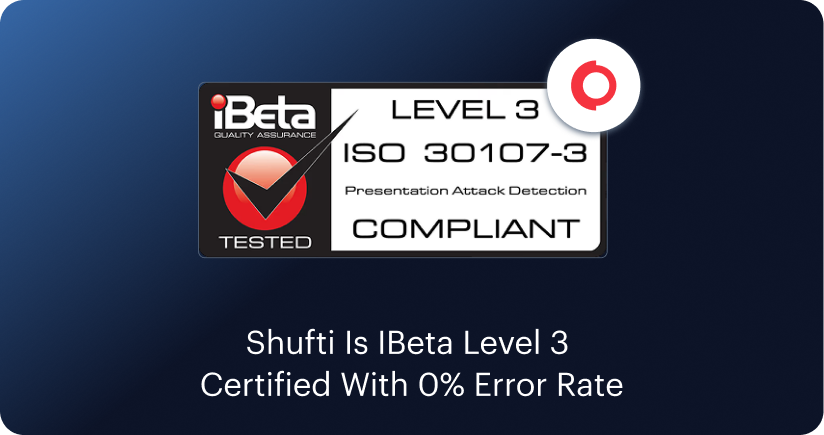
Two vendors here pair an end-to-end owned stack with iBeta Level 3 presentation-attack conformance, which is the highest published tier under ISO/IEC 30107-3. Ownership decides who fixes a failure and how fast that failure is fixed, whereas independent conformance decides whether the fraud claim was ever tested by anyone but the vendor.
Shufti
Shufti is an identity verification software designed to solve the four problems that decide whether verification holds up in production.
These four problems are:
1): a failed check that no single vendor can diagnose
2): assurance bought with abandoned signups
3): accuracy claims that cannot be interrogated beneath the headline number
4): an upload step that costs a slice of every onboarding cohort.
Most platforms in this comparison are strong on one or two of these and quiet about the rest. The sections below explain how Shufti handles each, with the evidence linked.
One owner for every failed verification
When OCR comes from one supplier, liveness from another and forensics from a third, a pass-rate drop would have three possible causes and nobody would be able to diagnose it. Shufti runs a fully proprietary AI stack with no third-party dependencies, so failures are fixed on one release timeline rather than arbitrated across two contracts. That is the ‘Glocal’ claim in practice, because one architecture reads a US driver’s licence and a Vietnamese national ID with the same engineering control, instead of routing the hard one to a regional partner.
Spoof resistance that does not cost you signups
Most systems prove a real person is present by asking them to blink, smile or turn their head, and every added instruction loses a share of genuine applicants. Security gets paid for in abandoned onboardings.
Shufti clears the highest published anti-spoofing grade, iBeta Level 3 under ISO/IEC 30107-3, from one still selfie with no prompts. It stopped all 900 mask attacks in that test and wrongly rejected none of the genuine faces, which is the pairing that matters, because tightening security usually starts blocking real customers too.
In DHS’s 2025 Remote Identity Validation Rally, five of sixteen systems met every performance goal against 1,632 volunteers, and Shufti reports being one of them at a 98.49% acceptance rate for genuine users. Incode was also among the five and also holds Level 3, so read this as a shared strength rather than a tiebreak. The two separate on coverage and deployment instead.
Accuracy across demographics and regions
Document libraries are the category’s favourite vanity metric, and a vendor can advertise a series its models have barely processed. Shufti’s figure is throughput rather than catalogue, at over 10,000 document types across 240+ countries and territories verified every month, with in-house OCR across 150+ languages. On demographic consistency it goes further than the category.
Tom Gadsden, VP of Product at Shufti, reports that testing found the algorithms commendably flat across racial groups on documents from 240+ jurisdictions each month.
Verification process that reduces friction
One of the biggest friction points in identity verification is when a user is asked to capture and upload their photo. The best way to reduce that friction is to have fewer customers go through the selfie/image upload process. This is exactly what Shufti has designed its workflows for.
Shufti can often verify a person without a document, by checking the details they give you against 270+ authoritative data sources across 95+ countries. If one of those sources is not working, it tries the next one automatically rather than rejecting the customer. In 30+ countries, people can verify by simply logging in with the national digital IDs, such as BankID in Sweden or Singpass in Singapore.
This way, the document-and-selfie route stays available for anyone these checks cannot clear, so the slow step is reserved for the minority who genuinely need it.
NFC passport-chip reading, EU digital identity wallets and qualified e-signatures under eIDAS 2.0 run through the same integration.
The honest trade-off: Shufti is UK-headquartered, and its North American presence is smaller than that of US-headquartered peers, a contracting difference rather than a capability one. Pricing is scoped per deployment rather than published, and teams wanting a same-day self-service sandbox will find developer-first vendors quicker to trial.
- Deployment: SaaS, cloud, local cloud, on-premise for data-residency compliance
- Certifications: iBeta Level 3 conformance under ISO/IEC 30107-3, DHS RIVR 2025 Top Performer, SOC 2 Type 2, ISO 27001:2022, PCI DSS, GDPR, Cyber Essentials Plus
- Recognitions: Leader in the G2 Identity Verification category, with Leader placements announced across the G2 Summer 2026 Identity Verification, Asia, Asia Pacific and AML Grids on 10 June 2026, and dual Leader in Liminal’s 2026 Age Verification and Age Estimation Indexes
- Ratings (verified 6 August 2026): G2 4.5 / 5 (151 reviews) and Trustpilot 4.8 / 5 (3,945 reviews)
Verdict: Shufti is the strongest single-vendor answer where assurance and conversion are under pressure at once, meaning non-Latin document mixes, deepfake exposure and data-residency rules in the same procurement. Buyers needing only one market or one method can be served well by a narrower vendor here. One platform. Fully owned technology. Global coverage with real local depth.
Incode
Incode is a San Francisco-headquartered vendor founded in 2015 that builds its facial recognition, document verification, OCR and liveness in-house, with a deep US footprint across banking and public-sector identity programmes.
Independent validation: In early 2026, iBeta announced Incode as the first vendor to pass Level 3 presentation-attack detection on both Android and iOS with a zero percent error rate, making it the closest direct comparison to Shufti here.
Accuracy consistency: Coverage concentrates in the Americas, so buyers needing depth across APAC, MENA and Africa should test those document sets rather than assume parity.
- Certifications: iBeta Level 3 PAD conformance, SOC 2 Type II, and a Leader placement in the Gartner Magic Quadrant for Identity Verification 2024 and 2025 per Incode
- Ratings (verified 6 August 2026): G2 5.0 / 5 (52 reviews), limited Trustpilot presence
Verdict: Incode fits US-centric enterprises, financial institutions and government identity programmes wanting owned technology and top-tier presentation-attack conformance.
Tier 2: Established Platforms With Partner-Dependent Components
Four vendors here carry large enterprise footprints and mature tooling, and each depends on third-party components somewhere in the core path. That dependency is not a defect, and it is a procurement fact worth pricing, because it sets whose release cycle governs your fraud response.
Jumio
Jumio is a US-headquartered vendor with one of the largest enterprise customer bases in the category. Per the Gartner Magic Quadrant 2025, its platform was initially built on third-party liveness from iProov, with in-house liveness developed only in late 2024, so the owned layer is less time-tested at scale than longer-standing own-IP vendors.
- Certifications: ISO/IEC 27001:2022, SOC 2 Type 2, PCI DSS, iBeta Level 2 PAD conformance
- Ratings (verified 6 August 2026): G2 4.0 / 5 (24 reviews), Trustpilot 1.3 / 5 (93 reviews), a consumer-side pattern common across the category and closer to end-user friction than enterprise sentiment
Verdict: Jumio fits established enterprises with large existing deployments, or Western-market buyers prioritising vendor scale over architectural ownership.
Entrust IDV
Onfido is a British-founded vendor acquired by Entrust in April 2024 and sold as Entrust IDV. Per the Gartner Magic Quadrant 2025, it carries documented partner dependencies including iProov and uses human reviewers as a fallback for non-Latin script OCR.
Accuracy consistency: That fallback is the clearest illustration here of what happens when models were not trained on a document set from the start, because it adds cost and latency exactly where volume grows fastest. A mature SDK and ETSI-certified support for Qualified Electronic Signatures remain genuine strengths.
- Certifications: ISO/IEC 27001 (BSI certified), SOC 2 Type II, ETSI-certified IDV for QES under eIDAS, iBeta Level 2 PAD conformance
- Ratings (verified 6 August 2026): G2 4.4 / 5 (122 reviews), Trustpilot 1.2 / 5 (381 reviews)
Verdict: Entrust IDV fits enterprise buyers with existing Entrust relationships, or those prioritising government and healthcare deployment alongside verification.
Sumsub
Sumsub is a UK-incorporated vendor with strong fintech, crypto and iGaming onboarding presence. Per the Gartner Magic Quadrant 2025, its platform incorporates third-party components including Smart Engines for document forgery detection and Inverid for NFC.
Independent validation: No public iBeta conformance letter appears for Sumsub at any level, leaving its liveness without an independent benchmark. That is a gap in published evidence rather than proof of missing capability.
- Certifications: ISO 27001, ISO 22301:2019, SOC 2 Type II and SOC 3, PCI DSS, ETSI standards under eIDAS
- Ratings (verified 6 August 2026): G2 4.6 / 5 (125 reviews), Trustpilot 1.3 / 5 (272 reviews)
Verdict: Sumsub fits crypto, fintech and iGaming operators needing rapid integration and broad document coverage, where independent liveness conformance is not a procurement requirement.
Veriff
Veriff is an Estonian vendor with strong AI-driven document and biometric verification positioning, using IDMerit as a partner for certain data verification capabilities per the Gartner Magic Quadrant 2025.
Accuracy consistency: Training data weights toward EU and US documents, so hard-market coverage is narrower than vendors trained on those documents from inception. Veriff is also SaaS-only with EU data residency and no on-premise or local-cloud option, excluding it from Gulf and Southeast Asian residency-bound contracts.
- Certifications: ISO/IEC 27001:2022, SOC 2 Type II, Cyber Essentials, iBeta Level 2 PAD conformance
- Ratings (verified 6 August 2026): G2 4.5 / 5 (61 reviews), Trustpilot 1.3 / 5 (228 reviews)
Verdict: Veriff fits EU and US digital platforms and marketplaces prioritising fast SaaS verification over deployment flexibility or hard-market depth.
Tier 3: Method And Market Specialists
Four vendors are strongest inside a defined boundary, whether a region, a single biometric layer, an orchestration model or one national data ecosystem. Each answers a narrow question well and a broad one only partly.
IDnow
IDnow is a German vendor with a long record in EU video-ident and deep DACH presence, holding eIDAS Qualified Trust Service Provider status through its ARIADNEXT acquisition. Coverage outside Europe is narrower than global-first competitors, and the architecture mixes owned, acquired and partner components.
- Certifications: ISO/IEC 27001, eIDAS QTSP status via ARIADNEXT, ETSI standards under eIDAS, EU data-centre options
- Ratings (verified 6 August 2026): no current G2 product rating found, Gartner Peer Insights 4.4 / 5 (16 reviews), Trustpilot 3.4 / 5 (16,408 reviews), a high-volume consumer profile reflecting video-ident friction
Verdict: IDnow fits EU-headquartered organisations, particularly DACH regulated financial services, needing video-ident at scale and qualified electronic signature delivery.
iProov
iProov is a London-headquartered biometric specialist supplying face verification and liveness rather than a full platform, which is why several vendors elsewhere in this comparison license its technology. Read it as a component decision, not a platform decision.
Independent validation: iProov is the one vendor here with independently validated resistance to injection attacks, and on that criterion it is stronger than anyone else in this guide, Shufti included. Per its own certifications page, Dynamic Liveness achieved CEN/TS 18099 High with Ingenium Level 4 through ISO/IEC 17025-accredited testing, with no successful injection method established across 40 days and a bona fide presentation classification error rate of 1.3% against a permitted maximum of 15%. Its iBeta conformance sits at Levels 1 and 2.
Method coverage: The boundary is the trade-off. iProov does not provide document verification, KYB, AML screening or doc-less eIDV, so it pairs with another platform, reintroducing the multi-vendor accountability problem that owning a stack avoids.
- Certifications: CEN/TS 18099 High with Ingenium Level 4 for injection attack detection, FIDO Alliance certification for remote face verification, iBeta PAD Levels 1 and 2, UK DIATF gamma certification issued 16 October 2025, ETSI TS 119 461, eIDAS eID assurance High, SOC 2 Type II, ISO/IEC 27001:2022
- Ratings (verified 6 August 2026): no material G2 or Trustpilot presence found, so certification evidence carries the assessment
Verdict: iProov fits government, banking and high-assurance programmes buying a biometric layer for a wider stack, not teams wanting one vendor end to end.
Persona
Persona is a US-based, API-first identity platform built around orchestration and developer experience, widely used across US fintech and marketplaces. The KuppingerCole 2025 assessment positions it as an orchestration-led entrant, and its building-block model lets teams assemble flows quickly. It is SaaS-only, so on-premise requirements rule it out, and no public iBeta conformance level was confirmed at the time of writing.
- Certifications: ISO 27001 (recertified February 2025), SOC 2 Type II, PCI DSS, HIPAA, GDPR and CCPA compliance
- Ratings (verified 6 August 2026): G2 4.3 / 5 (45 reviews), Trustpilot 1.2 / 5 (185 reviews)
Verdict: Persona fits US-headquartered marketplaces and fintechs prioritising workflow flexibility and developer experience over deployment options or hard-market depth.
Socure
Socure is a US-headquartered vendor focused on domestic identity proofing through predictive risk modelling on alternative data such as phone, email and behavioural signals. Per the Gartner Magic Quadrant 2025, almost all documents it processes are North American. It is SaaS-only with US data residency, and no public iBeta conformance listing was found.
- Certifications: refer to socure.com directly, as specific public listings were not prominently surfaced in review
- Ratings (verified 6 August 2026): G2 4.5 / 5 (103 reviews), limited Trustpilot presence
Verdict: Socure fits US-only verification volumes prioritising predictive identity risk scoring and alternative-data depth for domestic fintech onboarding.
What To Look For In An Identity Verification Provider In 2026
The right provider is not the one with the longest feature list. It is the one whose technology verifies your users, in your markets, against the fraud you face, at a conversion rate your growth targets can absorb. Six criteria separate a serious shortlist from a marketing one.
Technology ownership versus orchestrated stacks
Many platforms describe themselves as end-to-end while assembling core capabilities from partners, with OCR from one supplier, liveness from another and forensics from a third. The Gartner Magic Quadrant for Identity Verification 2025 documents those dependencies vendor by vendor. When a new attack vector emerges, an orchestrated vendor waits on someone else’s release cycle. Ownership also removes stacked licensing fees and keeps verification data in a single chain of custody.
Independent validation, and the two attacks it covers
Presentation attacks and injection attacks are different threats, and buyers routinely conflate them. Presentation attacks are physically shown to a camera, covering photos, masks and replayed video, and fall under ISO/IEC 30107-3 as tested by iBeta, where Level 3 is the highest published tier, lifts the artefact cost ceiling above the $300 cap applied at Level 2, and tightens the permitted bona fide error rate to 10%. Injection attacks bypass the camera and feed synthetic video into the data stream, falling under the newer CEN/TS 18099 specification.
It’s quite possible that a vendor holds strong presentation-attack conformance and have no validated resistance to injection, so ask which of the two a certificate covers.
Accuracy consistency across document origins and demographics
Verification on US, EU and Canadian documents is largely commoditised. The spread appears on non-Latin scripts and regional formats from Vietnam, Indonesia, Brazil, South Asia and the Gulf, where a vendor scoring 99% on Western documents can fall sharply on the same volume elsewhere. Demographic consistency deserves equal scrutiny, because models trained on narrow populations produce uneven error rates by skin tone, age and gender. Ask for pass rates split by document origin and demographic segment.
Verification method coverage
Identity can be proven several ways, and the strongest providers support more than one. Document plus biometric verification is the familiar path. Doc-less verification cross-references a user against authoritative databases, while electronic ID schemes authenticate through a trusted national digital identity. AI-powered identity verification runs across all three, where optical character recognition reads the document, a face-matching model compares it to a live selfie, a liveness model confirms a real present human, and a risk model scores device and behavioural signals. A vendor locked to one method trades assurance against conversion permanently.
Deployment flexibility and data residency
A platform operating across the EU, the US, the Gulf and Southeast Asia satisfies several residency regimes at once. SaaS-only vendors cannot serve organisations bound by frameworks such as Saudi PDPL, UAE NESA, Thailand PDPA and Indonesia OJK, which restrict where verification data is processed. As those regimes diverge, deployment flexibility becomes a contract qualifier rather than an architectural preference.
Commercial model and cost per successful onboarding
Almost no vendor publishes a flat rate, because price depends on document mix, geography and check depth. Most charge per verification on pay-as-you-go or committed-volume tiers, with rates falling as volume rises, and a document-plus-biometric check costing more than a database lookup. Compare cost per successful onboarding rather than headline rate, because a cheap check with a poor pass rate is more expensive once abandoned signups are counted. Ask what happens on a failed attempt, since some vendors bill every attempt and others only approved verifications.
See these criteria on a real platform
The criteria above separate a serious shortlist from a marketing one. Shufti runs all of them on owned, end-to-end technology across 240+ countries and territories.
How We Evaluated
Every vendor was assessed against the same six criteria, in the same order, under a two-tier evidence rule.
- Tier 1 covers each vendor’s own primary documentation and official registers, including iBeta ISO/IEC 30107-3 conformance listings, the gov.uk digital identity services register, ISO and SOC certification statements, and published product pages.
- Tier 2 covers dated third-party assessment, including the Gartner Magic Quadrant for Identity Verification 2025, the KuppingerCole Analysts 2025 market assessment, the Liminal 2026 indexes, and G2 and Trustpilot profiles quoted with review counts and dates.
- Excluded are vendor marketing claims without a primary source, figures traceable only to other comparison articles, and undated assertions.
Where a conformance letter could not be located, this guide records “no public listing found” rather than stating a vendor lacks the capability, because absence of a listing is not evidence of absence. Where a competitor is verifiably stronger than Shufti on a criterion, as iProov is on injection-attack validation, the guide says so. Shufti figures were verified in August 2026, and competitor figures carry the date each was last verified.
How To Choose The Right Identity Verification Software For Your Business
There is no single best identity verification software for every buyer. The right one handles your users, in your markets, against your fraud exposure, in a deployment model your regulator accepts. Most buyers land in one of five situations.
Scenario 1: Startups and early-stage platforms
Shufti works for early-stage teams through a single API, pre-built SDKs and a pay-as-you-go entry point, and the advantage compounds for founders expecting to enter new markets, because the architecture does not need replacing when they do. Persona’s no-code builder appeals to US developer-first startups assembling their own flows. A vendor chosen purely on early-stage price often becomes the constraint once volumes, markets or fraud exposure grow, so teams planning international expansion are better served choosing the architecture they will need in two years.
Scenario 2: Fintech and financial services
Shufti fits regulated financial onboarding because owned OCR, liveness and document intelligence sit under one architecture with native AML screening and continuous monitoring on a single audit trail, which is the shape of evidence FinCEN’s April 2026 effectiveness proposal asks institutions to produce. For fintechs operating only in the United States and committed to staying there, Socure offers deeper domestic consortium fraud data, and Incode is a strong US-enterprise alternative with owned technology and Level 3 liveness. For anyone serving more than one region, a single owned stack removes the need to bolt on regional vendors later.
Scenario 3: Multi-market and non-Latin document coverage
Shufti’s owned stack and cross-market training make it the structural fit for platforms verifying users across North America or Europe alongside Vietnam, Indonesia, Brazil, South Asia or the Gulf, with public clients including Binance, Stripe and ByteDance on exactly that profile. Vendors trained primarily on EU and US documents treat non-Latin formats as edge cases and fall back to slower, costlier human review, which the Gartner Magic Quadrant 2025 documents explicitly for Entrust IDV. Run pass-rate tests on your real document mix before signing.
Test us on your hardest documents, not our marketing
Shufti actively verifies 10,000+ document types across 240+ countries and territories every month, including the non-Latin IDs most vendors treat as edge cases.
Scenario 4: High deepfake and injection-attack exposure
Shufti is the most defensible single-vendor posture for crypto, forex, gaming and other high-exposure verticals, combining iBeta Level 3 conformance with full-stack ownership that puts defence updates on its own release timeline rather than a third-party supplier’s. Incode also holds Level 3 and is a credible alternative for US-centric enterprise and government buyers. Where injection attacks specifically are the primary threat and the purchase is a component rather than a platform, iProov’s CEN/TS 18099 validation is the strongest independent evidence available, though it covers the biometric layer alone.
Deepfake exposure needs an independent benchmark
Shufti holds iBeta Level 3 conformance under ISO/IEC 30107-3, the highest published presentation-attack detection tier, with defence updates on our own release timeline.
Scenario 5: Data-residency-bound and regulated deployments
Shufti is one of the few vendors here offering SaaS, local cloud and on-premise deployment for buyers bound by residency frameworks such as PDPL in Saudi Arabia, NESA in the UAE, PDPA in Thailand or OJK in Indonesia. IDnow fits where the requirement is EU-specific. The SaaS-only vendors here, including Persona, Socure and Veriff, are excluded from those contracts by architecture rather than preference.
Marketing pages do not reveal the right vendor. Verification performance on your own traffic does. The question is which vendor’s structural advantages match your reality, meaning where your users live, which regimes you face, how you deploy and how exposed you are to AI-driven fraud.
For buyers facing more than one at once, Shufti’s combination of full-stack ownership, iBeta Level 3 conformance, deployment flexibility and doc-less depth is the broadest single-vendor answer. Confirm it with a proof of concept on your hardest documents, in your highest-risk markets, with your fraud team running attack scenarios.
Frequently Asked Questions
What is identity verification software?
Identity verification software confirms a person is who they claim to be, typically by checking a government-issued document, matching it to a live selfie with biometric liveness detection, and cross-referencing authoritative data sources. Businesses use it for onboarding, account recovery and fraud prevention.
What are the top identity verification companies in 2026?
Buyers most commonly shortlist Shufti, Incode, IDnow, iProov, Jumio, Onfido (Entrust IDV), Persona, Socure, Sumsub and Veriff. The best identity verification company depends on your markets, fraud exposure, deployment requirements and conversion targets rather than any single ranking.
How does AI improve identity verification in 2026?
AI reads documents in any script, matches faces to document photos, detects presentation and injection attacks through liveness models, and scores fraud risk from device and behavioural signals. The strongest results come from vendors that train and own their models rather than orchestrating third-party AI.
Which identity verification software is best for fintech companies?
For fintech, the strongest option pairs accurate document and biometric checks with native AML screening and independent liveness conformance under one audit trail. Shufti fits multi-market fintechs, Socure suits US-only operations, and Incode suits US enterprises. Test shortlisted vendors on real traffic first.
How much does identity verification software cost?
Most vendors charge per verification on pay-as-you-go or committed-volume tiers, with rates falling as volume rises, and document-plus-biometric checks costing more than a database lookup. Few publish flat rates. Compare cost per successful onboarding, and check whether failed attempts are billed.