


 Face Verification
 Address Verification
 Document Verification
 Age Verification
 VideoIdent
 Fast ID
 Docless Verification
 Consent Verification
 NFC Verification
 Business Verification
 Due Diligence
 Investor Verification
 E-Signature

 QES
QES
 AML Screening
 Transaction Monitoring
 Adverse Media
 Business AML Screening
 PEP & RCA
 Sanctions
 Watchlist
 Behavioural Biometrics
 Device Fingerprinting
 Biometric Face Authentication
 MFA
MFA
 Fraud Hub
 Onboarding
 Ongoing Monitoring
 KYC
KYC
 KYB
KYB
 KYI
KYI
 Age Assurance
 Identity Verification
 Workforce IAM
 Candidate Verification
 Compliance
 Fraud prevention
 Trust & safety
 Global expansion
 Product Managers
 Compliance Officers
 Fraud Analysts
 Developers
 Deepfake Detection
 Bonus Abuse / Promotion Abuse
 Account Takeover
 Synthetic Identity Fraud
 Document Fraud
 Impersonation Fraud
 Multi-Accounting
 Fraud Networks
 Chargeback Fraud
 Money Mule Activity
 Party Fraud
 Regulatory & Compliance Risks
 Fintech
 Crypto
 iGaming
 Forex
Forex
 Social Network
 Marketplace
 Banking
 Gig Economy
 Payments
 Ride Hailing
 Adult Content
 Blind Spot Audit
 Deepfake Detector
 Liveness Spoofs
 Document Originality
 Document Deepfake
 Global Trust Platform
 Journey Builder
 Case Management
 Shufti AI
 Fraud Analytics
 Vendor Comparison
 Brand Personalisation
 AI Compliance Co-Pilot
 OCR
OCR
 Secure Capture
 Deployment Options
 Identity Methods
 API Documentation
 Mobile SDKs
 Service Status
 Help Center
 Contact Us
 Technical Support
 Supported Documents
 Supported Countries
 Content library
 Blogs
Blogs
 News
News
 Reports
 Insights
 Knowledgebase
 ROI calculator
 About
About
 Career
 Press Release
 Certifications
 Partnership
 Awards
 Events & Webinar
 Interactive Demo
 Podcast Studio
 Spotlight Studio
Identity Verification Pricing: How Pricing Models Work and What to Look For?

TL:DR
- A verification quote means little until you know what it includes and excludes.
- US consumers lost over $12.5 billion to fraud in 2024, up 25%.
- Providers bundle or split document, biometric, and AML checks differently.
- Check types, geographic coverage, and deployment model all drive total cost.
- Manual review, setup, and monitoring fees often sit outside headline quotes.
You have just received a quote from an identity verification provider. The number means little until you understand what it includes, what it leaves out, and how the cost will change as your verification volumes grow.
The fraud problem pushing businesses toward IDV keeps getting worse. The Federal Trade Commission reported that consumers lost more than $12.5 billion to fraud in 2024, a 25% jump over the prior year, with over 1.1 million identity theft reports filed. For regulated businesses, identity verification is no longer optional. But the pricing structures surrounding it remain confusing for most buyers.
This guide explains how identity verification pricing is typically structured, what factors push costs up or down, and the specific questions worth asking any provider before committing.
Why identity verification pricing vary so much?
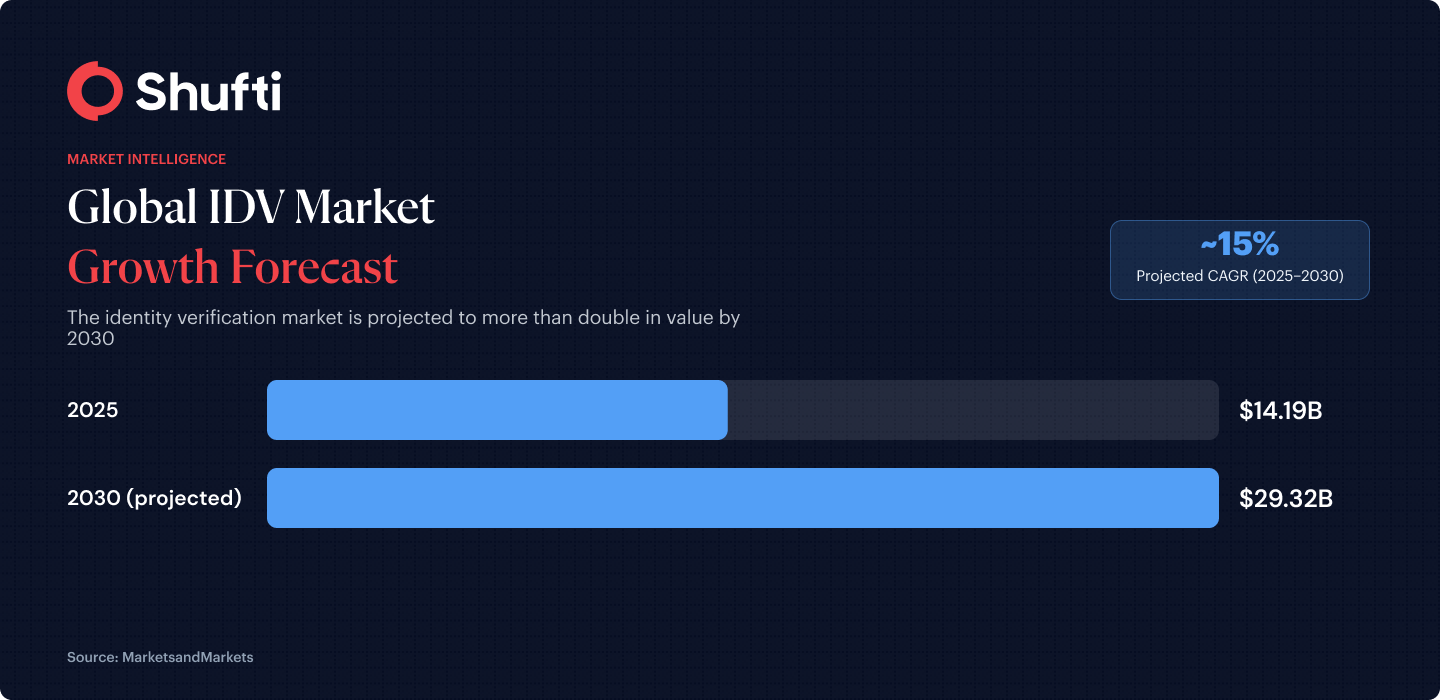
The global identity verification market is projected to grow from around $14.19 billion in 2025 to $29.32 billion by 2030. That scale of growth attracts a wide range of providers, each bundling checks differently.
A quote from one provider for “identity verification” might include a document scan, a biometric liveness check, and a sanctions screen in a single unit. From another, each of those three checks is a separate line item. Comparing raw numbers without knowing what each covers means you are not comparing the same thing.
The checks that make up a complete digital identity verification flow can include document extraction and fraud analysis, biometric face matching, liveness detection, sanctions and PEP screening, address confirmation, and periodic re-verification. Whether a given quote bundles these or splits them into modular add-ons shapes the final cost considerably.
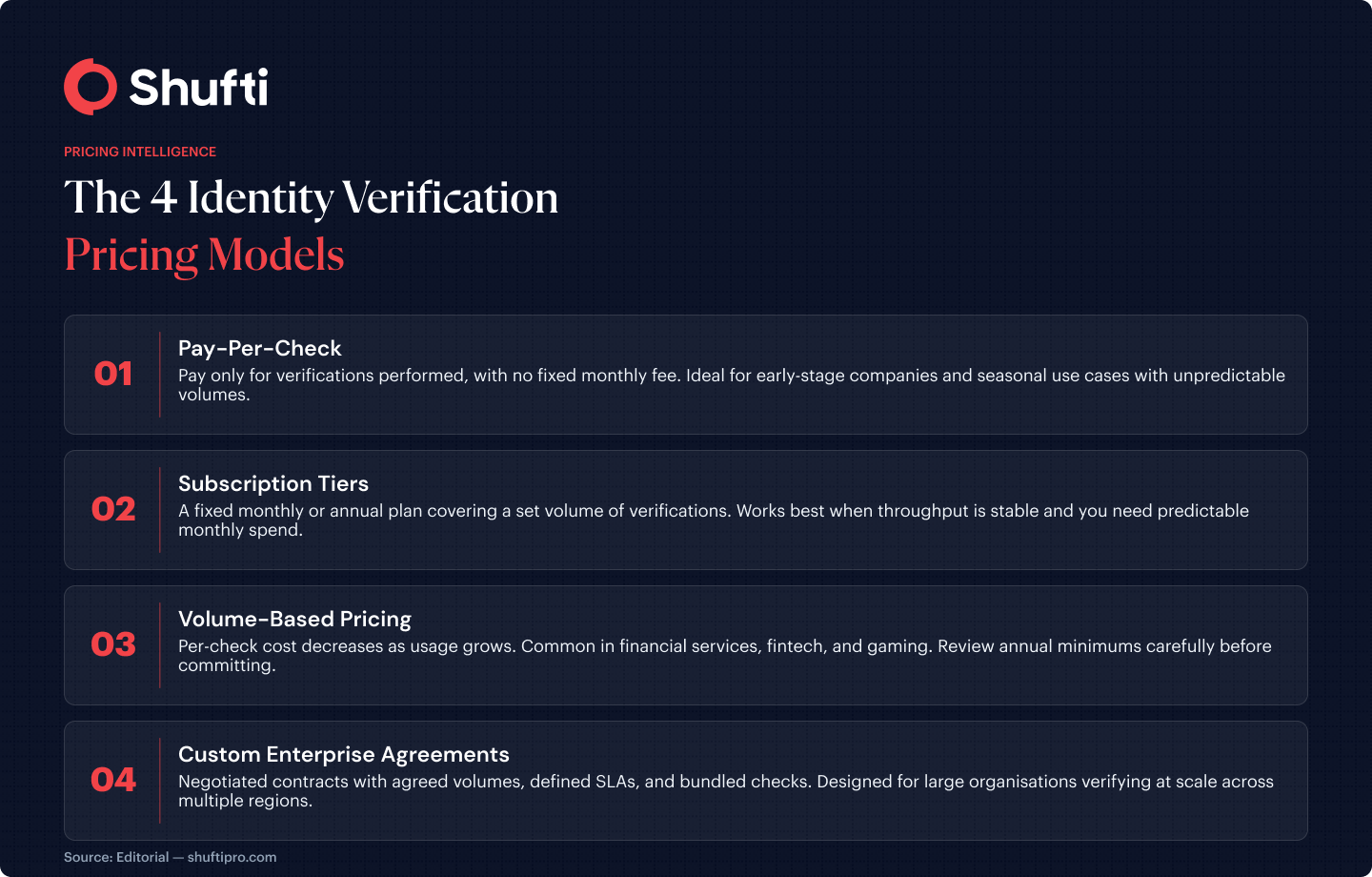
The four main identity verification pricing models
Pay-per-check
The most direct model: you pay for each verification performed, with no fixed monthly fee. If your volumes are low or seasonal, this gives you the flexibility to scale spending alongside actual usage. Early-stage companies running limited pilots avoid paying for unused capacity.
The trade-off is predictability. At high volumes, per-check rates can become expensive relative to alternatives that reward consistent throughput.
Subscription tiers
Some providers package a set volume of verifications into a monthly or annual subscription. When you exceed the tier threshold, overage rates apply or you move to the next tier. This works well when volumes are stable and predictable, letting you budget around a fixed commitment.
The risk is overbuying. If your actual volumes fall short of the tier minimum, you pay for verifications that never happen.
Volume-based pricing
Volume pricing reduces the per-check rate as usage increases. The more you verify, the lower the per-check cost. This model is common among providers serving financial services, fintech, and gaming clients at scale.
Read the volume thresholds carefully. The discount tiers may require annual minimums that only make sense once your onboarding volume reaches a certain floor.
| Pricing model | How it works | Best fit | Trade-off |
| Pay-per-check | Pay per verification, no fixed fee | Low or seasonal volumes | Costly at high volume |
| Subscription tiers | Set volume packaged monthly or annually | Stable, predictable volumes | Overbuying if volumes fall short |
| Volume-based | Per-check rate drops as usage rises | High-volume financial, fintech, gaming | May require annual minimums |
| Custom enterprise | Bespoke contract, agreed volumes and SLAs | High volumes across product lines | Longer commitment terms |
Custom enterprise agreements
Large organizations often negotiate bespoke contracts that fix agreed volumes, define service levels, and bundle multiple check types into a single commercial arrangement. Enterprise agreements can offer meaningful value for organizations running verification at high volumes across multiple product lines or regions.
These contracts typically carry longer commitment terms. Make sure the agreement allows you to adjust volumes if your business changes shape.
Understanding how the KYC verification process works end-to-end helps you match the right pricing model to your actual compliance workflow before you negotiate.
What actually drives identity verification costs?
The pricing model is only half the picture. What sits inside a quote also shapes the total cost.
Check types bundled
A document-only check costs less than a combined document-plus-biometric check. Add AML screening, and the cost rises again. Providers that bundle document extraction, liveness, and sanctions screening into one call make total costs easier to model. Those that sell each check separately give you flexibility, but the line items accumulate quickly.
KYC compliance obligations under frameworks like the Bank Secrecy Act typically require all three layers. Building a cost model around document checks only, then adding biometrics and AML later, leads to billing surprises.
Geographic and document coverage
Some providers charge more to verify documents from certain countries or to run checks against databases in specific regions. If your customer base spans multiple markets, find out whether geographic coverage is priced as a flat global rate or as regional add-ons. McKinsey has noted that KYC-AML compliance is among the most expensive functions inside financial institutions, and geographic fragmentation of compliance tools adds directly to that overhead.
Deployment model
Cloud deployments are typically faster to set up and carry lower upfront costs. On-premises and hybrid deployments cost more to configure and maintain, but may be required by your data sovereignty obligations or internal security policy. The FATF Recommendation 10 customer due diligence requirements do not specify a deployment model, but your regulator or legal team may. Factor the deployment cost into your total cost model, not just the per-check rate.
Hidden fees in identity verification pricing plans
Several cost categories do not always appear in headline quotes.
Manual review fees apply when automated checks cannot reach a decision and a human analyst reviews the case. Some providers include a portion of manual review in the base rate. Others bill per review event. If your use case involves complex documents or elevated-risk customers, clarify this in writing before signing.
Setup and integration costs cover the engineering work to connect the provider’s API or SDK to your onboarding flow. Some providers include implementation support in the commercial arrangement. Others bill separately for it.
Minimum volume commitments matter if your business is growing or seasonal. A monthly or annual minimum you cannot reliably hit becomes a sunk cost.
Ongoing monitoring fees arise when you need periodic re-verification of existing customers. Many regulated businesses under EU Anti-Money Laundering rules run ongoing monitoring as a process separate from initial onboarding. Check whether your contract covers it, and on what terms.
Questions worth asking any provider before signing
Ask whether the quote is all-in for every check your compliance team requires, or whether document, biometric, and AML checks are billed separately. Ask what the cost looks like at double your current volume, and whether the contract allows mid-term volume adjustments. Ask what manual review rates look like and whether they are included or a separate line. Ask whether geographic coverage beyond your current markets carries an additional charge. Ask what service levels and support tiers are included in the base price and what costs more.
Total cost of ownership across two or three years is the right number to compare, not the headline per-check rate.
Frequently Asked Questions
How is identity verification typically priced?
Most providers use one of four structures: pay-per-check, subscription tiers, volume-based pricing, or custom enterprise agreements. The right model depends on your verification volumes, how stable those volumes are, and how many check types you need bundled.
What pricing models do identity verification providers offer?
The common models are usage-based pay-per-check, tiered subscriptions with volume thresholds, volume discounts at scale, and negotiated enterprise contracts. Providers differ in how they bundle document, biometric, and AML checks within each model.
Does identity verification pricing include document and biometric checks?
It depends on the provider. Some quote a single all-in rate. Others price document extraction, face matching, liveness detection, and AML screening as separate items. Confirming exactly what is included in a quote is the first step toward an accurate comparison.
How does identity verification pricing change at higher volumes?
Most providers reduce the per-check cost as usage increases, either through automatic volume tiers or negotiated enterprise agreements. The size of the discount and the thresholds that trigger it vary widely, so ask for a volume-based rate table when evaluating any provider.
Are there hidden fees in identity verification pricing plans?
Common additional costs include manual review fees, setup and integration charges, geographic add-on rates for coverage in certain regions, and ongoing monitoring fees for re-verification. These are not always visible in a headline quote, so ask for a full commercial breakdown before committing.