




 Face Verification
 Address Verification
 Document Verification
 Age Verification
 VideoIdent
 Fast ID
 Docless Verification
 Consent Verification
 NFC Verification
 Business Verification
 Due Diligence
 Investor Verification
 E-Signature

 QES
QES
 AML Screening
 Transaction Monitoring
 Adverse Media
 Business AML Screening
 PEP & RCA
 Sanctions
 Watchlist
 Behavioural Biometrics
 Device Fingerprinting
 Biometric Face Authentication
 MFA
MFA
 Fraud Hub
 Onboarding
 Ongoing Monitoring
 KYC
KYC
 KYB
KYB
 KYI
KYI
 Age Assurance
 Identity Verification
 Workforce IAM
 Candidate Verification
 Compliance
 Fraud prevention
 Trust & safety
 Global expansion
 Product Managers
 Compliance Officers
 Fraud Analysts
 Developers
 Deepfake Detection
 Bonus Abuse / Promotion Abuse
 Account Takeover
 Synthetic Identity Fraud
 Document Fraud
 Impersonation Fraud
 Multi-Accounting
 Fraud Networks
 Chargeback Fraud
 Money Mule Activity
 Party Fraud
 Regulatory & Compliance Risks
 Fintech
 Crypto
 iGaming
 Forex
Forex
 Social Network
 Marketplace
 Banking
 Gig Economy
 Payments
 Ride Hailing
 Adult Content
 Blind Spot Audit
 Deepfake Detector
 Liveness Spoofs
 Document Originality
 Document Deepfake
 Global Trust Platform
 Journey Builder
 Case Management
 Shufti AI
 Fraud Analytics
 Vendor Comparison
 Brand Personalisation
 AI Compliance Co-Pilot
 OCR
OCR
 Secure Capture
 Deployment Options
 Identity Methods
 API Documentation
 Mobile SDKs
 Service Status
 Help Center
 Contact Us
 Technical Support
 Supported Documents
 Supported Countries

 Content library
 Blogs
Blogs
 News
News
 Reports
 Insights
 Knowledgebase
 ROI calculator
 About
About
 Career
 Press Release
 Certifications
 Partnership
 Awards
 Events & Webinar
 Interactive Demo
 Podcast Studio
 Spotlight Studio
The Real Cost of Identity Verification (And 5 Ways to Reduce It)

-
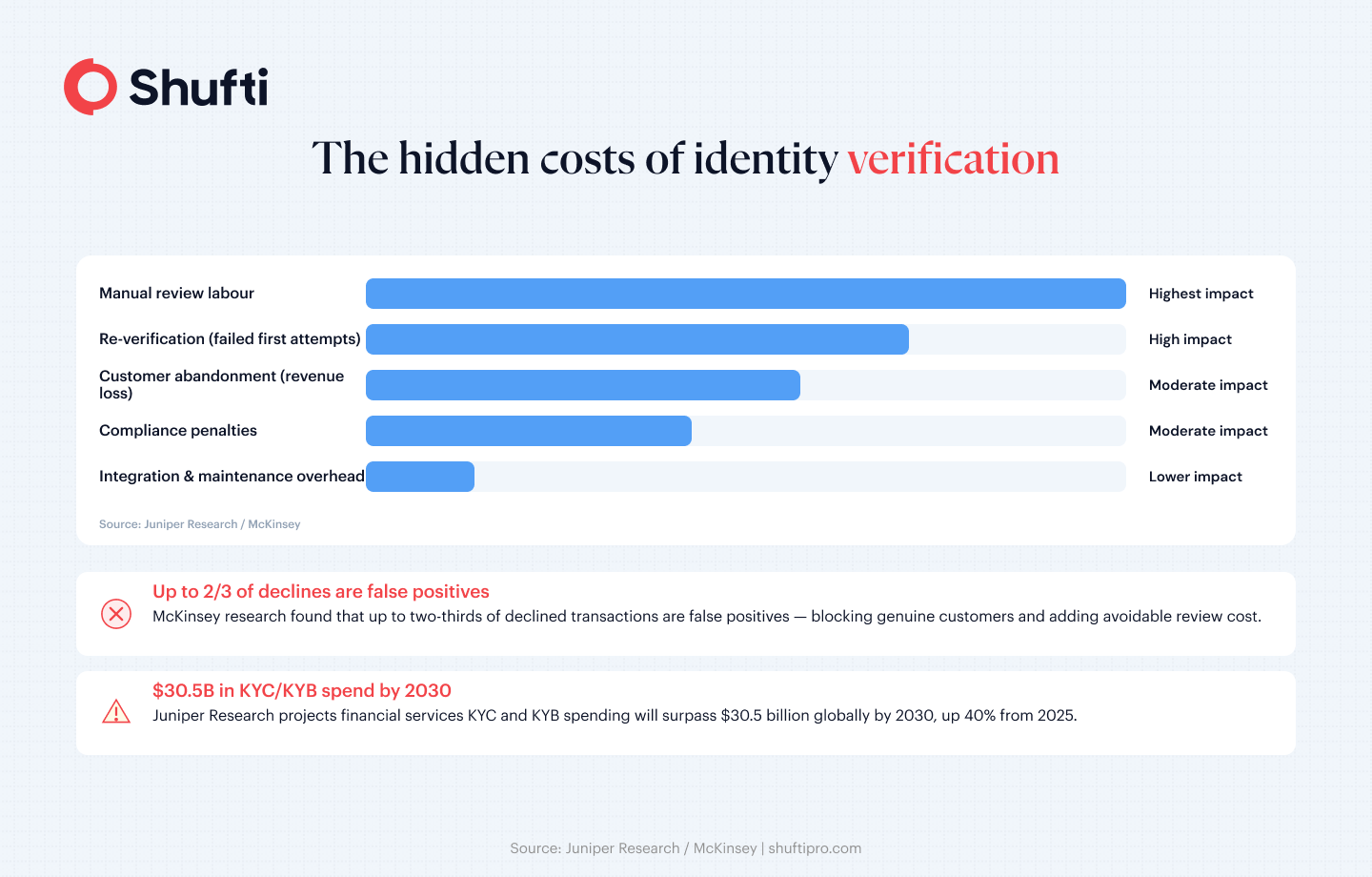
Financial services KYC and KYB spend is set to surpass $30.5 billion by 2030.
-
The per-check fee covers only a fraction of the true verification cost.
-
Failed checks and false positives drive much of the hidden spend.
-
Up to two-thirds of declined sales transactions are false positives.
-
Risk-based tiers, better capture, and reusable identity reduce total cost.
Most compliance teams watching their verification budgets grow focus on one number: the per-check fee. That number is real, but it covers only a fraction of what identity verification actually costs an organization. According to Juniper Research, financial services firms are on track to spend more than $30.5 billion on KYC and KYB systems globally by 2030, up 40% from just under $20 billion in 2025. That growth reflects both higher verification volumes and the cost of inefficiency: manual review queues that expand with scale, failed checks that need re-processing, and false positives that turn away genuine customers. The organisations that contain this spend without weakening their compliance posture are the ones that treat identity verification as a total-cost-of-ownership problem, not a line-item negotiation.
This article breaks down where the real costs live and outlines five concrete strategies for reducing them.
What’s actually driving your identity verification spend?
When organizations map the full cost of their IDV stack, three drivers account for the bulk of the spend. Check volume is the most visible: more onboardings mean more verifications and a higher bill. Two other drivers carry comparable weight and receive far less?
The first is the cost of failed checks. A document scan that does not pass on the first attempt gets queued for a retry. A biometric match that falls below the confidence threshold gets escalated to manual review. These are not rare exceptions. They are a direct function of how well the underlying technology handles real-world conditions, including poor lighting, varied camera quality, and the full range of identity documents your users carry. Investing in end-to-end identity verification that performs across these conditions is itself a cost-reduction measure, because every first-attempt failure is a cost multiplier.
The second driver is false positives. McKinsey research found that up to two-thirds of declined sales transactions are false positives, meaning legitimate customers are blocked by a verification system that misreads the risk. Each one represents a compliance analyst’s time spent reversing the decision and a probable abandonment event if the user finds the process too difficult to complete. At high volumes, these costs compound quickly.
The hidden costs that inflate your IDV bill
The visible portion of an IDV contract is the stated check fee. What organizations consistently undercalculate are the costs that sit around that figure.
Manual review labour is the largest concealed cost. Every escalated case requires a compliance analyst to adjudicate the result. In organisations processing significant onboarding volumes, the total time spent on manual review can exceed the cost of the automated checks themselves.
Re-verification adds a direct multiplier to your per-user cost. If a material share of users need to re-submit because the capture failed on the first attempt, you are paying for multiple check cycles per onboarded customer without receiving additional compliance value.
Customer abandonment carries no direct line item, but it represents a real and measurable revenue loss. Users who encounter friction in the verification process and drop out do not return. The onboarding abandonment rate is a legitimate cost of verification that rarely appears in any IDV invoice.
Compliance failures create the most expensive downstream exposure. Verification gaps that allow fraudulent identities through the process generate fraud losses, regulatory penalties, and remediation costs that substantially exceed any short-term savings from a cheaper verification solution.
Juniper Research projects that global spending on digital identity verification will exceed $26 billion by 2029, a 74% increase from $15.2 billion in 2024. That trajectory reflects how seriously regulated industries are investing in solutions that get the full-cost equation right.
Five strategies to reduce identity verification cost
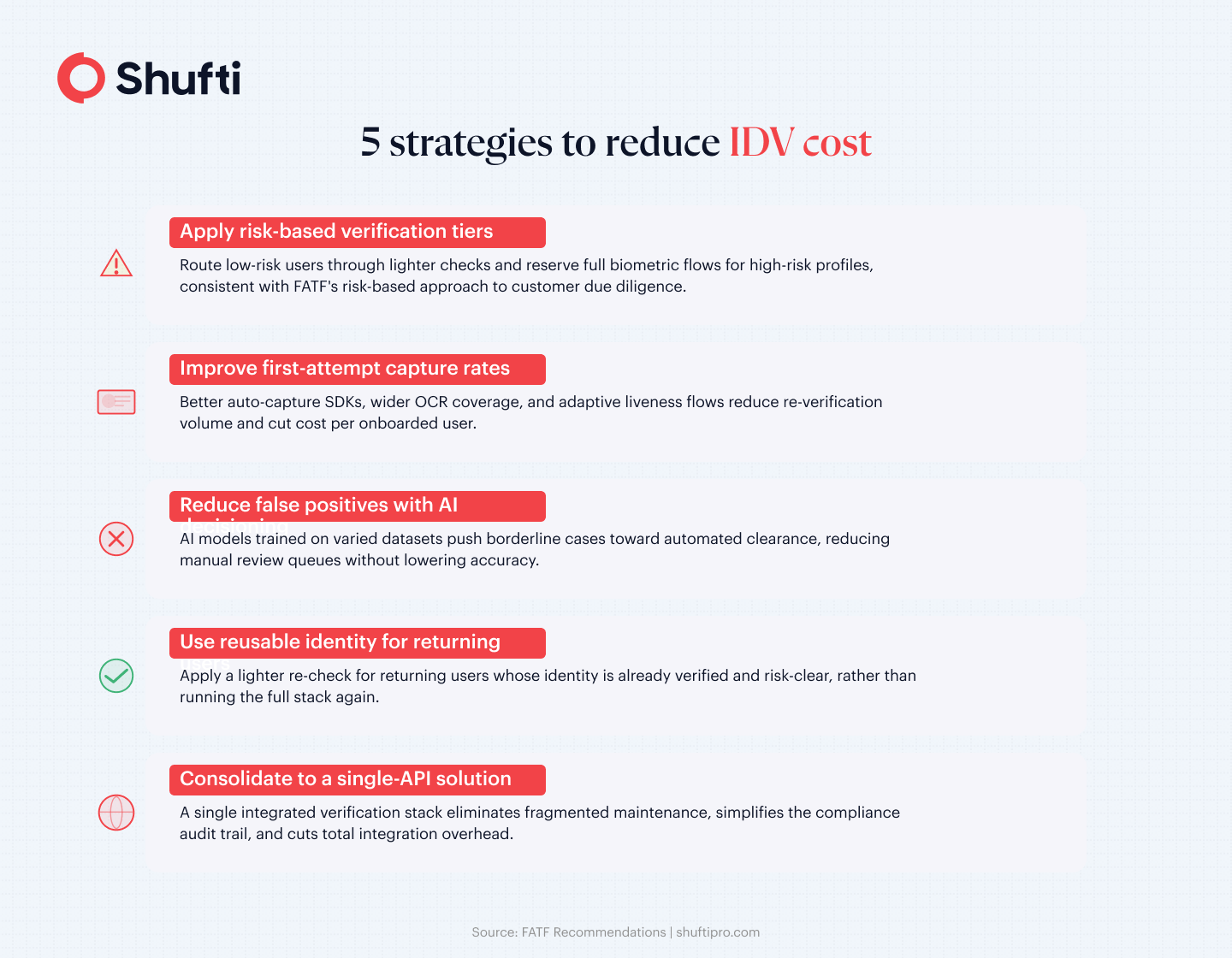
|
Strategy |
How it cuts costs |
|
Risk-based verification tiers |
Reserves expensive checks for higher-risk users |
|
Improve first-attempt capture |
Fewer retries and re-verifications |
|
Reduce false positives with AI |
Cuts manual review labour |
|
Reusable identity for returning users |
Lighter re-check avoids full verification stack |
|
Consolidate to single-API solution |
Removes multi-vendor overhead; cleaner audit trail |
1. Apply risk-based verification tiers
Not every user presents the same risk profile, and running the same verification depth across your entire user base wastes budget on cases that do not warrant it. A risk-based approach, aligned with the FATF Recommendations on proportionate customer due diligence, routes low-risk users through lighter checks while directing higher-risk profiles to full biometric or enhanced due diligence flows.
The practical result is a lower average verification cost per user, because you reserve the expensive check types for cases that genuinely need them. This approach also tends to improve completion rates, since lower-risk users face less friction. A detailed guide to how automated KYC workflows implement this routing covers the compliance framework in practice.
2. Improve first-attempt capture rates
A verification flow that completes on the first attempt costs less than one that relies on retries. Capture rates improve through better auto-capture SDKs that guide users in real time, OCR engines that handle a wider range of document conditions and lighting, and adaptive liveness flows that adjust to device quality.
First-attempt success, tracked as a formal KPI, gives you a concrete measure of where your current solution is leaking cost. A ten-percentage-point improvement in capture rate translates directly into a reduction in re-verification volume, which is one of the cleaner levers to pull when reducing spend.
3. Reduce false positives with AI-driven decisioning
When a verification system flags a significant share of legitimate users for manual review, the labour cost scales quickly with onboarding volume. AI models trained on large, varied datasets produce more accurate risk scores, pushing borderline cases toward automated clearance rather than a human review queue.
The objective is not to lower the accuracy bar for verification. It is to improve precision so that analyst time goes to genuinely ambiguous or high-risk cases, rather than to reviews of customers who would always have been cleared. This AI-powered identity verification overview explains the model architecture and its measurable impact on escalation rates.
4. Use reusable identity for returning users
Full re-verification on every user, every time, is one of the more straightforward cost inefficiencies in current IDV architectures. A returning user whose identity has been verified and who has not triggered any risk events since their last check does not need the same depth of verification as a new applicant.
Reusable identity flows allow your platform to apply a lighter, faster re-check for returning users, preserving the security standard without running the full verification stack on someone already in your system. The savings compound with user volume: as your returning user base grows, the aggregate cost reduction from not repeating full verifications grows with it.
5. Consolidate to a single-API solution
Fragmented verification stacks, where document verification, liveness, and AML checks run through separate providers, introduce overhead at every integration point. That overhead includes maintenance work, separate support contracts, and the added complexity of reconciling outputs from different systems.
A single-API approach reduces that overhead measurably. It also produces a cleaner audit trail, because all verification outputs flow through one system with consistent logging. When a regulator asks for documentation of your verification process, a consolidated flow is considerably easier to evidence than outputs from three separate providers. This piece on risk-based customer onboarding covers how consolidated solutions manage compliance documentation in practice.
Evaluating IDV solutions on total cost, not unit price
The most common procurement mistake in identity verification is selecting solutions primarily on the per-check fee. A solution with a lower unit price but a higher false positive rate, a slower first-attempt capture time, or narrower document coverage will often cost more in practice once the labour, abandonment, and re-verification costs are factored in.
A more useful evaluation compares first-attempt success rate, false positive and false negative rates at your expected volume, manual review escalation rate, geographic document coverage against your user base, and time from contract signing to live integration. These figures give you the full-cost picture that a price sheet does not.
Juniper Research projects that the average cost of digital identity verification will fall 15% globally between 2025 and 2029, driven by automation maturity. That decline rewards organisations that have already moved to automated, high-accuracy solutions, because their cost curves fall faster than those still carrying significant manual review overhead. The relevant question is not only what a check costs today, but how that cost trajectory develops over a three-to-five-year horizon as your onboarding volumes grow.
Producing that full-cost picture before a procurement decision takes more time than comparing price sheets. It also tends to produce materially different conclusions.
Frequently Asked Questions
What factors drive up the cost of identity verification?
The main drivers are low first-attempt capture rates that force re-runs, high false positive rates that generate manual review work, fragmented vendor stacks with separate integration and maintenance overhead, and poor document coverage that limits automated clearance rates across your user geography.
How can businesses lower their identity verification cost without losing accuracy?
Apply risk-based verification tiers to match check depth to user risk profile, work to improve first-attempt capture rates, and use reusable identity flows for returning users. Each change reduces the volume of expensive checks and manual review without weakening the compliance outcome.
Is it cheaper to build or buy an identity verification solution?
An in-house build requires sustained investment in OCR, liveness detection, biometric matching, and ongoing model maintenance, on top of legal and compliance review. Most organizations find that a purpose-built solution delivers faster time to production and lower total cost once the ongoing engineering upkeep is included in the comparison.
How does failed identity verification add to total cost?
Failed verifications send users through the process again, which increases the effective check volume per onboarded customer and raises the probability that the user abandons the flow before completing it. Both outcomes represent costs that do not appear in the headline per-check fee.
Can automation lower identity verification costs?
Yes. Automation raises first-attempt success rates, reduces manual review queues, and routes expensive check types only to users who genuinely need them. According to Juniper Research, the average cost of digital identity verification is projected to fall 15% globally by 2029 as automated solutions mature.