AMLR Solutions
  AMLR Consultation
 EUDI Wallet
 Onboarding
 Ongoing Monitoring
 FRAML
FRAML KYC
KYC KYB
KYB KYI
KYI Age Assurance
 Workforce IAM
 Candidate Verification
 Account Takeover
 Bonus/ Promotion Abuse
 Chargeback Fraud
 Deepfake
 Document Fraud
 Fraud Networks
 Impersonation Fraud
 Money Mule Activity
 Multi-Accounting
 Party Fraud
 Regulatory & Compliance Risks
 Synthetic Identity Fraud
 Adult Content
 Banking
 Crypto
 Fintech
 Forex
Forex Compliance
 Fraud prevention
 Trust & safety
 Global expansion
 Compliance Officers
 Developers
 Fraud Analysts
 Product Managers
 Journey Builder
  Global Trust Platform
 Customer Profiles
 Vendor Comparison
 IDV Case Management
 AML Case Management
 Regulatory Reporting
 Agentic Rule Builder
  AI Compliance Co-Pilot
  Fraud Analytics
 Fraud Hub
  OCR
OCR Shufti AI
 Bank Account Verification
  Biometric Duplication
 Database Checks
 Document Intelligence
 Government ID
 Mobile Driver's License
 NFC
NFC Selfie Liveness
 Brand Personalisation
 Deployment Options
 Identity Methods
 IDV Modes
 Multi-tenancy
 On-Premise IDV
 Secure Capture
 Shufti MCP








London, United Kingdom, 23 June 2026— Knowing who a customer is solves only half of regulated onboarding.
The harder question is whether that verified identity can be carried over into a legally binding agreement that will withstand regulatory scrutiny, audits, or legal challenge.
Under the eIDAS Regulation, a Qualified Electronic Signature (QES), the only electronic signature with the same legal effect as a handwritten one across all 27 EU member states, under Article 25, draws its validity from the identity verification behind the Qualified Certificate.
Verification and signing are, in effect, a single evidentiary chain. When they run in separate systems from separate vendors, the chain breaks at the seam: the proof that a signature belongs to a genuinely verified person weakens, audit trails fragment, and fraud finds an opening.
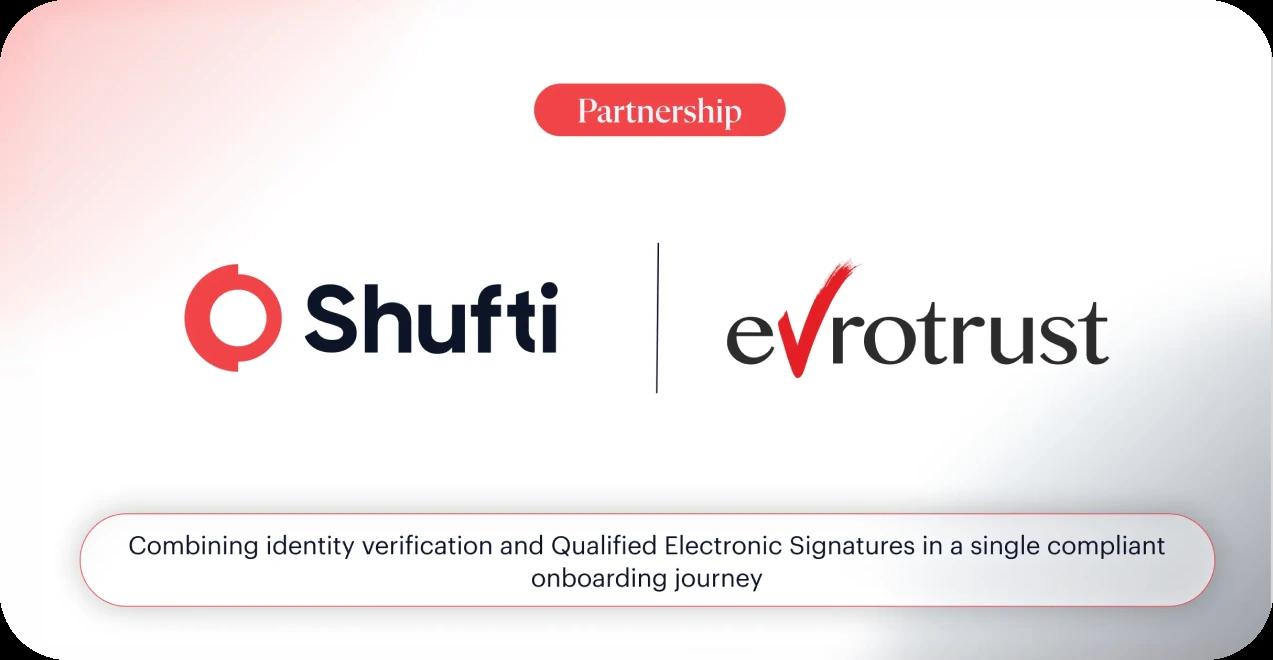
To close this gap, Shufti, a global identity verification and AML compliance provider, has partnered with Evrotrust, a Qualified Trust Service Provider on the EU Trusted List, to enable a single onboarding journey.
Shufti handles identity verification, onboarding orchestration, and compliance controls; Evrotrust issues the Qualified Certificate and performs the qualified signing, available wherever QES is recognised under eIDAS. The result lets businesses carry a verified identity through to a legally binding, eIDAS-qualified signature in one auditable flow.
“The future of digital trust will be built through collaboration. Our collaboration with Shufti reflects a shared vision for the future of digital trust, one where security, compliance, and user experience go hand in hand. Together, we are creating a stronger foundation for businesses across Europe to grow with confidence,” said Konstantin Bezuhanov, CEO at Evrotrust.
Where The Gap Shows Up Across Regulated Sectors
The gap reads differently depending on where the business sits.
- Banking & lending: High-value agreements such as loans or mortgages often involve additional verification or signing steps depending on risk policy and jurisdictional requirements. Under eIDAS (Regulation (EU) No 910/2014), Qualified Electronic Signatures (QES) provide legal equivalence to handwritten signatures where implemented.
- Insurance: Long-term products such as life and pension policies rely on strong evidence of customer consent and signature integrity, particularly in cases where agreements are later challenged or disputed.
- Investment & wealth: Mandates and authorisations require a verifiable link between the identified client and the instruction or agreement under regulated advisory and execution frameworks.
- Crypto services: Under MiCA, providers remain subject to EU anti-money laundering requirements, including customer due diligence, requiring reliable evidence of customer identity and consent at the point of agreement.
From fintech and payments to healthcare, real estate, and legal services, the requirement is the same: a durable, verifiable link between identity and signature, which is exactly what this partnership delivers.
From Verified Identity To Qualified Signature
Shufti verifies the customer through document and biometric checks, NFC-enabled document reads, or national eID schemes. The verified details pass securely to Evrotrust, which issues the Qualified Certificate and signs a cryptographic hash of the document. The resulting signature is then embedded back into the file. It includes:
- Only a hash of the document is ever sent for signing, so the document itself can stay entirely within the organisation’s own environment.
- The signature is embedded in a PAdES-LTV file with long-term validation, keeping it verifiable for up to 20 years, while the supporting evidence package is retained for 10 years per signed document.
- Under eIDAS Article 25, the signature is automatically recognised across the EU and the wider EEA, including Iceland, Liechtenstein, and Norway, so its legal standing holds in every member state without separate validation, even where the underlying transaction carries its own local rules.
- A single verified session can carry the signer through several documents at once, not just one.
- The organisation keeps the full evidence package and audit trail, while the signer receives the finished signed document.
- The whole flow runs through a single API across web and mobile.
Because verification and signing share a single record, a challenged agreement can be evidenced from one trail rather than reconciled across two systems.
“This partnership reflects how we’re building Shufti, one platform that handles identity, AML, and fraud, now extended to qualified electronic signatures through Evrotrust,” said Roger Redfearn-Tyrzyk, Chief Commercial Officer at Shufti. “Bringing QES into the platform gives regulated businesses a single trusted journey from onboarding through to legally binding signature, and lets us enable eID and EUDI wallets paired with qualified signing for fully compliant eIDAS 2.0 journeys.”
Built for what’s coming under eIDAS 2.0 and AMLR
The timing of the partnership aligns with major changes in Europe’s digital identity and compliance landscape.
From 10 July 2027, the EU’s Anti-Money Laundering Regulation (AMLR) will make Qualified Electronic Signatures, notified eIDs, and the EU Digital Identity Wallet the primary route for compliant onboarding, downgrading remote video identification to a fallback method.
A parallel shift comes from ETSI TS 119 461, the standard for identity proofing. Verification today is eIDAS-compliant under ETSI TS 119 461 v1. From 19 August 2027, v2.1.1 takes full effect and raises the bar to its highest level, the Extended Level of Identity Proofing (LoIP). Shufti is on a roadmap to v2.1.1 certification ahead of that deadline, positioning it for eID and EUDI Wallet-based onboarding.
Redfearn-Tyrzyk further added: “Because we own our core technology, we adapt to regulatory change at speed, from the incoming AMLR single rulebook to evolving eIDAS requirements, far faster than legacy providers can. We’re proud to extend Shufti’s verification to Evrotrust’s clients and to bring qualified signing to ours.”
While EUDI Wallets take on a growing role, organisations will still need orchestration layers for onboarding, compliance checks, fraud prevention, auditability, and qualified signing. Qualified signatures don’t replace that journey; under the incoming rules, they become essential to it.
Organisations exploring QES-enabled onboarding can learn more at www.shufti.com.
About Shufti
Shufti is a global identity verification and AML compliance provider, helping businesses onboard customers and meet their regulatory obligations across more than 240 countries and territories. Built entirely in-house, its platform spans document verification, biometric verification, age verification, AML screening, deepfake detection, fraud prevention, and VideoIdent, with solutions tailored to regulated European markets.
Shufti’s passive liveness detection is certified to iBeta Level 3 (ISO/IEC 30107-3) with a 0% error rate, and the platform is certified to ISO 27001 and SOC 2 Type II, and is fully GDPR compliant.
Media Contact
Aroosa Virk
Brand and Communications Manager
Shufti
[email protected]