




 Face Verification
 Address Verification
 Document Verification
 Age Verification
 VideoIdent
 Fast ID
 Docless Verification
 Consent Verification
 NFC Verification
 Business Verification
 Due Diligence
 Investor Verification
 E-Signature

 QES
QES
 AML Screening
 Transaction Monitoring
 Adverse Media
 Business AML Screening
 PEP & RCA
 Sanctions
 Watchlist
 Behavioural Biometrics
 Device Fingerprinting
 Biometric Face Authentication
 MFA
MFA
 Fraud Hub
 Onboarding
 Ongoing Monitoring
 KYC
KYC
 KYB
KYB
 KYI
KYI
 Age Assurance
 Identity Verification
 Workforce IAM
 Candidate Verification
 Compliance
 Fraud prevention
 Trust & safety
 Global expansion
 Product Managers
 Compliance Officers
 Fraud Analysts
 Developers
 Deepfake Detection
 Bonus Abuse / Promotion Abuse
 Account Takeover
 Synthetic Identity Fraud
 Document Fraud
 Impersonation Fraud
 Multi-Accounting
 Fraud Networks
 Chargeback Fraud
 Money Mule Activity
 Party Fraud
 Regulatory & Compliance Risks
 Fintech
 Crypto
 iGaming
 Forex
Forex
 Social Network
 Marketplace
 Banking
 Gig Economy
 Payments
 Ride Hailing
 Adult Content
 Blind Spot Audit
 Deepfake Detector
 Liveness Spoofs
 Document Originality
 Document Deepfake
 Global Trust Platform
 Journey Builder
 Case Management
 Shufti AI
 Fraud Analytics
 Vendor Comparison
 Brand Personalisation
 AI Compliance Co-Pilot
 OCR
OCR
 Secure Capture
 Deployment Options
 Identity Methods
 API Documentation
 Mobile SDKs
 Service Status
 Help Center
 Contact Us
 Technical Support
 Supported Documents
 Supported Countries

 Content library
 Blogs
Blogs
 News
News
 Reports
 Insights
 Knowledgebase
 ROI calculator
 About
About
 Career
 Press Release
 Certifications
 Partnership
 Awards
 Events & Webinar
 Interactive Demo
 Podcast Studio
 Spotlight Studio
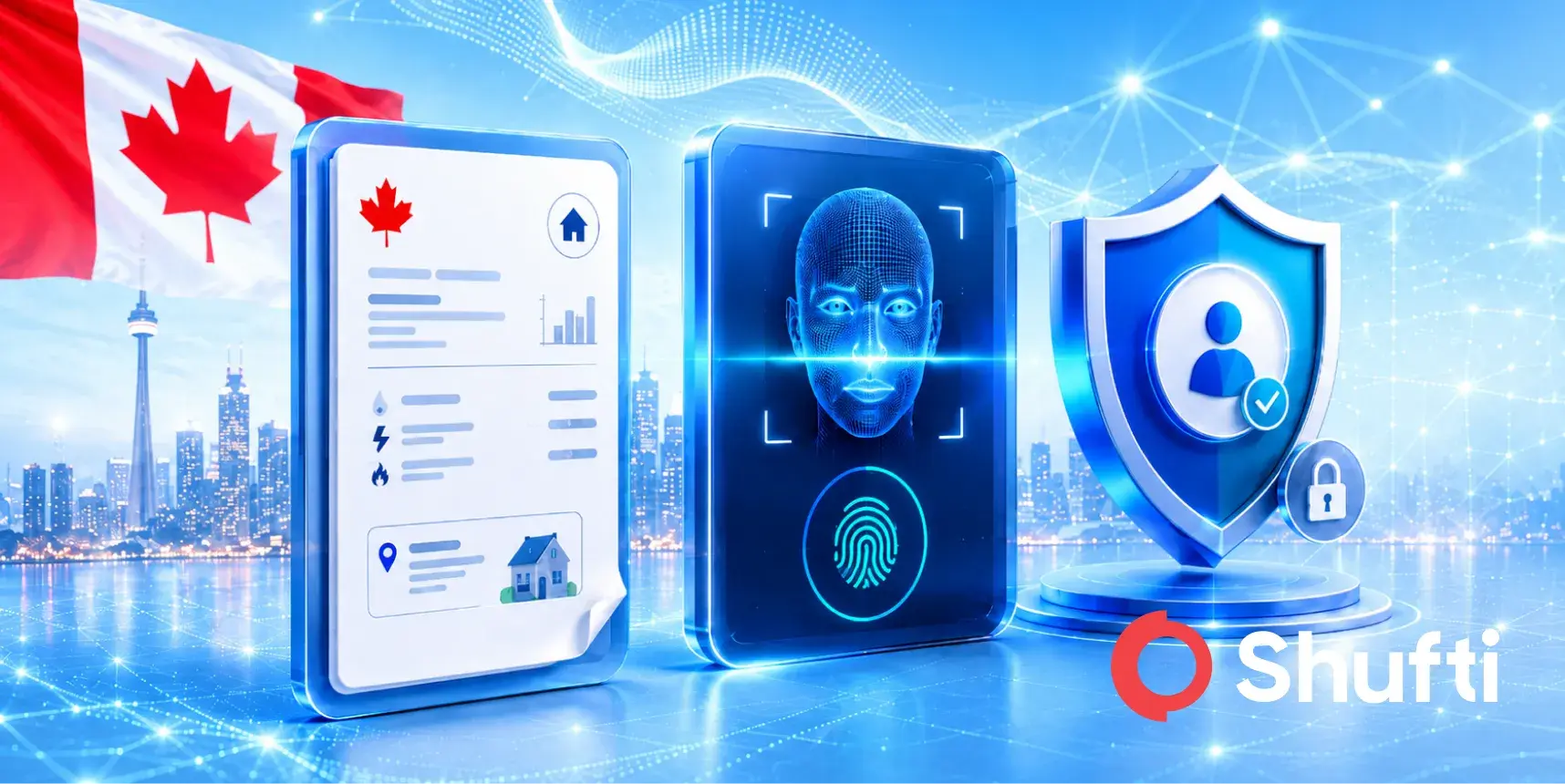
Address Verification Canada 2026: FINTRAC Requirements & Proof of Residence Guide
-
Add us as a Preferred Source
- 01 Why does fake address fraud create a compliance problem in Canada?
- 02 What does FINTRAC require for address verification?
- 03 How does address verification work in Canada under FINTRAC?
- 04 What documents are accepted as proof of address in Canada?
- 05 How Shufti helps Canadian fintechs meet FINTRAC address requirements
TL;DR
Address verification is mandatory under FINTRAC regulations. Reporting entities must verify a customer’s residential address using an approved method as part of KYC compliance under the PCMLTFA.
FINTRAC accepts multiple verification methods. Common approaches include government-issued photo ID, credit file verification, and the dual-process method using independent sources.
Several documents qualify as proof of address. CRA notices, CPP statements, utility bills, bank statements, and property tax assessments are among the commonly accepted documents.
Electronic proof of address is permitted. Digital documents can be used when their authenticity is properly assessed, with FINTRAC’s latest guidance emphasizing software-based verification.
Non-compliance can lead to regulatory consequences. Businesses must document verification activities, retain records for five years, and ensure every address verification decision is audit-ready.
Canadians reported $704 million in fraud losses in 2025, according to the Canadian Anti-Fraud Centre, and the Competition Bureau estimates only 5 to 10 per cent of incidents are ever reported. Address manipulation sits at the centre of many synthetic identity schemes, and building a fake address in Canada gives fraudsters a plausible footprint for opening accounts and accessing credit before detection catches up. For any reporting entity under Canada’s Proceeds of Crime (Money Laundering) and Terrorist Financing Act (PCMLTFA), Financial Transactions and Reports Analysis Centre of Canada (FINTRAC) KYC requirements go beyond collecting an address. Verification method, document source, and five-year record retention each carry specific standards. This guide covers the rules, which documents qualify as proof of address in Canada, which methods FINTRAC accepts, and how fintech platforms run address verification digitally.
Address verification in Canada is the legally required process of confirming a customer’s declared residential address using a government-approved method under the PCMLTFA. FINTRAC regulates these requirements across all reporting entities as part of standard know your customer (KYC) compliance in Canada.
Why does fake address fraud create a compliance problem in Canada?
Fake address fraud in Canada creates a direct regulatory liability. FINTRAC examination teams inspect both the address data collected and the verification methodology used to confirm it. An unverified or poorly documented address can constitute a breach of Customer Due Diligence (CDD) obligations under the PCMLTFA, even when the rest of the onboarding record is complete.
The mechanics of a fake address in Canada are straightforward. Fraudsters supply a real street address in a postal code they do not occupy, or build synthetic residential data that passes basic format validation. Standard tools that check only whether an address exists miss whether the customer actually lives there. Canada’s 2025 National Risk Assessment identifies synthetic identity fraud and the misuse of government identifiers as priority risks in the national financial system.
For fintech platforms handling high-volume onboarding, the exposure compounds quickly. Address verification in Canada, whether done through a manual review process or an automated pipeline, must produce a documented audit trail that FINTRAC inspectors can follow from source to decision. A process that works at 1,000 monthly verifications often breaks under the volume pressures of a scaling operation.
What does FINTRAC require for address verification?
FINTRAC’s address verification requirements under the PCMLTFA define what must be collected and how it must be confirmed. Non-compliance can result in administrative penalties and public findings. As of October 2025, the scope of reporting entities has expanded.
Who must comply with FINTRAC KYC requirements
The PCMLTFA covers a broad range of Canadian financial sector participants. Banks, credit unions, trust and loan companies, securities dealers, money services businesses (MSBs), insurance companies, and real estate professionals have been subject to FINTRAC requirements for years. New amendments effective October 2025 brought financing and leasing entities, cheque cashers, and title insurers under the PCMLTFA as new reporting entities, each with address verification obligations. Fintech platforms that operate as MSBs or under banking partner arrangements also fall within this scope.
What information must be collected and verified
Under FINTRAC’s identity verification guidance, reporting entities must collect the customer’s full legal name, date of birth, and residential address. Collecting the address is only the first step. The entity must verify it using one of FINTRAC’s approved methods, document the method used, and retain that record for five years from the date of the transaction or end of the business relationship.
How the October 2025 PCMLTFA amendments expanded obligations
The October 2025 amendments extended agent-or-mandatary authority to cover entity verification. Real estate licensees gained obligations to verify unrepresented parties in property transactions, and title insurers became regulated reporting entities for the first time, closing a gap that had allowed title fraud to move undetected. These requirements took effect October 1, 2025, adding address verification obligations to sectors previously outside FINTRAC oversight.
How does address verification work in Canada under FINTRAC?
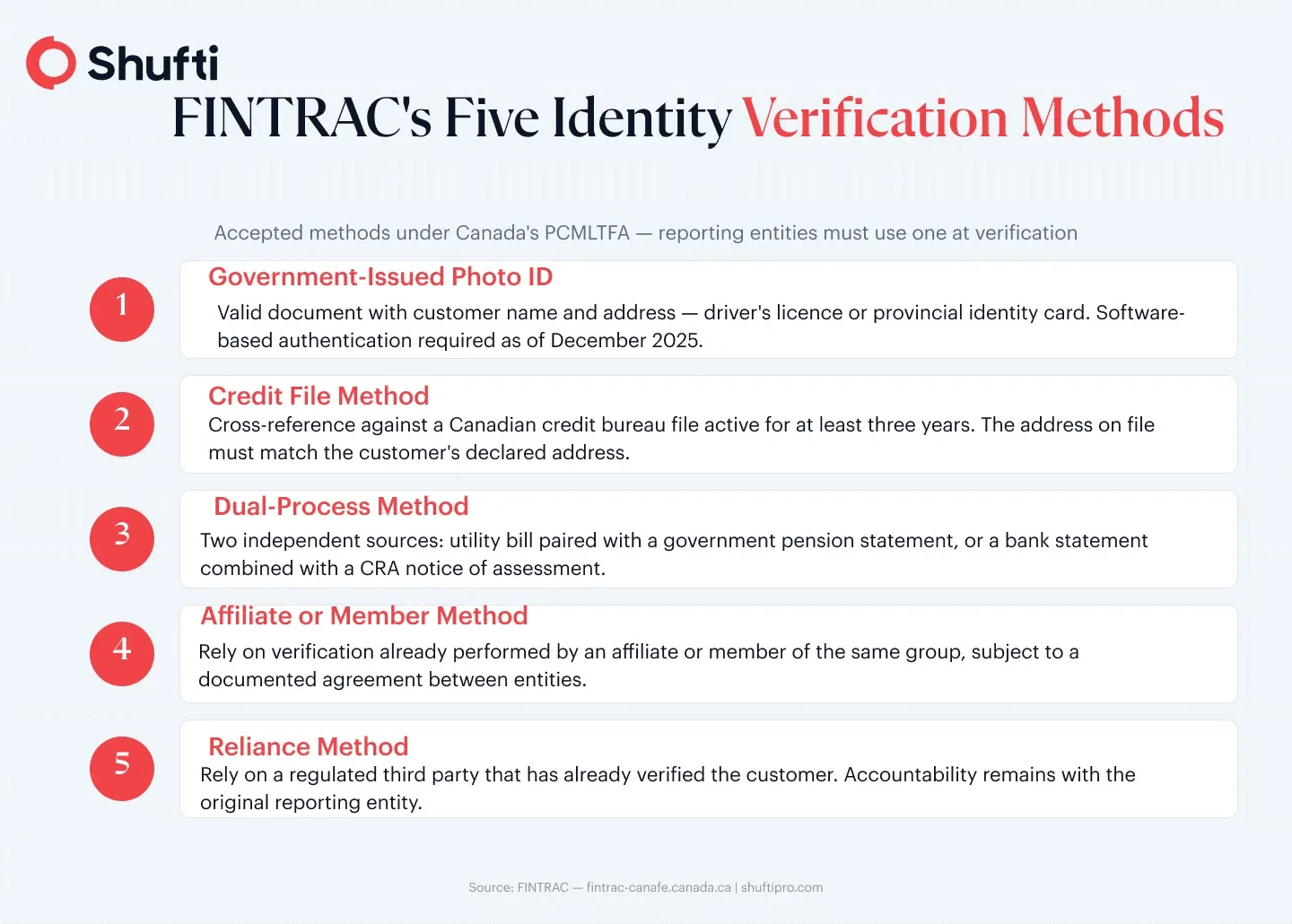
FINTRAC prescribes five accepted methods for identity verification in Canada, each suited to a different onboarding context. The method must be documented at the time of verification. Choosing the wrong method for a given risk profile creates an audit gap regardless of outcome. As of December 2025, FINTRAC’s updated guidance specifies that technology-based authentication must use actual software, not video chats, scans, or selfies alone.
Government-issued photo ID method
The government-issued photo ID method requires a valid document that includes the customer’s name and address. A Canadian driver’s licence, provincial identity card, or equivalent government-issued document satisfies the method when authentic, unexpired, and unaltered. For digital identity verification in Canada’s remote onboarding flows, FINTRAC as of December 2025 requires software-based authentication to confirm the document’s legitimacy before a match is accepted.
Credit file method
The credit file method cross-references name and address against a credit file active for at least three years, sourced from a Canadian credit bureau. The address on file must match what the customer provided. This method works well for customers with established credit histories and for fintech platforms where document upload at the address step would increase drop-off rates.
Dual-process method
The dual-process method verifies a customer’s name and address using two separate, independent sources. A utility bill proof of address Canada paired with a government pension statement, or a bank statement combined with a Canada Revenue Agency (CRA) notice of assessment, both satisfy the method when documents come from different institutions and name the customer at the current address. Annex 5 of FINTRAC’s identity verification guidance lists additional qualifying sources, and affiliate and reliance methods round out the five accepted approaches.
What documents are accepted as proof of address in Canada?
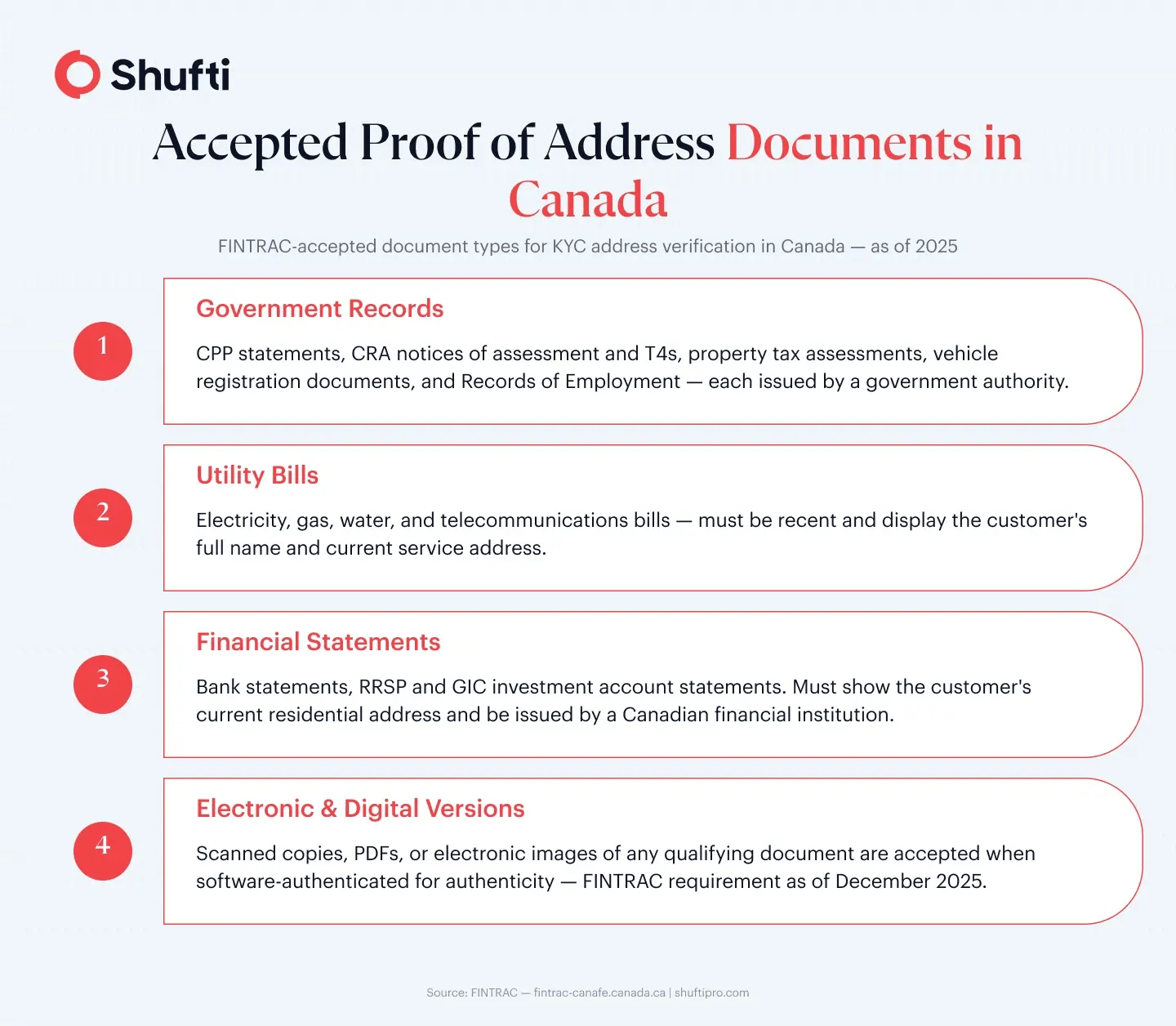
Documents accepted for proof of address in Canada span government records, financial statements, and utility documentation. Each document must be current, authentic-looking, and issued by an organisation independent of the customer. FINTRAC does not publish a single exhaustive list, but its identity verification methods guidance provides representative examples that compliance teams can map to their own acceptance policies.
Government-issued documents
Canadian government documents accepted under FINTRAC’s guidance include Canada Pension Plan (CPP) statements, CRA notices of assessment and T4 statements, property tax assessments, vehicle registration documents, and Records of Employment. Each originates from a government authority and contains the customer’s full name and residential address.
Utility bills and financial statements
Utility bill proof of address Canada is one of the most commonly used formats in the dual-process method. Accepted utility-category documents include electricity, gas, water, and telecommunications bills, provided they are recent and display the customer’s name and service address. Registered investment account statements, including Registered Retirement Savings Plan (RRSP) and Guaranteed Investment Certificate (GIC) statements, also qualify when they show a current address.
Electronic and digital proof of residence
FINTRAC’s guidance confirms electronic versions of qualifying documents are acceptable. A scanned copy, PDF, or electronic image satisfies the requirement when it can be reviewed for authenticity and has not been tampered with. FINTRAC’s December 2025 guidance update clarifies that authenticity assessment must use actual software, not a visual check alone. This is the point where a purpose-built address verification API for Canada adds compliance value that manual document review cannot match at volume.
How Shufti helps Canadian fintechs meet FINTRAC address requirements
FINTRAC’s December 2025 guidance raises the bar for digital address verification in Canada. Manual document inspection is no longer sufficient when technology-based authentication is available. Canadian fintech teams need an address verification API Canada solution that accepts the full range of FINTRAC-approved document types, verifies them forensically, and produces an audit trail that FINTRAC examination teams can follow from source to decision.
Shufti’s address verification solution covers the three primary FINTRAC onboarding scenarios through a single integration. A doc-less database check verifies identity and address data against authoritative sources in under three seconds, with no document upload required. For regulated onboarding flows requiring documentary proof, the Document Proof of Address module processes utility bills, government correspondence, and financial statements using forensic analysis that flags EXIF metadata anomalies, AI-generated content, and layout tampering.
For compliance teams identifying the best KYC software for Canada’s FINTRAC-regulated onboarding requirements, Shufti’s Address Verification API processes over one million verifications per day across 240+ countries, with 99.3% fraud detection accuracy. The same API handles doc-less speed and document-forensic depth, with configurable routing that escalates to document review only when risk or regulation calls for it.
Frequently Asked Questions
What is proof of address in Canada?
Proof of address in Canada is a document confirming a customer's current residential address, such as a utility bill, CRA notice of assessment, CPP statement, or bank statement. FINTRAC requires the document to be current, authentic, and issued by a source independent of the customer.
Who regulates KYC in Canada?
The Financial Transactions and Reports Analysis Centre of Canada (FINTRAC) regulates KYC compliance for all reporting entities under the PCMLTFA. FINTRAC sets identity and address verification standards and examines reporting entities to confirm ongoing compliance.
Is FINTRAC mandatory?
Yes. FINTRAC compliance is mandatory for all reporting entities under the PCMLTFA, including banks, credit unions, money services businesses, real estate professionals, and, as of October 2025, financing and leasing entities and title insurers. Non-compliance can result in administrative monetary penalties and public findings.
What happens if an address cannot be verified?
If an address cannot be verified using an approved FINTRAC method, the reporting entity cannot complete onboarding. The entity must document the failure, apply appropriate risk controls, and may need to file a suspicious transaction report. Proceeding without verification puts the entity in breach of PCMLTFA obligations.
What documents are accepted for KYC proof of address?
FINTRAC accepts government documents such as CRA notices, CPP statements, and property tax assessments, alongside utility bills, bank statements, and registered investment account statements. Documents must be current, authentic, unaltered, and issued by a source independent of the customer. Electronic versions are accepted when software-authenticated.