


 Face Verification
 Address Verification
 Document Verification
 Age Verification
 VideoIdent
 Fast ID
 Docless Verification
 Consent Verification
 NFC Verification
 Business Verification
 Due Diligence
 Investor Verification
 E-Signature

 QES
QES
 AML Screening
 Transaction Monitoring
 Adverse Media
 Business AML Screening
 PEP & RCA
 Sanctions
 Watchlist
 Behavioural Biometrics
 Device Fingerprinting
 Biometric Face Authentication
 MFA
MFA
 Fraud Hub
 Onboarding
 Ongoing Monitoring
 KYC
KYC
 KYB
KYB
 KYI
KYI
 Age Assurance
 Identity Verification
 Workforce IAM
 Candidate Verification
 Compliance
 Fraud prevention
 Trust & safety
 Global expansion
 Product Managers
 Compliance Officers
 Fraud Analysts
 Developers
 Deepfake Detection
 Bonus Abuse / Promotion Abuse
 Account Takeover
 Synthetic Identity Fraud
 Document Fraud
 Impersonation Fraud
 Multi-Accounting
 Fraud Networks
 Chargeback Fraud
 Money Mule Activity
 Party Fraud
 Regulatory & Compliance Risks
 Fintech
 Crypto
 iGaming
 Forex
Forex
 Social Network
 Marketplace
 Banking
 Gig Economy
 Payments
 Ride Hailing
 Adult Content
 Blind Spot Audit
 Deepfake Detector
 Liveness Spoofs
 Document Originality
 Document Deepfake
 Global Trust Platform
 Journey Builder
 Case Management
 Shufti AI
 Fraud Analytics
 Vendor Comparison
 Brand Personalisation
 AI Compliance Co-Pilot
 OCR
OCR
 Secure Capture
 Deployment Options
 Identity Methods
 API Documentation
 Mobile SDKs
 Service Status
 Help Center
 Contact Us
 Technical Support
 Supported Documents
 Supported Countries

 Content library
 Blogs
Blogs
 News
News
 Reports
 Insights
 Knowledgebase
 ROI calculator
 About
About
 Career
 Press Release
 Certifications
 Partnership
 Awards
 Events & Webinar
 Interactive Demo
 Podcast Studio
 Spotlight Studio
Address Verification System for E-Commerce: Reduce Fraud & Errors

-
Add us as a Preferred Source
- 01 How Does AVS Work in E-Commerce Payments?
- 02 Why Address Errors Are a Checkout Conversion Problem?
- 03 What Real-Time Address Validation Actually Does at Checkout?
- 04 Billing Address Verification vs. Shipping Address Verification
- 05 What to Evaluate in Address Verification Software?
- 06 Key Takeaways
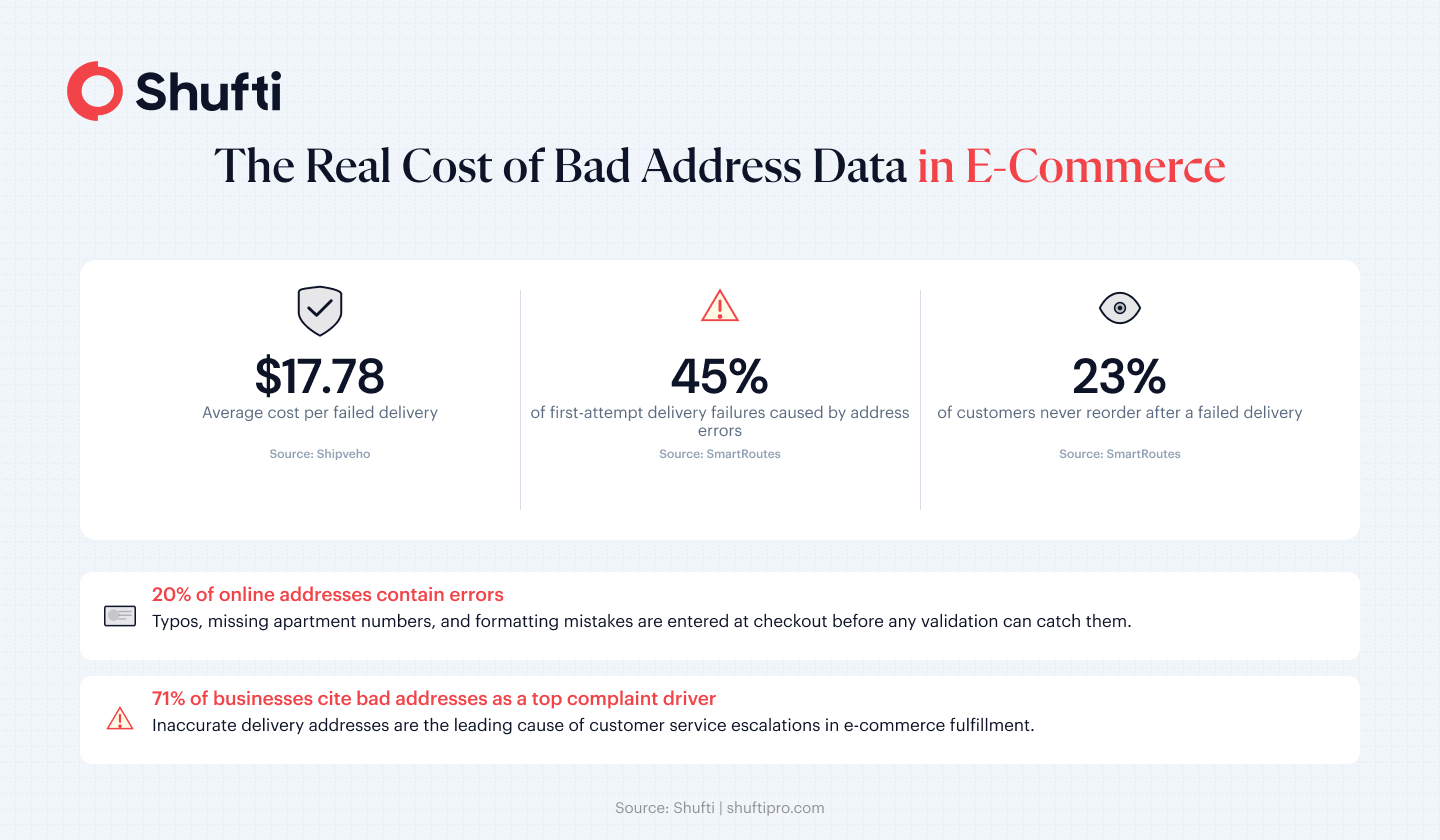
Industry delivery data shows that 23% of customers who experience one simply never order again. Yet address errors, the single biggest driver of first-attempt delivery failure, are largely preventable at the point of checkout with the right tooling in place.
An address verification system (AVS) is a tool that validates a customer’s submitted address against authoritative records, including postal databases and card-issuer data, to confirm accuracy, support proof of address requirements, catch formatting errors, and screen for fraud before an order is processed or a package is dispatched.
How Does AVS Work in E-Commerce Payments?
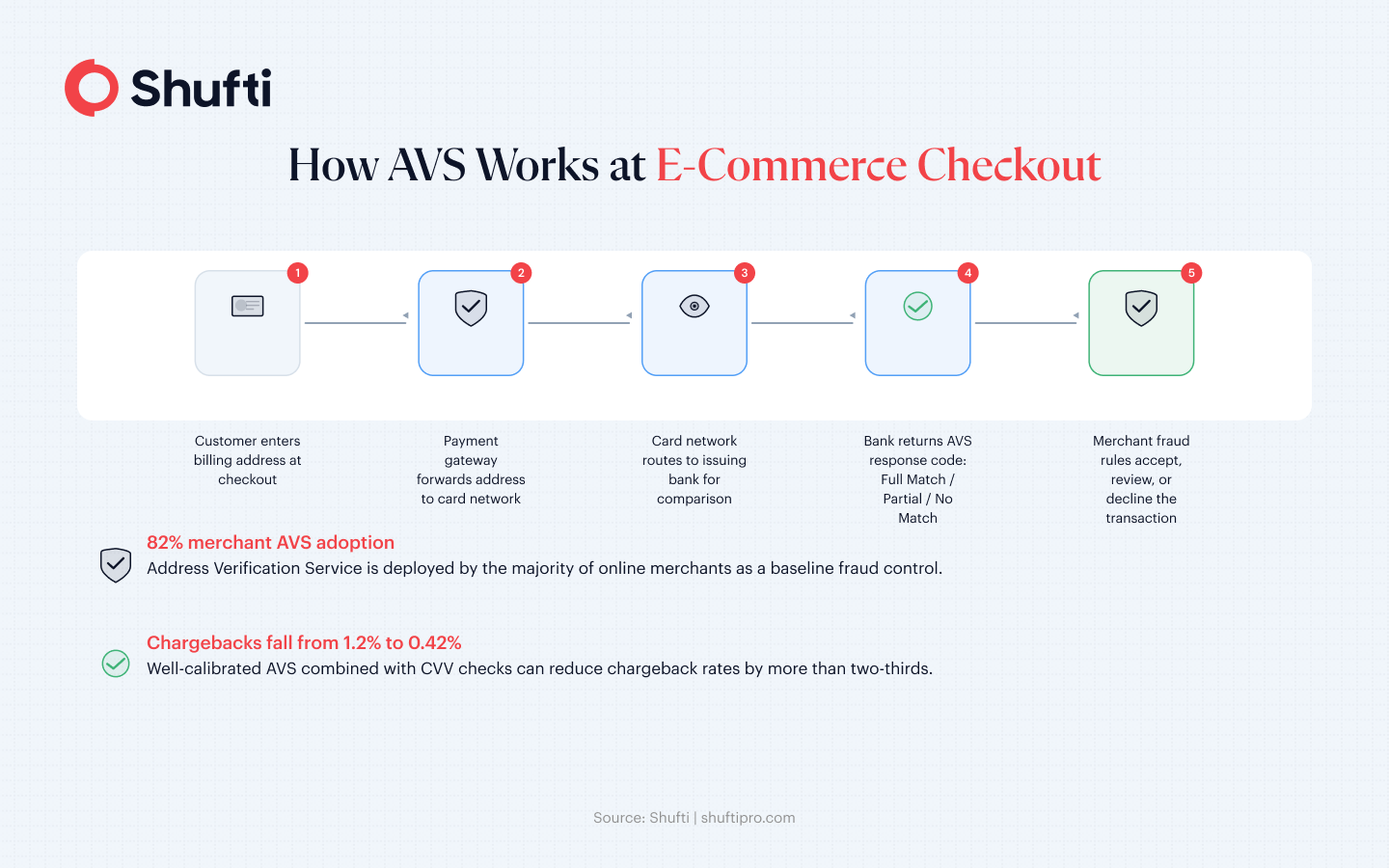
When a card-based payment is submitted at checkout, the payment gateway forwards the billing address to the card network, which routes it to the issuing bank. The bank compares the submitted details against its cardholder records and returns a response code: full match, partial match (postcode only), or no match. The merchant’s fraud rules then decide whether to accept, review, or decline the transaction.
AVS adoption sits at 82% among merchants. When combined with CVV checks, a well-calibrated AVS implementation can reduce chargeback rates from 1.2% to 0.42%. The emphasis is on well-calibrated: an overly strict AVS filter generates false declines, which are a different kind of revenue leak.
Why Address Errors Are a Checkout Conversion Problem?
The Form-Level Impact
Baymard Institute’s large-scale checkout research puts the average cart abandonment rate at 70.19%. Among the reasons shoppers give, 22% cite a checkout that is too long or too complicated. Address forms are a consistent friction point: the average US checkout contains 23.48 form elements, and address fields are where formatting errors, autofill mismatches, and country-specific postcode rules create hesitation.
Real-time address validation at the point of data entry resolves this by querying an address database as the user types, suggesting and auto-completing the correct entry, and flagging undeliverable addresses before the order is submitted. The error gets caught before it enters the fulfillment pipeline, not after the parcel is already in transit.
The Fulfillment Cost of Bad Address Data
Address errors account for approximately 45% of first-attempt delivery failures. At a median cost of $17.78 per failed parcel, a retailer processing 8,000 monthly orders with a 4% address error rate is looking at roughly $5,700 in avoidable monthly fulfillment costs before accounting for customer service calls and refund processing.
What Real-Time Address Validation Actually Does at Checkout?
Real-time address validation operates during data entry, not after the fact. The system queries a standardised postal database, reformats the entry to the postal standard for the destination country, and returns a corrected or confirmed address before the user submits the form.
For cross-border e-commerce, this matters considerably. Address formats diverge across markets: building names in the UK, ward-level hierarchies in Japan, and named street segments in Germany. A checkout address validation engine without international postal coverage simply exports domestic formatting assumptions into markets where they will fail, increasing the share of undeliverable international orders.
Checkout address verification for payments adds a fraud-screening layer on top of data quality. It is not enough for an address to be real and deliverable. The AVS layer confirms the person submitting the payment is associated with that address according to the issuing bank’s records.
Billing Address Verification vs. Shipping Address Verification
These solve different problems. Billing address verification is a fraud prevention that confirms card ownership: the billing address submitted must match what the issuing bank holds on record. Shipping address verification is a logistics control that confirms the delivery destination is real, correctly formatted, and serviceable by the chosen carrier.
A customer placing an order with a gift delivery to a different address is a normal scenario, but it requires the system to validate both addresses independently, with different logic applied to each. Address validation for e-commerce that conflates the two or validates only one leaves a gap that either fraud or failed deliveries will eventually find.
What to Evaluate in Address Verification Software?
Postal database coverage: Does the provider hold authoritative address data for every market you ship to? Thin coverage in emerging markets means validation falls back to formatting checks, which do not catch undeliverable addresses.
API response time: Validation that adds visible latency to checkout form fields creates the friction it is supposed to remove. Sub-second response is the benchmark.
Fraud signal integration: Address match scores are most useful when they feed into an existing fraud scoring model rather than operating as a standalone accept/decline gate.
Compliance audit trail: Merchants operating in regulated categories such as age-gated products, financial services, and prescription goods need a documented record of every verification decision. Address verification software without an auditable log is not fit for those use cases.
Pricing model: Most address verification tools charge per lookup. Total cost depends on verification volume, international order share, and whether the platform bills differently for billing versus shipping validation.
Key Takeaways
Address verification problems show up in three places simultaneously: checkout conversion, fulfillment cost, and payment fraud exposure. Real-time validation at the form level removes the majority of errors before they cascade downstream.
Billing address verification reduces chargeback exposure. Shipping address verification cuts the failed deliveries that cost $17.78 each and lose 23% of affected customers for good.
Managing address validation across checkout, payments, and compliance requirements typically means stitching together multiple tools with separate contracts and no unified audit trail. Shufti’s address verification solution handles real-time validation, billing address fraud screening, and proof of address compliance through a single API integration. Request a demo to see how it fits into your existing checkout and onboarding workflow.
Frequently Asked Questions
What is an address verification system (AVS)?
An address verification system validates a customer's submitted address against authoritative records, including postal databases and card-issuer data, to confirm accuracy, prevent delivery failures, and screen for payment fraud.
How does AVS work in e-commerce payments?
The payment gateway sends the billing address to the card network, which checks it against the issuing bank's records and returns a match code. The merchant uses that code in their fraud decision logic.
How does address verification improve checkout conversion?
Real-time address validation corrects formatting errors inline and removes undeliverable entries before submission, reducing the form friction that causes 22% of shoppers to abandon at checkout, according to the Baymard Institute.
What is the difference between billing address and shipping address verification?
Billing address verification confirms card ownership as a fraud control. Shipping address verification confirms parcel deliverability as a logistics control. Both require independent validation with separate logic.
What is shipping address verification?
Shipping address verification checks that a delivery address is real, correctly formatted, and serviceable by the carrier before an order is dispatched, reducing first-attempt delivery failure.