




 Face Verification
 Address Verification
 Document Verification
 Age Verification
 VideoIdent
 Fast ID
 Docless Verification
 Consent Verification
 NFC Verification
 Business Verification
 Due Diligence
 Investor Verification
 E-Signature

 QES
QES
 AML Screening
 Transaction Monitoring
 Adverse Media
 Business AML Screening
 PEP & RCA
 Sanctions
 Watchlist
 Behavioural Biometrics
 Device Fingerprinting
 Biometric Face Authentication
 MFA
MFA
 Fraud Hub
 Onboarding
 Ongoing Monitoring
 KYC
KYC
 KYB
KYB
 KYI
KYI
 Age Assurance
 Identity Verification
 Workforce IAM
 Candidate Verification
 Compliance
 Fraud prevention
 Trust & safety
 Global expansion
 Product Managers
 Compliance Officers
 Fraud Analysts
 Developers
 Deepfake Detection
 Bonus Abuse / Promotion Abuse
 Account Takeover
 Synthetic Identity Fraud
 Document Fraud
 Impersonation Fraud
 Multi-Accounting
 Fraud Networks
 Chargeback Fraud
 Money Mule Activity
 Party Fraud
 Regulatory & Compliance Risks
 Fintech
 Crypto
 iGaming
 Forex
Forex
 Social Network
 Marketplace
 Banking
 Gig Economy
 Payments
 Ride Hailing
 Adult Content
 Blind Spot Audit
 Deepfake Detector
 Liveness Spoofs
 Document Originality
 Document Deepfake
 Global Trust Platform
 Journey Builder
 Case Management
 Shufti AI
 Fraud Analytics
 Vendor Comparison
 Brand Personalisation
 AI Compliance Co-Pilot
 OCR
OCR
 Secure Capture
 Deployment Options
 Identity Methods
 API Documentation
 Mobile SDKs
 Service Status
 Help Center
 Contact Us
 Technical Support
 Supported Documents
 Supported Countries
 Content library
 Blogs
Blogs
 News
News
 Reports
 Insights
 Knowledgebase
 ROI calculator
 About
About
 Career
 Press Release
 Certifications
 Partnership
 Awards
 Events & Webinar
 Interactive Demo
 Podcast Studio
 Spotlight Studio
AML Compliance Solutions: Buyer’s Guide for 2026

TL;DR
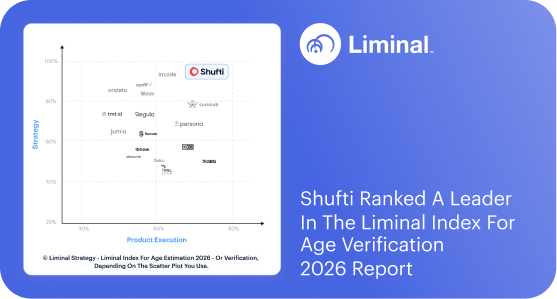
- The AML software market reaches 10.74 billion dollars by 2035 at 10.83% CAGR.
- Compliance teams are retiring rule-only platforms under regulatory pressure.
- Rule-based systems miss layering, smurfing, and shell structures below thresholds.
- EU AMLA now requires ongoing monitoring, not just onboarding screening.
- Six criteria determine whether a platform holds up under compliance pressure.
The global anti-money laundering (AML) software market reached USD 3.84 billion in 2025 and is on track to hit USD 10.74 billion by 2035 (Precedence Research, 2025), growing at a compound annual rate of 10.83%. That growth reflects regulatory pressure, not platform loyalty. Compliance teams across banking, fintech, and crypto are retiring manual workflows and rule-only platforms at a pace the vendor market is still catching up with.
This guide covers what AML compliance software needs to do in 2026, what regulatory and technological shifts have changed the buying calculus, and the six evaluation criteria that determine whether a platform will hold up under genuine compliance pressure.
Anti-money laundering compliance software is the technology layer that enables regulated businesses to screen customers, transactions, and entities against sanctions lists, politically exposed person (PEP) databases, adverse media sources, and risk-based behavioural rules. The screening runs continuously, not just at onboarding.
What does AML compliance software actually do?
AML compliance software is not a single module. It is a stack of detection and monitoring functions, each targeting a different point in the financial crime exposure cycle. The distinction matters to buyers because some platforms cover the full cycle and some are point solutions built around one function. Knowing which type you are evaluating determines whether you are comparing like for like.
Core detection functions
At the screening layer, the platform matches individuals, beneficial owners, and legal entities against global sanctions regimes, PEP registries, and adverse media databases. The United Nations Office on Drugs and Crime (UNODC) estimates annual money laundering at 2–5% of global GDP, a figure the agency places between USD 800 billion and USD 2 trillion (UNODC, Money Laundering Overview). At the monitoring layer, the platform analyses transaction patterns, flags structuring activity, and surfaces behavioural anomalies that point-in-time screening misses entirely.
What rule-based systems can no longer cover?
Rule-based AML systems fire alerts when transactions cross defined thresholds. Financial crime is not threshold-driven. Layering, smurfing, and shell entity structures are designed to stay below rule ceilings, making them invisible to a threshold-only alert engine. Modern AML screening platforms address this by pairing rules with machine learning models that establish customer behavioural baselines and flag deviations. That is a different category of detection, one that rules alone cannot replicate.
Why are compliance teams replacing rule-based AML systems in 2026?
The Financial Action Task Force (FATF), INTERPOL, and UNODC issued a joint statement in May 2025 calling for stronger, risk-proportionate AML and counter-terrorist financing (CFT) measures across all jurisdictions (UNODC/FATF/INTERPOL Joint Statement, May 2025). The direction is clear. Regulators are moving away from checklist compliance toward proportionate risk reasoning, and that shift is tightening what “adequate” AML software looks like. Two operational pressures are reinforcing the platform replacement cycle.
The false positive burden on compliance teams
The practical failure mode of legacy rule-based platforms shows up in analyst workload. Compliance teams at mid-market banks and fintechs routinely spend the majority of working hours reviewing alerts that turn out to be benign name-match collisions. Moody’s analysis of AML transformation trends in 2025 found that AI-driven platforms materially reduce this burden through better contextual matching and behavioural scoring (Moody’s, AML in 2025). That is not a marginal efficiency gain. It is the difference between a compliance function operating within its headcount and one that is permanently behind on reviews.
The EU AMLA ongoing monitoring requirement
The EU Anti-Money Laundering Authority (AMLA) became operational as of 2025 and carries direct supervisory power over high-risk obligated entities. The AMLA framework places explicit weight on ongoing monitoring, not just onboarding screening. Platforms that only check at customer acquisition now represent a compliance gap under the EU supervisory regime, not just a capability shortcoming. Any AML compliance software shortlist that excludes ongoing monitoring functionality is already outdated for EU-regulated businesses. For a broader look at how enforcement trends are shaping AML investment decisions, record-breaking fines on banks for KYC and AML non-compliance document the scale of consequences for gap areas.
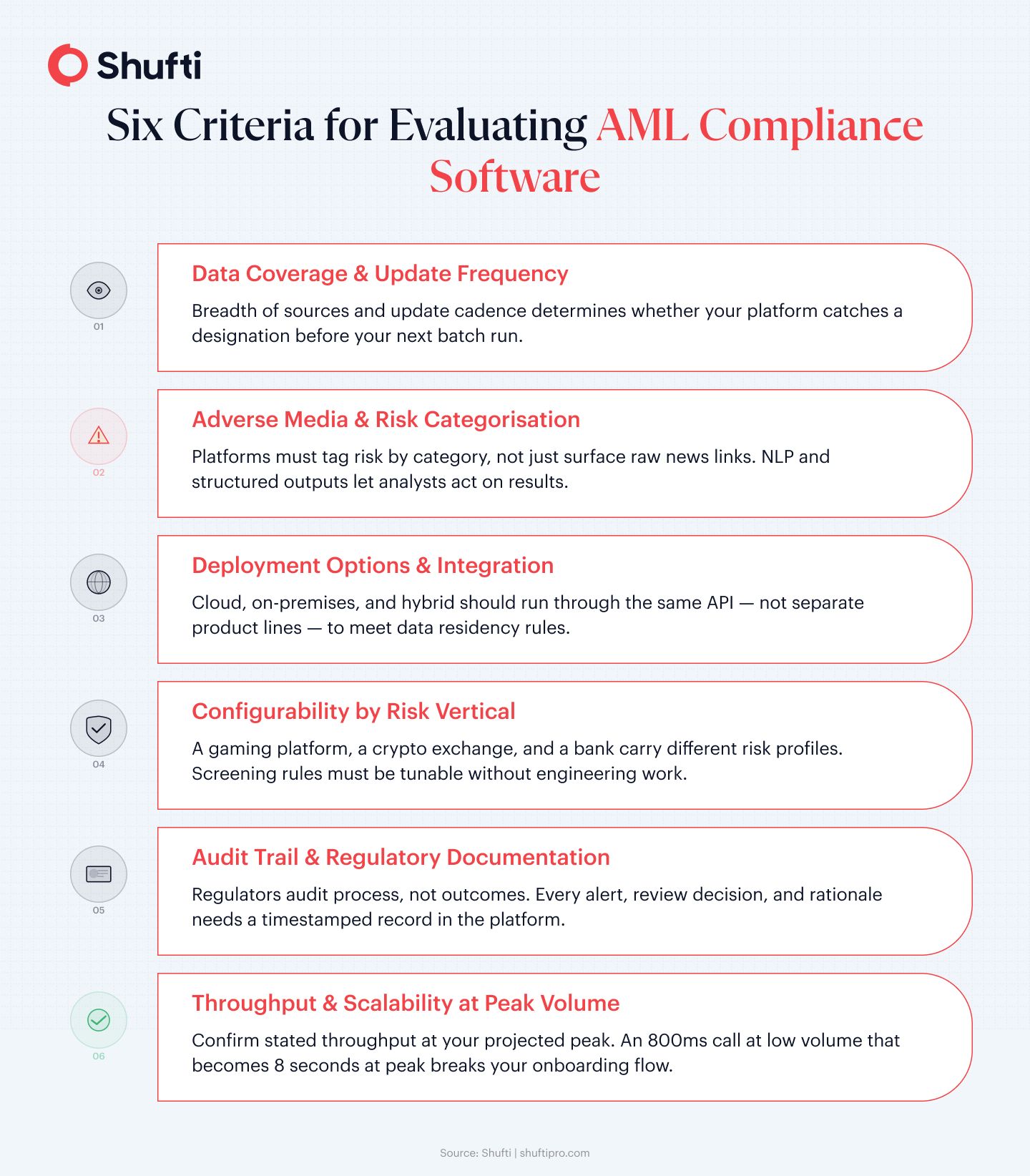
What to look for in AML compliance software: six evaluation criteria?
Choosing an AML compliance solution is not a feature comparison exercise. It is a risk assessment. Which platform holds up under the specific regulatory regime your business operates in, at your transaction volumes, in your customer geography. These six criteria are the questions that determine fit, not marketing claims.
| Criterion | What to assess |
| Data coverage and update frequency | Watchlist breadth and refresh cadence (15-min vs weekly) |
| Adverse media depth | NLP source coverage with structured risk categories |
| Deployment and integration | Cloud, on-prem, hybrid via one API; shared audit trail |
| Configurability by vertical | Industry-specific risk rules without custom engineering |
| Audit trail and documentation | Timestamped, decision-level risk-based rationale |
| Throughput and scalability | Stated throughput and latency at your projected peak |
1. Data coverage and update frequency
The breadth of the underlying database matters in proportion to your geographic footprint. A platform sourcing from thousands of global watchlists and millions of PEP profiles surfaces risk that narrower databases miss, particularly in jurisdictions where secondary sanctions and informal PEP networks are not well-indexed by smaller providers. Update cadence matters just as much. Data refreshed every 15 minutes catches an Office of Foreign Assets Control (OFAC) designation before your next day’s batch run. A weekly update cycle does not.
2. Adverse media and risk categorisation depth
Sanctions and PEP screening covers declared risk. Adverse media screening covers emerging risk before formal designation occurs. Look for platforms that combine natural language processing with broad source coverage and structured risk category outputs that analysts can act on. Raw news links are not an adverse media product. The output should tell you which risk category the story falls into, not just that negative coverage exists.
3. Deployment options and integration architecture
A cloud-only platform creates a constraint for regulated entities with data residency obligations, particularly in the EU, Asia-Pacific (APAC), and Middle East and North Africa (MENA) regions. Evaluate whether the platform supports cloud, on-premises, and hybrid deployment through the same API rather than across separate product lines. For integration, the practical test is whether your user risk assessment workflows, KYC onboarding, and transaction monitoring share a single audit trail or require reconciliation across disconnected dashboards.
4. Configurability by risk vertical
A fintech processing peer-to-peer payments carries a different risk profile from a crypto exchange or a gaming platform. AML tools applying a single screening cascade to every customer segment will over-alert on one vertical and under-screen another. Configuration options for building industry-specific risk rules without custom engineering work are a baseline requirement. For context on how AML and KYC compliance requirements vary by industry, KYC and AML for Fintech covers sector-specific considerations in detail.
5. Audit trail and regulatory documentation
Regulators do not audit AML outcomes in isolation. They audit the process that produced those outcomes, examining how alerts were generated, what triggered a review, what decision was made, and by whom. Your AML compliance platform must produce a documented, timestamped audit trail that demonstrates the risk-based rationale behind every decision. Platforms that generate alerts without decision history fail this requirement regardless of their detection accuracy.
6. Throughput and scalability at peak volume
AML screening at 500 onboardings per day presents a different throughput requirement than 50,000. Confirm the platform’s stated throughput at your projected peak, and ask specifically about latency under load. A screening call that takes 800ms at low volume and eight seconds at peak breaks your onboarding flow. KYC onboarding and transaction screening pipelines that run in parallel with AML checks compound this requirement substantially.
How Shufti helps compliance teams run real-time AML screening?
Shufti’s AML screening runs through a single API that covers sanctions and PEP screening, adverse media analysis, and ongoing monitoring without splitting those functions across separate products or contracts. The underlying database indexes over 100,000 AML data sources, 3,500 global watchlists, 2.6 million PEP profiles across 215 sanction regimes, and 50,000 adverse media sources covering 415 risk categories. Data is updated every 15 minutes, which addresses the update frequency requirement that daily batch systems fail to meet.
The platform supports cloud, on-premises, and hybrid deployment through the same API. That matters for businesses with GDPR or data residency obligations that prevent a cloud-only deployment. Configurable workflows allow risk rules to be tuned by industry vertical without requiring engineering work, so a gaming operator, a crypto exchange, and a bank can each run appropriate screening cascades from the same integration.
Where Shufti’s approach differs from standalone screening tools is in the integration between AML and identity. When a customer’s KYC data and their AML profile live on the same platform, the audit trail is complete from onboarding through ongoing monitoring. Analysts see the full risk picture in one view rather than reconciling exports across systems. Screening outputs carry structured risk categories, source classifications, and confidence scores that give compliance teams the decision context to act on a result, not just a match flag to chase down.
Frequently Asked Questions
How do AML systems work?
AML systems screen customers, transactions, and entities against structured data sources including sanctions lists, PEP databases, and adverse media. Modern platforms combine these database checks with machine learning models that establish behavioural baselines and surface anomalies that static rules would miss.
What features should AML compliance software include?
A complete platform includes sanctions and PEP screening, adverse media monitoring, transaction monitoring, CDD workflows, a configurable risk scoring engine, and a timestamped audit trail. Platforms should support ongoing monitoring after onboarding, not just point-in-time checks at customer acquisition.
Does AML software use artificial intelligence?
Most modern platforms use AI and machine learning for risk scoring, false positive reduction, and anomaly detection. AI models analyse transaction patterns and customer behaviour in context, identifying structuring and layering that rule-based thresholds would miss entirely.
How do AML tools detect suspicious transactions?
AML tools combine rule-based thresholds with behavioural analytics that compare each transaction against the customer's established pattern. When a transaction falls outside the expected envelope, even below a formal reporting threshold, the system generates an alert for analyst review.
What is real-time AML monitoring?
Real-time AML monitoring means screening runs continuously against an up-to-date database rather than in daily or weekly batch cycles. When a customer is added to a sanctions list, real-time monitoring surfaces the match the same day. The same principle applies at the transaction level, where alerts fire within the same session rather than during an overnight review.
How does AML software reduce false positives?
False positives are reduced through better matching algorithms that account for name transliterations and aliases, contextual risk scoring that weighs a match against other risk signals before firing an alert, and configurable sensitivity thresholds by customer segment. Machine learning models that establish normal behaviour for each customer profile reduce noise by separating genuine anomalies.