



 Face Verification
 Address Verification
 Document Verification
 Age Verification
 VideoIdent
 Fast ID
 Docless Verification
 Consent Verification
 NFC Verification
 Business Verification
 Due Diligence
 Investor Verification
 E-Signature

 QES
QES
 AML Screening
 Transaction Monitoring
 Adverse Media
 Business AML Screening
 PEP & RCA
 Sanctions
 Watchlist
 Behavioural Biometrics
 Device Fingerprinting
 Biometric Face Authentication
 MFA
MFA
 Fraud Hub
 Onboarding
 Ongoing Monitoring
 KYC
KYC
 KYB
KYB
 KYI
KYI
 Age Assurance
 Identity Verification
 Workforce IAM
 Candidate Verification
 Compliance
 Fraud prevention
 Trust & safety
 Global expansion
 Product Managers
 Compliance Officers
 Fraud Analysts
 Developers
 Deepfake
 Bonus Abuse / Promotion Abuse
 Account Takeover
 Synthetic Identity Fraud
 Document Fraud
 Impersonation Fraud
 Multi-Accounting
 Fraud Networks
 Chargeback Fraud
 Money Mule Activity
 Party Fraud
 Regulatory & Compliance Risks
 Fintech
 Crypto
 iGaming
 Forex
Forex
 Social Network
 Marketplace
 Banking
 Gig Economy
 Payments
 Ride Hailing
 Adult Content
 Blind Spot Audit
 Deepfake Detector
 Liveness Spoofs
 Document Originality
 Document Deepfake
 Global Trust Platform
 Journey Builder
 Case Management
 Shufti AI
 Fraud Analytics
 Vendor Comparison
 Brand Personalisation
 IDV Modes
 AI Compliance Co-Pilot
 OCR
OCR
 Secure Capture
 Deployment Options
 Identity Methods
 API Documentation
 Mobile SDKs
 Service Status
 Help Center
 Contact Us
 Technical Support
 Supported Documents
 Supported Countries
 Content library
 Blogs
Blogs
 News
News
 Reports
 Insights
 Knowledgebase
 ROI calculator
 About
About
 Career
 Press Release
 Certifications
 Partnership
 Awards
 Events & Webinar
 Interactive Demo
 Podcast Studio
 Spotlight Studio
Best Business Verification Software in 2026
- 01 TL;DR
- 02 What Is KYB Verification and How Does It Work?
- 03 What Should You Look for in a KYB Software Provider in 2026?
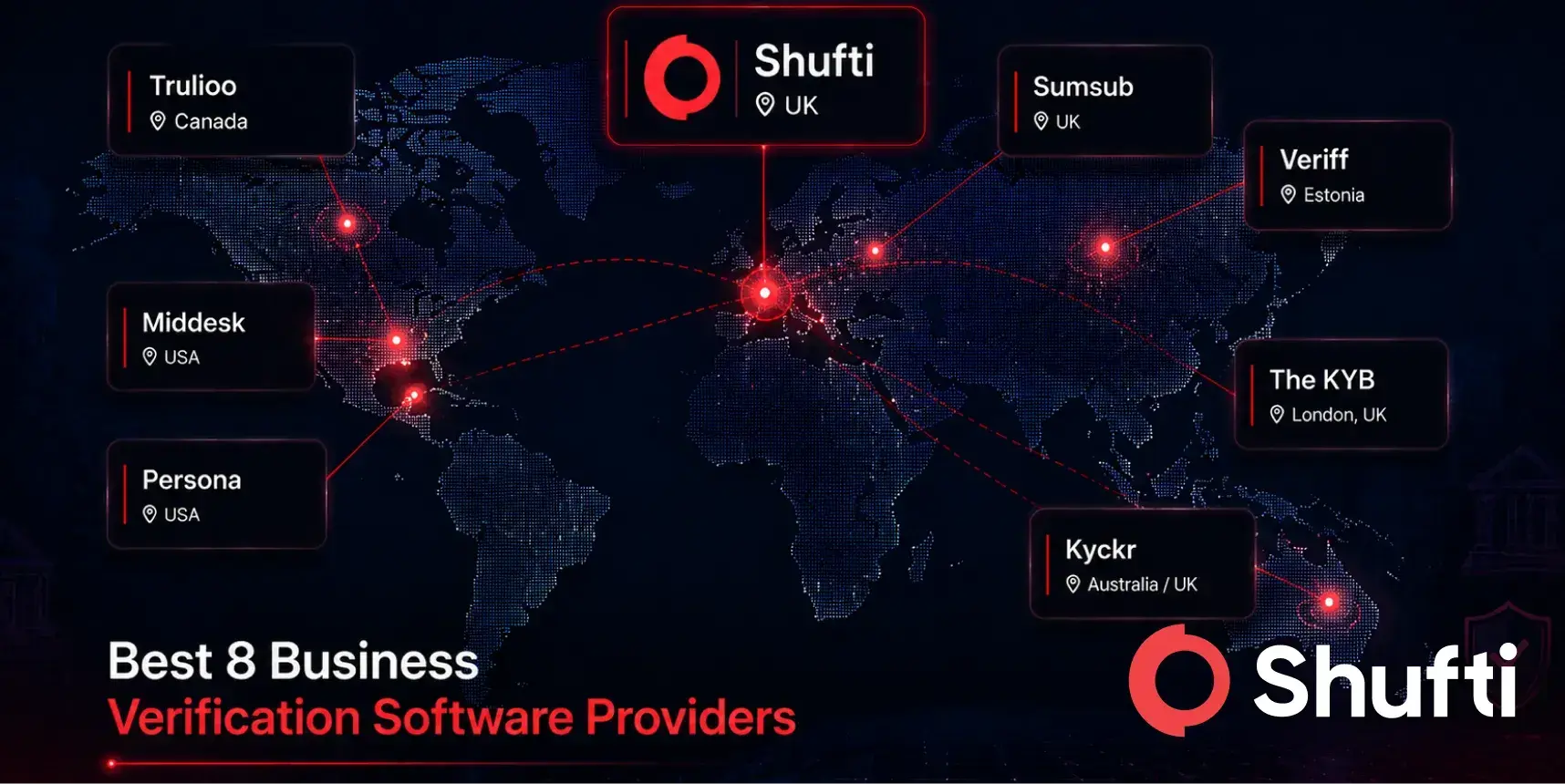
- 04 The 8 Best Business Verification Software in 2026
- 05 Business Verification Software Vendor Comparison at a Glance
- 06 #1. Shufti
- 07 #2. Kyckr
- 08 #3. Middesk
- 09 #4. Persona
- 10 #5. Sumsub
- 11 #6. The KYB
- 12 #7. Trulioo
- 13 #8. Veriff
- 14 How Do You Choose the Right Business Verification Software for Your Business?
TL;DR
- KYB software automates company registry checks, UBO discovery, and AML screening in a single onboarding flow.
- FATF’s 2022 update to Recommendation 24 and the EU AMLA Single Rulebook (directly applicable July 2027) have raised the global floor on beneficial ownership verification.
- Manual KYB creates defensible audit gaps: incomplete ownership chains, stale registry data, and no monitoring once a business is onboarded.
- The right platform connects live to official registries, resolves UBO chains automatically, and re-screens entities on an ongoing basis.
- Shufti combines business entity verification, UBO-linked identity checks, and proprietary AML screening under a single API with no partner dependencies.
Onboarding a business customer is not a single check. It is a sequence: confirm the entity is legally registered, map its ownership structure to the ultimate beneficial owners, verify the identity of each UBO, screen all of them against sanctions and PEP lists, collect supporting documents, and keep monitoring for changes after the file is closed. Every gap in that chain is a gap in your compliance posture and regulators are closing the exit routes.
In March 2022, the Financial Action Task Force updated Recommendation 24 to require countries to ensure adequate, accurate, and up-to-date beneficial ownership information through multi-pronged mechanisms, not just self-declaration. In February 2023, Recommendation 25 extended the same logic to legal arrangements including trusts and foundations.
The EU’s AMLA Single Rulebook, directly applicable from 10 July 2027, will apply a uniform 25% beneficial ownership threshold across all EU member states, replacing the patchwork of national interpretations that previously let compliance teams take shortcuts.
This guide compares 8 business verification software providers on the criteria that matter for procurement: registry coverage, UBO mapping depth, AML screening, deployment flexibility, and third-party review scores. All product claims are sourced to each vendor’s public site, the Gartner Magic Quadrant for Identity Verification 2025, the KuppingerCole Analysts 2025 market assessment, and verified review platforms.
What Is KYB Verification and How Does It Work?
Know Your Business (KYB) is the compliance process of verifying that a business entity is legitimate, active, and not associated with financial crime, and then tracing ownership to the natural persons who ultimately control it. For regulated institutions, completing this process accurately is a legal obligation. For any B2B platform accepting business customers, it is the foundation of counterparty risk management.
KYB verification typically runs in four sequential steps. First, the software queries an official company registry to confirm the entity exists, is active, and holds current filings. Second, it resolves the ownership structure from registry records and corporate filings to identify UBOs above a defined threshold, commonly 25% or more of ownership or control. Third, it screens the entity and each identified UBO against sanctions lists (OFAC, UN, EU, HMT), PEP databases, and adverse media. Fourth, it collects and verifies supporting documents, certificates of incorporation, proof of address, and identity documents for each UBO. Ongoing monitoring continues this process after onboarding, re-screening when registry data changes or new watchlist entries appear.
The gap between platforms is in how much of this chain runs automatically, how many official registries they connect to directly, and how they handle jurisdictions with thin or opaque registry data.
What Is the Difference Between KYC and KYB Verification?
KYC (Know Your Customer) verifies an individual: their identity document, biometric liveness, and personal screening against sanctions and PEP lists. KYB verifies a legal entity which includes its registration, corporate structure, beneficial ownership chain, and AML screening at the entity level. In practice, KYB always contains a KYC component, because every UBO identified during business verification must themselves be identity-verified.
Platforms that handle both natively running the KYB entity check and the UBO identity checks in one connected flow produce a more defensible audit trail than those that force compliance teams to switch between separate tools for the two tasks.
What Should You Look for in a KYB Software Provider in 2026?
Choosing KYB software is a structural decision, not a feature checklist. The platform you pick defines your audit trail, your onboarding speed, and your ability to re-verify businesses as ownership structures change. These are the criteria that separate platforms that hold up under regulatory examination from those that introduce the compliance gaps they claim to close.
Technology Ownership Versus Orchestrated Stacks
KYB platforms built on orchestrated stacks route different parts of the verification process to different third-party vendors: one for registry data, one for document OCR, one for AML screening, one for biometric liveness. Each handoff introduces a failure point, a contractual dependency, and an accountability gap when something goes wrong. A platform with full-stack ownership controls the entire data chain, the registry query, the document check, the AML screening, and the biometric step under a single chain of custody. When a regulator asks how a specific verification decision was reached, that architectural choice matters considerably.
Company Registry Coverage and Data Freshness
The distinction between a platform that claims registry coverage and one that delivers it in real time is material. Some providers query official registries live at the moment of verification; others serve cached data from a prior bulk pull. For jurisdictions where company statuses change frequently, strike-offs, administration filings, ownership changes, stale data creates liability. Evaluate how many official registries the platform connects to directly, whether data is fetched in real time, and whether the platform returns the original registry document or a derived summary.
UBO Discovery and Beneficial Ownership Mapping
Automated UBO resolution is among the hardest problems in KYB. Ownership chains that run through holding companies, trusts, nominee directors, and offshore shell structures in low-transparency jurisdictions cannot be resolved from a single registry query. Post-FATF Recommendation 24, the defensibility of that resolution process is what regulators examine. Evaluate how many layers of ownership the platform resolves automatically, how it handles circular or opaque structures, and what the documented process is for escalating unresolvable chains to human review. For buyers with exposure to offshore jurisdictions, ask explicitly how the platform handles structures that terminate in anonymous nominee arrangements.
AML Screening at the Entity Level
Sanctions screening for businesses is not the same as sanctions screening for individuals. A business may appear on no list while its UBO is a designated person. A business may not be listed but operate in a sanctioned sector or jurisdiction. Evaluate whether the platform screens at the entity level, at the UBO level, and at the relationship level (business connections to sanctioned parties). Check the watchlist coverage: OFAC SDN, UN Security Council, EU Consolidated List, HMT, and regional lists depending on your geographic exposure. Adverse media screening at both the entity and UBO level matters for higher-risk counterparties.
Deployment Flexibility and Data Residency
Organisations subject to Saudi PDPL, UAE NESA, Indonesian OJK, or Thai PDPA requirements cannot run business verification on a SaaS platform with data processing in the US or EU. Local Cloud (data never leaves the region) and on-premises options are not nice-to-haves for those buyers; they are hard procurement requirements. SaaS-only platforms should be excluded before the feature-comparison stage for any organisation with active data-localisation obligations.
Integration Depth and Developer Experience
For KYB to run inside an onboarding flow without creating friction, the platform must integrate cleanly with existing systems. Evaluate REST API quality, webhook support for async verification events, no-code dashboard availability for compliance teams without engineering resources, and time-to-first-call. Platforms that require weeks of integration work before a single live verification runs have a real cost in compliance programme velocity.
Ongoing Monitoring and Risk Re-Scoring
KYB is not a one-time check. Business structures change, sanctions lists are updated, adverse media breaks on formerly clean entities, and beneficial owners change. Evaluate whether the platform re-verifies entities on a schedule or on trigger, what watchlist update cadence it uses, and whether monitoring alerts integrate into your case management workflow with an auditable evidence trail.
The 8 Best Business Verification Software in 2026
As the publisher of this guide, we list Shufti first for transparency. The remaining 7 vendors are listed alphabetically and described on the same factual basis. Each entry includes an overview, key strengths, considerations, certifications and recognitions, current public ratings, and the use case the vendor is best suited to. All product details are sourced from each vendor’s public website, the Gartner Magic Quadrant for Identity Verification 2025, the KuppingerCole Analysts 2025 market assessment, public iBeta conformance listings, and verified review platforms.
- Shufti
- Kyckr
- Middesk
- Persona
- Sumsub
- The KYB
- Trulioo
- Veriff
Business Verification Software Vendor Comparison at a Glance
| Vendor | Architecture | UBO Mapping | AML Screening | Deployment | G2 | Trustpilot | Best fit |
| Shufti | Own IP (full stack) | Yes — with integrated KYC | Proprietary, in-house | SaaS, Local Cloud, On-prem | 4.5 / 5 (71) | 4.8 / 5 (3,800+) | KYB + KYC + AML, global |
| Kyckr | Own (direct-to-registry API) | Data layer only | Not native | SaaS | Limited presence | Limited presence | Registry data as API input |
| Middesk | Own | Yes (US entities) | Yes (US watchlists) | SaaS — US only | Limited presence | Limited presence | US business onboarding |
| Persona | Orchestrated | Yes | Via partners | SaaS — US and EU | 4.3/ 5 (45) | Limited | Developer-first KYB/KYC |
| Sumsub | Orchestrated (multi-partner) | Yes | Via ComplyAdvantage / AML Watcher | SaaS | 4.6 / 5 (112 reviews) | 1.3 / 5 (264) | Crypto/fintech rapid integration |
| The KYB | Own | Yes | Yes (11,000+ sources) | Verify with vendor | Limited Presence | Limited Presence | Dedicated KYB workflow |
| Trulioo | Own + IDMerit | Yes | Yes | SaaS | 4.4 / 5 (40) | Limited Presence | Non-document data verification |
| Veriff | Own + IDMerit | Partial (via KYB add-on) | Via integrations | SaaS — EU residency | 4.5 / 5 (61 reviews) | 1.4 / 5 (213) | EU/US IDV with KYB add-on |
Sources: Gartner Magic Quadrant for Identity Verification 2025, KuppingerCole Analysts 2025 market assessment, public iBeta conformance listings, vendor public sites, G2.com vendor profiles, Trustpilot vendor profiles. Ratings marked “Verify before publish” had insufficient public review volume at time of writing. All data accurate as of June 2026; verify directly with each vendor before procurement.
#1. Shufti
UK-headquartered and built entirely on owned intellectual property: OCR, liveness detection, document intelligence, KYB, KYC, and AML are all developed and maintained in-house rather than licensed from partners. That full-stack ownership is what made Shufti a genuinely ‘Glocal’ verification vendor: the same architecture that verifies a US-registered LLC also resolves beneficial ownership chains for a Vietnamese joint-stock company, a Saudi limited liability company, or a Brazilian LTDA, with the same engineering control and the same audit trail. That is the architecture mainstream IDV players turned to when their orchestrated stacks could not handle the document complexity and corporate structure variety those markets require.
For KYB specifically, Shufti runs business entity verification, ownership resolution, UBO-linked identity checks, and AML screening as a single connected workflow through one API. When a UBO is identified from a registry record, their identity document and biometric liveness can be verified in the same pipeline, producing a linked audit trail that covers the entity, the ownership structure, and each natural person at the end of that chain.
Key strengths:
Shufti’s KYB pipeline spans 240+ countries and jurisdictions, with the UBO identity layer drawing on 270+ authoritative data sources for passive eIDV checks across 95+ countries and 40+ active eID integrations including BankID, Singpass, MitID, and OneID serving three verification modes (Passive, Active, and Biometrically Enriched) through a single API.
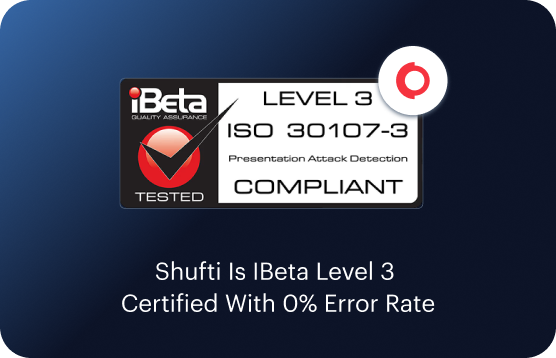
When biometric liveness is required for UBO identity verification, Shufti holds iBeta Level 3 conformance under ISO/IEC 30107-3, the highest published independent presentation-attack detection standard, held by only three vendors globally as of June 2026. The in-house OCR reaches 99.7% accuracy across 150+ languages and scripts, outperforming Google Vision on Arabic, Vietnamese, CJK, and Burmese scripts relevant for corporate documents from non-Latin jurisdictions that many KYB platforms cannot process without human review fallback.
Proprietary AML screening covers sanctions, PEPs, adverse media, and continuous monitoring all in-house, with no dependency on ComplyAdvantage, AML Watcher, or equivalent third-party services.
The KuppingerCole Analysts 2025 assessment assigned Shufti the highest overall technical capability score (79 / 100) and identified it as the only vendor in the comparison group with no partner dependencies across core capabilities. In the U.S. Department of Homeland Security Remote Identity Validation Rally 2025, Shufti was named a Top Performer with a 98.49% True Accept Rate and Zero False Template Creation events. Public clients operating across complex multi-jurisdiction profiles include Binance, Stripe, ByteDance/TikTok, XM, and Coinbase.
Considerations:
Smaller commercial presence in North American markets than US-headquartered peers (a brand-awareness and contracting consideration, not a capability one). Pricing varies by deployment model and is not published per-transaction; enterprise and on-premises contracts are quoted directly.
Deployment Options:
- SaaS
- Cloud
- Local Cloud
- On-premise for data-residency compliance
Certifications and Recognitions:
- iBeta Level 3 conformance under ISO/IEC 30107-3
- Shufti DHS RIVR 2025 Top Performer: 98.49% True Accept Rate, zero False Template Creation events in the U.S. Department of Homeland Security Remote Identity Validation Rally 2025
- SOC 2 Type II
- PCI DSS
- GDPR compliance, Cyber Essentials, Cyber Essentials Plus
- KuppingerCole Analysts 2025: highest overall technical capability score (79 / 100) and the only vendor in the market assessment with no partner dependencies across core capabilities
Ratings (as of June 2026):
- Shufti G2 Reviews: 4.5 / 5 (71 reviews)
- Shufti Trustpilot Reviews: 4.8 / 5 (3,800+ reviews) the highest Trustpilot rating-and-volume combination among the vendors compared
Best for:
Fintechs, crypto exchanges, B2B platforms, and regulated enterprises that need KYB entity verification, UBO identity checks, and AML screening under one API, particularly across multi-jurisdiction onboarding flows where non-Latin registry documents, complex ownership structures, or data-residency requirements are part of the operational reality. One platform. Fully owned technology. Global coverage with real local depth.
#2. Kyckr
Kyckr is an Australian-founded, UK-listed KYB data specialist providing direct API access to 300+ official company registers across 120+ countries. Unlike platforms that maintain internal databases sourced from a prior bulk pull from registries, Kyckr queries official sources at the time of request, returning incorporation documents, filing histories, and directorship data as close to real time as each registry allows. As of 2025, Kyckr serves as a data partner to over 35 KYB software platforms and a direct supplier to 80 regulated businesses, per Kyckr’s public site.
Key strengths:
Direct-to-registry API architecture means data returned is sourced from official registers rather than proprietary databases, reducing the risk of stale or derived information. Coverage across 120+ countries includes many jurisdictions that broader KYB platforms reach only via data intermediaries. The platform returns original registry documents alongside structured data, which is directly useful for compliance audit files requiring primary-source evidence. For compliance teams building their own onboarding stack, Kyckr functions as a reliable registry data layer that can be embedded into existing workflows via API.
Considerations:
Kyckr is a data provider, not a full KYB workflow platform. It does not include native AML screening, biometric UBO identity verification, document OCR, or case management dashboards. Buyers needing a complete KYB-to-UBO-identity pipeline will need to integrate additional tooling on top of the registry data layer. No public iBeta submission. Pricing and SLA terms are enterprise-contracted.
Certifications and recognitions:
- ISO 27001
- GDPR-aligned data processing
Ratings (as of June 2026):
- G2:Limited presence
- Trustpilot: Limited presence
Best for:
RegTech platforms, compliance software vendors, and enterprise compliance teams that need authoritative company registry data as a clean API input into their own KYB workflows, and who are building bespoke onboarding stacks rather than buying a turnkey solution.
#3. Middesk
Middesk is a US-founded business identity platform connecting to US state company registries, IRS EIN records, and US watchlists to automate CIP, CDD, and merchant risk verification for businesses registered in the United States. The platform draws on 400+ data sources and is designed for rapid integration; a dashboard is available immediately, with API integration achievable within days. The platform covers automated bulk business lookups, watchlist screening, litigation and bankruptcy history, and industry classification.
Key strengths:
Deep US registry connectivity, including direct ties to state-level registration authorities and the IRS, makes Middesk’s data freshness and pass rates strong for US-incorporated entities. The platform is purpose-built for CIP and CDD under US BSA/AML frameworks, with a clean integration path that compliance teams can stand up quickly without significant engineering resource. Middesk Agents pull and cross-reference data across its source network, purpose-built for CIP, CDD, EDD, and merchant risk, per Middesk’s public product documentation.
Considerations:
Middesk is US-only, a hard limit for any organisation onboarding businesses incorporated outside the United States. SaaS-only delivery with US data residency; no Local Cloud or on-premises option for international data-residency requirements. Native biometric UBO identity checks require additional tooling. Public G2 review volume was limited at time of writing; verify current ratings at middesk G2 before procurement.
Certifications and recognitions:
- SOC 2 Type II
- GDPR-aligned data handling for permissible US-based use cases
Ratings (as of June 2026):
- G2: Limited Presence
- Trustpilot: Limited presence
Best for:
US-native fintechs, lenders, payment platforms, and marketplaces that exclusively onboard US-registered business customers and need a fast, purpose-built CIP and CDD automation tool without international coverage requirements.
#4. Persona
Persona is a US-based, API-first identity orchestration platform offering unified KYB and KYC flows for business onboarding across 200+ countries and territories. Per the KuppingerCole Analysts 2025 assessment, Persona operates as a top-down orchestration-led entrant, coordinating third-party components rather than owning the full verification stack. The platform positions on developer experience: configurable flows, low-code and no-code options, and documented integration achievable in an afternoon.
Key strengths:
Unified KYB-KYC flows allow businesses and their UBOs to be verified together in a single configurable workflow with shared case management. Dynamic flows and human-review fallback allow compliance teams to handle edge cases without engineering resources. Link analysis supports connected fraud-ring detection across entity and individual records. G2 reviewers consistently cite ease of implementation and support responsiveness as differentiators, with a G2 rating of 4.4 / 5 based on 43 reviews. ISO 27001 recertified February 2025.
Considerations:
Orchestrated architecture (KuppingerCole 2025) means Persona coordinates third-party components rather than owning the full stack, creating third-party dependency to assess in procurement. SaaS-only with US and EU data residency only; no Local Cloud or on-premises option for GCC, SEA, or other regional data-residency frameworks buyers subject to PDPL, NESA, OJK, or PDPA requirements should exclude Persona at the architecture stage. Trustpilot presence is limited.
Certifications and recognitions:
- ISO 27001 (recertified February 2025)
- SOC 2 Type II
- PCI DSS
- ISO/IEC 30107-3 liveness conformance (Level 2)
- GDPR and CCPA compliance
Ratings (as of June 2026):
- G2: 4.3/5( reviews)
- Trustpilot: Limited presence
Best for:
US and EU developer-first fintechs, marketplaces, and B2B platforms that need configurable, low-code KYB-KYC workflows and prioritise integration speed and UX, where SaaS delivery and US/EU data residency satisfy all regulatory requirements.
#5. Sumsub
Sumsub is a UK-incorporated identity and compliance platform offering a KYB module alongside KYC, AML, and transaction monitoring. Per the Gartner Magic Quadrant for Identity Verification 2025, Sumsub uses Smart Engines for document forgery detection, Inverid for NFC verification, Resistant.ai for document forensics, and ComplyAdvantage and AML Watcher for AML screening an orchestrated stack with multiple third-party dependencies. The platform covers 14,000+ document types per Sumsub’s public site and self-reports an average verification pass rate of 90% and 30-second verification time.
Key strengths:
Broad product coverage spanning KYB, KYC, AML, and transaction monitoring under one contract is attractive to operators seeking a consolidated compliance vendor relationship. The 14,000+ document library is one of the wider catalogues in this comparison. Sumsub has a strong installed base in crypto, fintech, and iGaming and a G2 rating of 4.6 / 5 based on 109+ reviews, indicating strong satisfaction in those verticals. Multiple ISO certifications including ISO 27001 and ISO 22301:2019 for business continuity.
Considerations:
Orchestrated multi-partner architecture (Gartner MQ 2025) means accountability is fragmented across the stack when a component fails or a partner updates their API. Sumsub has not submitted to iBeta at any level as of June 2026, per public iBeta listings a material consideration for buyers in crypto, forex, and gaming where deepfake-driven fraud is a live attack vector. Trustpilot 1.3 / 5 (256 reviews) reflects consumer-facing verification experience, which affects end-user pass rates and brand perception.
Certifications and recognitions:
- ISO 27001
- ISO 22301:2019 (business continuity)
- ISO/IEC 27017 (cloud security)
- ISO/IEC 27018 (cloud privacy)
- SOC 2 Type II, SOC 3
- PCI DSS
- ETSI 119 and 319 standards under eIDAS
Ratings (as of June 2026):
- Sumsub G2 reviews
- Trustpilot: 1.3 / 5 (264 reviews)
Best for:
Crypto, fintech, and iGaming operators needing a broad KYB-KYC-AML feature set with rapid integration, where independent liveness conformance is not a procurement requirement and SaaS delivery meets all data-residency needs.
#6. The KYB
The KYB is a dedicated business verification platform purpose-built for KYB compliance workflows. The platform screens against 11,000+ data sources per The KYB’s public site, using AI-driven analysis to evaluate hits and filter false positives at the entity and beneficial-owner level. Vendor-reported performance figures include a 97% average pass rate and 15-second entity verification time, with automated document collection and UBO mapping built into the standard onboarding flow. The platform positions itself as a specialist KYB tool rather than a broad IDV and fraud platform.
Key strengths:
As a pure-play KYB platform, The KYB’s product focus is entirely on business verification rather than the broader IDV and fraud stack, which typically translates to a more refined workflow and faster time-to-value for compliance teams whose primary need is entity verification and UBO mapping. The AI-driven false-positive filtering across 11,000+ sources is designed to reduce manual review load for analysts working high-volume B2B onboarding pipelines. Automated document collection and risk scoring are integrated into the onboarding flow.
Considerations:
As a dedicated KYB tool, buyers needing native biometric liveness verification for UBOs, full document OCR across complex international IDs, or a combined full-IDV-and-KYB pipeline will need to integrate additional tooling. Deployment model and data-residency options should be confirmed directly with The KYB for GCC, SEA, or EU-localisation requirements.
Certifications and recognitions:
- SOC 2 Type II
- ISO/IEC 27001
- GDPR & CCPA Compliance
- PCI DSS
- iBeta Level 2 Certification
Ratings (as of June 2026):
- G2: Limited Presence
- Trustpilot: Limited Presence
Best for:
Compliance teams and B2B onboarding platforms that need a focused, dedicated KYB workflow business registry checks, UBO mapping, and entity AML screening without requiring an integrated biometric identity pipeline.
#7. Trulioo
Trulioo is a Canadian data-aggregation specialist providing identity and business verification across 195 countries and 14,000+ document types. For KYB, Trulioo’s structural strength is its authoritative data network, 450+ global data sources spanning government databases, utility records, telco data, and credit bureaux, per Trulioo’s public site. Per the Gartner Magic Quadrant for Identity Verification 2025, Trulioo uses IDMerit as a partner for certain capabilities.
Key strengths:
The 450+ data source network provides significant depth for non-document identity verification of both individuals and, for business verification, entity confirmation in jurisdictions where official registry access is unreliable or absent. Coverage across 195 countries makes Trulioo one of the widest-coverage platforms in this comparison. Its G2 score reflects positive assessments from compliance teams in data-coverage-sensitive verticals.Trulioo remains ISO 27001 certified since 2015 and SOC 2 Type 2 certified since February 2024.
Considerations:
Partner dependency on IDMerit for certain capabilities (Gartner MQ 2025) introduces a third-party dependency to assess procurement. Trulioo’s KYB workflow is strongest where non-document data verification is the primary requirement; buyers needing native biometric UBO identity checks or on-premises deployment should evaluate specific capability gaps. Its Trustpilot presence is limited.
Certifications and Recognitions:
- ISO 27001 (certified since 2015)
- SOC 2 Type 2 (since February 2024)
- GDPR compliance
Ratings (as of June 2026):
- G2: 4.4 / 5 (40 reviews)
- Trustpilot: Limited public presence
Best for:
Buyers require deep non-document business and identity verification via authoritative data sources, particularly in markets where official registry access is limited or where document-based KYB alone is insufficient to resolve ownership chains to natural persons.
#8. Veriff
Veriff is an Estonian AI-driven identity verification platform covering 12,000+ government-issued IDs across 230+ countries. Per the Gartner Magic Quadrant for Identity Verification 2025, Veriff uses IDMerit as a partner for certain capabilities. iBeta Level 2 conformance under ISO/IEC 30107-3 is confirmed on public iBeta listings. Veriff’s primary product is IDV for individuals; KYB is available as an add-on to that core capability.
Key Strengths:
Veriff’s core IDV capability comprises 12,000+ documents, 230+ countries, an average verification time of 6 seconds per Veriff’s public site, and iBeta Level 2 conformance makes it a capable UBO identity verification layer when connected to a separate KYB registry data tool.
Its G2 rating reflects positive user assessments primarily for the IDV use case. Certifications include ISO/IEC 27001:2022, SOC 2 Type II, Cyber Essentials, and iBeta Level 2 PAD conformance.
Considerations:
EU and US training-data weighting per Gartner MQ 2025 means non-Latin hard-market document processing is narrower than for vendors trained on those documents from inception. SaaS-only with EU data residency hosted on AWS; no on-premises or Local Cloud option for GCC, SEA, or other regional data-residency frameworks. Buyers needing a complete KYB registry layer, not just the UBO IDV component will need supplementary tooling. Trustpilot 1.5 / 5 (213 reviews) reflects consumer-facing verification experience.
Certifications and recognitions:
- ISO/IEC 27001:2022
- ISO/IEC 27017:2015
- ISO/IEC 27018:2019
- SOC 2 Type II
- Cyber Essentials
- iBeta Level 2 PAD conformance under ISO/IEC 30107-3
- GDPR and CCPA compliance
Ratings (as of June 2026):
- G2: 4.5 / 5 (61 reviews)
- Trustpilot: 1.4 / 5 (213 reviews)
Best for:
EU and US digital platforms needing fast IDV with a KYB add-on, where SaaS delivery and EU data residency are sufficient and non-Latin hard-market document depth is not a primary requirement.
How Do You Choose the Right Business Verification Software for Your Business?
The vendor that fits is the vendor that handles your KYB use cases under your specific compliance regime, with a deployment model your data-residency requirements accept, and a UBO resolution approach that holds up under regulatory examination. Most buyers fall into one or more of five common procurement situations.
Scenario 1: Fintech or crypto platform onboarding businesses globally
For platforms onboarding businesses across multiple jurisdictions — particularly those that include non-Latin markets, GCC entities, or LATAM corporate structures — the core requirement is a single API that covers registry verification, UBO mapping, and UBO identity checks in one connected flow. Shufti’s combination of full-stack ownership, 240+ country coverage, and integrated KYB,KYC and AML pipeline handles this profile without the data-residency complications and partner-dependency risks that come with orchestrated platforms. For buyers who need non-document UBO identity verification as the primary method in markets with unreliable document availability, Trulioo’s 450+ data source network is a specialist complement for that specific layer.
Scenario 2: EU-regulated entity preparing for AMLA compliance
The EU AMLA Single Rulebook, directly applicable from 10 July 2027, requires consistent beneficial ownership verification at a 25% threshold applied uniformly across member states, with ongoing monitoring obligations that make point-in-time onboarding checks structurally insufficient. Shufti’s full eIDAS 2.0 spectrum support, proprietary continuous AML monitoring, and Local Cloud or on-premises deployment options for EU data-localisation needs make it the broadest structural fit for this scenario. For DACH-region buyers specifically needing video-ident at scale or eIDAS Qualified Electronic Signature use cases, IDnow (not covered in this guide) is a regional specialist for those sub-cases.
Scenario 3: US-only platform, all business customers US-registered
For a buyer certain that all business counterparties are US-incorporated and will remain so, Middesk’s purpose-built US CIP/CDD automation provides deep US state registry connectivity and a fast integration path. Shufti remains the right choice for any buyer likely to expand internationally, since switching KYB platforms when the first non-US entity requires onboarding carries significant compliance programmes and engineering costs.
Run a proof of concept on your hardest KYB cases, and benchmark the result against any vendor on this list, through a live walkthrough with Shufti.
Frequently Asked Questions
What criteria should I use to shortlist KYB software vendors?
Start with four structural filters before comparing features: deployment model (SaaS vs. Local Cloud vs. on-prem against your data-residency obligations), jurisdiction coverage (which registries the vendor connects to directly), UBO resolution depth (automated multi-layer vs. manual), and whether AML screening is proprietary or third-party. Then compare registry data freshness, integration complexity, ongoing monitoring capability, and independent review scores.
How does Shufti's business verification compare to dedicated KYB platforms like Sumsub or Veriff?
Shufti runs KYB entity verification, UBO mapping, UBO identity checks, and AML screening in a single API under one fully owned technology stack with no third-party pipeline dependencies. Sumsub uses multiple external partners for AML and document forensics (Gartner MQ 2025) and has no iBeta submission at any level. Veriff's primary product is IDV; KYB is an add-on. Shufti's Local Cloud and on-premises options also address data-residency requirements that neither Sumsub nor Veriff can serve.
How does automated KYB handle businesses registered in jurisdictions with limited registry data?
Platforms handle this in different ways. Best-practice platforms layer multiple signals: official registry data where available, authoritative data sources (government, credit, utility, telco) for passive entity confirmation, and document-based verification as a fallback. For UBOs in low-transparency jurisdictions, biometric identity verification with liveness detection provides the final link in the chain. Shufti's 270+ data sources across 95+ countries and Trulioo's 450+ source network are among the deepest multi-source approaches in this comparison.
Can business verification software verify Ultimate Beneficial Owners (UBOs) automatically?
Yes, though depth varies by platform. Most KYB platforms identify UBOs from registry filings automatically. The harder problem is resolving multi-layer ownership chains through holding companies or trusts and then verifying the identity of each natural person at the end. Platforms like Shufti run the UBO identity check — document verification and biometric liveness — as part of the same onboarding flow, producing a linked audit trail covering the entity and each beneficial owner in one connected workflow.
What compliance risk does manual business verification create compared to an automated solution?
Manual KYB creates four structural risk categories: stale registry data from pulling records once at onboarding without re-verification; incomplete UBO chains from stopping resolution before reaching natural persons; no continuous monitoring after onboarding, leaving sanctions list changes undetected; and inconsistent documentation with no defensible audit trail for regulatory examination. Automated KYB with ongoing monitoring closes all four categories simultaneously.