


 Face Verification
 Address Verification
 Document Verification
 Age Verification
 VideoIdent
 Fast ID
 Docless Verification
 Consent Verification
 NFC Verification
 Business Verification
 Due Diligence
 Investor Verification
 E-Signature

 QES
QES
 AML Screening
 Transaction Monitoring
 Adverse Media
 Business AML Screening
 PEP & RCA
 Sanctions
 Watchlist
 Behavioural Biometrics
 Device Fingerprinting
 Biometric Face Authentication
 MFA
MFA
 Fraud Hub
 Onboarding
 Ongoing Monitoring
 KYC
KYC
 KYB
KYB
 KYI
KYI
 Age Assurance
 Identity Verification
 Workforce IAM
 Candidate Verification
 Compliance
 Fraud prevention
 Trust & safety
 Global expansion
 Product Managers
 Compliance Officers
 Fraud Analysts
 Developers
 Deepfake Detection
 Bonus Abuse / Promotion Abuse
 Account Takeover
 Synthetic Identity Fraud
 Document Fraud
 Impersonation Fraud
 Multi-Accounting
 Fraud Networks
 Chargeback Fraud
 Money Mule Activity
 Party Fraud
 Regulatory & Compliance Risks
 Fintech
 Crypto
 iGaming
 Forex
Forex
 Social Network
 Marketplace
 Banking
 Gig Economy
 Payments
 Ride Hailing
 Adult Content
 Blind Spot Audit
 Deepfake Detector
 Liveness Spoofs
 Document Originality
 Document Deepfake
 Global Trust Platform
 Journey Builder
 Case Management
 Shufti AI
 Fraud Analytics
 Vendor Comparison
 Brand Personalisation
 AI Compliance Co-Pilot
 OCR
OCR
 Secure Capture
 Deployment Options
 Identity Methods
 API Documentation
 Mobile SDKs
 Service Status
 Help Center
 Contact Us
 Technical Support
 Supported Documents
 Supported Countries
 Content library
 Blogs
Blogs
 News
News
 Reports
 Insights
 Knowledgebase
 ROI calculator
 About
About
 Career
 Press Release
 Certifications
 Partnership
 Awards
 Events & Webinar
 Interactive Demo
 Podcast Studio
 Spotlight Studio
Identity Verification in Germany: A 2026 Compliance Guide
TL;DR
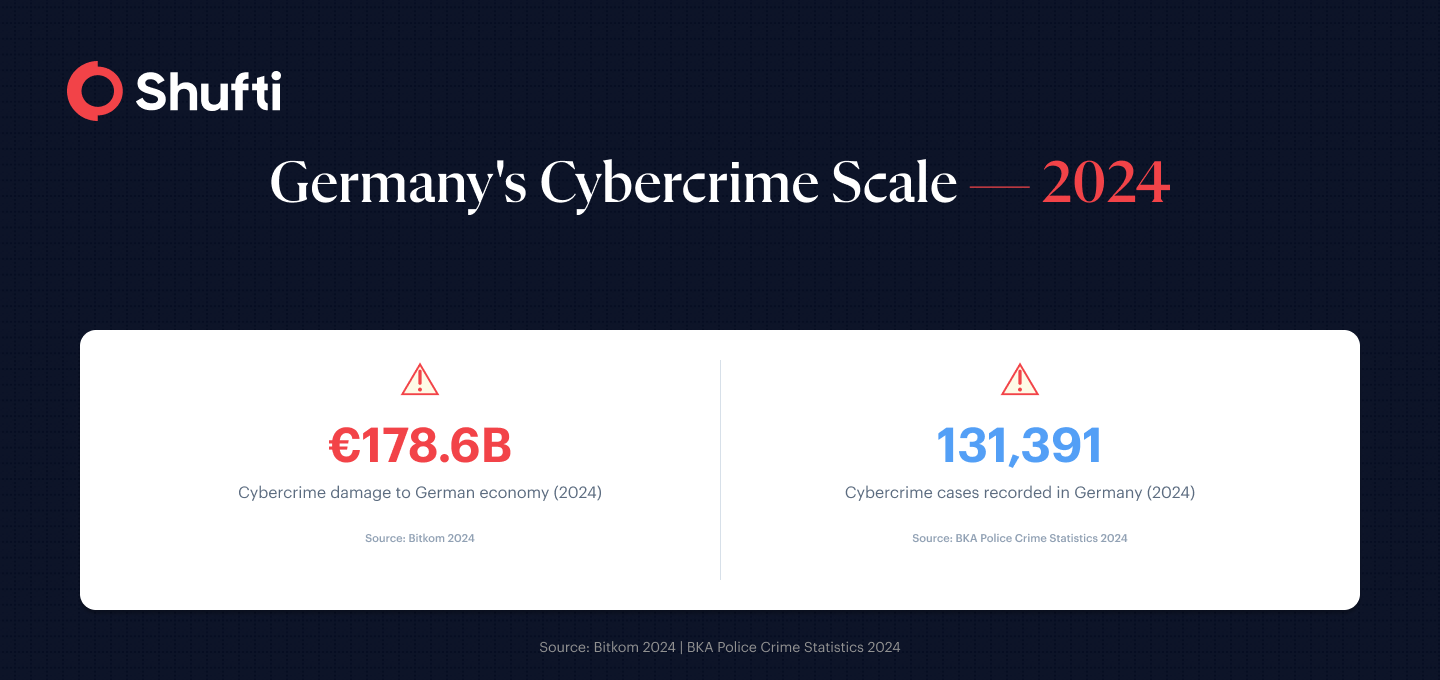
- Cyberattacks caused €178.6 billion in damage to the German economy in 2024, with 131,391 cybercrime cases recorded by the BKA
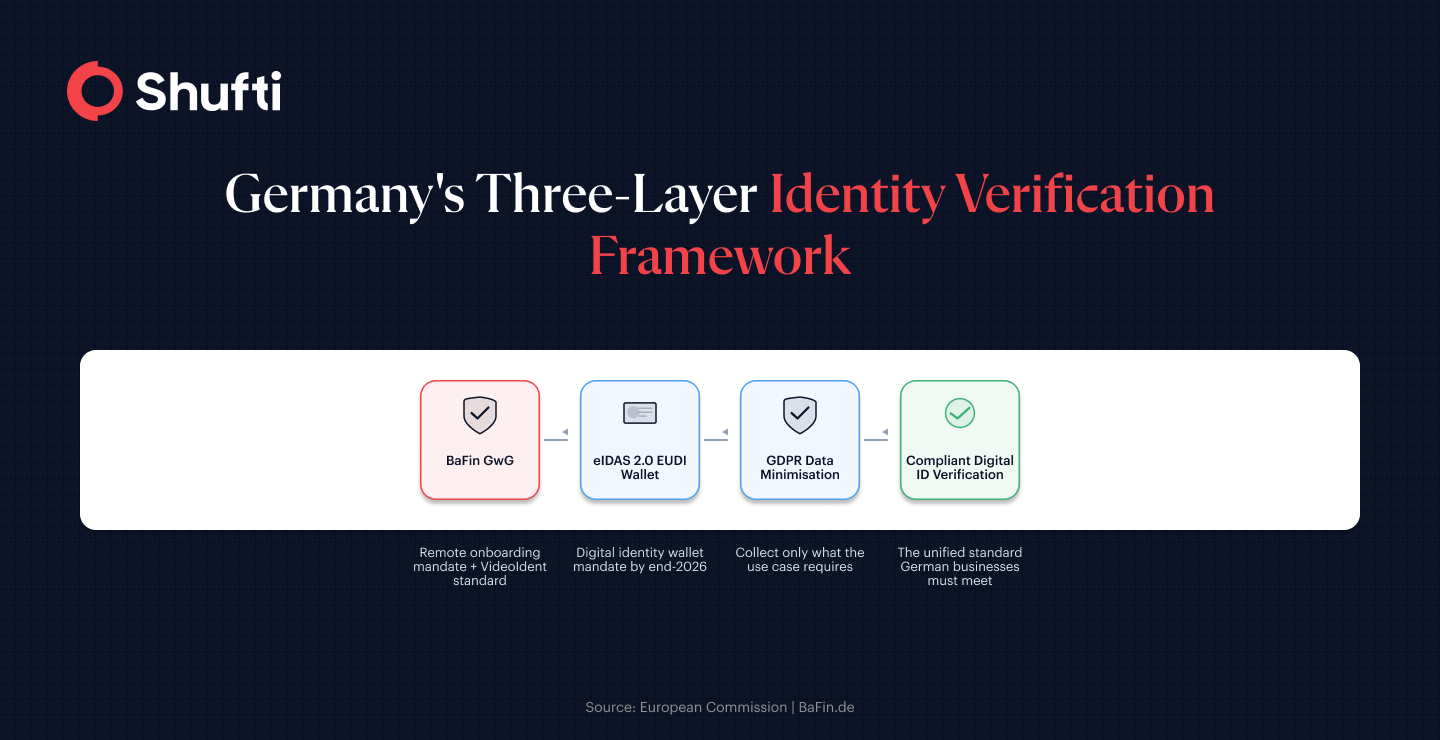
- Three frameworks now converge into one demanding standard: BaFin’s GwG, eIDAS 2.0, and GDPR
- BaFin’s February 2025 update made clear that document-only checks are insufficient at higher risk tiers
- All EU member states must provide citizens with a digital identity wallet by end of 2026 under eIDAS 2.0
- VideoIdent remains the gold standard for high-assurance remote onboarding under BaFin Circular 3/2017
- Database-led verification returns results in under three seconds without requiring any document upload
- Financial services, fintech, crypto, and gaming carry the heaviest compliance load in Germany
Germany’s compliance requirements for customer identity verification tightened significantly in early 2025. BaFin updated its GwG guidance in February, clarifying which digital methods meet the legal threshold for remote onboarding. eIDAS 2.0 requires all EU member states to provide citizens with a digital identity wallet by the end of 2026, changing how businesses must approach electronic ID verification across Germany. GDPR continues to impose strict data minimisation obligations on everything businesses collect during the verification process. These three frameworks no longer operate in isolation. For any regulated business in Germany fintech, banking, crypto, or gaming they are converging into a single, more demanding standard. Identity authentication Germany sits at the centre of that convergence.
Why Is Identity Verification Important for German Businesses?
German regulators have moved past treating weak identity controls as administrative shortfalls. They are now enforcement risks with measurable consequences. For any business handling customer funds, personal data, or age-restricted services, deploying effective ID verification solutions Germany’s regulators acceptance has become a prerequisite for market access not a vendor decision made after launch.
The Scale of the Fraud Threat
Cyberattacks caused €178.6 billion in damage to the German economy in 2024. The Bundeskriminalamt (BKA) recorded 131,391 cybercrime cases in Germany in the same year. A significant portion of those cases trace back to fraudulent account openings built on stolen or synthetic identities exactly the threat that structured identity verification is designed to prevent.
What Regulators Now Require
Germany’s Anti-Money Laundering Act the GwG requires regulated entities to verify customer identities before establishing a business relationship, and to apply enhanced due diligence for higher-risk cases. BaFin’s February 2025 guidance update reinforced that document-only checks are insufficient at higher risk tiers and set clearer expectations for which digital methods qualify as compliant. Firms that cannot satisfy a BaFin examiner face formal enforcement consequences. Major institutions across the DACH region have already felt that pressure directly.
How Is Identity Verified in Germany? The Regulatory Framework Explained
German digital ID verification does not operate under one rule. Three overlapping frameworks which are BaFin’s GwG, eIDAS 2.0, and GDPR each add requirements the others do not cover alone. Understanding how they interact is more useful than studying each in isolation.
BaFin, the GwG, and the VideoIdent Standard
For remote onboarding of bank customers and regulated financial services users, BaFin Circular 3/2017 designates attended video verification as an approved method equivalent to in-person identification. The circular requires trained agents operating in secured premises, inspection of at least three randomly selected document security features plus MRZ validation, a liveness challenge via head movement and a spoken system-generated character sequence, TAN/OTP session binding, full audio-visual recording, explicit consent capture before evidence is created, and five-year retention of all session evidence. German payment service provider Solaris SE was fined €6.5 million in 2024 for AML control failures, a clear signal that BaFin enforcement around identity verification standards is active and consequential.
eIDAS 2.0, GDPR, and the Data Minimisation Layer
eIDAS 2.0 adds a second layer. EU member states must provide citizens with EU Digital Identity Wallets by the end of 2026, per the EUDI Regulation. Once those wallets are live, regulated businesses accepting German users will need onboarding flows that can read and verify credentials from 30+ national eID schemes. GDPR closes the triangle: data minimisation requirements mean businesses cannot simply capture and retain everything a verification session produces. Flows must be engineered to return only the attributes the use case actually requires confirming a user is over 18, for example, rather than storing the full date of birth while still generating audit-ready evidence for regulators.
What Industries in Germany Rely on Identity Verification Most?
Online identity verification Germany requirements apply across most regulated sectors, but four verticals carry the heaviest compliance load and drive the most sustained demand for structured verification.
Financial Services, Fintech, and Crypto
Banks, neobanks, digital lenders, and payment institutions operate simultaneously under the GwG, BaFin licensing conditions, and PSD2 requirements. For a fintech launching in Germany, the KYC onboarding process must be fast enough to convert users and thorough enough to withstand a BaFin review. Crypto platforms face additional obligations under MiCA alongside the GwG, making Germany’s AML compliance framework a compulsory layer on top of initial identity checks.
Gaming and Age-Gated Services
Online gaming operators in Germany must satisfy both the Interstate Treaty on Gambling (GlüStV 2021) and KJM (Commission for the Protection of Minors) requirements. KJM specifies that operators must use KJM-approved age verification methods approval is granted to specific providers, not to categories of technology. German gambling regulations require player identity and age verification before any deposit or wager, making Germany one of the more structurally demanding markets for gaming compliance in Europe.
Can Identity Verification Be Done Online in Germany?
Yes. For most regulated use cases, the ability to verify identity online in Germany is both legally permitted and operationally expected. BaFin has approved multiple digital verification methods. The question is not whether online verification is legal but which method fits the risk profile of the customer relationship being established.
Document-Based and Database-Led Verification
Digital identity verification Germany flows typically combine two approaches. Document-based verification where the user photographs an ID card or passport checks the image against more than 10,000 document templates across international standards. It is effective for standard-risk onboarding but has a ceiling: high-quality forgeries and synthetic identities built from real document data can pass image-based checks alone.
Database-led electronic ID verification Germany cross-references submitted details against government registries, credit bureau records, and telecom data simultaneously. When a name, date of birth, and address match across two independent sources, the probability of a synthetic identity passing drops substantially. These identity verification services Germany processes return a result in under three seconds without requiring any document upload from the user. The electronic identity verification landscape in Germany is expanding as database coverage grows to include more national registries.
VideoIdent for High-Assurance Cases
Where automated checks are not sufficient tier upgrades, account recovery, high-value onboarding, PEP flags, VideoIdent closes the assurance gap. Under BaFin Circular 3/2017, attended video verification produces a complete evidence pack that survives regulatory examination. For compliance teams tracking how eIDAS 2.0 reshapes identity verification flows, video-based verification and Active eIDV operate as complementary high-assurance options rather than competing choices. German ID verification providers that offer both automated database checks and attended video sessions on a single platform are what compliance officers increasingly evaluate when selecting ID verification solutions Germany for 2025 and beyond.
How Shufti helps German businesses verify identity online
German compliance teams often describe the same structural tension. Methods that produce BaFin-grade evidence tend to add friction to the onboarding flow, while flows designed for high conversion often fall short of what examiners want to see. Most businesses end up managing multiple vendor integrations, which creates gaps in the audit trail and slows both onboarding and compliance review.
Shufti addresses both sides from a single platform. Passive eIDV checks run against 85+ country databases in under three seconds, covering German registries without requiring a document upload. Where BaFin’s Circular 3/2017 standards apply, VideoIdent delivers trained-agent sessions with complete evidence packs covering security feature inspection, liveness challenge, TAN binding, and retained recordings ready for examiner review. KJM-approved age verification handles gaming and age-gated platforms. The full verification spectrum runs through one integration.
Frequently Asked Questions
How is identity verified in Germany?
Germany permits multiple digital methods: document-based verification, database-led electronic checks against government and credit bureau registries, and attended VideoIdent sessions for high-assurance cases. BaFin's GwG sets the baseline requirements, and the appropriate method depends on the risk tier of the customer relationship.
Can identity verification be done online in Germany?
Yes. BaFin approves digital methods document verification, database-led eIDV, and VideoIdent as legally compliant alternatives to in-person identification. Each carries a different assurance level, and regulated businesses must match the method to the risk profile of the customer relationship being established.
How long does digital ID verification take in Germany?
Database-led electronic verification typically returns a result in under three seconds. Attended VideoIdent sessions average approximately two minutes from connection to evidence-pack generation. Automated document checks with AI processing complete within 15 seconds for a standard submission.
Why is identity verification important for German businesses?
Germany's GwG requires regulated businesses to verify customer identities before establishing a business relationship. Failure to meet BaFin's standards carries enforcement risk including fines and licensing consequences. Verified identity is also the primary defence against synthetic identity fraud and fraudulent account openings.
What changes when eIDAS 2.0 takes effect in Germany?
EU member states must provide citizens with digital identity wallets by end of 2026. Regulated businesses accepting German users will need flows that can authenticate national eID scheme credentials. Building eIDAS 2.0-compatible processes before the deadline avoids a forced infrastructure change when the mandate activates.