







TL;DR
- AUSTRAC’s Tranche 2 reforms expanded Australia’s AML/CTF Act to ~90,000 businesses as of July 2026, up from 17,000 — now covering lawyers, accountants, real estate agents, and precious metals dealers
- Australian scam losses exceeded $2.18 billion in 2025, a 7.8% rise year-on-year, with 220,400 Australians experiencing identity theft in 2024-25
- Online ID verification in Australia uses three layered methods: document verification, electronic ID verification (eIDV), and biometric liveness detection
- The Digital ID Act 2024 introduced myID, giving over 15 million Australians a government-verified digital credential usable for private-sector onboarding
- AUSTRAC’s AML/CTF Rules 2025 replaced the old fixed-checklist model with a risk-based CDD framework, meaning verification depth must now match customer risk level
- Banking, fintech, crypto, gambling, and healthcare have the longest verification history — but Tranche 2 sectors are now catching up fast
- Businesses have a three-year transition window to adapt to the new rules, making now the critical period to get verification infrastructure in place
As of July 2026, Australia’s Anti-Money Laundering and Counter-Terrorism Financing (AML/CTF) Act applies to approximately 90,000 businesses, up from 17,000 just months earlier.
The expanded reach of AUSTRAC’s Tranche 2 reforms means lawyers, accountants, real estate agents, and dealers in precious metals now carry the same identity verification obligations that banks and fintechs have met for years.
The compliance shift is arriving just as Australia’s fraud landscape is worsening. According to the Australian Bureau of Statistics, card fraud had a victimisation rate of 10.4% while scams stood at 2.7%, identity theft at 1% and online impersonation at 2.3%. For businesses handling customer onboarding, the message is clear: verifying who a customer is before extending a service is both a legal requirement and a practical safeguard.
The guide below covers how identity verification works in Australia, what documents are accepted, which industries rely on it, and what the regulatory framework requires.
What Is Identity Verification and Why Does It Matter?
Identity verification is the process by which a business confirms that a customer is who they say they are, typically by checking an identity document, validating biometric data, or querying a trusted database. Digital identity verification in Australia applies this process through technology, allowing businesses to onboard customers remotely without requiring them to appear in person.
For Australian businesses, identity verification is not optional in regulated sectors. The AML/CTF Act requires all reporting entities to carry out customer identification procedures before providing designated services. That obligation now reaches across a far broader market than before, driven by AUSTRAC’s Tranche 2 expansion. Online ID verification AU platforms serve banks, neobanks, crypto exchanges, insurers, and as of 2026, a new wave of professional services firms working through their obligations for the first time.
The fraud dimension
Personal fraud cost Australians dearly in 2024-25, with scam losses nationally exceeding $2.18 billion according to the Australian Competition and Consumer Commission (ACCC). Identity theft was the mechanism behind a significant share of those losses, with stolen personal information most commonly used to access bank accounts and superannuation funds. Identity verification at onboarding interrupts fraud before it escalates to financial loss.
How Does Online Identity Verification Work in Australia?
Online identity verification in Australia draws on three main methods, which are often layered together to meet AUSTRAC’s risk-based requirements. Each method varies in friction, speed, and the level of assurance it delivers to the business.
Document verification
Document verification is the most widely adopted method. A customer submits a photo of a government-issued identity document, and an AI-powered engine extracts the data, checks for signs of forgery, and confirms the document is genuine. Australian passports, driver’s licences, and Medicare cards are the most commonly verified documents. AI identity verification Australia-wide has made this process significantly faster: automated document verification checks now complete in under fifteen seconds, compared to hours or days for manual review.
Electronic ID verification
Electronic ID verification Australia businesses use cross-references customer data against national registries, credit bureaus, and telecommunications records, without requiring a document upload. Electronic ID verification (eIDV) is frictionless from the customer’s perspective. A person enters their name, date of birth, and address, and the system returns a result in seconds. Remote identity verification Australia-wide became significantly more practical through eIDV, particularly for fintech and banking platforms where drop-off at onboarding is a direct revenue concern. Electronic identity verification suits lower-risk customer relationships where the regulatory threshold does not require documentary evidence.
Biometric and face verification
Face verification cross-references a live selfie or video frame against the photo on a submitted identity document. Liveness detection confirms the image comes from a real person present during the check, not a photograph or a deepfake. Online identity verification Australia platforms increasingly require liveness as a default, particularly for higher-risk account types and transaction thresholds.
Identity Fraud in Australia: The Numbers Behind the Risk
The fraud risk Australian businesses are managing is specific and growing, not hypothetical.
In 2024-25, an estimated 220,400 Australians experienced identity theft, representing 1.0% of the population, according to the Australian Bureau of Statistics. The most common outcome was theft from a bank account, superannuation fund, or investment account. The same period saw around 500,000 Australians experience online impersonation. These figures reflect the specific risk businesses face when identity verification fails or is absent at onboarding.
The broader scam loss picture reinforces this pattern. Australian scam losses exceeded $2.18 billion in 2025, a 7.8% rise from the prior year according to the ACCC. That growth did not occur despite digitisation. Fraudsters adapted to digital onboarding faster than many legacy verification processes could track, making the case for automated, real-time identity checks stronger than it has ever been.
What IDs Are Accepted for Verification in Australia?
Identity authentication Australia requires businesses to collect and verify specific forms of identification that AUSTRAC considers reliable evidence of identity. The regulator accepts a range of government-issued documents, and requiring two sources from different categories strengthens the identity assertion for higher-risk services.
The documents most commonly accepted under AUSTRAC’s customer identification guidance include: Australian passport, state or territory-issued driver’s licence, Medicare card, birth certificate, and citizenship certificate for domestic customers. For international customers verifying remotely, foreign passports and national identity cards from the customer’s country of origin are accepted.
As of 2025, the Digital ID Act 2024 added a new path. More than 15 million Australians now hold a myID digital credential, the rebranded version of myGovID, which gives private-sector businesses a government-verified identity source they can query electronically. Australian digital ID verification through myID is expected to expand as the government accredits private-sector providers from November 2026 onward, broadening the options available to businesses building digital onboarding flows.
Which Industries Use Identity Verification in Australia?
Identity verification services Australia businesses operate across a wide range of sectors, though the obligation level and method differ significantly by industry and risk profile.
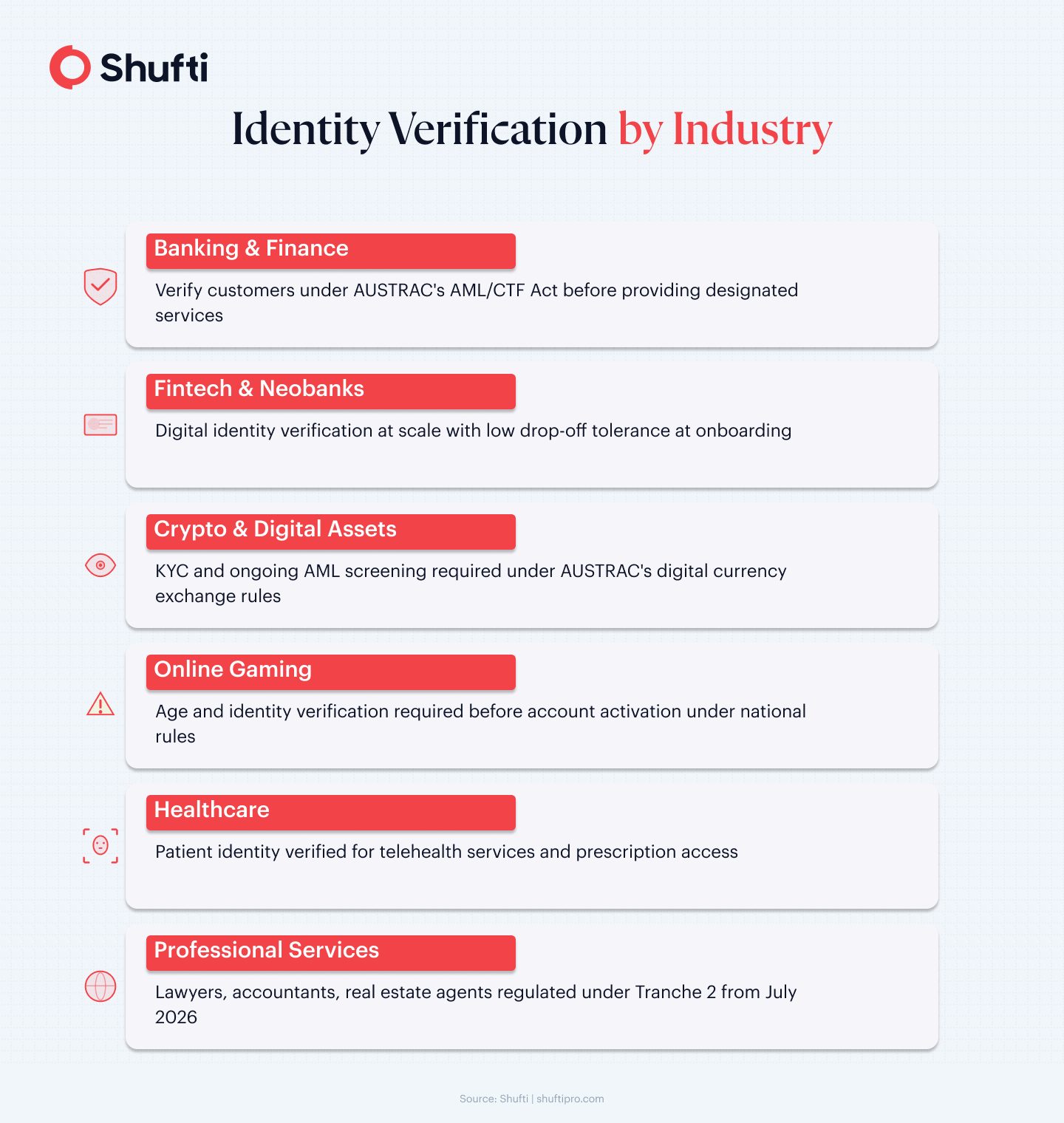
Banking and financial services carry the longest history of identity verification under AML/CTF obligations. Fintech platforms and neobanks require online identity verification to meet the same standards, often at higher onboarding volumes and with less tolerance for friction than traditional banks. Crypto exchanges and digital asset platforms must verify customers under AUSTRAC’s digital currency exchange registration requirements, with AML screening applied alongside identity checks for ongoing monitoring.
Online gambling operators are required to verify player age and identity before account activation. Healthcare providers increasingly verify patient identity for telehealth services and prescription access. The July 2026 Tranche 2 expansion added lawyers, accountants, real estate agents, and dealers in precious metals and stones to the regulated pool. ID verification solutions Australia providers are now extending services to these sectors, many of which had no formal verification program prior to the reform.
How Australia’s AML/CTF Framework Shapes Verification Requirements
AUSTRAC administers the Anti-Money Laundering and Counter-Terrorism Financing Act 2006 (AML/CTF Act), the primary legislation governing identity verification obligations for Australian reporting entities. The Act requires businesses to implement an AML/CTF program with customer due diligence (CDD) procedures built in.
The AML/CTF Rules 2025, which replaced the previous rules on 31 March 2026, introduced a more flexible, risk-based model for customer due diligence. Businesses transitioning from the previous “applicable customer identification procedures” (ACIP) framework have a three-year window to adapt. In practice, the shift means businesses must now tailor their verification depth to the risk level of each customer relationship rather than following a fixed checklist.
For Australian ID verification providers and the businesses they serve, this distinction is important. A basic identification check meets the threshold for lower-risk customers. Higher-risk relationships require enhanced due diligence, including more thorough document checks, ongoing monitoring, and additional identity confirmation steps. Verify identity online Australia requirements are therefore not uniform. They are risk-weighted, which means the technology layer needs to support multiple verification tiers through a single integration point.
How Shufti helps Australian businesses verify identities online
For many businesses preparing for AUSTRAC’s Tranche 2 obligations, the challenge is not understanding what verification is required. The challenge is standing up a workflow that handles multiple document types, adapts to different risk tiers, and processes checks fast enough not to lose customers at onboarding.
Shufti supports verification across 10,000+ document types from 230+ countries, which means Australian businesses can verify both domestic and international customers through a single integration. For businesses where document friction is a problem, Shufti’s eIDV checks customer data against trusted registries in under three seconds, removing the upload step entirely. For high-risk situations, iBeta Level 1 and Level 2 certified biometric liveness detection adds the identity confidence that ongoing AML monitoring requires.
The platform supports cloud, on-premises, or hybrid deployment, which addresses the data sovereignty requirements that some regulated businesses face in practice.
Frequently Asked Questions
Q: How does identity verification work in Australia?
Australian businesses verify customer identities by checking a government-issued document such as a passport or driver's licence, validating biometric data, or querying a trusted database electronically. AUSTRAC requires all reporting entities to complete this process before providing designated services under the AML/CTF Act.
Q: What IDs are accepted for verification in Australia?
AUSTRAC accepts Australian passports, driver's licences, Medicare cards, and birth certificates as primary identity documents. Foreign passports and national identity cards are accepted for international customers. As of 2025, myID digital credentials issued under the Digital ID Act 2024 are also available as a verification source.
Q: Can identity verification prevent fraud in Australia?
Identity verification at onboarding prevents fraud by confirming a customer is who they claim to be before access is granted. In 2024-25, 220,400 Australians experienced identity theft, most commonly leading to losses from bank and investment accounts. Verification stops fraudulent account creation before losses occur.
Q: Which industries use identity verification in Australia?
Banking, fintech, crypto, online gambling, and healthcare have used identity verification for years under AUSTRAC obligations. From July 2026, Tranche 2 reforms extended these requirements to lawyers, accountants, real estate agents, and dealers in precious metals and stones.
Q: How fast is digital identity verification in Australia?
AI-powered document verification typically completes in under fifteen seconds. Electronic identity verification using database queries returns a result in under three seconds. Both are significantly faster than manual review processes, which can take hours or days, and cause material drop-off in digital onboarding flows.