




 Face Verification
 Address Verification
 Document Verification
 Age Verification
 VideoIdent
 Fast ID
 Docless Verification
 Consent Verification
 NFC Verification
 Business Verification
 Due Diligence
 Investor Verification
 E-Signature

 QES
QES
 AML Screening
 Transaction Monitoring
 Adverse Media
 Business AML Screening
 PEP & RCA
 Sanctions
 Watchlist
 Behavioural Biometrics
 Device Fingerprinting
 Biometric Face Authentication
 MFA
MFA
 Fraud Hub
 Onboarding
 Ongoing Monitoring
 KYC
KYC
 KYB
KYB
 KYI
KYI
 Age Assurance
 Identity Verification
 Workforce IAM
 Candidate Verification
 Compliance
 Fraud prevention
 Trust & safety
 Global expansion
 Product Managers
 Compliance Officers
 Fraud Analysts
 Developers
 Deepfake Detection
 Bonus Abuse / Promotion Abuse
 Account Takeover
 Synthetic Identity Fraud
 Document Fraud
 Impersonation Fraud
 Multi-Accounting
 Fraud Networks
 Chargeback Fraud
 Money Mule Activity
 Party Fraud
 Regulatory & Compliance Risks
 Fintech
 Crypto
 iGaming
 Forex
Forex
 Social Network
 Marketplace
 Banking
 Gig Economy
 Payments
 Ride Hailing
 Adult Content
 Blind Spot Audit
 Deepfake Detector
 Liveness Spoofs
 Document Originality
 Document Deepfake
 Global Trust Platform
 Journey Builder
 Case Management
 Shufti AI
 Fraud Analytics
 Vendor Comparison
 Brand Personalisation
 AI Compliance Co-Pilot
 OCR
OCR
 Secure Capture
 Deployment Options
 Identity Methods
 API Documentation
 Mobile SDKs
 Service Status
 Help Center
 Contact Us
 Technical Support
 Supported Documents
 Supported Countries
 Content library
 Blogs
Blogs
 News
News
 Reports
 Insights
 Knowledgebase
 ROI calculator
 About
About
 Career
 Press Release
 Certifications
 Partnership
 Awards
 Events & Webinar
 Interactive Demo
 Podcast Studio
 Spotlight Studio
One integration for every identity format: rethinking digital identity verification.
-
Add us as a Preferred Source
- 01 TL;DR
- 02 What does digital identity verification mean when identity has no single format?
- 03 The identity formats your users will actually present
- 04 Why eIDAS 2.0 makes multi-format support non-optional?
- 05 One integration versus many: the architecture decision
- 06 How Shufti handles every identity format through one integration?
TL;DR
- Regulated EU firms must accept the EUDI Wallet for strong authentication by late December 2027.
- Identity now arrives in five formats at once, and the integration model decides who keeps up.
- Wiring up one format at a time multiplies maintenance work, vendor handoffs, and onboarding drop-off.
- One integration layer can accept physical IDs, national digital IDs, EUDI Wallets, NFC chips, and QES.
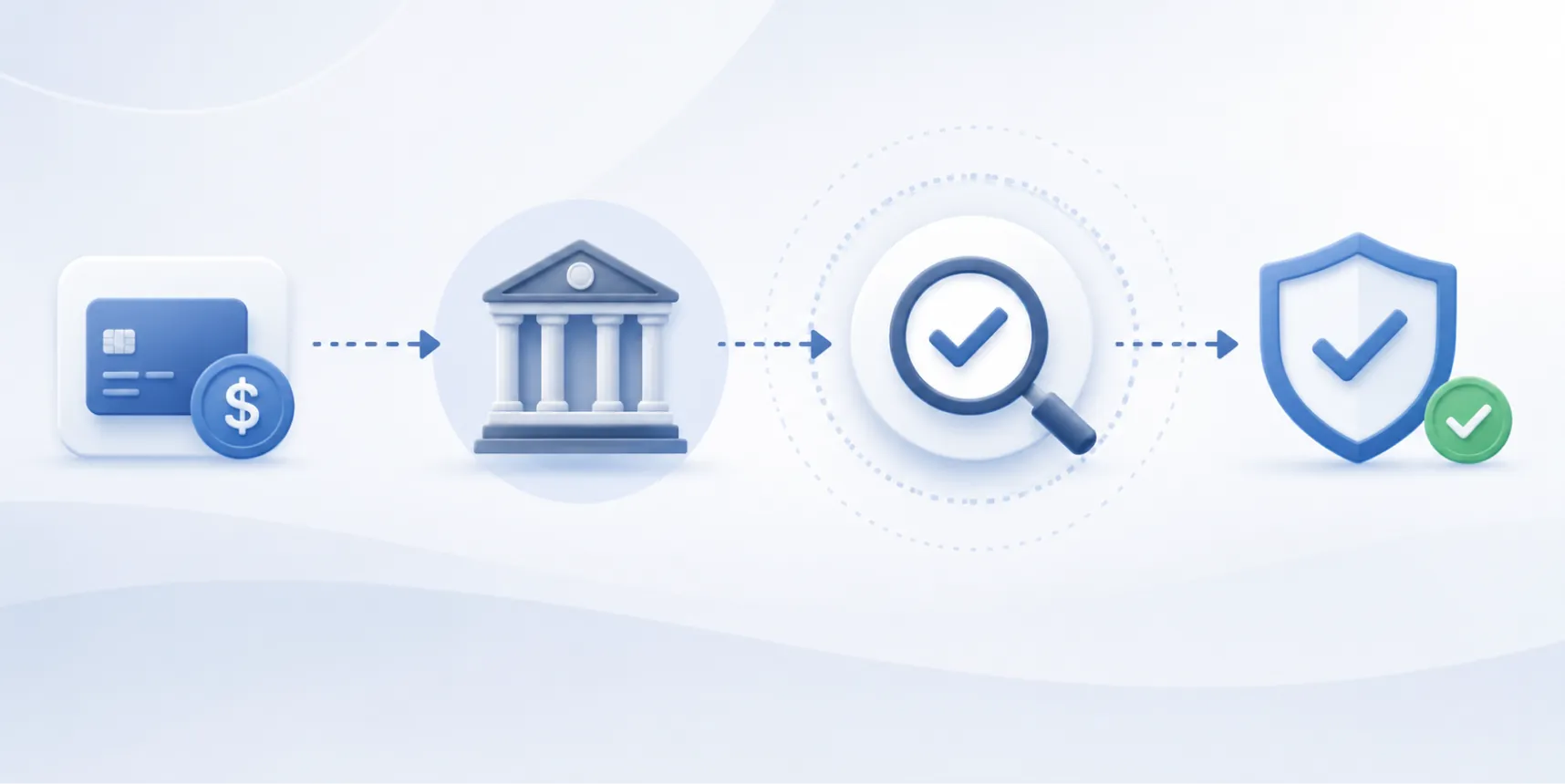
In May 2024, Regulation (EU) 2024/1183 brought the European Digital Identity framework into force and reset what “an ID” means for any business that onboards EU users. A passport scan used to be the whole job. Now the same onboarding flow has to handle a national digital identity, the chip inside an e-passport, a wallet credential on a phone, and a legally binding electronic signature, often for the same person across different sessions. The format a user shows up with is no longer your decision. This piece argues that the integration model you choose, not the individual check, is what now separates teams that keep pace from teams that fall behind.
What does digital identity verification mean when identity has no single format?
Digital identity verification is the process of confirming that a person is who they claim to be, using documents, biometrics, database checks, or cryptographic credentials, without an in-person meeting. The definition has not changed. What changed is the input. A single user can now prove identity with a physical document, a government-issued digital ID, an EU Digital Identity Wallet, an NFC chip read, or a Qualified Electronic Signature.
That shift matters because most verification systems were designed around one input and retrofitted for the rest. A flow built to read a driver’s licence does not natively accept a wallet credential. A flow built for wallets cannot fall back to a forensic document check when a user has no wallet yet. The result is a stack that handles the format it was born for and degrades on everything else. The failure mode is predictable: a user with a perfectly valid credential abandons onboarding because your system only speaks one language.
The identity formats your users will actually present
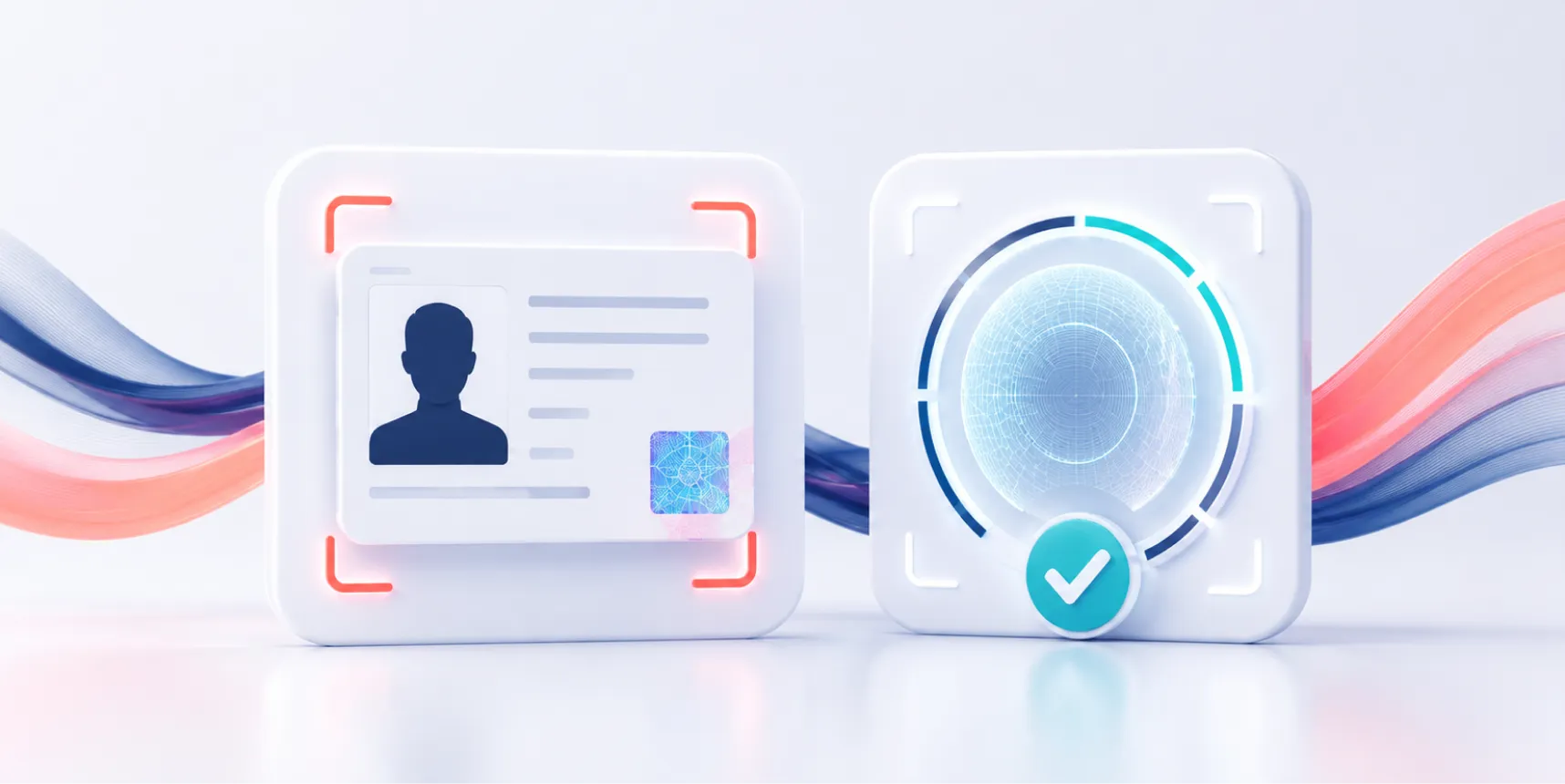
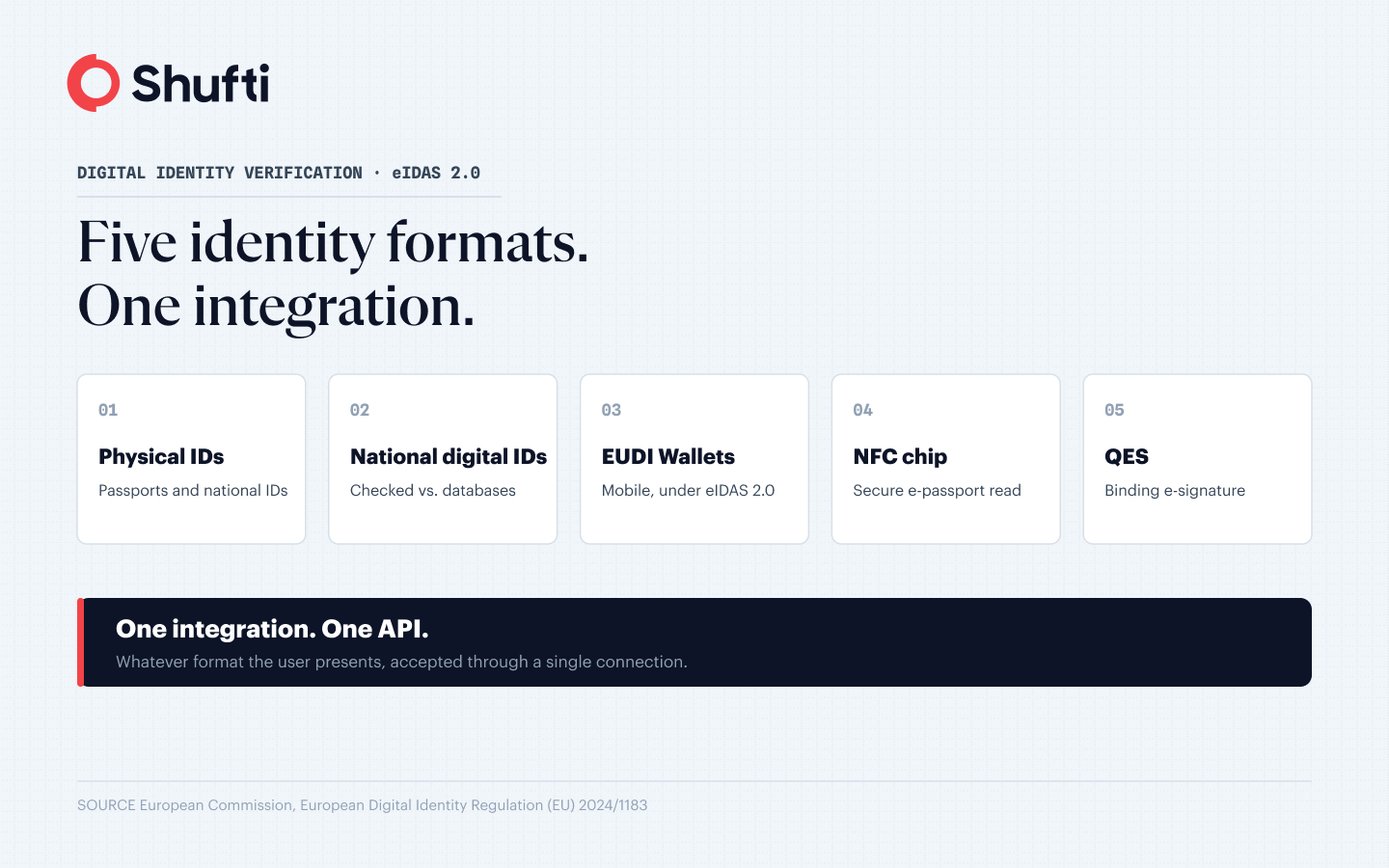
Five distinct identity formats are now in active use across the EU, and a user can present any of them depending on their country, device, and the service they are accessing. Treating these as one category is where most onboarding designs go wrong, because each carries a different capture method, trust level, and regulatory weight.
|
Identity format |
What it is |
Where will you see it |
|
Physical IDs |
Passports, national ID cards, driver’s licences, residence permits, captured by photo or scan |
Universal fallback, still the majority of global onboarding |
|
National digital IDs |
Government-issued digital identity schemes are verified against authoritative databases |
Nordics, India, the Netherlands, and other mature digital-ID markets |
|
EUDI Wallets |
A mobile credential under eIDAS 2.0 that holds verified attributes and shares them on request |
Rolling out across all 27 EU member states through 2026 |
|
NFC chip verification |
Reading the secure chip embedded in e-passports and e-IDs for tamper-evident data |
High-assurance onboarding, border-grade identity checks |
|
Qualified Electronic Signatures |
A legally binding e-signature with the same standing as a handwritten one under eIDAS 2.0 |
Contracts, account agreements, high-trust regulated services |
The point of the table is not that one format is better. It is that a user does not pick the format your system prefers. Coverage of all five, through the same flow, is what keeps a valid user from becoming a lost conversion.
Why eIDAS 2.0 makes multi-format support non-optional?
eIDAS 2.0 turns multi-format identity from a nice-to-have into a legal obligation with a date attached. Under Regulation (EU) 2024/1183, every EU member state must make at least one EU Digital Identity Wallet available to its citizens and residents, and specified private relying parties that require strong user authentication must accept that wallet as a means of identification. The deadlines are fixed, and they are closing.
|
Milestone |
Timing |
What it means |
|
Regulation (EU) 2024/1183 enters into force |
20 May 2024 |
The legal framework for the EUDI Wallet is live |
|
Member states issue wallets |
By late 2026 |
At least one wallet is available to every citizen and resident in each member state |
|
Mandatory acceptance |
By late 2027 |
Specified private relying parties needing strong authentication must accept the wallet |
The acceptance obligation is the part most teams underestimate. By late 2027, a regulated business cannot tell an EU user that it does not support their wallet, in the same way it cannot refuse a valid passport today. The wallet does not replace document verification. It joins it. According to Financial Action Task Force (FATF) guidance on digital identity, firms should take a risk-based approach and rely on identity systems with an appropriate level of trustworthiness at every stage of the process, which means the older formats stay in scope even as wallets arrive. You will be running physical IDs, database checks, NFC reads, and wallet credentials in parallel, not in sequence.
One integration versus many: the architecture decision
The strategic question is no longer “which check do we run?” It is “how many integrations are we willing to own?” Every format added as a separate connector is a separate contract, a separate SDK, a separate failure surface, and a separate thing to keep compliant as the rules move. Teams that treat each new format as its own project accumulate exactly the fragmentation that the regulation was meant to remove.
The cost of integrating one format at a time
Wiring up formats individually looks manageable at first, but compounds badly after that. Each connector has its own update cycle, its own edge cases, and its own owner, and the moment one of them lags a regulatory change, the whole onboarding flow inherits the gap. The engineering cost is visible in the backlog. The hidden cost is conversion: users routed to the wrong handler, sessions that cannot fall back when a credential is missing, and an audit trail stitched across systems that cannot prove the steps belonged to the same verification. When something breaks, the team spends its time finding which connector owns the problem instead of fixing it.
What a single integration layer changes?
A single integration layer flips the model. Instead of routing each format to a different system, one entry point accepts whatever the user presents and applies the right check behind it. The user shows a passport, a wallet, or a chip, and the flow adapts without a separate build for each path. For engineering, that means one API to maintain and one place to absorb a regulatory change rather than five. For compliance, it means one audit trail that holds the whole session together. The format becomes a runtime detail, not an architectural commitment, which is the only way to keep pace with a standard that is still adding formats.
How Shufti handles every identity format through one integration?
If you onboard EU users, you have already felt the pressure: the wallet deadline is fixed, your users still arrive with passports and national IDs, and supporting both without doubling your integration load is the real problem. Most verification systems were built around a single input and bolt the rest on, which is why coverage degrades the moment a user shows up with something the flow was not designed for.
Shufti accepts the full range through one integration: physical IDs, national digital IDs, EUDI Wallets, NFC chip verification, and Qualified Electronic Signatures under eIDAS 2.0, all via a single API. The same connection that runs a forensic document check also accepts a citizen’s wallet credential, with proprietary OCR trained natively on 10,000+ document types across 220+ countries for the formats that are not going anywhere. One platform, fully owned technology, global coverage with real local depth.
See how one integration handles every identity format your EU users present, book a 20-minute demo.
Frequently Asked Questions
Is the EUDI Wallet mandatory for businesses?
Acceptance is mandatory for specified private relying parties that require strong user authentication, by late 2027, under Regulation (EU) 2024/1183. It does not replace existing identity checks. Regulated firms will accept wallet credentials alongside physical and database-based verification, not instead of it.
What is the difference between electronic identity verification and document verification?
Document verification authenticates a physical ID by checking its security features and data. Electronic identity verification confirms identity against authoritative databases or digital credentials such as national digital IDs and EUDI Wallets. A complete digital identity verification flow uses both, because users present both.
Does accepting digital identity wallets remove the need for document verification?
No. Wallet adoption will grow through 2026 and 2027, but most users worldwide still verify with a physical document, and many EU users will for years. FATF guidance favours a risk-based approach across formats, so document verification stays a core part of any onboarding flow.