




 Face Verification
 Address Verification
 Document Verification
 Age Verification
 VideoIdent
 Fast ID
 Docless Verification
 Consent Verification
 NFC Verification
 Business Verification
 Due Diligence
 Investor Verification
 E-Signature

 QES
QES
 AML Screening
 Transaction Monitoring
 Adverse Media
 Business AML Screening
 PEP & RCA
 Sanctions
 Watchlist
 Behavioural Biometrics
 Device Fingerprinting
 Biometric Face Authentication
 MFA
MFA
 Fraud Hub
 Onboarding
 Ongoing Monitoring
 KYC
KYC
 KYB
KYB
 KYI
KYI
 Age Assurance
 Identity Verification
 Workforce IAM
 Candidate Verification
 Compliance
 Fraud prevention
 Trust & safety
 Global expansion
 Product Managers
 Compliance Officers
 Fraud Analysts
 Developers
 Deepfake Detection
 Bonus Abuse / Promotion Abuse
 Account Takeover
 Synthetic Identity Fraud
 Document Fraud
 Impersonation Fraud
 Multi-Accounting
 Fraud Networks
 Chargeback Fraud
 Money Mule Activity
 Party Fraud
 Regulatory & Compliance Risks
 Fintech
 Crypto
 iGaming
 Forex
Forex
 Social Network
 Marketplace
 Banking
 Gig Economy
 Payments
 Ride Hailing
 Adult Content
 Blind Spot Audit
 Deepfake Detector
 Liveness Spoofs
 Document Originality
 Document Deepfake
 Global Trust Platform
 Journey Builder
 Case Management
 Shufti AI
 Fraud Analytics
 Vendor Comparison
 Brand Personalisation
 AI Compliance Co-Pilot
 OCR
OCR
 Secure Capture
 Deployment Options
 Identity Methods
 API Documentation
 Mobile SDKs
 Service Status
 Help Center
 Contact Us
 Technical Support
 Supported Documents
 Supported Countries
 Content library
 Blogs
Blogs
 News
News
 Reports
 Insights
 Knowledgebase
 ROI calculator
 About
About
 Career
 Press Release
 Certifications
 Partnership
 Awards
 Events & Webinar
 Interactive Demo
 Podcast Studio
 Spotlight Studio
EUDI Wallet and iGaming: What EU Operators Need to Know for 2027

-
Add us as a Preferred Source
- 01 What is the EUDI Wallet and why does iGaming need to care?
- 02 The EUDI Wallet compliance countdown for iGaming
- 03 How does the EUDI Wallet change player onboarding?
- 04 What does the EUDI Wallet not replace?
- 05 How does Shufti help iGaming operators prepare for EUDI Wallet compliance?
TL;DR
- EU operators must accept EUDI Wallets for player authentication by December 2027.
- Selective disclosure lets players confirm age without sharing full documents.
- Manual KYC drives 40 to 50 percent player abandonment during registration.
- Wallet credentials verified once can be reused across gambling platforms.
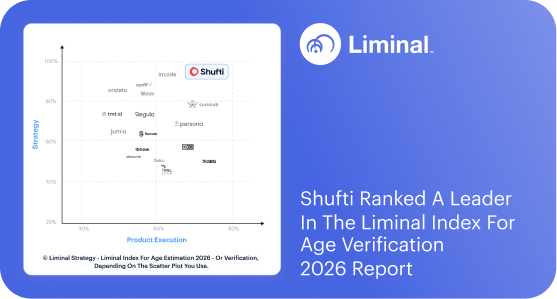
Regulation (EU) 2024/1183, which entered into force in May 2024, sets a December 2027 deadline for online gambling operators to accept the EU Digital Identity Wallet (EUDI Wallet) as a valid method of player authentication. That deadline is closer than most compliance teams have planned for, and the operational implications reach well beyond adding a new login option to a registration page.
The EU Digital Identity Wallet is a government-issued digital credential store that lets EU citizens authenticate their identity, share verified attributes, and confirm eligibility for age-gated services through a single mobile application issued by their member state.
EU-licensed platforms already manage fragmented KYC requirements across jurisdictions. EUDI Wallet adds a standardized, government-backed authentication method that players can use instead of uploading documents directly to your platform. The question for compliance officers and product leads is not whether to accept it, since acceptance will be mandatory, but how it changes what happens before, during, and after a player’s first session.
This article covers the regulatory timeline, the specific changes to your onboarding workflow, and what EUDI Wallet does and does not replace.
What is the EUDI Wallet and why does iGaming need to care?
The EU Digital Identity Wallet is a government-issued application that stores verified credentials, including national ID, date of birth, address, and tax number, and lets users share selected attributes with services they access. The wallet architecture follows GDPR’s data-minimisation principles. A gambling platform can request a yes/no age confirmation without receiving a full document copy or birth certificate. The player’s wallet returns only the attribute the operator requested.
For iGaming operators, this matters because the Electronic Identification, Authentication and Trust Services (eIDAS 2.0) framework, codified as Regulation (EU) 2024/1183, places online gambling in the category of private-sector services already required to use strong user authentication. Any operator in that category must accept EUDI Wallets as an identity-verification method once the December 2027 deadline passes. The sector covers a substantial market. EU online gambling was valued at USD 50.19 billion in 2026 and is projected to reach USD 68.19 billion by 2031, according to Mordor Intelligence, and these numbers are generated entirely under the compliance frameworks that EUDI Wallet now touches directly.
The wallet’s selective disclosure model is one of its more consequential features for operators. A player can confirm they are over 18 without showing their exact date of birth. They can verify their name without revealing their home address. This aligns with gambling regulators’ existing expectations around data minimisation, but it also requires operators to redesign their onboarding attribute-request logic to match what the wallet can actually provide.
The EUDI Wallet compliance countdown for iGaming
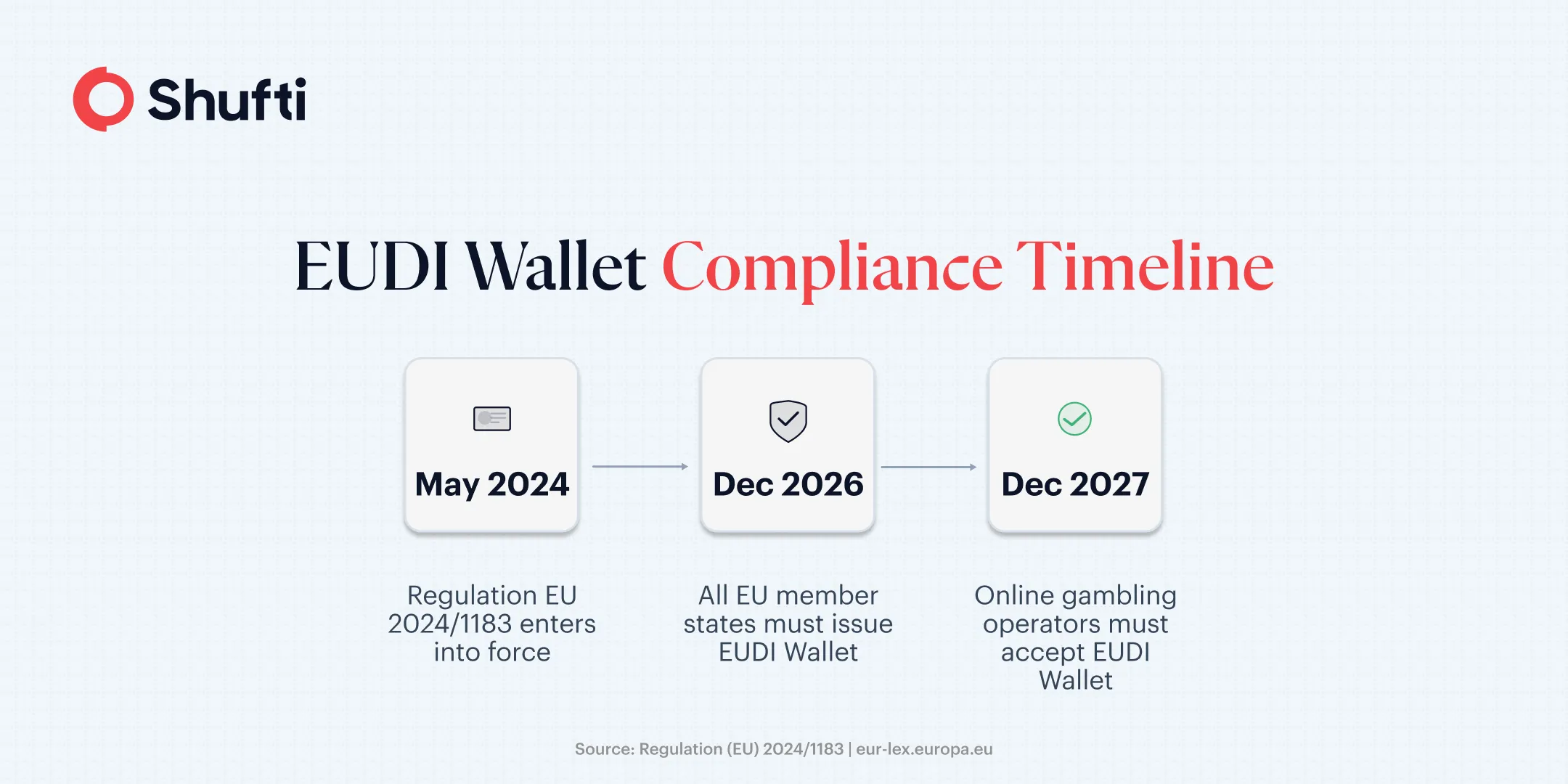
The implementation timeline runs in two stages, and most iGaming operators are already inside the first of them. The difference between the two stages defines whether operators hit the 2027 deadline with a tested integration or scramble to patch one in under pressure.
As of May 2024, all EU member states were required to begin building their national EUDI Wallet implementations under the eIDAS 2.0 implementing regulation. The December 2026 milestone requires every member state to have issued at least one functioning wallet and made it available to all citizens and residents. ABI Research forecasts 169 million digital ID wallets in circulation across the EU by the end of 2026, up from 83 million in 2025, meaning a substantial portion of your player base will hold a functional EUDI Wallet before your acceptance obligation begins.
The December 2027 deadline is the binding one for iGaming operators. From that date, platforms that use strong user authentication and hold any category of regulated-sector licence must accept EUDI Wallets when a player requests to use one. Operators cannot block the wallet authentication method, redirect the player to a document-upload flow instead, or treat wallet verification as incomplete without additional document submission.
For any platform still running the full document-upload-plus-selfie KYC flow as its primary registration path, 2027 is effectively an integration deadline. Operators that have already invested in a broader eIDAS 2.0 identity verification strategy will find the wallet integration materially easier than those starting from scratch at year-end 2026.
How does the EUDI Wallet change player onboarding?
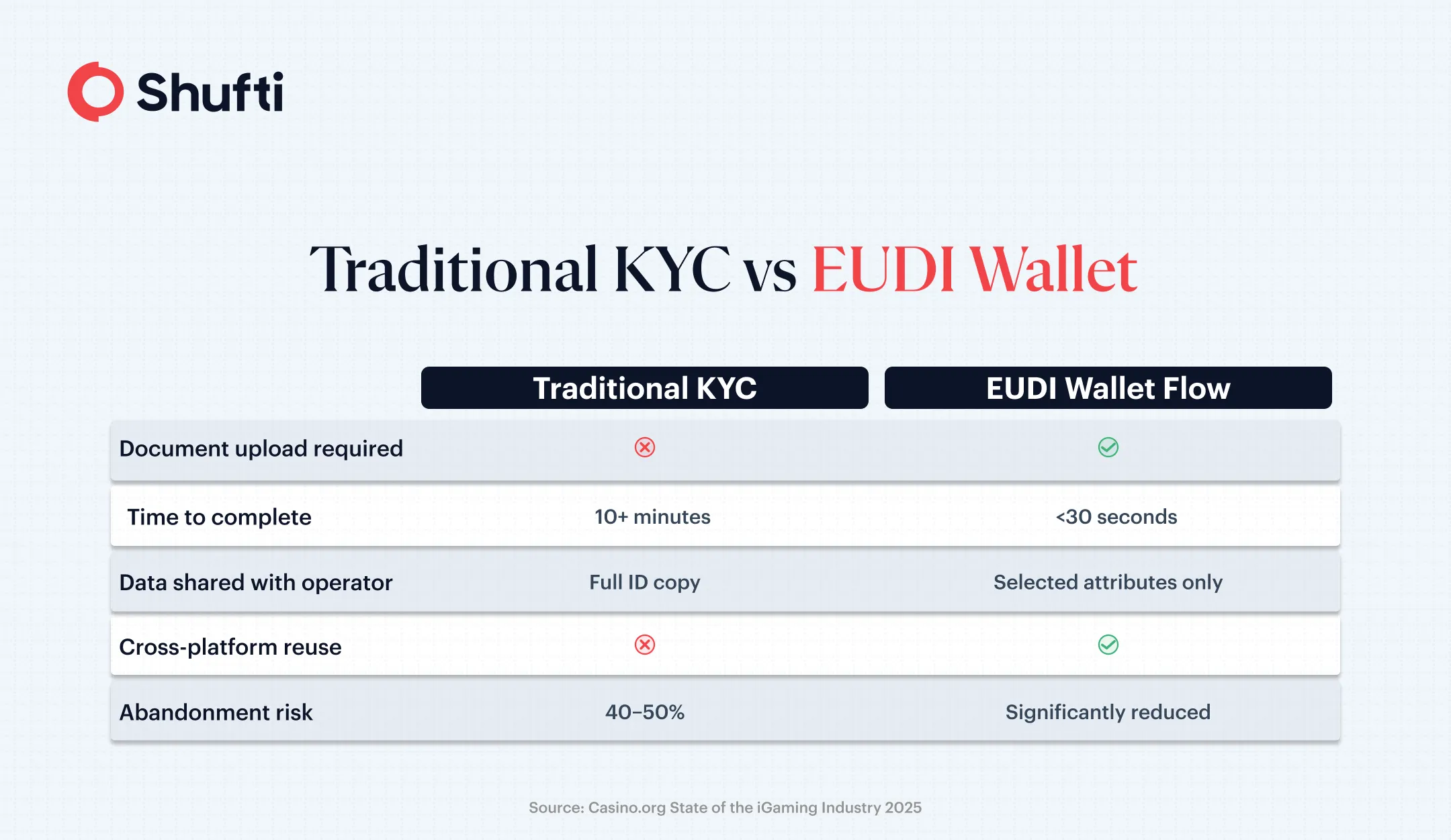
| Attribute | Traditional document KYC | EUDI Wallet onboarding |
| Player action | Upload passport and wait | Approve a wallet attribute request |
| Completion time | Lengthy; 40–50% abandonment | Verified response in seconds |
| Data shared with operator | Often more than needed (full passport copy) | Only the specific attributes requested |
| Cross-platform reuse | Re-upload documents on each site | Reusable across platforms |
EUDI Wallet changes what operators collect during registration, who controls the data-sharing step, and how long verified credentials remain valid across platforms. Each of these changes arrives simultaneously with the 2027 deadline, making early integration planning the most practical way to stay on schedule.
Traditional document-upload KYC creates friction that operators pay for in abandonment rates. The State of the iGaming Industry 2025 report by casino org found that manual KYC processes with lengthy completion times result in 40 to 50 percent player abandonment during registration. EUDI Wallet verification shifts the flow from “upload your passport and wait” to “approve this attribute request from your wallet app,” with the platform receiving a verified response in seconds.
The consent model also changes what operators receive and store. Under traditional document KYC, platforms often collect more data than they need, such as a full passport copy, just to confirm age. EUDI Wallet returns only the attributes the operator specifically requested. Operators cannot reverse-engineer or store the underlying credential. This simplifies data storage obligations and reduces the attack surface for player data breaches, but it requires operators to define their attribute-request logic with precision before the integration goes live.
For returning and re-acquired players, EUDI Wallet credentials verified once at the government level can be reused across platforms. A player who authenticated on one gambling site does not re-upload documents on another. For operators managing multi-brand portfolios across EU jurisdictions, this reusability is an onboarding advantage worth planning for early.
What does the EUDI Wallet not replace?
EUDI Wallet is not a full compliance solution, and operators who treat it as a single-step answer to EU iGaming compliance will find gaps in their stack within the first audit cycle.
Age-gated access is only one component of iGaming compliance. AML screening, sanctions checking, PEP screening, and self-exclusion list lookups sit outside the EUDI Wallet’s scope entirely. The wallet confirms who the player is. It does not confirm whether that player is sanctioned, politically exposed, or registered on a national self-exclusion list. Operators must continue running those checks through their existing screening infrastructure, regardless of how the player authenticates.
Affordability checks present the same gap. Under UK Gambling Commission requirements and equivalent frameworks in other EU jurisdictions, operators face obligations to assess player spending risk that go well beyond identity confirmation. The compliance gap in iGaming affordability checks is a separate problem from identity, and EUDI Wallet does not address it. Operators who expect the wallet mandate to reduce their full compliance burden still need a complete screening stack running behind the wallet integration.
Responsible gambling tooling (deposit limits, cooling-off periods, and reality checks) is unchanged. EUDI Wallet speeds up getting the right player into a session. It does not govern what happens inside that session once the player is verified.
How does Shufti help iGaming operators prepare for EUDI Wallet compliance?
The EUDI Wallet acceptance requirement alone does not complete your compliance stack. Operators need the full verification layer around the wallet, including AML screening, age confirmation, document verification for non-EU players, and sanctions checks, running through a single integration rather than separate tools patched together under time pressure.
Shufti’s electronic identity verification supports 30+ national eID schemes, including EUDI Wallet-compatible authentication flows, with sub-3-second verification against 230+ trusted data sources across 85+ countries. For player segments outside the EU wallet’s coverage, including non-EU nationals and players in markets where national wallets are not yet available, Shufti’s Passive eIDV layer runs database verification in the background without requiring document uploads, keeping the onboarding experience consistent across all player types.
The identity verification platform for gaming operators connects player authentication to AML screening and age confirmation through one API, with AML data updated every 15 minutes across 3,500+ global watchlists. The checks that EUDI Wallet does not replace run in the same workflow, not from a separate vendor with a separate integration timeline.
When players expect instant access and regulators require verified identity before a first session, the gap between the two defines your onboarding problem. Shufti’s electronic identity verification covers eIDAS 2.0-compliant authentication and the AML screening that the wallet itself does not provide, through one integration.
Request a demo to see the full EUDI Wallet-compatible verification flow against your current onboarding volumes.
Frequently Asked Questions
What is the EU Digital Identity Wallet (EUDI Wallet)?
The EU Digital Identity Wallet is a government-issued mobile application that stores verified identity credentials and allows users to share specific attributes, such as age confirmation or name, with services they access. Each EU member state issues its own wallet, with all wallets interoperable under the standard established by Regulation (EU) 2024/1183.
How will the EUDI Wallet impact the iGaming industry?
Online gambling operators will be required to accept EUDI Wallets as a valid identity-verification method by December 2027. Operators must update their onboarding flows to handle wallet-based attribute requests and cannot block players from using the wallet for authentication. AML screening, PEP checks, and self-exclusion verification remain separate operator obligations.
Is the EUDI Wallet mandatory for online gambling platforms?
Acceptance will be mandatory for EU-licensed gambling operators already required to use strong user authentication. The December 2027 deadline applies to the private-sector categories named in Regulation (EU) 2024/1183, which include online gambling services. Operators must accept the wallet when a player chooses to use it.
How does the EUDI Wallet improve KYC in online casinos?
The wallet's selective disclosure model lets players confirm age or identity without sharing a full document copy, reducing the data operators collect and store. Players do not need to upload passport scans to each new platform. Operators receive only the specific attributes they requested, which simplifies their data retention obligations.
Will iGaming operators be required to accept EUDI Wallet by law?
Yes. Under Regulation (EU) 2024/1183, online gambling operators using strong user authentication in EU member states must accept the EUDI Wallet when players request to use it. The mandatory acceptance deadline is December 2027. Operators who block wallet authentication risk non-compliance with the eIDAS 2.0 framework.