




 Face Verification
 Address Verification
 Document Verification
 Age Verification
 VideoIdent
 Fast ID
 Docless Verification
 Consent Verification
 NFC Verification
 Business Verification
 Due Diligence
 Investor Verification
 E-Signature

 QES
QES
 AML Screening
 Transaction Monitoring
 Adverse Media
 Business AML Screening
 PEP & RCA
 Sanctions
 Watchlist
 Behavioural Biometrics
 Device Fingerprinting
 Biometric Face Authentication
 MFA
MFA
 Fraud Hub
 Onboarding
 Ongoing Monitoring
 KYC
KYC
 KYB
KYB
 KYI
KYI
 Age Assurance
 Identity Verification
 Workforce IAM
 Candidate Verification
 Compliance
 Fraud prevention
 Trust & safety
 Global expansion
 Product Managers
 Compliance Officers
 Fraud Analysts
 Developers
 Deepfake Detection
 Bonus Abuse / Promotion Abuse
 Account Takeover
 Synthetic Identity Fraud
 Document Fraud
 Impersonation Fraud
 Multi-Accounting
 Fraud Networks
 Chargeback Fraud
 Money Mule Activity
 Party Fraud
 Regulatory & Compliance Risks
 Fintech
 Crypto
 iGaming
 Forex
Forex
 Social Network
 Marketplace
 Banking
 Gig Economy
 Payments
 Ride Hailing
 Adult Content
 Blind Spot Audit
 Deepfake Detector
 Liveness Spoofs
 Document Originality
 Document Deepfake
 Global Trust Platform
 Journey Builder
 Case Management
 Shufti AI
 Fraud Analytics
 Vendor Comparison
 Brand Personalisation
 AI Compliance Co-Pilot
 OCR
OCR
 Secure Capture
 Deployment Options
 Identity Methods
 API Documentation
 Mobile SDKs
 Service Status
 Help Center
 Contact Us
 Technical Support
 Supported Documents
 Supported Countries
 Content library
 Blogs
Blogs
 News
News
 Reports
 Insights
 Knowledgebase
 ROI calculator
 About
About
 Career
 Press Release
 Certifications
 Partnership
 Awards
 Events & Webinar
 Interactive Demo
 Podcast Studio
 Spotlight Studio
Fraud Prevention in Africa’s Digital Economy: Mobile Payments, KYC & Emerging Threats

-
Add us as a Preferred Source
- 01 Africa's $1.4 trillion mobile money market and its fraud problem
- 02 What does SIM swap fraud reveal about mobile money's identity gap?
- 03 How does KYC compliance vary across Nigeria, Kenya, Ghana, and South Africa?
- 04 What do the 2025 regulatory shifts mean for fintechs in Africa?
- 05 How does Shufti help fintechs prevent digital fraud across African markets?
TL;DR
- Africa’s mobile money market hit $1.4T in 2025 (nearly 75% of global volume), and fraud is scaling alongside it, 84% of providers report rising attacks.
- Identity fraud (90%) and social engineering (88%) are the top typologies; agent network collusion and SIM swap attacks exploit phone numbers as weak identity anchors.
- KYC maturity varies sharply by country: Nigeria (BVN/NIN, 51% fraud drop), Kenya (CBK, 9.8% user fraud exposure), Ghana (highest fraud rate at 4.6%), South Africa (3.1%, exited FATF grey list Oct 2025 alongside Nigeria).
- 2025 regulatory shifts (grey list exits, Kenya’s CBK compensation framework) signal maturing infrastructure, but compliance remains market-specific, not continent-wide.
- Fintechs need document verification + biometric matching + real-time transaction monitoring built for fragmented national ID systems; this is where Shufti’s platform positions itself as the single-API solution.
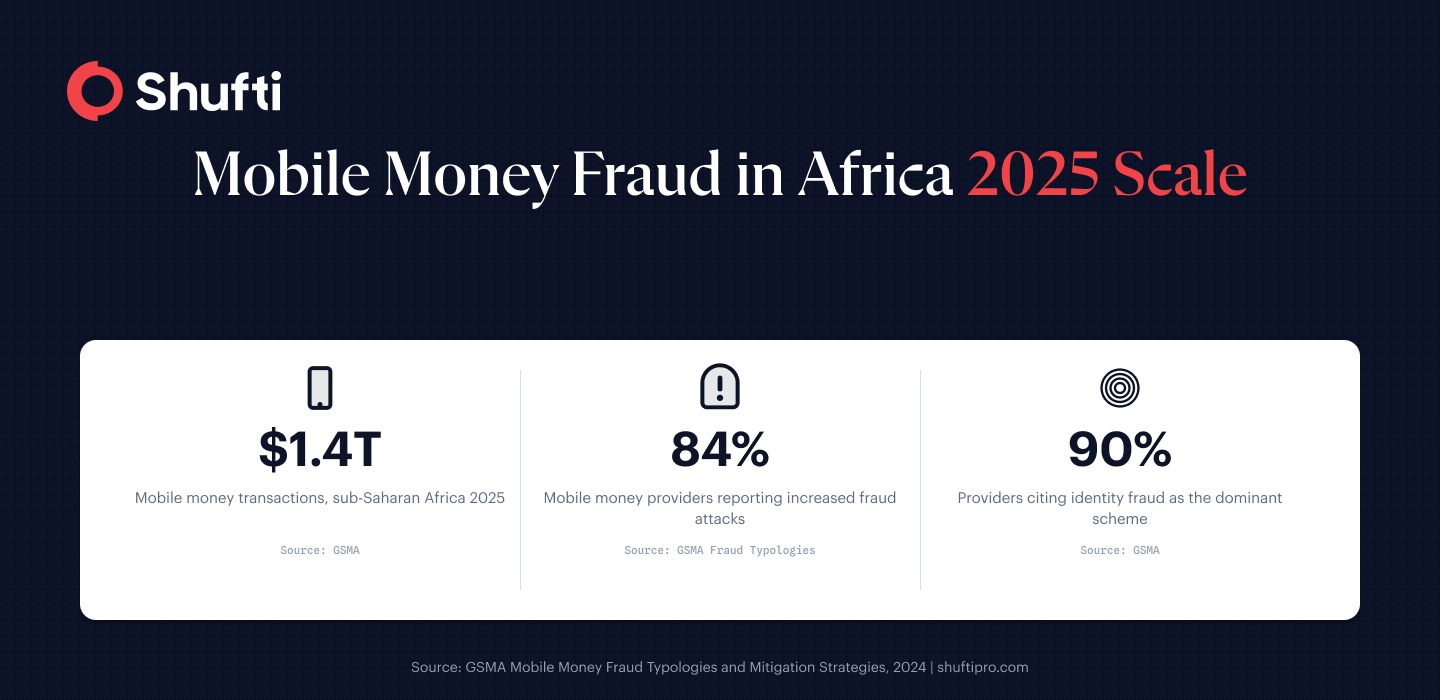
In 2025, $1.4 trillion flowed through mobile money accounts across sub-Saharan Africa, nearly three-quarters of total global mobile money volume, and the user base keeps expanding. Fraud volumes are expanding with it. The Global System for Mobile Communications Association (GSMA) found that 84% of mobile money professionals reported an increase in fraud attacks across their platforms, a figure that carries more weight when tens of millions of these users hold mobile wallets as their primary financial account with no bank branch alternative. This piece maps the fraud typologies that matter most for digital fraud prevention Africa’s fintechs now face, covers how KYC compliance Africa-wide varies by country, and tracks what 2025’s regulatory shifts mean for teams building across the continent’s payment rails.
Africa’s $1.4 trillion mobile money market and its fraud problem
Mobile payment fraud Africa’s compliance teams face does not follow the same patterns as fraud in card-based or branch-based banking systems. The infrastructure is different, the attack surface is different, and the user profile is different. Those distinctions matter for any fintech or compliance team trying to build effective fraud detection capability at scale.
Why does mobile payment fraud differ from traditional banking fraud?
Traditional banking fraud targets accounts at institutions with branch networks, relationship managers, and multi-step authentication. Mobile money operates by design around a different model. Accounts are accessible on feature phones, often held by first-time financial services users, and managed through agent networks rather than direct customer channels. The GSMA’s Mobile Money Fraud Typologies report identified identity fraud as the dominant scheme, cited by 90% of surveyed providers, with social engineering close behind at 88%.
Agent networks introduce a vulnerability that card-based account takeover fraud in traditional systems rarely faces. In West and East Africa, mobile money agents handle deposits, withdrawals, and account registration on behalf of millions of users. When agents are compromised through collusion or insider access, losses are difficult to attribute and rarely recovered. The GSMA found that 94% of mobile money providers reported concern about insider fraud, with agent collusion identified as the primary mechanism. Airtime fraud adds a further typology specific to markets where airtime carries near-cash value. Attackers convert stolen balances into airtime credits and resell them for cash, leaving account holders with empty wallets and few recovery options.
What does SIM swap fraud reveal about mobile money’s identity gap?
SIM swap fraud has become one of the defining identity attacks in African mobile money markets. In South Africa, nearly 60% of mobile banking fraud cases are linked to SIM swap attacks, according to reporting from the Communication Risk Information Centre. The scale of that figure traces back to a structural flaw in how mobile accounts are registered and authenticated across the continent.
Why do phone numbers make weak identity anchors?
A SIM swap replaces the registered SIM card tied to a mobile money account with one the attacker controls. Once the swap completes, verification codes and one-time passwords reach the attacker instead. The account holder gets no warning until the balance is gone.
The structural problem is that many mobile money accounts use a phone number as the primary identity anchor. A phone number is a network-assigned credential, not a verified identity. Anyone who can port or swap that number gains access to the account. Tying accounts to verified identity documents and biometric data removes this vulnerability at the source.
Africa’s digital identity gap makes any fix harder in practice. In several Sub-Saharan markets, large portions of the population lack formal registered identities, which constrains financially inclusive KYC approaches and leaves account registration dependent on whatever credentials a user can present. The result is uneven verification coverage across borders that financial crime compliance frameworks must address differently in each market.
How does KYC compliance vary across Nigeria, Kenya, Ghana, and South Africa?
KYC compliance across Africa’s digital economy is not a uniform challenge. Each major market has built its identity infrastructure at a different pace, under different regulatory pressure, and on different national ID foundations. Fraud rates, verification coverage, and enforcement intensity differ considerably from country to country, which is why fraud detection across Africa remains a market-by-market discipline rather than a single repeatable control set.
Nigeria: BVN, NIN, and the NIBSS fraud drop
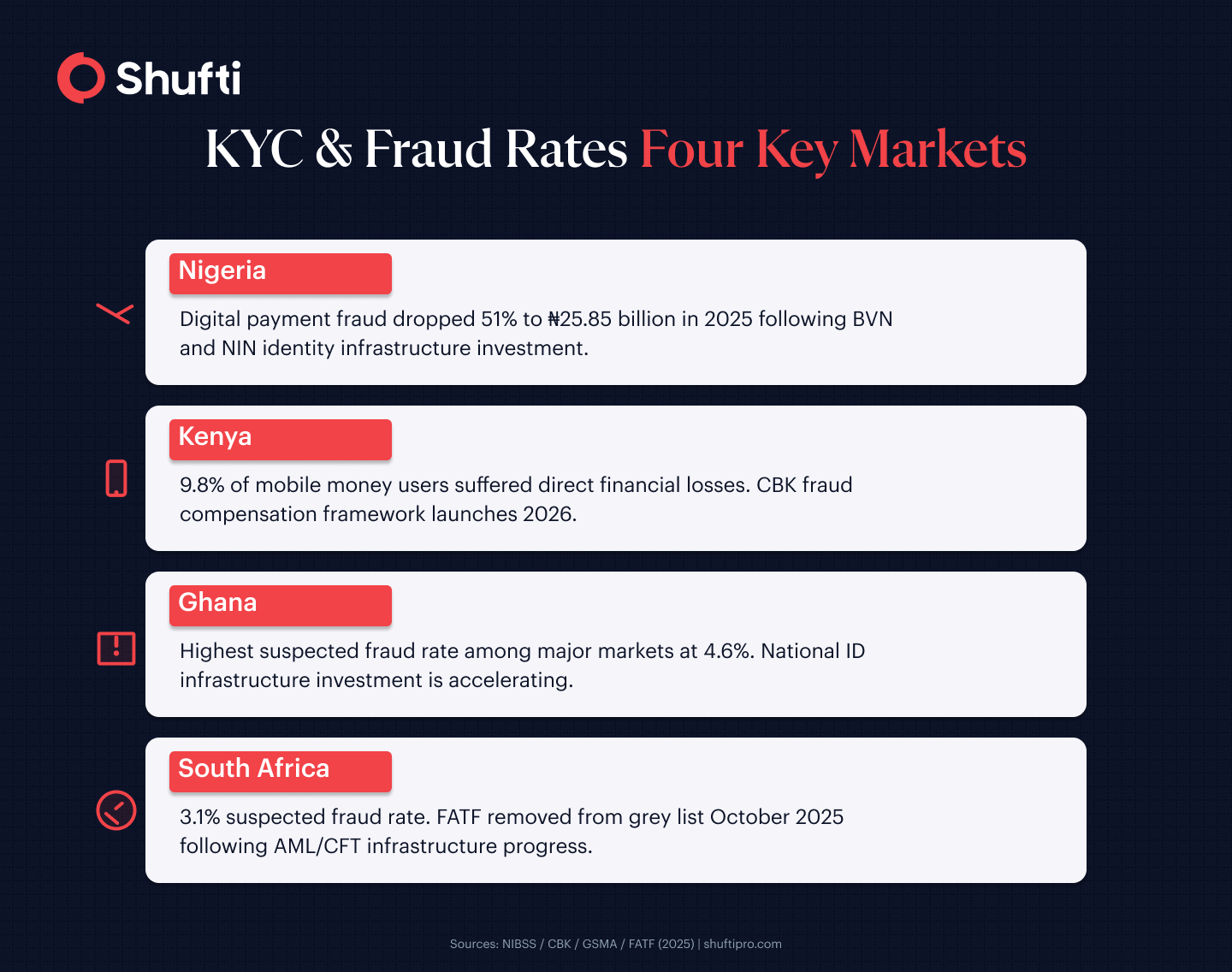
Nigeria runs the Bank Verification Number (BVN) and National Identity Number (NIN) as its primary identity anchors, both designated as Critical National Information Infrastructure under a 2024 government designation order. The Nigeria Inter-Bank Settlement System (NIBSS) reported in 2025 that digital payment fraud dropped 51% to ₦25.85 billion, from ₦52.26 billion the year before, with joint industry measures blocking an estimated ₦20 billion in additional losses. Social engineering in e-commerce and internet banking channels remains the most common technique, with Lagos accounting for 63% of reported fraud volume.
Kenya: CBK requirements and a 9.8% fraud exposure rate
The Central Bank of Kenya (CBK) found that 9.8% of mobile money users experienced direct financial losses through fraud, a rate higher than in traditional banking channels. Kenyan authorities recorded more than 146 mobile banking fraud incidents and 106 online banking fraud incidents as of mid-2025. The CBK’s Anti-Money Laundering and Counter-Financing of Terrorism (AML/CFT) framework applies to all mobile money operators, and a fraud compensation framework targeting rollout in 2026 will require providers to strengthen identity verification and deploy accessible digital complaint channels.
South Africa and Ghana: grey list progress and persistent fraud rates
Ghana recorded the highest suspected fraud rate among major African markets at 4.6%, compared to South Africa’s 3.1%. South Africa’s trajectory is improving. The Financial Action Task Force (FATF) removed South Africa from its grey list in October 2025 following measurable progress in risk-based supervision, beneficial ownership data access, and money laundering investigation rates. Nigeria’s removal from the same list in the same October 2025 plenary marked the first time both markets exited simultaneously, reflecting years of sustained AML/CFT infrastructure investment.
What do the 2025 regulatory shifts mean for fintechs in Africa?
Africa’s digital economy fraud problem is not uniform across borders, and neither is the regulatory response. The FATF grey list removals for Nigeria and South Africa in October 2025, alongside Kenya’s CBK compensation framework, signal that the continent’s largest markets are building compliance infrastructure that fintechs can build on rather than route around. Grey list removal does not mean the compliance work is complete. Regulators demonstrated minimum thresholds. Supervision of digital financial services providers in both markets will intensify as a result.
Financial fraud across Africa’s digital payment networks is growing faster in some markets than the regulatory infrastructure can absorb. Fintech fraud across Africa’s markets requires compliance planning that is market-specific, not continent-wide. Nigeria’s Central Bank of Nigeria (CBN), Kenya’s CBK, Ghana’s Bank of Ghana, and South Africa’s Financial Intelligence Centre each set their own customer due diligence (CDD) thresholds, data localisation rules, and audit expectations. A fintech treating the continent as a single compliance zone will find itself out of step in at least some of the markets where it operates.
The practical priorities for teams building AML compliance controls across African markets are identity document verification at onboarding, biometric matching for ongoing authentication, and transaction monitoring that flags abnormal patterns in real time. Markets that invested in national identity infrastructure are already seeing the returns in fraud data. The question for fintechs in markets with less mature infrastructure is how to implement customer due diligence controls that work with the identity signals currently available, not the ones projected to arrive three years from now.
How does Shufti help fintechs prevent digital fraud across African markets?
The fraud prevention challenge fintechs face in Africa runs deeper than access to fraud data. The real constraint is verification infrastructure that works across fragmented national ID systems. A fintech operating in Nigeria uses BVN-tied identity checks. In Kenya, the same team works with CBK-regulated mobile wallet credentials. In Ghana, national ID card formats vary by generation and issuer. Each onboarding flow needs document verification that handles that variety without creating the friction that drives user drop-off.
Shufti’s fraud prevention platform runs identity verification across 230+ countries and territories, with support for 10,000+ document types, including the national identity formats used across West and East African markets. Where agent-assisted onboarding is the norm, KYC and AML screening run through the same API, so compliance teams carry one audit trail across every market they serve rather than stitching together outputs from separate providers.
Frequently Asked Questions
What are the biggest fraud risks in Africa's digital payment sector?
SIM swap attacks, social engineering, agent network fraud, and identity fraud are the most reported categories. The GSMA found identity fraud cited by 90% of mobile money providers as the top scheme, with social engineering close behind. Mobile money's reliance on phone numbers and agent networks amplifies these risks.
How is mobile money fraud different from traditional banking fraud in Africa?
Mobile money operates through agent networks and feature phones, not branch networks and relationship managers. Attackers target the agent layer through collusion and insider access. SIM swap fraud and airtime conversion exist almost exclusively in mobile money contexts and require identity-anchored authentication controls that card systems do not.
What role does KYC play in fraud prevention across African markets?
KYC determines whether the person opening an account can be verified against a government-issued identity document and a biometric match. Where identity infrastructure is fragmented, KYC gaps translate directly into fraud exposure. Nigeria's NIBSS data shows a 51% fraud drop following stronger verification requirements.
What is the regulatory framework for fraud in Nigeria and Kenya?
Nigeria operates through CBN-mandated BVN and NIN identity requirements and NIBSS fraud monitoring, with FATF grey list removal in October 2025 confirming AML/CFT progress. Kenya's CBK enforces AML/CFT requirements for all mobile money operators and is building a fraud compensation framework targeting a 2026 rollout.