




Picking an eIDV software provider is easy. Picking one that holds up two years into a contract, across every market you operate in and under the compliance frameworks that govern you, is harder than most procurement checklists suggest.
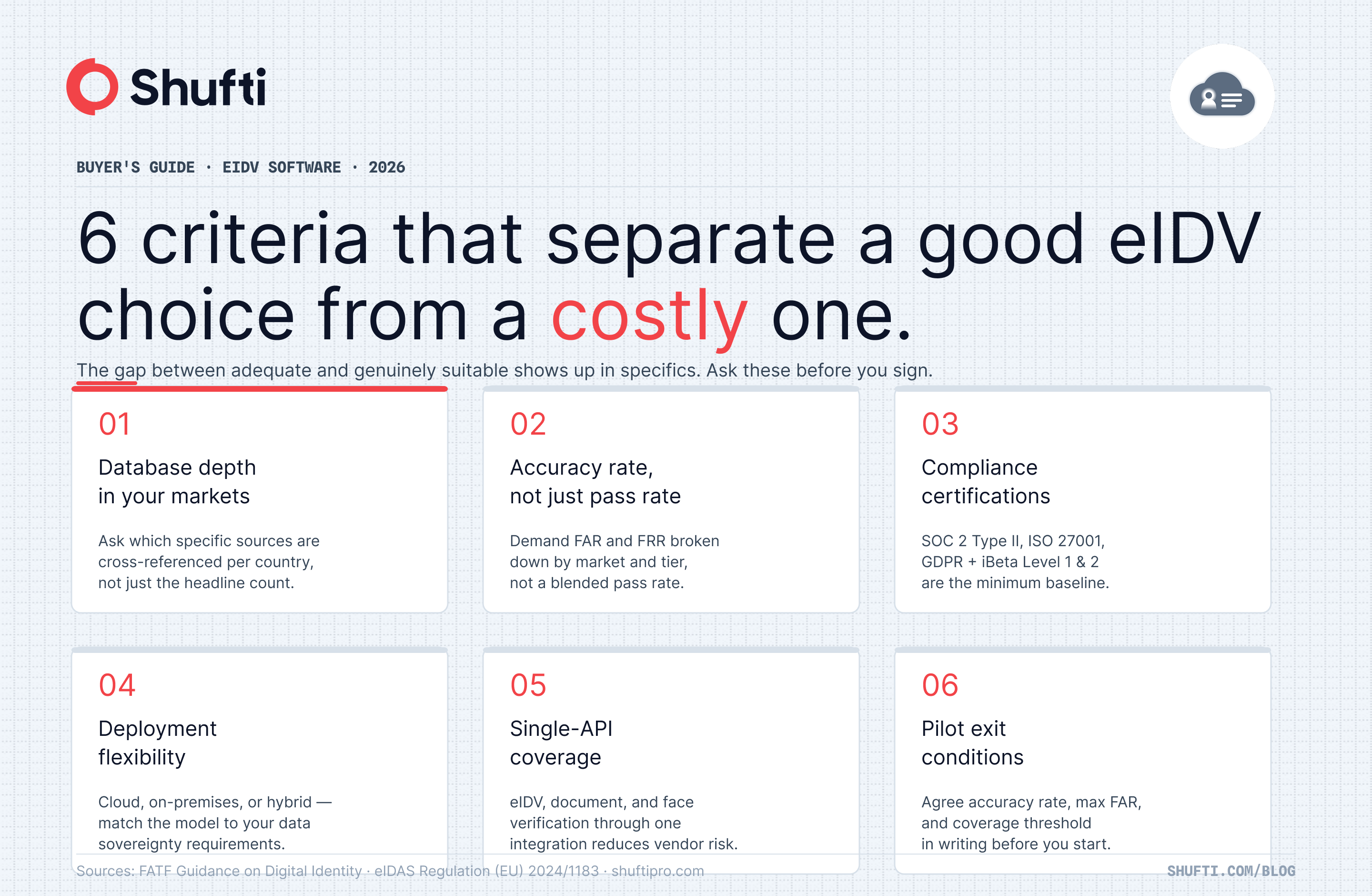
The gap between adequate and genuinely suitable shows up in specifics: database depth in tier-2 markets, whether the provider distinguishes accuracy from pass rate, and whether their deployment model fits your data sovereignty requirements.
Here are six criteria worth interrogating before you sign.
What Does an eIDV Services Provider Actually Do?
An eIDV (electronic identity verification) services provider verifies user identities in real time by cross-referencing personal data against authoritative sources: government registries, national identity databases, credit bureaus, and telecom records. Unlike document verification, which requires a passport or ID photograph, eIDV runs in the background. The user provides a name, date of birth, and address, and the system confirms or disputes those attributes against trusted data.
Document uploads are one of the most common friction points in digital onboarding, and electronic identity verification eliminates that step for low-to-medium risk use cases. It also handles compliance tasks that document checks cannot: instant age confirmation, address validation without utility bills, and pre-fill services that auto-populate forms from telco or government records.
Global Coverage Depth: Ask for the List, Not the Headline Number
Every eIDV provider markets global coverage. The useful question is: which specific databases do you connect to in my primary markets, and what happens when there is no match?
A provider might claim 100+ country coverage while connecting to a single telecom record in many of those markets. For the countries that matter to your business, database depth outweighs headline geography. Providers that cross-reference at least two independent sources per verification, such as a credit bureau record and a mobile operator record, catch synthetic identities that pass one system but not the other.
eIDAS 2.0, Regulation (EU) 2024/1183, in force since May 2024, mandates EU member states to offer digital identity wallets to citizens by the end of 2026. Any provider you evaluate for European markets should already support the national eID schemes feeding into those wallets, not just promise roadmap readiness.
The FATF Guidance on Digital Identity defines the assurance levels your eIDV checks need to satisfy for compliant customer due diligence. A provider that cannot map their database sources to FATF assurance tiers is a material risk signal.
Accuracy Rate vs. Pass Rate: Two Metrics That Measure Different Things
These terms appear in most vendor decks and are routinely conflated. They measure different things.
The pass rate is the percentage of users who complete verification successfully. A high pass rate supports conversion. An unusually high pass rate may mean the system is accepting marginal or fraudulent identities, which creates compliance exposure.
Accuracy rate measures how precisely the system separates genuine users from fraudulent ones. It breaks down into false acceptance rate (fraudulent identities approved) and false rejection rate (genuine users blocked unnecessarily). A provider with a 98% pass rate but a high false acceptance rate is creating quite a compliance risk.
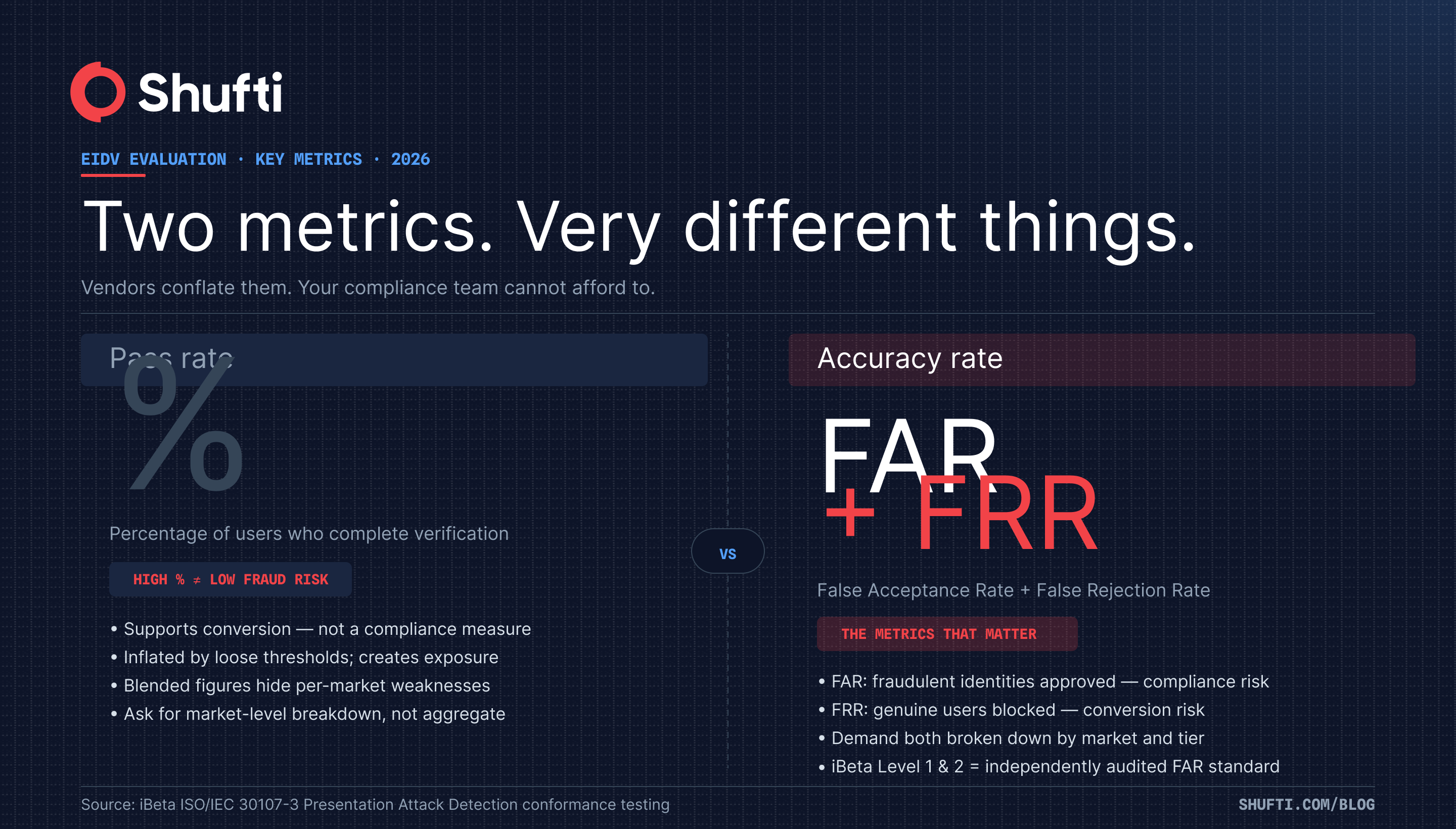
Before committing, ask for accuracy metrics broken down by verification tier and market, not just a blended pass rate. A provider who shares only aggregate pass rate is not giving you the data needed to assess fraud exposure or regulatory risk.
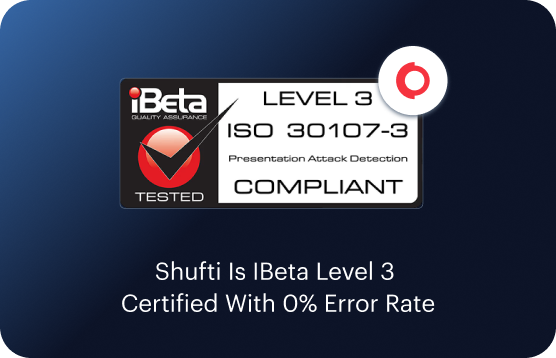
Shufti’s identity verification platform holds iBeta Level 1,2 and Level 3 certification for biometric accuracy. This is an independently audited standard for liveness detection that the majority of providers in this category do not carry.
What Compliance Certifications Should an eIDV Provider Hold?
The certifications your provider needs depend partly on your vertical, but certain ones set a baseline for any regulated use case.
SOC 2 Type II covers security, availability, and confidentiality. ISO 27001:2013 addresses information security management broadly. GDPR compliance determines whether the provider returns only match or no-match flags rather than raw personal attributes. That data minimisation requirement matters when your users are EU residents.
iBeta Level 1,2 and Level 3 is the independent standard for biometric liveness detection. It tests resistance to presentation attacks: printed photos, screen replays, and deepfake video. If your use case involves any biometric check, iBeta certification is the only third-party benchmark that carries real weight with regulators.
For high-assurance verticals such as banking, crypto, and government portals, also confirm PCI DSS certification and ask whether data handling has been audited against the relevant regional framework: RBI Video KYC guidelines in India, GCC eKYC standards in the Middle East, or HKMA guidance in Hong Kong.
Shufti holds all of these certifications and compliance standards, enabling organisations to meet global regulatory, security, and biometric verification requirements across regulated industries.
Integration Architecture and Deployment Flexibility
Most eIDV solution providers operate cloud-only. That covers the majority of use cases but excludes businesses with data sovereignty requirements. Banks, government contractors, and regulated entities subject to national data residency rules often cannot route personal identity data through a third-party cloud environment.
Ask your shortlisted providers for deployment options before the demo:
- Cloud deployment covers standard onboarding use cases with fast integration timelines.
- On-premises deployment keeps identity data within your own infrastructure, satisfying zero-trust and data residency requirements.
- Hybrid deployment applies different routing based on market-specific data classification rules.
Also assess API architecture. A provider whose document verification, eIDV, and face verification capabilities run through a single API reduces the overhead of managing separate vendor contracts. The global identity verification market is projected to grow from $13.75 billion in 2025 to $50.58 billion by 2034, meaning the vendor space will keep fragmenting. A single-API architecture reduces your exposure to that.
How to Run a Pilot Before You Commit
The right way to evaluate an eIDV software provider is against your own traffic, not their demo numbers.
Request a proof of concept using a representative sample of your real onboarding sessions, ideally 1,000 or more across your primary markets. This surfaces pass rates and false acceptance rates against your actual user base, not a curated demo.
Agree on exit criteria before you start: a minimum accuracy rate, a maximum false acceptance rate, and a coverage threshold for your key markets, in writing. If a provider resists committing to those conditions upfront, that tells you something about the contract negotiations to come.
How Shufti Meets These Criteria
Shufti’s eIDV Pro covers 85+ countries through Passive database verification and authenticates users via 30+ national eID schemes through Active eIDV. For higher-assurance scenarios, Biometrically Enriched eIDV adds iBeta Level 1,2 and Level 3 certified liveness detection. Verification completes in under 3 seconds.
The platform runs on cloud, on-premises (zero-trust), and hybrid deployment through a single API. The same integration covers all three eIDV tiers alongside document verification and face verification, without separate vendor contracts. Platform certifications include PCI DSS, SOC 2, ISO 27001:2013, iBeta Level 1,2 and Level 3, GDPR, and CCPA.
For teams running multi-market pilots, Journey Builder lets compliance and product teams configure verification flows without engineering involvement, making it straightforward to validate geographic coverage before a full rollout.
Conclusion
Choosing an eIDV services provider comes down to six questions: how deep the database coverage runs in your markets, whether the provider shares accuracy and pass rate separately, which certifications they hold independently, whether their deployment model fits your data sovereignty requirements, whether their API covers the full verification stack, and whether they will define pilot exit conditions in writing.
Providers who answer those questions with specifics, not headline numbers, are worth taking to the next stage.
Choosing the wrong eIDV software provider means discovering coverage gaps and compliance mismatches after the contract is signed. Shufti covers 85+ countries with iBeta-certified biometrics, on-premises deployment for data sovereignty requirements, and a single API for the full verification stack. Request a demo to pilot coverage against your actual onboarding volumes before you commit.
Frequently Asked Questions
How do you evaluate the accuracy rate of an eIDV software provider?
Ask for false acceptance rate and false rejection rate separately, broken down by market and verification tier, not just aggregate pass rate.
What integration options should an eIDV provider offer?
At minimum: a REST API with webhook support, mobile and web SDKs, and the ability to run eIDV, document verification, and biometric checks through a single integration.
How important is document coverage when selecting an eIDV vendor?
Providers offering both through one API can run combination checks that cross-reference physical IDs against database records, catching synthetic identities that pass one check but not the other.
What data privacy standards should your eIDV provider comply with?
GDPR, SOC 2 Type II, and ISO 27001 form the baseline. For biometric use cases, iBeta Level 1,2 and Level 3 certification is the independently audited standard that regulators recognise.
Can eIDV software providers handle verification across multiple countries?
Yes, but coverage depth varies significantly. Ask for the specific sources connected to your key markets. The FATF Guidance on Digital Identity defines the assurance levels that cross-border eIDV checks need to meet for compliant customer due diligence.