AMLR Solutions
 AMLR Consultation
 Onboarding
 Ongoing Monitoring
 FRAML
FRAML KYC
KYC KYB
KYB KYI
KYI Age Assurance
 Workforce IAM
 Candidate Verification
 Account Takeover
 Bonus/ Promotion Abuse
 Chargeback Fraud
 Deepfake
 Document Fraud
 Fraud Networks
 Impersonation Fraud
 Money Mule Activity
 Multi-Accounting
 Party Fraud
 Regulatory & Compliance Risks
 Synthetic Identity Fraud
 Adult Content
 Banking
 Crypto
 Fintech
 Forex
Forex Compliance
 Fraud prevention
 Trust & safety
 Global expansion
 Compliance Officers
 Developers
 Fraud Analysts
 Product Managers
 Advanced Journey Builder (AJB)
 Global Trust Platform
 Customer Profiles
 Vendor Comparison
 IDV Case Management
 AML Case Management
 Regulatory Reporting
 Travel Rule Protocols
 Agentic Rule Builder
 AI Compliance Co-Pilot
 Fraud Analytics
 Fraud Hub
 OCR
OCR Shufti AI
 Bank Account Verification
 Biometric Duplication
 Database Checks
 Document Intelligence
 Government ID
 Mobile Driver's License
 NFC
NFC Selfie Liveness
 Brand Personalisation
 Deployment Options
 Identity Methods
 IDV Modes
 Multi-tenancy
 On-Premise IDV
 Secure Capture









Here’s the problem every fintech, crypto, and gaming company faces: 68% of consumers abandon digital onboarding due to friction, according to Bynn research. At the same time, the FTC reported $12.5 billion in fraud losses in 2024, up 25% year-over-year. Companies are caught between two impossible choices. Add more verification steps and customers leave. Remove them and fraudsters walk in.
Electronic identity verification (eIDV) ends that paradox. Instead of asking customers to upload physical documents (a process that kills conversion and creates massive document storage liability), eIDV checks identities against government databases, national eID schemes, and biometric signals in seconds. No scanning. No friction. No documents to store or eventually delete.
This guide covers how eIDV works, the three distinct operational modes, regulatory requirements across regions, and why 2026 is the inflection year for adoption. By the end, you’ll understand why companies are shifting from document-heavy flows to eIDV-first verification.
What Is Electronic identity verification?
Electronic identity verification (eIDV) is a method of confirming a person’s identity by cross-referencing personally identifiable information (name, date of birth, address, national ID number) against authoritative government databases, credit bureaus, telco records, postal registries, and national eID schemes. The user never needs to upload or photograph a physical document.
Key Takeaways
- eIDV uses three operational modes: passive database checks (fastest, lowest friction), active national eID authentication (highest assurance, EU/Nordic standard), and biometrically enriched verification (for high-risk markets)
- Regulatory breakthrough in 2026: eIDAS 2.0 mandates EU Digital Identity Wallets across all 27 Member States by December 2026; AMLD6 AML requirements take effect July 10, 2026
- eIDV outperforms document-based IDV: Passive eIDV delivers 99% pass rates vs. 40–50% on document scans; reduces drop-off by 30%+ compared to document upload flows
- Coverage spans 85+ countries: Shufti’s platform reaches 4.29 billion reachable identities via 30+ national eID schemes and government database integrations
- Three industries driving adoption: crypto exchanges (MiCA compliance), fintech/banking (AMLD6, BSA), and gaming (GlüStV, UKGC requirements)
- eIDV is legally defensible: Accepted under eIDAS, Bank Secrecy Act, FCA rules, and equivalent regulations in APAC and Middle East
- The shift is happening now: Companies moving to eIDV-first flows onboard faster, approve more customers, and meet regulatory deadlines without scrambling
How Does Electronic Identity Verification Work?
eIDV starts with a simple transaction. A user enters personal information (name, date of birth, address, national ID number) into your onboarding form. The system submits this data to authoritative sources in the background.
What happens next depends on your data sources. The system queries government ID registries (like the US Social Security Administration, UK DVLA, German Bundeszentralamt für Steuern), credit bureaus (Experian, Equifax, TransUnion equivalents), telecommunications company records, postal databases, and commercial identity registries. Within seconds, the system receives match signals from one or more sources.
The outcome is one of three states: match (identity confirmed), no match (identity not found or data mismatch), or partial match (some fields align, others don’t). Partial matches often trigger step-up verification, like a biometric check or a secondary data source query, before a final decision.
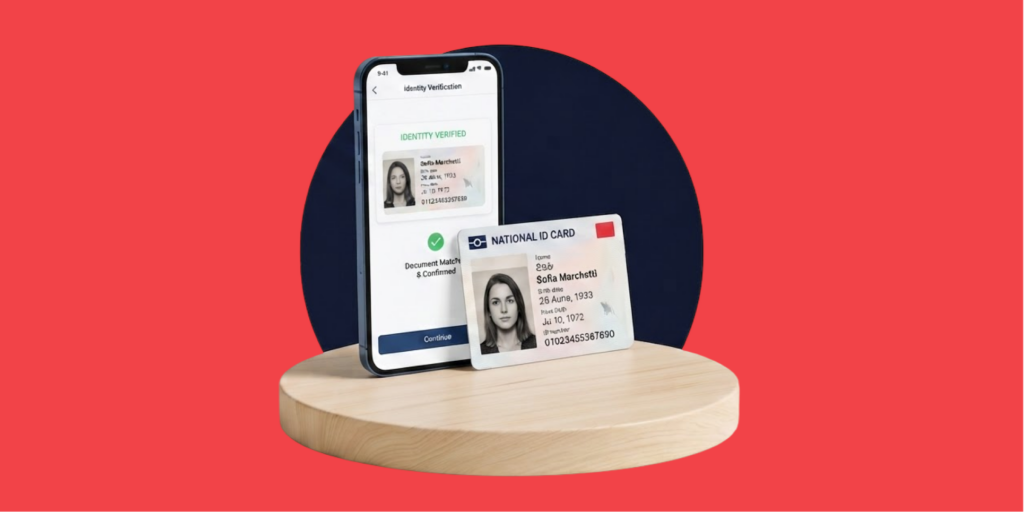
This is fundamentally different from document-based identity verification. Traditional IDV requires the user to photograph a passport or national ID, upload it, and wait for manual or AI review. The document then lives in your database indefinitely, creating compliance and security headaches. eIDV bypasses documents entirely. The data is validated against live government sources, not against an image.
One enterprise retailer told us their onboarding process was “predominantly very document-heavy,” and they explicitly wanted to “shift strategy toward more passive, low-friction eIDV checks first.” That’s the movement happening across industries right now.
Three Modes of eIDV and When to Use Each
eIDV isn’t one-size-fits-all. The three operational modes offer different trade-offs between speed, user friction, and assurance level. Smart platforms let you deploy all three and route users based on risk.
Passive eIDV (Database Verification)
Passive eIDV is the fastest mode. The user submits personal information, and the system checks it against government databases and credit bureaus in the background. No user action beyond typing in a form. No redirects. No app installs. The verification completes in under 3 seconds.
Passive eIDV reaches 85+ countries and can verify against 4.29 billion reachable identities (Shufti internal data). It works because most developed nations maintain either a national ID registry, a credit bureau, or both. Countries like Germany, France, the Netherlands, South Africa, India, Australia, and Singapore all expose their registries through eIDV APIs.
Pass rates on passive eIDV are typically 99% when the user provides accurate information. The only failures come from typos, outdated records (someone who moved last month), or identity mismatch (someone using a false name).
Passive eIDV is your first line. Deploy it for all new users. It converts at high rates because there’s virtually zero friction. Just form fields. Use it as the primary gate for standard KYC, onboarding high-volume users, and qualifying first-time customers.
Active eIDV (National eID Authentication)
Active eIDV shifts the verification burden to government-issued eID schemes. Instead of submitting data, the user authenticates via their national eID app. BankID (Sweden, Norway), MitID (Denmark), UAE Pass, PhilSys (Philippines), Singpass (Singapore), iDIN (Netherlands), SPID (Italy), and Smart-ID (Estonia, Lithuania, Latvia) are all supported.
Shufti supports 30+ national eID schemes, all compliant with eIDAS 2.0. The user taps the eID app, authenticates with biometric or PIN, and control passes back to your platform with verified identity data.
Active eIDV delivers the highest assurance level. Government cryptographic verification means the user is authenticating directly with their own digital identity, not submitting data that could be fake. It’s immune to credential stuffing, data breaches, and synthetic fraud because the government is the arbiter.
But active eIDV carries a friction cost. It requires the user to have a national eID app installed, to trust the redirect flow, and to authenticate. One payment company rejected an active eIDV flow because it redirected users away from their platform mid-onboarding. They saw it as an abandonment risk and chose passive eIDV instead.
Deploy active eIDV as a secondary gate: for high-assurance KYB, regulated markets (EU/Nordic), or step-up verification. Don’t force it on all users unless your market requires it.
Biometrically Enriched eIDV
This mode combines passive database verification with facial liveness detection. The system checks the database AND confirms that the person presenting the identity is actually that person (not a deepfake, mask, or presentation attack).
Biometric enrichment is expensive and introduces friction because the user must take a selfie video. But it’s necessary for high-risk markets, crypto exchanges, high-value transactions, or jurisdictions with endemic synthetic fraud.
Crypto exchanges adopt this mode because MiCA regulations in the EU now require robust identity verification that can’t be fooled by synthetic fraud. One crypto exchange told us they’d shift from purely document-based verification to biometrically enriched eIDV because “the regulatory expectation is clear: just checking a document isn’t enough anymore.”
Deploy biometric enrichment where risk is high: crypto onboarding, transactions above a threshold, or jurisdictions with high synthetic fraud rates (Southeast Asia, parts of Africa).
|
Mode |
Speed |
User Friction |
Assurance Level |
Best Use Case |
Regulatory Fit |
|
Passive eIDV |
<3 seconds |
Minimal (form) |
Medium |
Standard KYC, high-volume onboarding |
Most jurisdictions |
|
Active eIDV |
30–60 seconds |
High (app redirect) |
Very High |
Regulated markets, KYB, step-up |
EU, Nordic, APAC |
|
Biometric eIDV |
60–90 seconds |
High (video selfie) |
Highest |
Crypto, high-value, high-risk |
Crypto, high-risk regions |
What Documents and Data Sources Does eIDV Check?
eIDV doesn’t check documents. It checks the data behind them. The sources vary by country and provider, but they fall into these categories.
Government ID registries are the gold standard. These are national or sub-national databases that store official identity data. The US Social Security Administration database, UK DVLA, German Bundeszentralamt für Steuern (BZSt), and equivalent agencies in other countries all expose APIs for identity verification. When a user submits their name and national ID number, the system queries these registries in real-time.
Credit bureaus (Experian, Equifax, TransUnion in the US; equivalent agencies in Europe, APAC, and the Middle East) maintain historical records of credit accounts, addresses, and identity data. They’re highly accurate because they’re updated constantly as people take out loans and credit cards.
Telecommunications records are underrated but powerful. When someone opens a phone account, they provide verified identity data. Telco records are current, detailed, and hard to fake. Shufti queries telco databases in 40+ countries.
Postal and address databases (like Royal Mail in the UK, Poste Italiane in Italy, Australia Post) verify that an address is real and associated with the identity. These catch typos and phishing attempts.
Commercial registries (business registries, professional licensing boards) verify KYB (know your business) data when you’re onboarding a company officer.
Most eIDV providers use a 1×1 check (identity confirmed by a single source) for low-risk onboarding. But regulated businesses often require a 2×2 check (dual independent source confirmation, e.g., government registry + credit bureau) for higher assurance. Shufti and other platforms let you configure this based on your risk appetite.
The critical distinction: eIDV never requires the user to upload or photograph documents. The documents are verified electronically against their source systems. You never store them, never manage document retention, never face regulatory scrutiny for keeping someone’s passport image on your servers for five years.
eIDV vs Traditional Identity Verification Methods
eIDV is faster and more frictionless than traditional IDV, but it’s not the only verification method. Here’s how they compare.
|
Method |
Speed |
User Friction |
Fraud Detection |
Regulatory Acceptance |
Coverage |
|
eIDV (Passive) |
<3 seconds |
Minimal |
High (database match) |
Universal (EU, US, APAC) |
85+ countries |
|
eIDV (Active) |
30–60 seconds |
Medium (app) |
Highest (government crypto) |
EU, Nordic, APAC |
30+ schemes |
|
|
|
|
|
|
|
|
eIDV (Biometric) |
60–90 seconds |
High (video) |
Highest (liveness + match) |
Crypto, regulated |
85+ countries |
|
Document Verification |
30–120 seconds |
High (upload, photo) |
Medium (AI/manual review) |
High (legacy standard) |
Universal |
|
Video KYC |
5–15 minutes |
Very High (live agent) |
Very High (human review) |
Highest (regulated) |
Global |
|
In-Person Verification |
Real-time |
Very High |
Highest (direct ID check) |
Highest |
Limited |
The data is striking. One gaming company running a 2×2 document verification solution achieved a ~60% pass rate. When the same company tried pure document scan (uploading an image), their pass rate dropped to ~50%. Switch that same company to passive eIDV, and pass rates jump to 99%.
Why? Because passive eIDV is checking against live government data, not trying to extract information from a photograph of a document. There’s no OCR error. There’s no blurry image. There’s no manual review backlog.
Drop-off rates tell the same story. Companies that move from document-upload flows to eIDV-first see a 30%+ reduction in abandonment (Shufti internal data). Users don’t want to take photos. They want to move forward.
Document verification still has a place. In high-risk KYB scenarios, when regulatory examiners demand a paper trail, or as a secondary verification when eIDV partial-matches. But the future of onboarding is eIDV as the primary gate.
Is eIDV Legally Valid? Regulations You Need to Know
Yes. eIDV is legally defensible across nearly every major jurisdiction. The regulatory tailwinds in 2026 are unprecedented.
European Union: eIDAS 2.0 and AMLD6
The EU is forcing the transition. eIDAS 2.0, the updated Regulation on electronic identification and trust services, requires all 27 Member States to offer EU Digital Identity Wallets to their citizens by December 2026. These wallets will contain verified identity attributes, accessible via eIDV. The regulation mandates that EU and non-EU businesses must accept eIDV as proof of identity. There’s no opt-out.
Simultaneously, AMLD6 (the Sixth Anti-Money Laundering Directive) takes effect on July 10, 2026, tightening beneficial ownership reporting and customer due diligence. AMLD6 explicitly permits electronic verification. No requirement for physical documents.
For any business with EU customers, eIDV shifts from “nice to have” to “regulatory requirement” on July 10, 2026.
United States: BSA and FinCEN Guidance
The Bank Secrecy Act (BSA) and FinCEN Customer Identification Program (CIP) requirements don’t mandate documents. They mandate identity verification. Electronic verification, including eIDV, satisfies both. The OCC and Federal Reserve have issued guidance confirming that “electronic databases are an acceptable means of identity verification” (Federal Reserve Letter 09-13, 2009, still valid).
FinCEN’s CDD Rule updated in 2016 explicitly permits electronic verification, including “government-issued database checks.”
For fintech, banking, and money transmission in the US, eIDV is legally compliant and often preferred because it creates a better audit trail than handwritten documents.
United Kingdom: FCA and MLR 2017
The FCA’s Money Laundering Regulations 2017 (MLR 2017) permit electronic identity verification, including database checks and eID authentication. The FCA doesn’t require documents; it requires verification of identity and beneficial ownership. eIDV meets this requirement.
Asia-Pacific: National Schemes
Coverage varies by country, but is growing.
- Singapore: Singpass (government digital ID) is ubiquitous. Financial institutions and crypto exchanges can use Singpass-backed eIDV as proof of identity.
- India: Aadhaar-based eKYC is the de facto standard for KYC. Over 1.4 billion Aadhaar numbers issued. Financial institutions must accept it.
- Philippines: PhilSys (Philippine Identification System) launched in 2024. By law, eIDV via PhilSys is accepted for KYC.
- Australia: Government ID databases (state motor registries + federal tax records) are queryable by licensed financial services providers. eIDV via these sources is legally recognized.
Middle East: Emerging Frameworks
- UAE: UAE Pass, the government digital identity app, is now the standard for KYC in the UAE financial sector. eIDV via UAE Pass is legally required for regulated entities.
- Saudi Arabia: NISA (National Information & Security Authority) launched Absher, a unified citizen services platform. eIDV integration is growing.
The regulatory trajectory is clear: governments are building digital identity infrastructure (eID wallets, digital ID apps) and requiring that businesses accept eIDV. The companies that adopt it first avoid scrambling in 2026 when mandates hit.
Which Industries Must Use Electronic Identity Verification?
Not every industry is forced to use eIDV yet, but these sectors have the strongest regulatory drivers.
Banking and fintech face the hardest deadline. AMLD6 (July 10, 2026) and eIDAS 2.0 (December 2026) will make eIDV a minimum requirement across the EU. US banking regulations (BSA, CIP) already permit and implicitly encourage electronic verification. Banks adopting eIDV now reduce compliance risk and improve onboarding speed simultaneously.
Crypto and digital assets are moving the fastest. MiCA (Markets in Crypto Assets), effective in the EU, requires robust customer due diligence. One crypto exchange told us they’re “shifting from document-based to eIDV-based” because “the regulatory expectation is clear.” Binance, BitDelta, and other major exchanges are integrating eIDV platforms for faster customer onboarding while meeting MiCA requirements.
Gaming and gambling face gambling-specific regulations. Germany’s GlüStV, the UK Gambling Commission (UKGC), and equivalent regulators in other jurisdictions all require verified identity. Many gaming operators are moving to eIDV to reduce chargebacks (often stemming from unverified players using stolen payment methods) and speed up player onboarding. Operators like Ellipse and Sweeprush have adopted eIDV platforms.
Insurance requires customer due diligence and beneficial ownership verification under the equivalent of AMLD. eIDV accelerates the underwriting process without sacrificing compliance.
Healthcare is emerging as a vertical. Patient identity verification, required for handling protected health information, is increasingly done via eIDV. This is an earlier stage, but healthcare providers are beginning to adopt national eID schemes.
Real estate and fintech lending require beneficial ownership verification and identity confirmation for mortgage and loan applications. eIDV cuts the underwriting timeline from days to hours.
Real-world adopters: Shufti’s platform is used by crypto exchanges, social media platforms (TikTok onboarding in certain markets), gaming operators, fintech lenders, money transfer services, and large retailers. These aren’t small companies experimenting. They’re mainstream platforms moving to eIDV because it works. For a banking and fintech-specific look at this shift, read how eIDV is improving client onboarding for banks and fintech.
Common Reasons eIDV Fails and How to Prevent Them
eIDV sounds simple, but implementation is where most companies stumble. Here are the real failure modes and how to fix them.
Low auto-approve rates:
One fintech company told us they had a 13% auto-approve rate on their eIDV flow. The problem wasn’t eIDV itself—it was their configuration. They were running overly strict rules (e.g., requiring exact name matches across government and credit bureau records, even though databases often contain abbreviations or spelling variations). They’d also built in a 2×2 check requirement for every user, which increased friction and introduced more points of failure. The fix: configurable risk-based rules. Low-risk users auto-approve on a 1×1 check. Higher-risk users require 2×2. Allow fuzzy matching (acoustic similarity, abbreviation handling) so “Robert” matches “Bob” on a government registry. Don’t treat eIDV as a binary gate—treat it as a signal in a risk model.
False positives in adverse media and PEP screening:
One compliance team told us they were running “three or four providers” for AML/PEP screening, and the multiple vendors kept returning false positives on the same users. The burden of manual review was “consuming their entire product roadmap.” The issue with basic AML screening string-matching algorithms: flagging “John Brown” as a potential match for “Juan Brun” (similar-sounding name, different spelling). The fix: NLP-powered intelligent tagging that understands transliteration, handles non-Latin scripts (Arabic, Cyrillic, Chinese), and uses semantic similarity rather than raw string distance. Better vendors apply machine learning to learn the difference between true matches and false alarms.
Poor UX on external redirects:
One payment company explicitly rejected an active eIDV flow because “the redirect to an external eID app felt like abandonment.” Users saw the redirect and closed the browser, thinking the onboarding had failed. The company preferred passive eIDV, which requires no redirects. The fix: if you use active eIDV, either embed it as a native SDK experience (so users never leave your platform) or make the redirect pattern extremely clear (“You’ll be redirected to your banking app to authenticate in 3 seconds. You’ll be back here.”).
Coverage gaps:
A company wanting to verify identities in the Philippines, Brazil, and Middle East found their eIDV provider had zero coverage in those regions. They ended up running separate vendors for different markets. The fix: verify coverage exhaustively before contracting. Ask for a list of supported countries and data sources. Don’t assume “global coverage.” Many vendors cover the US, UK, and Western Europe well and have gaps elsewhere.
Vendor fragmentation:
One mid-market fintech was using one provider for passive eIDV, another for active eIDV (national eIDs), another for adverse media screening, and another for document verification. Each integration required a separate API, separate data pipeline, separate compliance review. The result: “the onboarding flow became staggered across three or four providers,” and managing it “consumed their entire product roadmap.” The fix: consolidate on a single platform that offers all three eIDV modes, plus AML/PEP screening, plus document verification (as a fallback). Single-vendor integration is radically simpler than stitching together four vendors.
For a deeper dive, read 6 Reasons eIDV Fails and What Businesses Must Require for Reliability.
How Shufti’s eIDV Works (Value-First Positioning)
A modern eIDV solution should meet five criteria.
Three modes in one platform. You don’t want to license passive eIDV from Vendor A, active eIDV from Vendor B, and biometric verification from Vendor C. A consolidated platform lets you deploy all three modes, route users based on risk, and scale without managing multiple vendors. Shufti’s eIDV covers passive (database), active (30+ national eID schemes), and biometrically enriched (iBeta Level 1 & 2 certified) in a single API.
Global coverage without coverage surprises. Shufti’s platform reaches 85+ countries and 4.29 billion reachable identities via government registries, telco records, credit bureaus, and postal databases. The 30+ supported national eID schemes (including BankID, MitID, UAE Pass, PhilSys, Singpass, iDIN, SPID, Smart-ID) cover the most regulated and fastest-growing markets. Before signing any contract, ask your vendor for an explicit list. Surprises mid-deployment are expensive.
Sub-3-second passive verification with 99% pass rates. When you deploy passive eIDV, speed and conversion matter. Shufti’s platform completes passive database checks in under 3 seconds and typically achieves 99% pass rates on accurate data. That means you’re not losing customers to slow verification or false rejections.
30%+ drop-off reduction. Companies switching from document-upload flows to eIDV-first see dramatic conversion lifts. Shufti data shows a 30%+ reduction in abandonment when moving from document verification to eIDV as the primary gate.
On-premises deployment available. If you’re operating in a zero-trust environment or handling highly sensitive customer data, you need verification infrastructure you control. Shufti offers on-premises deployment of its eIDV platform, so data never leaves your infrastructure.
Conclusion
By the end of 2026, Electronic identity verification will be a regulatory expectation, not an option. eIDAS 2.0 Digital Identity Wallets roll out December 2026. AMLD6 enforcement begins July 10, 2026. MiCA is already forcing crypto exchanges to strengthen verification. FCA, FinCEN, and equivalent regulators worldwide expect electronic verification, not documents.
The companies that move to eIDV-first flows today will onboard faster, approve more legitimate customers, reduce fraud, meet regulatory deadlines without cramming, and cut the compliance overhead of storing millions of document images.
The companies waiting for regulatory hammers will be scrambling in mid-2026 to retrofit their onboarding. By then, their competitors will have already captured market share with frictionless eIDV flows.
The shift is happening now. Request a demo to see how Shufti’s eIDV can tighten verification while accelerating onboarding.
Frequently Asked Questions
What documents are accepted for electronic identity verification?
eIDV doesn't require documents. Instead, it verifies identity information against government ID registries, credit bureaus, telecommunications records, postal databases, and national eID schemes. The user enters their name, date of birth, address, and national ID number. No document upload required. If your eIDV provider needs document backup, it's typically for failed cases or high-risk scenarios, not as the primary verification method.
How is eIDV different from traditional identity verification methods?
Traditional identity verification (document upload) requires users to photograph a passport or national ID, upload it, wait for manual or AI review, and deal with the liability of you storing the document. eIDV queries live government databases in real-time, completes verification in under 3 seconds, and never requires document storage. Document verification typically achieves 40–50% pass rates on first attempt due to image quality and OCR errors. Passive eIDV achieves 99% pass rates. eIDV also reduces drop-off by 30%+ compared to document-upload flows.
Is electronic identity verification legally valid across different countries?
Yes. eIDV is legally defensible under eIDAS 2.0 and AMLD6 (EU), the Bank Secrecy Act and FinCEN CIP rules (US), FCA Money Laundering Regulations 2017 (UK), and equivalent regulations in APAC and the Middle East. Starting July 10, 2026 (AMLD6 effective date), eIDV becomes a de facto regulatory requirement in the EU. By December 2026, eIDAS 2.0 Digital Identity Wallets are mandated across all 27 Member States, making eIDV the standard for regulated customer verification.
How long does the eIDV process take to verify a person's identity?
Passive eIDV (database checks) completes in under 3 seconds. Active eIDV (national eID app authentication) takes 30–60 seconds, depending on the eID scheme and whether the user has the app pre-installed. Biometrically enriched eIDV (with facial liveness detection) takes 60–90 seconds. All three are orders of magnitude faster than document verification, which requires manual review or AI image analysis (30–120 seconds) and often has manual exceptions that drag the process to hours or days.
What technologies power electronic identity verification?
eIDV integrates with government ID registries via APIs, credit bureau data feeds, telecommunications databases, postal registries, and national eID schemes. The core technologies are real-time API queries to authoritative sources, cryptographic verification (for active eID), and AI-powered biometric liveness detection (for enriched eIDV). iBeta Level 1 & 2 certification means the biometric component is attack-resistant to presentation attacks (masks, deepfakes, silicone heads).
Can eIDV detect forged or tampered identity documents?
eIDV doesn't work with documents, so it can't be fooled by document forgery. It verifies against live government data. If someone gives you a forged national ID number, the government registry query returns no match. That said, eIDV can fail if someone uses a stolen identity (someone else's real data). That's why regulated businesses often pair passive eIDV with adverse media/PEP screening or step up to biometric enrichment for high-risk scenarios.
Which industries are required to use electronic identity verification?
Banking and fintech face the hardest deadlines (AMLD6 and eIDAS 2.0, both enforced in 2026). Crypto exchanges must comply with MiCA. Gaming operators must meet gambling-specific regulations (GlüStV, UKGC). Insurance, healthcare, real estate, and lending all have know your customer (KYC) or beneficial ownership verification requirements that eIDV satisfies. Most regulated industries can use eIDV; some will be required to by the end of 2026.
What happens if a person fails electronic identity verification?
A failed eIDV result (identity not found in databases) can occur due to incomplete data entry, outdated records, or identity mismatch. The next step is configurable by your team. You can prompt for re-entry of information (perhaps the user misspelled their name), escalate to manual review, ask for document upload as a secondary verification, or route to a higher-friction eID authentication (active eIDV). Don't deny access immediately. Failures often stem from typos, not fraud.