




 Face Verification
 Address Verification
 Document Verification
 Age Verification
 VideoIdent
 Fast ID
 Docless Verification
 Consent Verification
 NFC Verification
 Business Verification
 Due Diligence
 Investor Verification
 E-Signature

 QES
QES
 AML Screening
 Transaction Monitoring
 Adverse Media
 Business AML Screening
 PEP & RCA
 Sanctions
 Watchlist
 Behavioural Biometrics
 Device Fingerprinting
 Biometric Face Authentication
 MFA
MFA
 Fraud Hub
 Onboarding
 Ongoing Monitoring
 KYC
KYC
 KYB
KYB
 KYI
KYI
 Age Assurance
 Identity Verification
 Workforce IAM
 Candidate Verification
 Compliance
 Fraud prevention
 Trust & safety
 Global expansion
 Product Managers
 Compliance Officers
 Fraud Analysts
 Developers
 Deepfake Detection
 Bonus Abuse / Promotion Abuse
 Account Takeover
 Synthetic Identity Fraud
 Document Fraud
 Impersonation Fraud
 Multi-Accounting
 Fraud Networks
 Chargeback Fraud
 Money Mule Activity
 Party Fraud
 Regulatory & Compliance Risks
 Fintech
 Crypto
 iGaming
 Forex
Forex
 Social Network
 Marketplace
 Banking
 Gig Economy
 Payments
 Ride Hailing
 Adult Content
 Blind Spot Audit
 Deepfake Detector
 Liveness Spoofs
 Document Originality
 Document Deepfake
 Global Trust Platform
 Journey Builder
 Case Management
 Shufti AI
 Fraud Analytics
 Vendor Comparison
 Brand Personalisation
 AI Compliance Co-Pilot
 OCR
OCR
 Secure Capture
 Deployment Options
 Identity Methods
 API Documentation
 Mobile SDKs
 Service Status
 Help Center
 Contact Us
 Technical Support
 Supported Documents
 Supported Countries

 Content library
 Blogs
Blogs
 News
News
 Reports
 Insights
 Knowledgebase
 ROI calculator
 About
About
 Career
 Press Release
 Certifications
 Partnership
 Awards
 Events & Webinar
 Interactive Demo
 Podcast Studio
 Spotlight Studio
Identity Verification for Transport Companies: KYC, AML, and Driver Checks Explained
TL;DR
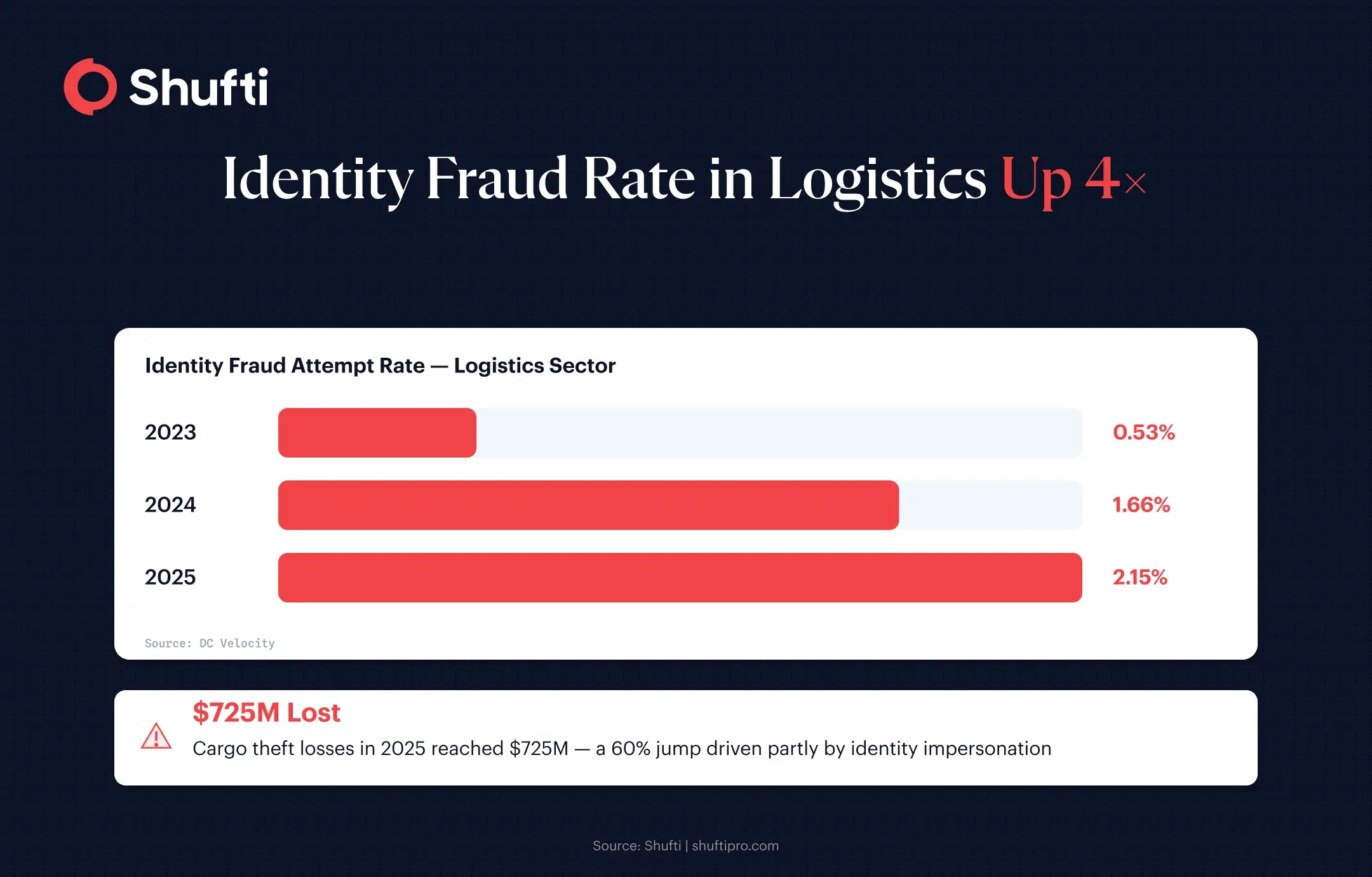
- Identity fraud in transport and logistics rose fourfold between 2023 and 2025, reaching 2.15% of all verification transactions.
- Transport platforms face fraud through fake driver credentials, cargo theft via identity impersonation, and account sharing on delivery apps.
- Identity verification combines document authentication, biometric face matching, and AML watchlist screening to confirm drivers are who they claim to be.
- Fleet operators, ride-hailing platforms, and logistics companies each have distinct verification workflows but share the same compliance baseline.
- Compliance obligations include FATF risk-based AML screening, EU eIDAS 2.0, and UK digital identity standards under the Data (Use and Access) Act 2025.
- Shufti verifies identity across 10,000+ document types in 240+ countries in under 15 seconds, with passive liveness detection and screening against 100,000+ AML data sources.
Identity fraud attempts across the logistics sector rose fourfold between 2023 and 2025, reaching 2.15% of all verification transactions as of last year. For platforms that onboard drivers and couriers at speed, the window between document submission and first job acceptance is where organized fraud enters.
Regulators across Europe and the UK are tightening rules around digital identity for transport workers, and platforms face mounting liability when an unverified worker causes harm.
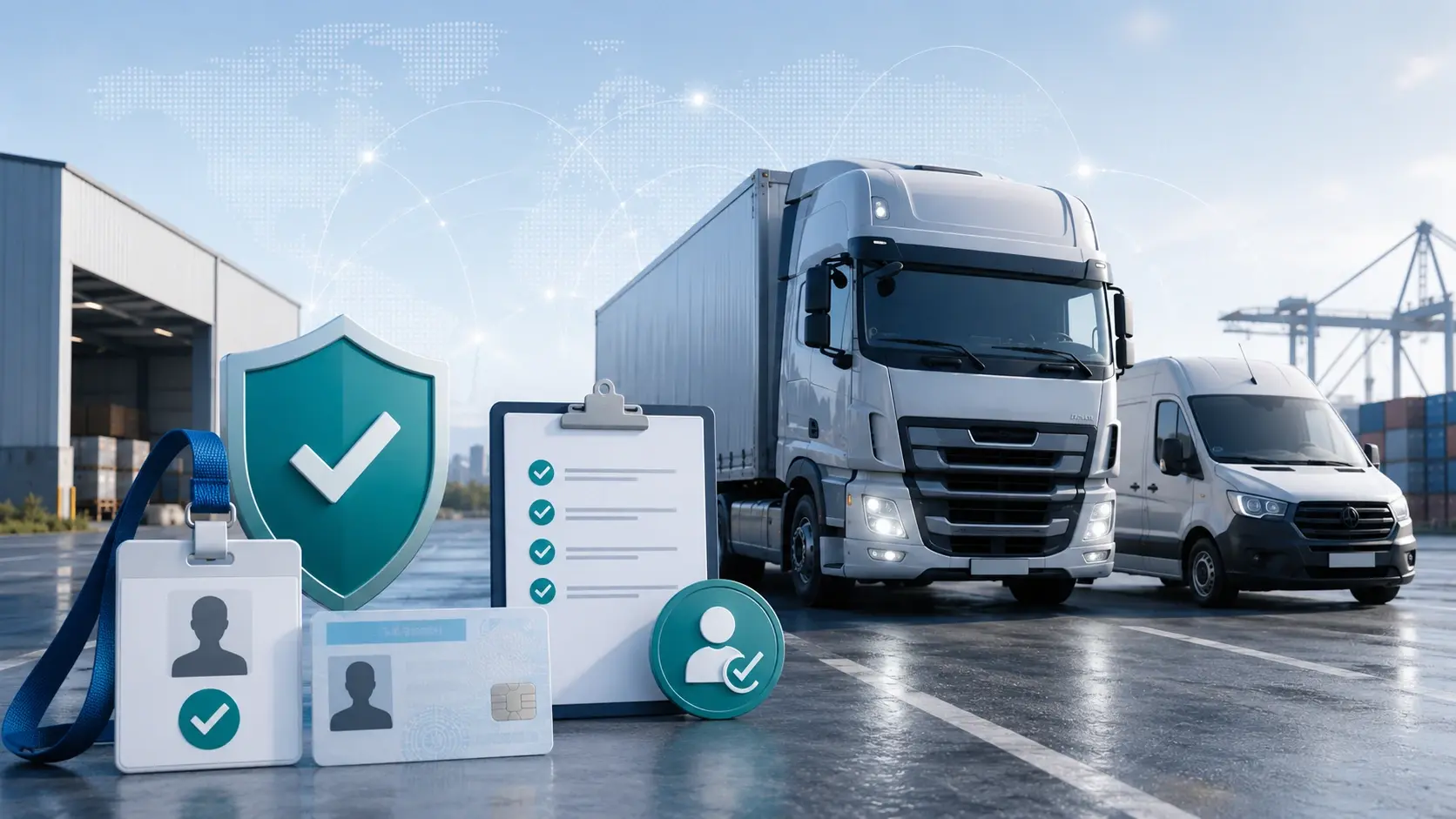
Identity verification in the transport industry is the process of confirming that drivers, couriers, and logistics workers are who they claim to be before they are granted access to vehicles, cargo manifests, or platform accounts. It combines document authentication, biometric face matching, and AML screening against global watchlists.
Why identity fraud has escalated in transport and logistics
Identity fraud is not a new problem for transport, but the scale and method have shifted sharply. Criminal networks now use altered identity documents, synthetic identities, and stolen credentials to bypass onboarding checks across freight, ride-hailing, and last-mile delivery. The financial damage that follows is measurable and growing.
Freight and cargo theft driven by stolen identities
Cargo theft losses in 2025 reached an estimated $725 million, a 60% jump from the previous year. A growing share of those thefts involved identity impersonation, with carriers presenting false credentials to collect freight they were never authorized to handle. When a company relies on unverified paperwork to approve a driver and cargo pickup, a manipulated license or forged registration document opens the door to losses running well into the hundreds of thousands per incident.
Account sharing and ghost drivers on delivery platforms
Platforms running last-mile delivery face a different version of the same problem. Gig economy platforms rank stopping multi-account creation as their top fraud priority. In practice, account sharing means a verified driver sells or rents their profile to someone who has not passed background or identity checks. A delivery driver identity checks platform that lacks continuous biometric re-verification cannot catch this shift once an account is live and rated.
How does identity verification work across transport sub-sectors?
Driver identity verification solutions serve different operational needs depending on the sub-sector. Fleet-based transport runs high-volume onboarding with documentation-heavy checks. Ride-hailing prioritises speed of approval and continuous re-verification. Logistics and delivery sit in the middle, requiring both document depth and real-time checks at the point of job acceptance.
Fleet driver onboarding and license checks
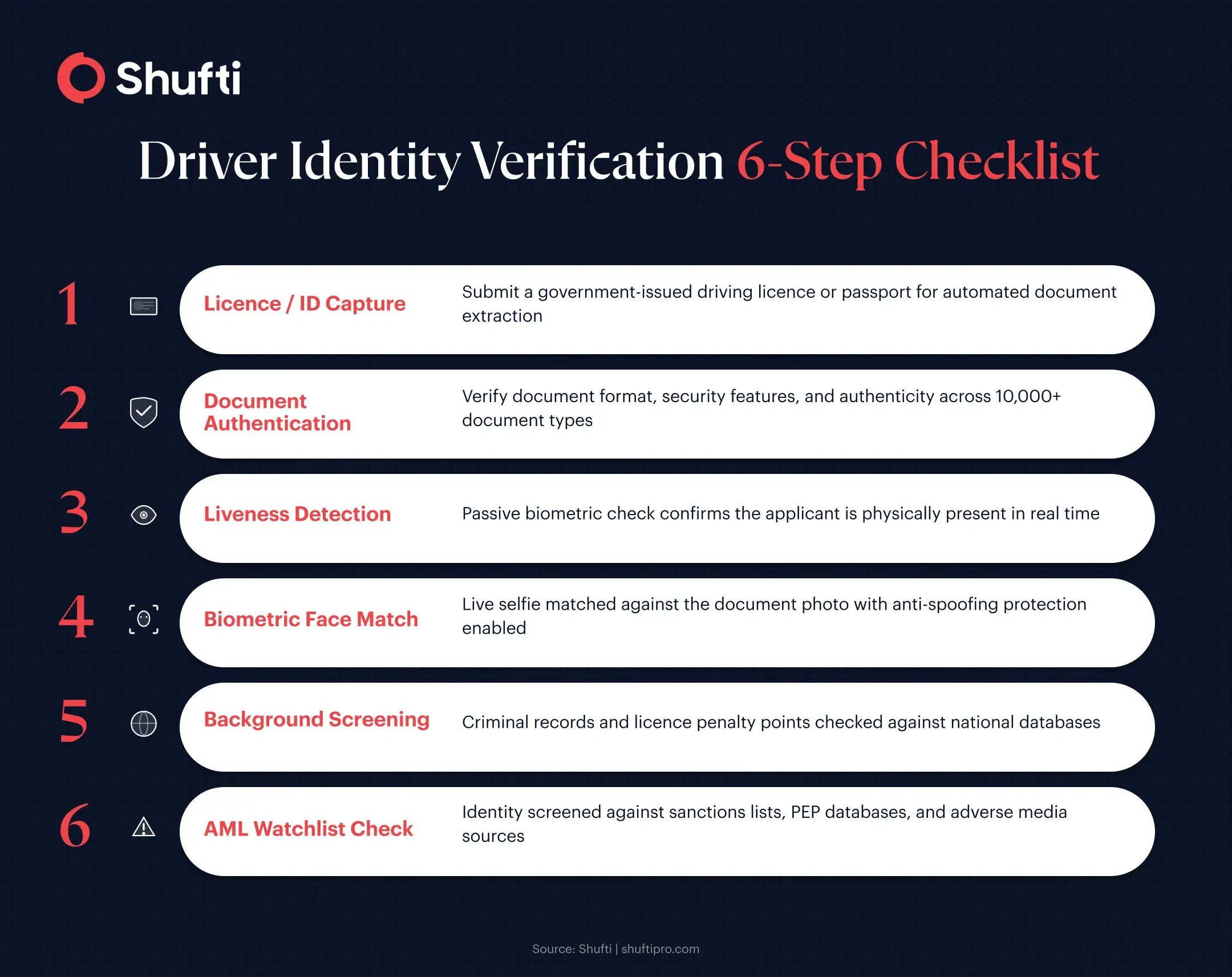
Fleet driver onboarding identity checks typically involve document submission, biometric matching, and AML screening run in sequence. The driver submits a government-issued license and supporting photo ID for automated extraction and authenticity verification across more than 10,000 document formats. A biometric selfie is matched against the document photo using liveness detection to confirm the applicant is physically present rather than submitting a photo of a photo. The identity is then cross-checked against sanctions lists, PEP databases, and adverse media sources to satisfy transport industry AML KYC compliance obligations.
Ride-hailing platform KYC and Driver Onboarding
Ride-hailing platform KYC identity verification runs faster than fleet onboarding because platform growth depends on a short approval cycle. A driver submits a license, proof of vehicle registration, and a biometric selfie during sign-up. A real-time driver ID verification app processes these within seconds using automated document reading and passive liveness detection, so the driver does not need to follow gesture-based instructions or re-attempt under variable lighting. Once approved, periodic re-verification checks confirm that the account holder and the person accepting rides are the same individual, not a substitute operating under a shared profile. Earlier coverage on safeguarding ride-hailing services covers the broader trust and safety architecture for these platforms.
Logistics worker identity verification and onboarding
Logistics worker identity verification onboarding adds a right-to-work document layer not typically required on consumer-facing ride-hailing apps. Warehouse operators and freight companies verify that a worker’s identity matches their employment record and that they do not appear on sanctions or adverse media lists that would create regulatory exposure. For cross-border logistics, the check maps to the applicable framework, covering EU requirements under the Electronic Identification, Authentication and Trust Services Regulation (eIDAS 2.0), UK digital identity standards under the Data (Use and Access) Act 2025, or local licensing requirements. The identity check is also the point where biometric identity verification for transport workers catches document alterations that manual review would miss under time pressure.
What compliance requirements govern driver identity checks?
Transport company identity verification compliance is not uniform across markets. The obligations differ by sub-sector, jurisdiction, and worker classification, but several baseline requirements apply across most markets. Ride-hailing platforms, fleet operators, and freight carriers each sit under different regulatory frameworks.
AML and KYC obligations in transport
Transport industry AML KYC compliance applies most directly to platforms handling financial flows between drivers and the platform, including payouts, passenger payment settlement, and freight invoicing. The Financial Action Task Force (FATF) risk-based approach requires companies, as of 2025, to assess the money-laundering risk of each user type and apply proportionate verification controls. For these platforms, this means screening workers against global sanctions lists and PEP databases at onboarding and at defined intervals thereafter. Platforms that skip ongoing screening are exposed when a previously clean account is later flagged. AML screening that runs continuously against updated watchlists closes that gap without adding friction to the driver’s day-to-day experience.
Document requirements for transport driver verification
The documents required for a driver identity verification solution vary by role and jurisdiction, but a standard set covers most scenarios. A primary government-issued photo ID, typically a national driver’s license or passport, anchors the identity claim. Proof of vehicle registration and insurance follows for ride-hailing and freight drivers. For goods vehicles above a certain weight, an operator’s licence is required in the UK under the Driver and Vehicle Standards Agency (DVSA) Business Plan 2025–2026. A biometric selfie matches the applicant to their document photo, and a background check covers criminal records and licence penalty points. Platforms onboarding drivers across multiple markets use document verification technology to automate extraction and authenticity checking across all these formats simultaneously, cutting the manual review queue without reducing document coverage.
How Shufti helps transport companies verify drivers
Transport platforms face a specific identity verification challenge. Onboarding volume is high, document types vary across markets, and a single fraudulent driver who passes initial screening creates both liability and operational damage. Manual review cannot keep pace.
Shufti’s identity verification runs document authentication and biometric face verification in under 15 seconds across 10,000+ document types in 240+ countries. Passive liveness detection removes the need for drivers to follow gesture prompts, which reduces drop-off on mobile onboarding flows. The platform screens verified identities against 100,000+ AML data sources and 3,500+ global watchlists so transport companies meet their sanctions and PEP obligations without building a separate screening stack. For platforms onboarding drivers across jurisdictions, the result is a single integration that handles document variety, biometric fraud defence, and compliance in one flow.
Frequently Asked Questions
Q: How does identity verification work for transport and logistics companies?
Transport companies run automated document checks and biometric matching to confirm a driver's identity before platform access is granted. The process verifies document authenticity, matches a live selfie to the document photo, and screens the identity against AML watchlists. Most checks complete in under 30 seconds.
Q: Why do ride-hailing platforms need driver identity verification?
Ride-hailing platforms carry liability if an unverified driver causes harm to a passenger. Identity checks at onboarding confirm the driver is who they claim to be, and periodic re-verification detects account sharing where a verified profile is used by an unscreened substitute.
Q: What is the role of biometric identity verification for transport workers?
Biometric identity verification for transport workers confirms that the person presenting an ID document is physically present and matches the document photo. Liveness detection blocks spoofing attempts using printed photos, video replays, or digitally injected face images.
Q: How can transport companies prevent driver identity fraud?
Transport companies prevent driver identity fraud by combining automated document authentication with biometric face matching and AML watchlist screening. Continuous re-verification triggered by account behaviour changes catches fraud that a one-time document upload at onboarding would miss.
Q: What are the compliance requirements for driver identity checks?
Requirements vary by market, but most jurisdictions expect document verification, biometric confirmation, and AML watchlist screening for workers handling passengers or high-value cargo. The FATF risk-based approach and EU eIDAS 2.0 framework set the baseline obligations for international transport operators.