



 Face Verification
 Address Verification
 Document Verification
 Age Verification
 VideoIdent
 Fast ID
 Docless Verification
 Consent Verification
 NFC Verification
 Business Verification
 Due Diligence
 Investor Verification
 E-Signature

 QES
QES
 AML Screening
 Transaction Monitoring
 Adverse Media
 Business AML Screening
 PEP & RCA
 Sanctions
 Watchlist
 Behavioural Biometrics
 Device Fingerprinting
 Biometric Face Authentication
 MFA
MFA
 Fraud Hub
 Onboarding
 Ongoing Monitoring
 KYC
KYC
 KYB
KYB
 KYI
KYI
 Age Assurance
 Identity Verification
 Workforce IAM
 Candidate Verification
 Compliance
 Fraud prevention
 Trust & safety
 Global expansion
 Product Managers
 Compliance Officers
 Fraud Analysts
 Developers
 Deepfake
 Bonus Abuse / Promotion Abuse
 Account Takeover
 Synthetic Identity Fraud
 Document Fraud
 Impersonation Fraud
 Multi-Accounting
 Fraud Networks
 Chargeback Fraud
 Money Mule Activity
 Party Fraud
 Regulatory & Compliance Risks
 Fintech
 Crypto
 iGaming
 Forex
Forex
 Social Network
 Marketplace
 Banking
 Gig Economy
 Payments
 Ride Hailing
 Adult Content
 Blind Spot Audit
 Deepfake Detector
 Liveness Spoofs
 Document Originality
 Document Deepfake
 Global Trust Platform
 Journey Builder
 Case Management
 Shufti AI
 Fraud Analytics
 Vendor Comparison
 Brand Personalisation
 AI Compliance Co-Pilot
 OCR
OCR
 Secure Capture
 Deployment Options
 Identity Methods
 API Documentation
 Mobile SDKs
 Service Status
 Help Center
 Contact Us
 Technical Support
 Supported Documents
 Supported Countries

 Content library
 Blogs
Blogs
 News
News
 Reports
 Insights
 Knowledgebase
 ROI calculator
 About
About
 Career
 Press Release
 Certifications
 Partnership
 Awards
 Events & Webinar
 Interactive Demo
 Podcast Studio
 Spotlight Studio
Seamless Identity Verification for Gig Economy Platforms
- 01 Why GIG Platforms Cannot Afford Weak Identity Checks
- 02 How does identity verification work for gig economy platforms?
- 03 What documents are needed for gig worker identity verification?
- 04 How compliance is reshaping gig platform identity checks
- 05 Where Shufti fits in gig platform identity checks
TL;DR
- Identity verification helps gig platforms prevent fraud, account sharing, impersonation, and fake worker profiles while improving user safety.
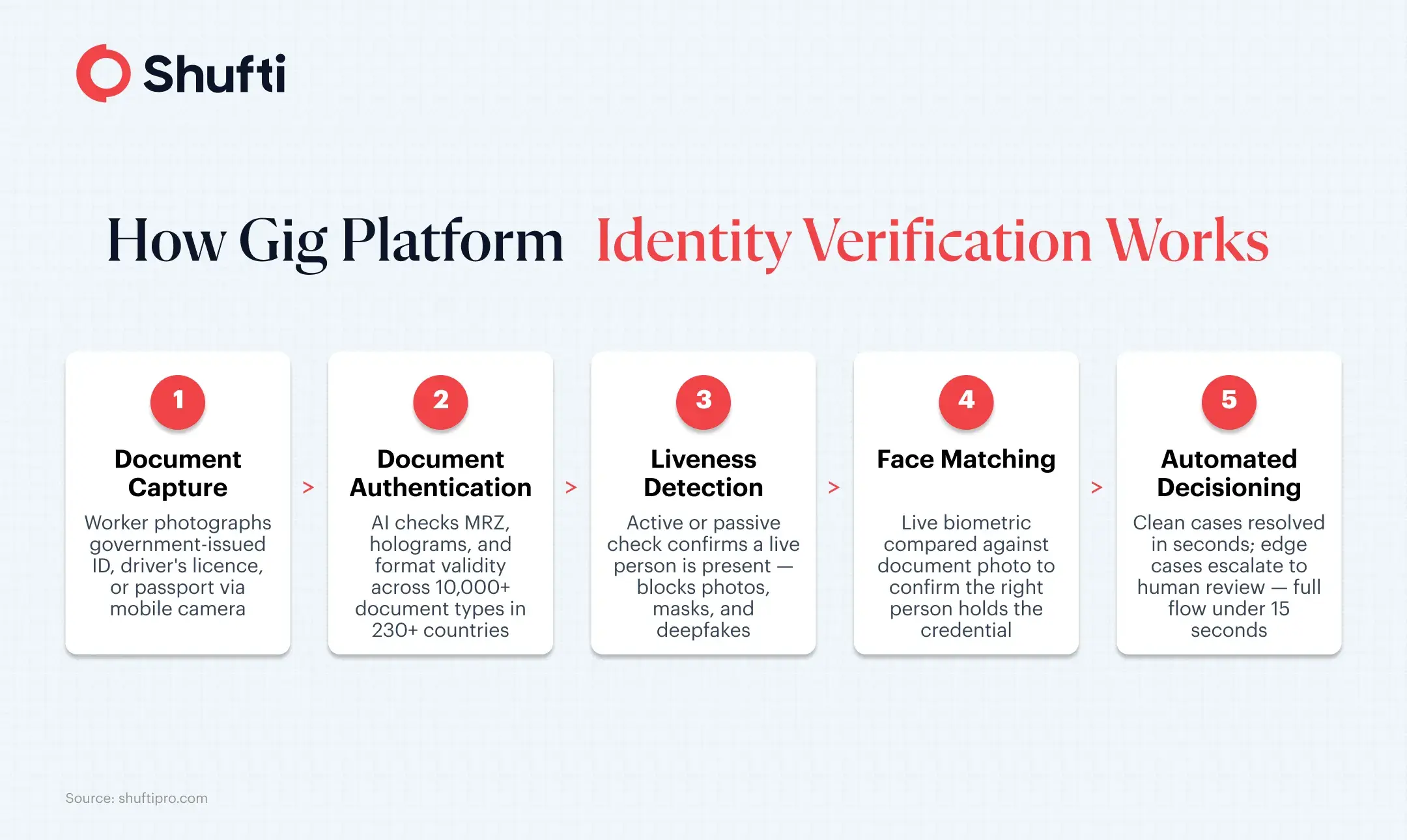
- Secure onboarding combines document verification, biometric face matching, and liveness detection to verify workers in under 15 seconds.
- Ongoing re-verification at high-risk events, such as new device logins or account changes, helps detect account sharing after onboarding.
- Different gig roles require different verification documents, with higher-risk services often needing additional background and right-to-work checks.
- Compliance with regulations such as the EU Platform Work Directive and regional background check requirements is driving stronger identity verification practices.
- A unified identity verification solution enables fast onboarding, reduces fraud, supports regulatory compliance, and builds trust across gig economy platforms.
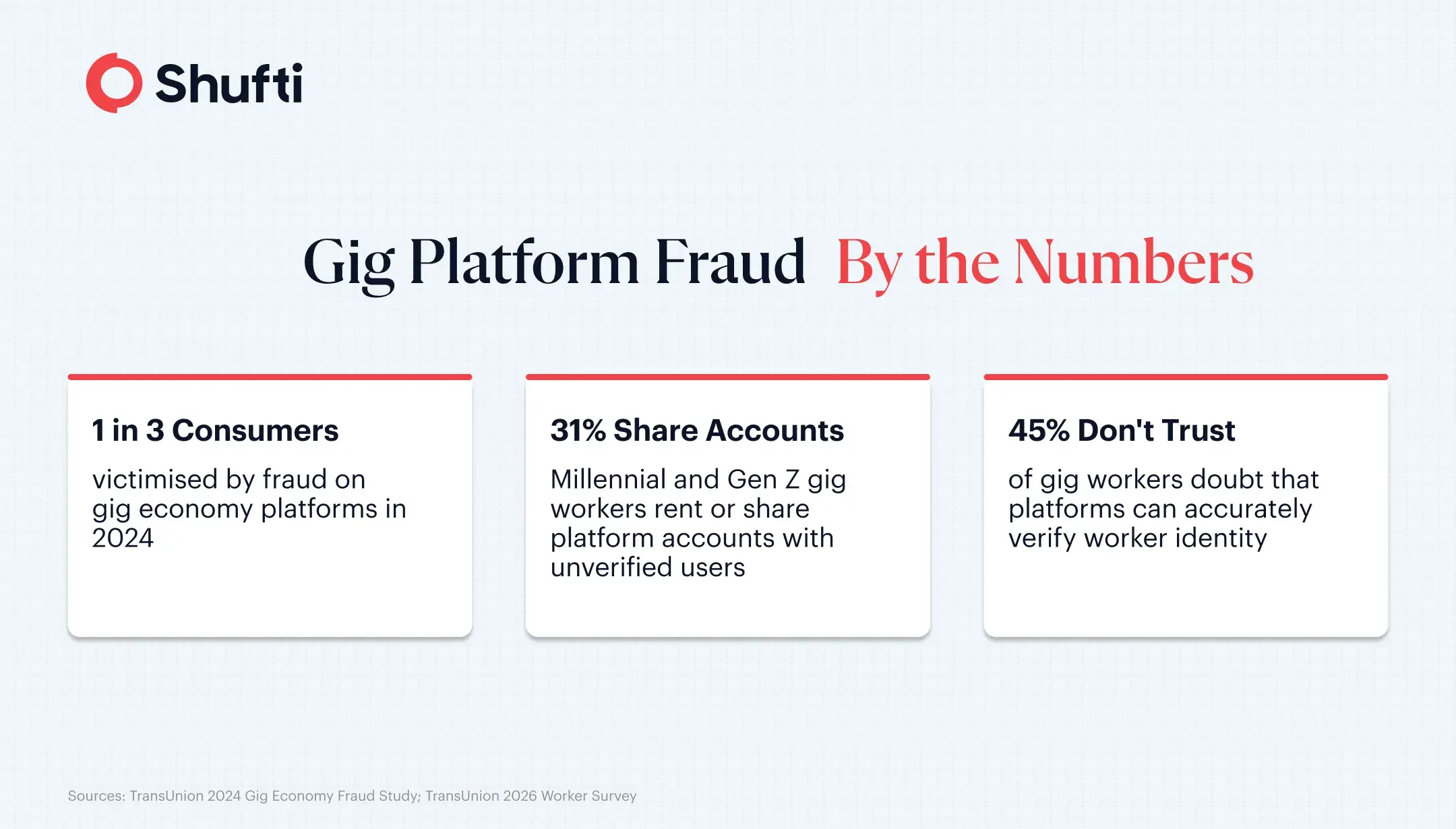
One in three consumers has been defrauded on a gig economy platform. TransUnion’s 2024 research put that figure on record. Gig platforms, covering ride-hailing, food delivery, freelance marketplaces, and home services, sit at a particular junction of risk. High volumes of new workers, intense onboarding pressure, anonymous transactions, and no physical touchpoint make the fraud surface wide. The regulatory exposure is growing alongside it. Getting identity verification right is not optional for any platform in this space.
Why GIG Platforms Cannot Afford Weak Identity Checks
Weak identity checks create compounding exposure. Every unverified driver, unconfirmed courier, or anonymised freelancer is a risk vector for passengers, clients, and the platform itself. The question has shifted from whether to verify to how to do it without losing applicants in the process.
The fraud exposure on gig platforms
The numbers frame the problem clearly. One in three consumers using gig platforms reported being victimised by fraud in 2024, according to TransUnion. The threat profile includes identity theft, synthetic identities, and impersonation, with workers using someone else’s credentials to pass initial screening then operating the platform with no accountability. For delivery and ride-hailing apps, a fraudulent driver is a safety liability. For freelance marketplaces, it is a contract and IP exposure. For home services, it is a background-check gap with direct physical consequences for clients.
Account sharing and the verification confidence gap
A 2026 TransUnion study found that 31% of Millennial and Gen Z gig workers had rented or shared their platform accounts with unverified users. Nearly half, 45%, doubted that platforms could accurately verify worker identity. These figures point to a specific failure mode in gig worker account sharing identity checks. The initial onboarding check does not extend to session-level accountability. A worker passes document verification at sign-up, then hands their account to someone who has not been checked at all. The platform records a verified session. The actual person acting is unverified. Gig economy fraud prevention identity verification that stops at registration closes only half the gap.
How does identity verification work for gig economy platforms?
When the industry talks about seamless identity verification, gig economy platforms are describing a precise set of requirements. The check must be fast enough that workers do not drop off during sign-up, and accurate enough that fraud cannot get through. The components that determine whether a system meets both criteria run in sequence, largely invisible to the applicant.
Document capture and authentication
The flow starts with a document capture. The worker photographs a government-issued ID, a driver’s licence, or a passport. This is not simply an image upload. A capable freelancer platform KYC identity verification system runs a full authenticity check against that image, including MRZ parsing, hologram analysis, document format validation against 10,000+ known document types across 230+ countries, and tamper detection. The system distinguishes a genuine document from a printed forgery, a screen replay, or an AI-generated fake in seconds. Without this layer, any fraudster with a template image and a printer passes the opening check.
Face verification and liveness detection for gig workers
With the document confirmed, the next step binds a live person to it. This is where biometric identity verification gig workers get concrete. The worker submits a selfie, and the system runs two simultaneous checks, liveness detection and face matching. The liveness detection gig platform verification distinguishes a real person from a photo, mask, or deepfake video presented to the camera. It runs either actively, through a brief gesture prompt, or passively, where the system infers depth and presence from a single frame with no user action required. The face match compares the live biometric against the document photo, confirming the person presenting the document is its actual holder. For delivery platform driver identity verification, this step is what separates a credentialed check from a name lookup.
Automated real-time decisioning
Both layers feed into a unified decision engine. Where the document and the biometric match cleanly, the decision is automated. Edge cases, including a partially damaged document, a low-confidence liveness signal, or a face match score near the threshold, escalate to human review without removing the applicant from the queue. The combined flow runs in under 15 seconds for the majority of applicants. For a platform processing thousands of worker applications daily, that decision velocity is what makes gig platform onboarding identity checks operationally viable.
What documents are needed for gig worker identity verification?
The answer varies by platform type, role risk level, and the jurisdictions in which workers operate. Document requirements are not universal. What a ride-hailing app needs from a driver differs from what a freelance marketplace needs from a copywriter, or a home-services platform needs from a cleaner. The common baseline holds across most gig worker identity verification solutions, but the specifics depend on the risk profile of the role.
Standard accepted documents
For most gig platforms, the core document set includes national identity cards, passports, and driver’s licences. In markets where driver’s licences are the primary credential, delivery platform driver identity verification typically requires a licence alongside vehicle documentation, which means the system needs to verify both the identity document and the professional credential. Document verification systems covering 10,000+ document types in 230+ countries handle the variation in layout, language, and security features without manual configuration per market.
Supplementary checks for higher-risk roles
Home services and care platforms carry a distinct risk profile. The worker enters a private home, which warrants background checks layered on top of identity verification, including proof of address, right-to-work documentation in regulated markets, and in some jurisdictions, criminal record screening integrated into the onboarding flow. The identity layer anchors all of these supplementary checks to a verified person. Without a confirmed identity, a background check returns results that could apply to anyone with the same name. With a biometrically confirmed identity, the background check results attach to a unique, verified individual.
How compliance is reshaping gig platform identity checks
The regulatory baseline for gig platforms is shifting. Compliance now touches worker classification, pre-activation identity checks, and payment monitoring, often under frameworks that were not written with gig platforms in mind but apply to them regardless. The direction of travel is consistent across jurisdictions. More obligation, not less.
EU and UK obligations
The EU Platform Work Directive, adopted by the European Parliament in April 2024, reframes how platforms classify workers. With reclassification comes an expanded set of employer-equivalent obligations, including identity verification and right-to-work checks for workers operating across EU member states. In the UK, Disclosure and Barring Service checks for certain home-services and transportation categories have been an active enforcement priority, with platforms expected to verify worker identity before activating accounts in regulated categories.
US and cross-border compliance
In the US, state-level background check legislation varies by platform category and region. Several jurisdictions impose mandatory pre-activation identity and background checks for ride-hailing and delivery drivers, with requirements differing across states. Cross-border freelance marketplaces face a different compliance map. VAT identification obligations, anti-money-laundering requirements for platforms handling payments, and sanctions screening obligations all activate when freelancers operate in or are nationals of restricted jurisdictions. The map is expanding, not contracting.
Where Shufti fits in gig platform identity checks
Gig platforms stall at two points. The onboarding queue, where friction drops sign-up completion, and the accountability gap, where account sharing passes undetected after initial verification. Both share the same root cause. A verification layer that runs once and assumes the result holds indefinitely.
Shufti’s document verification covers 10,000+ document types in 230+ countries, with automated authenticity scoring that handles the document variation a global platform encounters daily. The face verification layer runs active or passive liveness with a match that closes in under three seconds. For ongoing accountability, the same identity graph supports re-verification at any high-risk trigger, such as account access from a new device, a high-value transaction, or a change in worker status. The combined flow posts a 99.5% pass rate in under 15 seconds.
See how Shufti’s identity verification handles gig worker onboarding at your platforms volume request a demo.
Frequently Asked Questions
What is identity verification for gig economy platforms?
Identity verification for gig economy platforms is the process of confirming a worker is who they claim to be before granting platform access. It combines document authentication and biometric face matching, with liveness detection confirming a real person is present rather than a photo or deepfake.
How long does gig worker identity verification take?
A full document and biometric check, covering document capture, authenticity review, liveness detection, and face matching, completes in under 15 seconds for the majority of applicants. Automated decisioning handles clean cases instantly. Edge cases escalate to human review without removing the applicant from the queue.
What compliance requirements apply to gig platforms for identity verification?
Requirements vary by jurisdiction. The EU Platform Work Directive introduces employer-equivalent obligations including right-to-work checks. In the US, state-level background check legislation varies by platform category. Anti-money-laundering and sanctions screening obligations apply to platforms handling cross-border payments or operating in regulated jurisdictions.
Can identity verification stop account sharing on gig platforms?
Registration-only checks do not catch account sharing that occurs after onboarding. Platforms that build re-verification triggers into their workflow, such as new device access or high-value transaction events, can detect when the active account user no longer matches the verified identity on file.
What documents do gig workers need for identity verification?
The standard set includes a government-issued ID, passport, or driver's licence. For delivery and ride-hailing platforms, a driver's licence also serves as the professional credential. Higher-risk categories, such as home services, may require supplementary documentation including proof of address or right-to-work evidence.