







Most companies that decide to build their own identity verification stack eventually reach the same conclusion, which is that it is more difficult than it looks, takes longer than planned initially, and has higher costs. By the time you’ve licensed document databases, trained a biometric model, sourced AML watchlist data, and achieved the certifications regulators actually care about, a full year has passed, and you’re still not covering half the document types your users submit.
Identity verification services are third-party platforms that handle this entire stack for you. They let businesses confirm a user’s identity through document authentication, biometric face matching, liveness detection, and AML database screening, delivered through an API or SDK that connects directly to your product. Instead of building the infrastructure, you call the service. Your job is to act on the result.
This post dives into the details of what exactly these services include, the working of API and SDK integration, and how the pricing looks in 2026, along with the specific needs in terms of evaluation for AML compliance.
What Identity Verification Services Actually Include?
The term “identity verification” is used to describe everything from a relatively simple document scan to a full-fledged compliance workflow. A contemporary online identity verification service typically has four individuals and unique capacities in one single integration.
Document verification basically validates government-issued IDs using forensic analysis and optical character recognition (OCR). This means checking conformance to MRZ and to ICAO standards, validating holographic elements, detecting physical or any sort of digital changes, and matching the document against a database that is of known templates. Shufti’s document verification covers 230+ countries and processes results in under 2 seconds.
Biometric face verification matches a selfie to the document photo using facial landmark mapping and liveness detection. Liveness is what stops someone from holding a photo in front of the camera. Shufti’s biometric face verification achieves 98.72% accuracy at iBeta Level 1 and Level 2, with a 95% first-attempt capture success rate.
AML screening checks names, entities, and beneficial owners against sanctions regimes, PEP databases, adverse media, and watchlists. The quality depends entirely on how frequently the data is refreshed. Shufti’s AML screening updates every 15 minutes across 215+ sanction regimes and 3,500+ official watchlists.
User data is cross-checked through electronic identity verification (eIDV) against multiple government as well as private databases (credit bureaus, telcos, and utility records) without requiring a physical document.
The practical value of outsourcing is that all four arrive pre-integrated, with certifications already in place. You don’t spend 12 months getting to iBeta. A sanctions data pipeline is not exactly built from scratch.
How Identity Verification APIs and SDKs Actually Work?
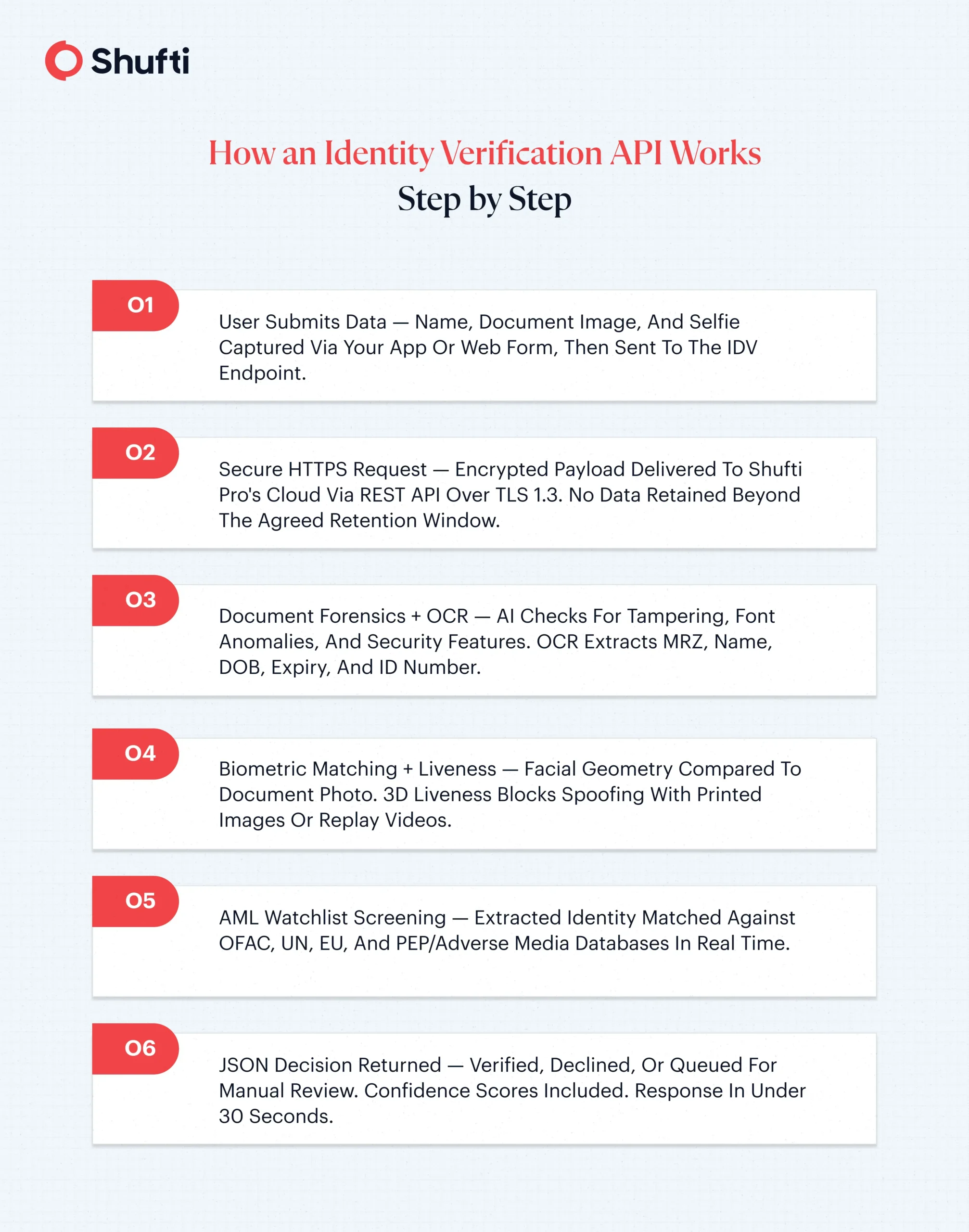
An identity verification API is a programmatic interface that lets your application send user data to an external verification engine, and as a result, it receives a more structured decision back. Your system doesn’t run the checks. It makes a request, the IDV provider processes everything, and you get a JSON response: verified, review required, or declined, with extracted document fields included.
The flow usually works like this once the user provides their ID and selfie through your interface. Your backend, in turn, sends the data to the API endpoint over HTTPS with your authentication token. The engine runs document forensics, biometric matching, liveness detection, and optionally AML screening in sequence. The response comes back. At Shufti, the full cycle completes in under 15 seconds for standard KYC flows on GPU-accelerated infrastructure. OCR processing alone runs in under 2 seconds.
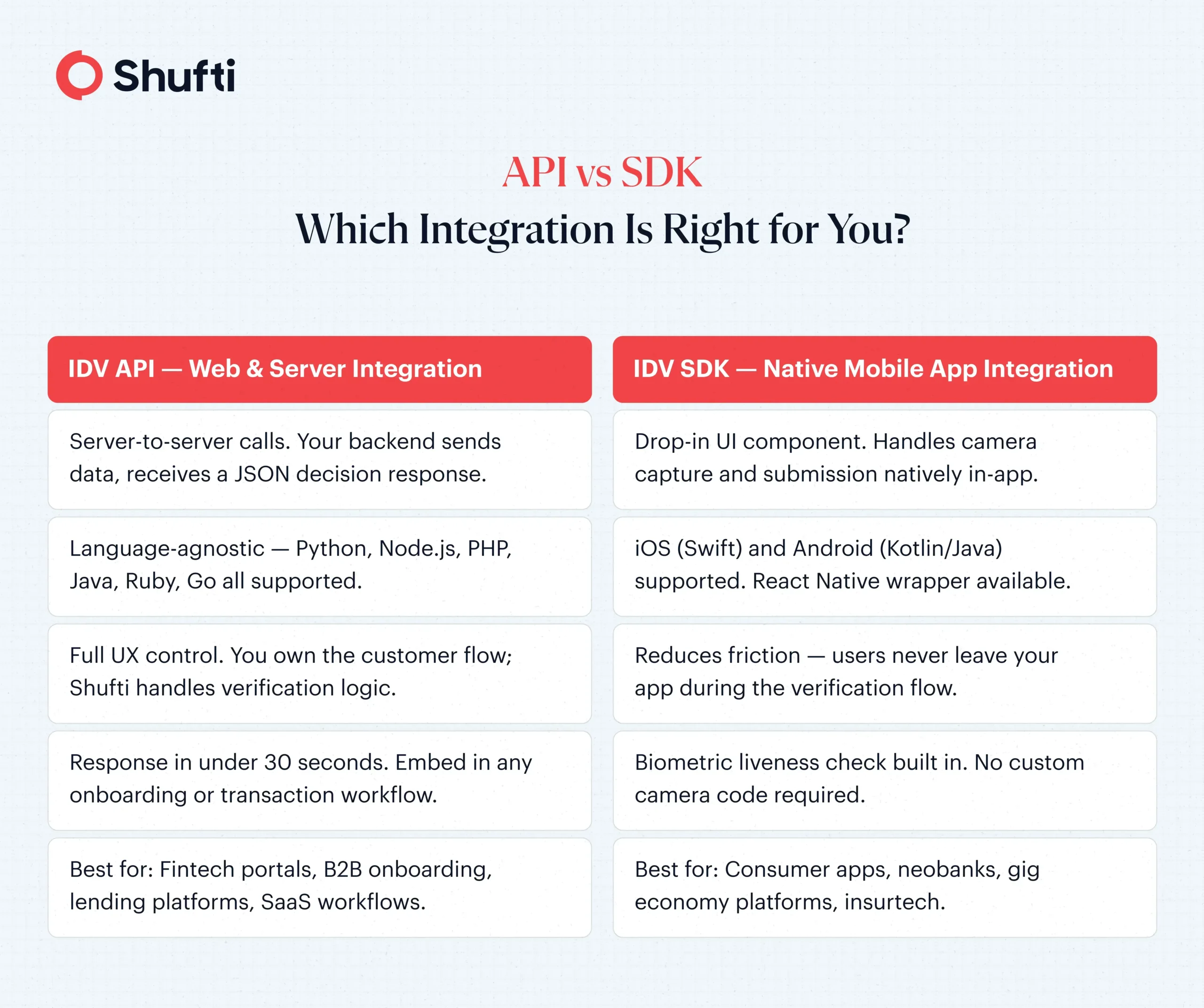
The difference between an API and an SDK is where the user-facing capture happens. An API handles the backend data exchange. You build the capture experience yourself: a webcam interface or file upload for web apps. An SDK goes further. It gives you pre-built mobile camera modules for iOS and Android, real-time guidance telling users to move their ID into frame, automatic glare and blur rejection before the image fully uploads, and face capture with dynamic landmark pre-validation. SDK remains the right path, especially in terms of mobile apps. Most first-attempt success rates are low. For mobile apps, the SDK remains the correct path. An increase in first-attempt success rates is a result of better picture quality, which also plays a role in less user drop-off.
For web app integration, a direct API is usually enough, or you can use Shufti’s hosted verification flow. With the hosted option, users are redirected to a verification link, complete the process, and return to your app with a status callback. Almost no code required. Standard integration time on either path runs under 48 hours.
On testing before go-live: a production-grade IDV API should incorporate a sandbox that mirrors the live environment exactly, with the same response structures, error codes, and webhook payloads. Use it to cover success flows, rejections, biometric mismatches, and AML hits. Then run a considerably small pilot; this should happen before the actual complete launch. Sandbox tests won’t replicate lighting variation or device diversity the way a live pilot will.
What are the Per-Call Costs for Services related to Digital Identity Verification?
For digital identity verification and all the services it relates to, per-verification pricing usually ranges between relatively small amounts per check, which also depends on which services are demanded together and the volume at which a company is running. The three standard models:
| The Pricing Model | Its Working | Best For |
|---|---|---|
| Transaction-based | Pay per verification; per-call cost decreases as the volume increases. | Variable monthly demand |
| Subscription plan | Flat monthly fee with overage charges above the cap. | Predictable verification volume |
| Prepaid credits | Buy checks in advance at a committed rate; credits will follow. | Cost control without a subscription |
What most teams miss at the time of procurement is figuring out the overall costs for false positives. A provider with a lower per-call rate but a high false positive rate usually means a surge in manual reviews, more customer support contacts, and more users abandoning onboarding mid-flow. A system that incorrectly flags 10% of legitimate users creates downstream costs that dwarf the difference in API pricing. The per-call rate is one input. Total verification economics, including manual review amount and onboarding drop-off, remain the actual numbers.
In the case of AML screening specifically, watch how providers package it. Some charge per watchlist check separately. A platform that bundles AML with document verification, along with biometric matching, into a single per-verification rate is almost always more cost-effective in practice.
What Fintech Teams Should Actually Evaluate for AML Compliance in 2026?
In the first quarter of 2025, FATF updated its standards; this was done in order to confirm that digital-first onboarding is no longer classified as inherently high-risk, provided businesses are able to show the quality of their verification controls. The EU AMLA framework, effective mid-2026, tightens ongoing monitoring requirements for high-risk customers. FinCEN beneficial ownership rules continue to require documented identity verification at account opening.
What this means practically: regulators aren’t asking whether you verify users. They’re asking whether you can prove the verification is credible.
Coverage takes precedence over headline country counts. A provider covering 230+ countries for document verification, but only 40 for AML screening, creates gaps that are to be patched manually. AML data refresh rate is a real differentiator: watchlist data updated every 15 minutes versus every 24 hours creates meaningful compliance exposure during high-risk onboarding windows.
The false positive rate is operationally as important as the detection rate. A system flagging 20% of legitimate customers for manual review creates customer service volume that hinders businesses’ growth. Shufti’s linguistic intelligence engine handles different naming conventions that vary from region to region, transliterations, and fuzzy matching across 80+ languages, keeping false positives low without reducing detection coverage. Audit trails determine whether you can actually demonstrate compliance when a regulator asks.
For identity verification services for fintech, Shufti’s automated KYC solution is able to cover the complete chain in one API call: document authentication, biometric matching, liveness, AML screening, and eIDV. The fraud probability engine synthesises 500+ signals into a configurable risk score. AI identity verification models retrain hourly against adversarial data, which is what keeps the 99.3% true detection rate consistent as fraud patterns evolve.
Shufti holds DHS RIVR 2025 Top Performer recognition, iBeta Level 1 and Level 2 biometric certification, PCI DSS, SOC 2, GDPR compliance, and ISO 27001. For KYC identity verification services in environments that are regulated, those certifications reduce your compliance evidence burden during regulatory reviews significantly.
Explore how Shufti applies to different jurisdictions and onboarding volume. Talk to our team.
The outsourcing of AI identity verification is, for most businesses, the relatively faster and more justifiable option as compared to building in-house. The build timeline, certification overhead, and fraud model maintenance required to match what a dedicated IDV provider offers simply aren’t worth it for companies whose core product is something else.
The criteria that matter aren’t complicated: coverage, AML data quality, false positive rate, certification status, and whether the provider is the owner of the technology it is providing. Per-call pricing and speed are all secondary to those.
Ready to see how biometric identity verification services work end to end? Get started with Shufti today and have live verifications running in under 48 hours.
Frequently Asked Questions
What is an identity verification service?
An identity verification service is a third-party platform that lets businesses confirm a user's identity through document authentication, biometric face matching, liveness detection, and AML watchlist screening, delivered via API or SDK without the business running the underlying infrastructure themselves.
How does an identity verification API work?
You send user data (ID image, selfie, personal details) to the provider's API endpoint. The engine does its required tasks: document forensics, biometric matching, and watchlist checks; it then returns a JSON response with the relevant verification outcomes and collected document fields. A standard KYC flow typically completes in under 15 seconds.
What is the difference between an API and an SDK for identity verification?
An API handles the data exchange between your backend and the verification engine. An SDK adds pre-built camera modules and capture UI for native mobile apps, improving image quality and first-attempt success rates. Web apps use the API; mobile apps benefit from the SDK.
How much does an identity verification API cost per call?
Per-verification pricing typically ranges from $0.30 to $1.50, depending on volume and which checks are bundled. Providers offering document verification, biometric matching, and AML screening in a flat per-call rate are usually more cost-effective than those pricing each component separately.
What should fintech companies prioritise when choosing KYC identity verification services?
Prioritise AML data quality (update frequency and sanctions breadth), false positive rate, audit trail capability, and the provider's regulatory certifications. These determine your compliance posture far more than API speed or per-call pricing.