




 Face Verification
 Address Verification
 Document Verification
 Age Verification
 VideoIdent
 Fast ID
 Docless Verification
 Consent Verification
 NFC Verification
 Business Verification
 Due Diligence
 Investor Verification
 E-Signature

 QES
QES
 AML Screening
 Transaction Monitoring
 Adverse Media
 Business AML Screening
 PEP & RCA
 Sanctions
 Watchlist
 Behavioural Biometrics
 Device Fingerprinting
 Biometric Face Authentication
 MFA
MFA
 Fraud Hub
 Onboarding
 Ongoing Monitoring
 KYC
KYC
 KYB
KYB
 KYI
KYI
 Age Assurance
 Identity Verification
 Workforce IAM
 Candidate Verification
 Compliance
 Fraud prevention
 Trust & safety
 Global expansion
 Product Managers
 Compliance Officers
 Fraud Analysts
 Developers
 Deepfake Detection
 Bonus Abuse / Promotion Abuse
 Account Takeover
 Synthetic Identity Fraud
 Document Fraud
 Impersonation Fraud
 Multi-Accounting
 Fraud Networks
 Chargeback Fraud
 Money Mule Activity
 Party Fraud
 Regulatory & Compliance Risks
 Fintech
 Crypto
 iGaming
 Forex
Forex
 Social Network
 Marketplace
 Banking
 Gig Economy
 Payments
 Ride Hailing
 Adult Content
 Blind Spot Audit
 Deepfake Detector
 Liveness Spoofs
 Document Originality
 Document Deepfake
 Global Trust Platform
 Journey Builder
 Case Management
 Shufti AI
 Fraud Analytics
 Vendor Comparison
 Brand Personalisation
 AI Compliance Co-Pilot
 OCR
OCR
 Secure Capture
 Deployment Options
 Identity Methods
 API Documentation
 Mobile SDKs
 Service Status
 Help Center
 Contact Us
 Technical Support
 Supported Documents
 Supported Countries
 Content library
 Blogs
Blogs
 News
News
 Reports
 Insights
 Knowledgebase
 ROI calculator
 About
About
 Career
 Press Release
 Certifications
 Partnership
 Awards
 Events & Webinar
 Interactive Demo
 Podcast Studio
 Spotlight Studio
EUDI Wallet: Is Your Identity Stack Ready for It?

-
Add us as a Preferred Source
- 01 TL;DR
- 02 What is the EU Digital Identity (EUDI) Wallet?
- 03 What the eIDAS 2.0 timeline actually requires of you
- 04 How wallet-based verification changes your onboarding flow
- 05 Where most identity stacks will break in the wallet era
- 06 Where Shufti fits in wallet-based onboarding
TL;DR
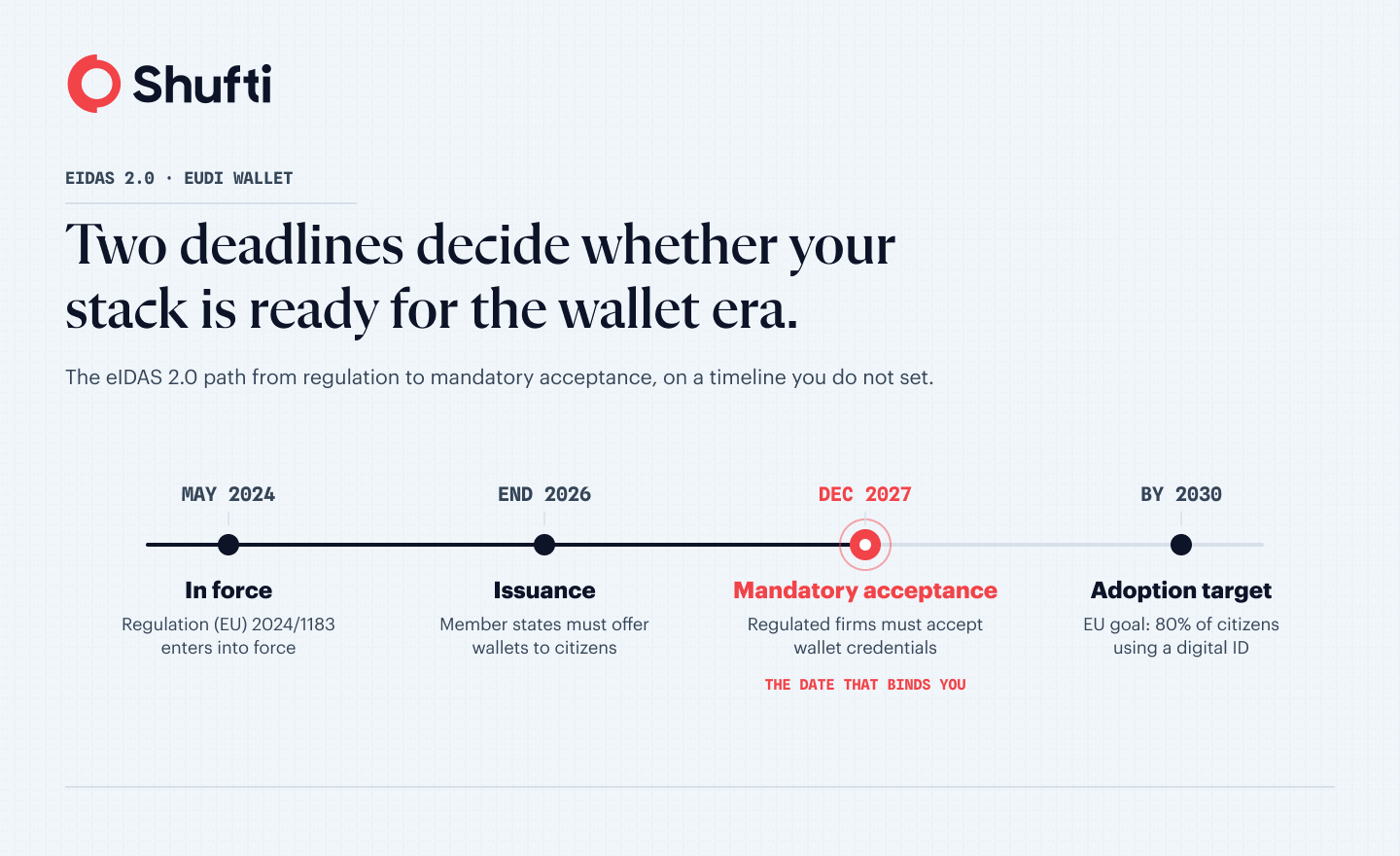
- EU member states must offer EUDI Wallets to citizens by the end of 2026.
- Regulated relying parties must accept wallet credentials by December 2027.
- Wallets shift onboarding from document capture to credential presentation.
- Stacks built only for ID-photo upload will need a verification path rebuilt.
- The EU targets 80% of citizens using a digital ID by 2030.
In May 2024, the EU put a hard date on digital identity. Regulation (EU) 2024/1183 took effect, and with it every member state took on an obligation to offer citizens an EU Digital Identity (EUDI) Wallet by the end of 2026. A year after that, regulated institutions have to accept those wallets at onboarding. For anyone who runs a verification flow in Europe, that second date is the one that matters. It moves the wallet out of a government roadmap and into your onboarding stack, on a timeline you do not set. The question is no longer whether wallet-based identity arrives. It is whether the verification path you run today can accept a wallet credential the moment a customer presents one.
What is the EU Digital Identity (EUDI) Wallet?
The EUDI Wallet is a free mobile app, issued or certified by each EU member state, that lets a citizen or resident store verified identity credentials and share them on demand. Instead of photographing a passport at every signup, the user presents a pre-verified credential straight from the wallet, and the relying party reads only the attributes it needs. The wallet runs on the eIDAS 2.0 framework, carries credentials at the highest assurance level, and works across borders. A wallet issued in Spain has to be accepted by a regulated service in Germany. That portability is the whole point of the design.
What the eIDAS 2.0 timeline actually requires of you
eIDAS 2.0 sets two deadlines that matter to a verification team, and they land a year apart. The first is an obligation on governments. The second is an obligation on you. Reading them as a single event is the most common planning mistake, because the gap between issuance and mandatory acceptance is exactly the window you have to prepare.
The issuance deadline (end of 2026)
By the end of 2026, all 27 member states must make an EUDI Wallet available to any citizen or resident who wants one, free of charge and without forcing adoption. Use is voluntary for the individual. That means wallets start appearing in your onboarding funnel during 2026 as states roll out, well before any acceptance mandate binds you. Early adopting markets will produce wallet-carrying users first, so a flow that cannot read a credential will simply show those users an upload screen they did not need.
The acceptance deadline for regulated relying parties (December 2027)
About one year after issuance, regulated relying parties have to accept the EUDI Wallet as a valid means of identification. That covers banks, telecoms, and other regulated sectors named in the regulation. If you onboard customers in one of those sectors, accepting a wallet credential stops being a product choice and becomes a compliance requirement by December 2027. The build, the testing, and the trust-registry integration all have to be finished before that date, not started on it.
How wallet-based verification changes your onboarding flow
Wallet-based verification replaces a capture step with a presentation step, and that single change ripples through the rest of the flow. In a document flow, the user supplies raw evidence and your stack does the forensic work. In a wallet flow, the evidence arrives already verified by a trusted issuer, and your stack shifts from proving the document to validating the credential. Both paths still end in a risk decision. They just start from very different inputs.
From document capture to credential presentation
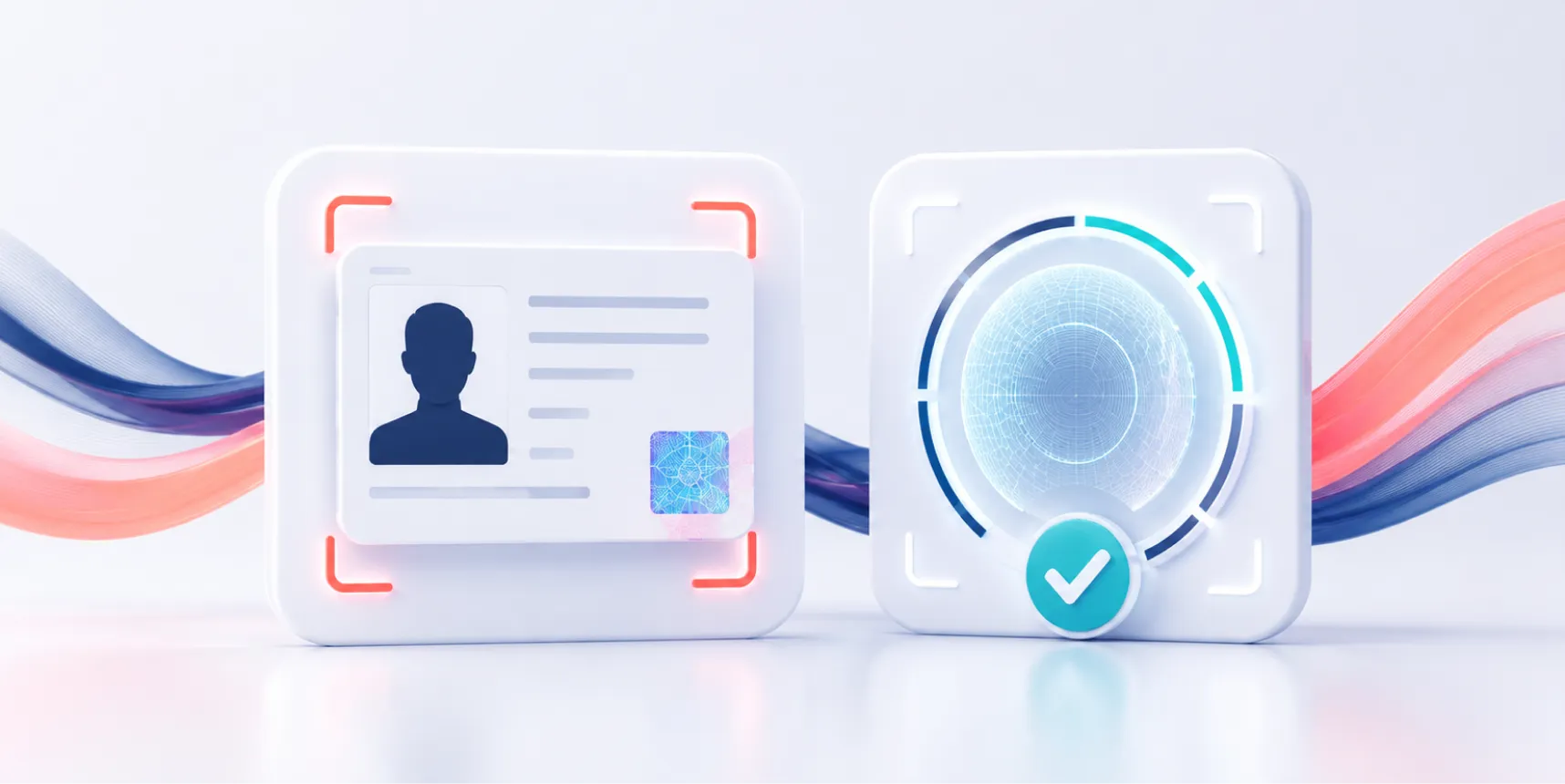
In today’s flow, a user photographs an ID, your forensic layer authenticates it, and a biometric check ties the document to the person. In a wallet flow, the user taps to share a credential the issuer already verified, and the heavy document forensics drop out of that path. Onboarding can land in seconds because the assurance work happened once, at wallet issuance, rather than at every signup. For the user, the upload friction disappears. For you, the verification logic moves upstream.
What still has to happen behind the wallet
The wallet removes document capture, not your obligation to verify. You still have to confirm the credential is authentic, check that it was issued by a trusted source, read only the attributes you are entitled to, and run the credential holder through sanctions and PEP screening where the regulation applies. A presented credential answers who the person is. It does not answer whether you can onboard them. Anti-money-laundering checks, age rules, and risk scoring all still run after the wallet hands over its data.
Where most identity stacks will break in the wallet era
Most identity stacks will not fail at reading the wallet. They will fail at the seams around it, where wallet users and document users meet the same flow. The teams that struggle in 2027 will mostly be the ones that treated the wallet as a swap rather than an addition.
Treating the wallet as a replacement, not an additional rail
The wallet is a new rail, not a replacement for the ones you run today. Adoption is voluntary, coverage builds gradually toward the EU goal of 80% of citizens using a digital ID by 2030, and your non-EU customers will never present one. A stack rebuilt only for wallets strands everyone without one. The durable design accepts a wallet credential when offered and falls back to document and biometric verification when it is not, through the same decisioning layer, so one risk policy governs both.
Losing the fallback path for non-wallet users
The fastest way to break onboarding in 2027 is to route every user toward the wallet and leave a dead end for those who decline. A tourist, a new resident without a national scheme, or a customer who simply prefers not to use the app all still need to onboard. If your wallet path and your document path are two disconnected systems, you cannot prove both belong to the same risk decision, and your audit trail fragments at exactly the point a regulator will probe. The fallback has to be a first-class path, not an afterthought.
Where Shufti fits in wallet-based onboarding
If you onboard across Europe, the wallet era hands you two jobs at once. You have to accept EUDI Wallet credentials before December 2027, and you have to keep verifying everyone who does not present one, without running two disconnected systems. Most stacks were assembled rail by rail, so adding a wallet path means bolting another component onto a flow that already strains at the seams.
Shufti was built for the full identity spectrum through one integration. The same eIDV layer that accepts EUDI Wallet credentials under eIDAS 2.0 also runs traditional document verification when a customer has no wallet, so both routes resolve through one decisioning layer and one audit trail. One platform. Fully owned technology. Global coverage with real local depth.
Map your wallet-readiness gap against a live flow rather than a slide deck book a demo.
Frequently Asked Questions
Is the EUDI Wallet mandatory for businesses?
Holding a wallet is voluntary for individuals, but accepting one is not for many businesses. Under eIDAS 2.0, regulated relying parties such as banks and telecoms must accept the EUDI Wallet as a means of identification by December 2027. Unregulated businesses can choose to accept it but face no acceptance mandate.
Will the EUDI Wallet replace document verification?
No. Wallet adoption is voluntary, coverage builds gradually toward 2030, and customers outside the EU will not carry one. Document and biometric verification stays essential as the fallback path for everyone without a wallet, which is why most stacks will need to run both routes through one decisioning layer.
When do companies have to accept the EUDI Wallet?
Regulated relying parties named in eIDAS 2.0 must accept the EUDI Wallet by December 2027, about a year after member states begin issuing wallets at the end of 2026. The gap between those two dates is the window businesses have to build and test their acceptance flow.
What is the difference between eIDAS and eIDAS 2.0?
The original eIDAS regulation, from 2014, recognised national electronic identification schemes across borders but left adoption uneven. eIDAS 2.0, Regulation (EU) 2024/1183, adds the EUDI Wallet as a single user-held credential every member state must offer, raising both interoperability and the assurance level across the EU.