AMLR Solutions
 AMLR Consultation
 Onboarding
 Ongoing Monitoring
 FRAML
FRAML KYC
KYC KYB
KYB KYI
KYI Age Assurance
 Workforce IAM
 Candidate Verification
 Account Takeover
 Bonus/ Promotion Abuse
 Chargeback Fraud
 Deepfake
 Document Fraud
 Fraud Networks
 Impersonation Fraud
 Money Mule Activity
 Multi-Accounting
 Party Fraud
 Regulatory & Compliance Risks
 Synthetic Identity Fraud
 Adult Content
 Banking
 Crypto
 Fintech
 Forex
Forex Compliance
 Fraud prevention
 Trust & safety
 Global expansion
 Compliance Officers
 Developers
 Fraud Analysts
 Product Managers
 Advanced Journey Builder (AJB)
 Global Trust Platform
 Customer Profiles
 Vendor Comparison
 IDV Case Management
 AML Case Management
 Regulatory Reporting
 Travel Rule Protocols
 Agentic Rule Builder
 AI Compliance Co-Pilot
 Fraud Analytics
 Fraud Hub
 OCR
OCR Shufti AI
 Bank Account Verification
 Biometric Duplication
 Database Checks
 Document Intelligence
 Government ID
 Mobile Driver's License
 NFC
NFC Selfie Liveness
 Brand Personalisation
 Deployment Options
 Identity Methods
 IDV Modes
 Multi-tenancy
 On-Premise IDV
 Secure Capture













Ask a fintech onboarding lead what’s blocking their B2B funnel and you will hear the same answer in three different words. The intake form for a new business customer sits somewhere between a tax return and a scavenger hunt. Analysts chase certificates of incorporation, re-key ownership data into spreadsheets, and wait days for a reply from a registry in a country they have never filed against. One ops lead on a recent call put it plainly. Manual process is a bottleneck, very time consuming, and it restricts how many new sellers they can bring onboard.
KYB automation is the fix that gets pitched whenever that line comes up. The claim sounds clean. Pull the registry, extract the ownership structure, screen the people behind the business, and make a decision. In practice the story is messier. Some parts of that KYB workflow automation perform cleanly and save real weeks of analyst time. Others still need a human looking at the screen, particularly when a shell company sits three layers deep or a director shares a name with someone on a sanctions list. This piece walks through both, with the 2026 regulatory picture sitting on top.
What is KYB Automation?
Automated KYB verification is the machine-run version of the checks a compliance analyst used to do by hand. Manual approach involves reading incorporation, ownership and license documents, verifying data across official data sources where available and writing the ownership, registration business details in spreadsheets. Manual process take days and is costly. Automated business onboarding KYB is faster and cheaper. The purpose of AI-powered KYB automation is to lower operational cost, increase process efficiency, and enhance user experience with quicker business onboarding.
How KYB Automation Works
The workflow is a short pipeline. A business submits its details. An API call reaches a corporate registry in the country of formation. Incorporation documents, directors, shareholders, and company status come back as structured data. Optical character recognition reads any uploaded documents. The platform walks through the ownership layers until it finds every individual who ultimately owns or controls more than the reporting threshold. Those people run against sanctions lists, politically exposed person databases, and adverse media feeds. A risk score lands on the analyst’s queue with the evidence attached.
The AI part of that pipeline sits in three places. Document extraction needed rule-based OCR a decade ago and now runs on vision models that read layouts, not just text. A Brazilian articles of association and a German Handelsregister extract land in the same normalised schema. Entity resolution connects a director named “R. Schmidt” in the registry with “Rolf Schmidt” on a watchlist without falsely matching every other Rolf. Ownership graph construction climbs through holding companies and nominee directors to find the real UBO instead of stopping at the first corporate shareholder.
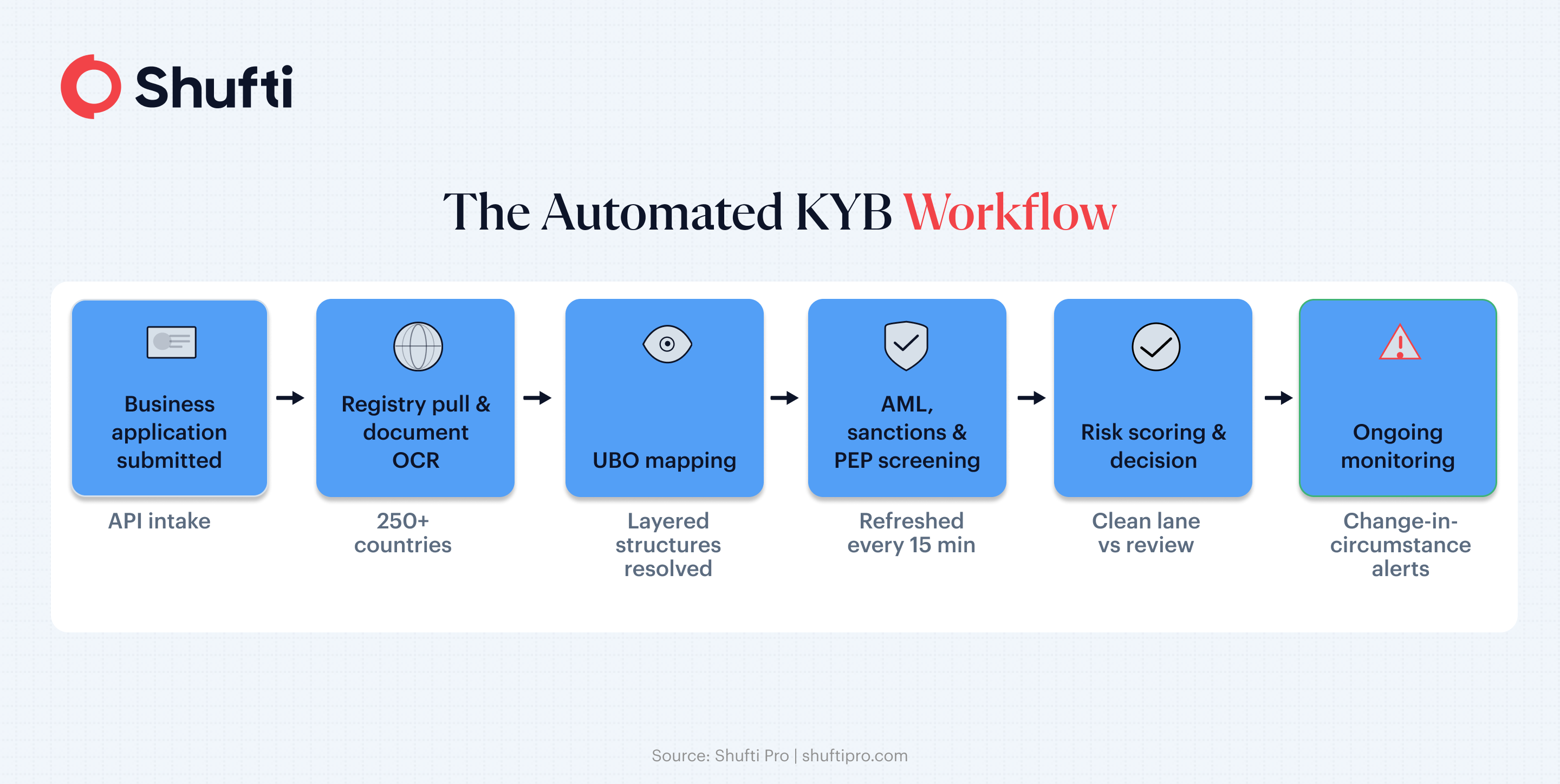
The onboarding time impact is where most of the ROI shows up. A KYB case that used to take five to ten business days of analyst work compresses into minutes for clean applicants and hours for messy ones. Clean applicants automate end-to-end. Messy applicants come pre-packaged for the analyst with the ownership tree already built and the screening hits highlighted.
Why KYB Automation is Essential for Compliance
You cannot talk about KYB without talking about who is checking your work. Three things have moved in the last eighteen months.
In April 2024, the European Parliament adopted the EU AML package, which is now the anchor for corporate transparency across the bloc. AMLD6, the AML Regulation, and the AMLA Regulation harmonise how obliged entities run customer due diligence, centralise beneficial-ownership registers, and create a single EU-level AML authority. For a KYB program in Europe this is the rule set that matters, and the harmonisation removes the country-by-country guesswork that used to make registry coverage feel optional.
March 2025 brought a different signal from FinCEN. The agency issued an interim final rule that narrowed the Corporate Transparency Act’s beneficial-ownership reporting requirement. US-formed entities and US persons are no longer in scope. Only foreign reporting companies have to file. The operational consequence is the opposite of relief. The central FinCEN database that onboarding teams expected to query will not contain data on domestic US entities, so the UBO work has to run on registry data, filings, and your own verification stack.
The UK route is less about new law and more about how the FCA is pricing failure. In December 2022 the regulator fined Santander UK £107,793,300 for AML control failures affecting more than 560,000 business banking customers, with over £298 million passing through the bank before accounts were closed. Several smaller KYB-adjacent penalties have followed. Sloppy onboarding is now expensive in a way that pays for a year of decent automation many times over.
FATF Recommendation 24, the international benchmark, keeps a heavy finger on the scale. Mutual evaluations have repeatedly found that countries struggle to keep beneficial-owner data accurate and up to date, and that anonymous shell companies remain one of the most widely used methods for laundering proceeds of crime. That finding is why ongoing monitoring, not one-off verification, is now the bar.
KYB Automation vs Manual KYB Processes
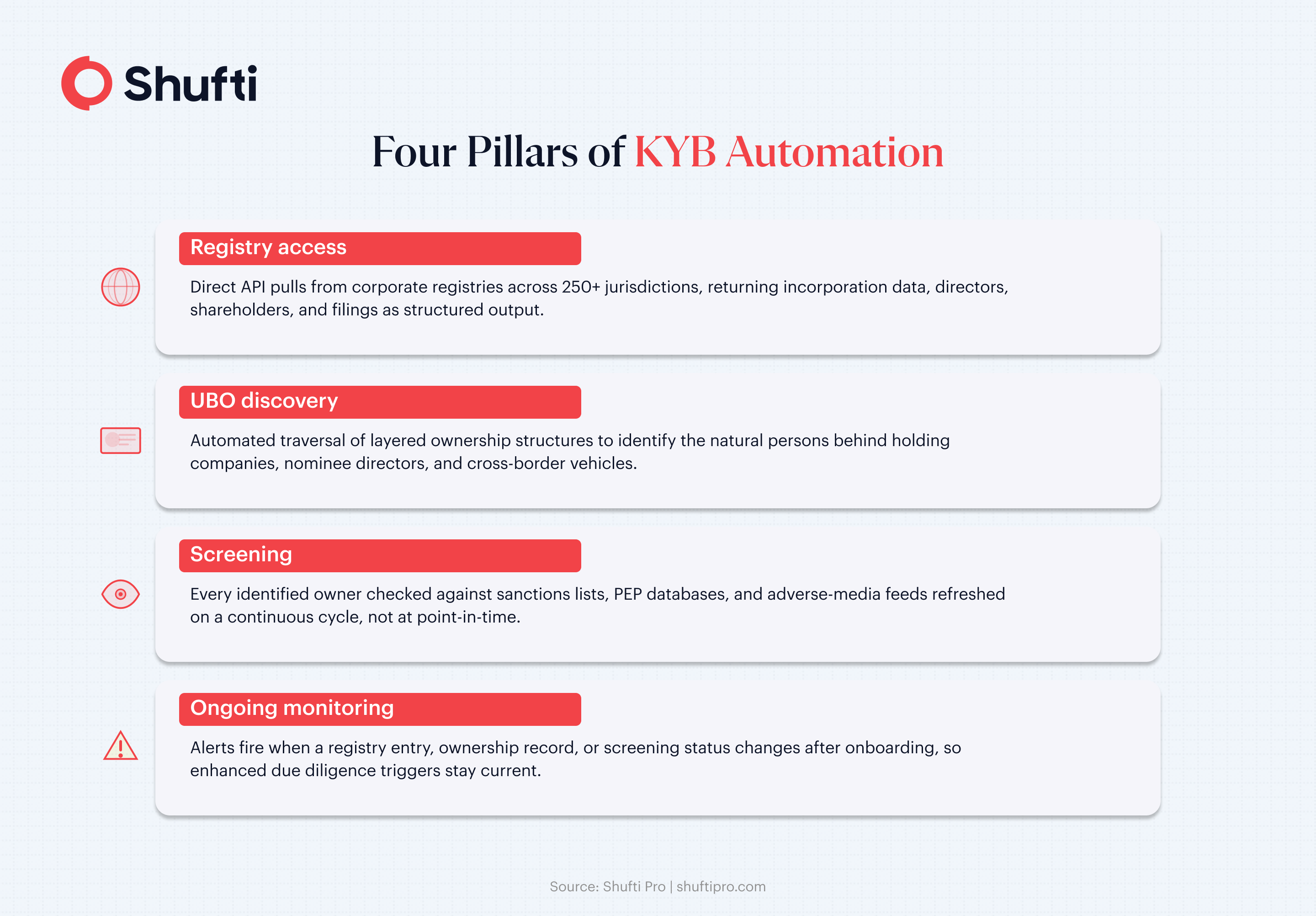
The cleanly automatable parts of KYB are the ones that read like data-engineering problems. Registry pulls, document OCR, director and shareholder extraction, basic sanctions and PEP screening on named individuals, and ongoing monitoring triggers when a registry entry changes or a new adverse-media hit lands. These are repetitive, high-volume, and well-served by business AML screening workflows that run every fifteen minutes against refreshed datasets.
Complex ownership structures are where automation earns the bulk of its keep. An analyst reading a Maltese holding company that owns a Luxembourg vehicle that owns a Delaware LLC will miss an edge or give up and approve. KYB automation tools walk the full graph, flag nominee directors, and surface the natural person at the end of the chain. Edges still need a human eye, particularly trust-owned layers and jurisdictions where registries are paper-only, but the baseline coverage beats hand-built family trees by an order of magnitude.
The pieces that still need human judgement tend to cluster around two things. Risk-based decisions on PEP matches and adverse-media hits rarely survive a rules-only approach, because half of the hits are name collisions and the other half need context about the relationship, the jurisdiction, and the company’s business model. Enhanced due diligence on high-risk clients is the other one. Cases that score above threshold should land with an analyst who reads the file and makes the call, not a confidence score alone.
The risk of fully automating KYB is the risk of skipping that second bucket. A program that auto-approves everything with a clean score will miss structured cases where a real problem hides behind a technically clean file, and the regulatory response when it surfaces is predictable. Automation removes the grunt work. The accountable human still signs off.
How to Automate Your KYB Workflow
A useful sequencing for ops and onboarding leads looks like this. Start with registry coverage that actually covers your target markets, because a tool that handles 50 countries when you sell in 80 is a gap that fills itself with manual work. Map the auto-approve lane against your risk appetite and keep the manual review lane short and well-instrumented. Pick a platform that ties identity verification of directors to ongoing monitoring of the entity, so a change in control does not wait for the annual review. Build a dashboard that tracks how many applications hit each lane per week. That ratio is the honest measure of whether your automation is working, and compliance teams at fintech platforms tend to revisit it quarterly.
Manual KYB breaks the onboarding funnel long before it breaks compliance, and the fix is not a bigger compliance team. Shufti’s Know Your Business automation pulls corporate registries across 240+ countries, maps ownership through layered structures, screens every UBO against sanctions, PEP, and adverse-media data, and keeps monitoring live after onboarding closes. Request a demo to see how it fits against your current B2B funnel.
Frequently Asked Questions
What is automated KYB verification?
Automated KYB verification runs the checks a compliance analyst used to do by hand, as an API-driven workflow. Registry pulls, document extraction, ownership mapping, and sanctions screening happen in a single pipeline. Clean applicants pass through in minutes. Messy ones arrive with the evidence already compiled.
How does AI improve KYB automation?
AI lifts three specific steps. Vision-model OCR reads incorporation documents in any layout and any language. Entity resolution matches directors to watchlist records without a flood of false positives. Ownership-graph construction climbs through holding-company layers to surface the real ultimate beneficial owner.
How do automated KYB tools handle complex ownership structures?
Good tools walk the full corporate graph, layer by layer, resolving intermediate shareholders until they hit a natural person or a publicly listed entity. They flag nominee directors, trust structures, and jurisdictions where registry data is incomplete, so the analyst sees what is known and what still needs a human call.
What are the risks of fully automating KYB checks?
The main risk is losing the human layer on cases that actually need it. Auto-approval on clean scores works well for the bulk of applicants, but enhanced due diligence on PEP hits, adverse media, and high-risk jurisdictions still belongs with an analyst. A program that skips that step will miss structured cases where a file looks clean but the relationship behind it is not.