




 Face Verification
 Address Verification
 Document Verification
 Age Verification
 VideoIdent
 Fast ID
 Docless Verification
 Consent Verification
 NFC Verification
 Business Verification
 Due Diligence
 Investor Verification
 E-Signature

 QES
QES
 AML Screening
 Transaction Monitoring
 Adverse Media
 Business AML Screening
 PEP & RCA
 Sanctions
 Watchlist
 Behavioural Biometrics
 Device Fingerprinting
 Biometric Face Authentication
 MFA
MFA
 Fraud Hub
 Onboarding
 Ongoing Monitoring
 KYC
KYC
 KYB
KYB
 KYI
KYI
 Age Assurance
 Identity Verification
 Workforce IAM
 Candidate Verification
 Compliance
 Fraud prevention
 Trust & safety
 Global expansion
 Product Managers
 Compliance Officers
 Fraud Analysts
 Developers
 Deepfake Detection
 Bonus Abuse / Promotion Abuse
 Account Takeover
 Synthetic Identity Fraud
 Document Fraud
 Impersonation Fraud
 Multi-Accounting
 Fraud Networks
 Chargeback Fraud
 Money Mule Activity
 Party Fraud
 Regulatory & Compliance Risks
 Fintech
 Crypto
 iGaming
 Forex
Forex
 Social Network
 Marketplace
 Banking
 Gig Economy
 Payments
 Ride Hailing
 Adult Content
 Blind Spot Audit
 Deepfake Detector
 Liveness Spoofs
 Document Originality
 Document Deepfake
 Global Trust Platform
 Journey Builder
 Case Management
 Shufti AI
 Fraud Analytics
 Vendor Comparison
 Brand Personalisation
 AI Compliance Co-Pilot
 OCR
OCR
 Secure Capture
 Deployment Options
 Identity Methods
 API Documentation
 Mobile SDKs
 Service Status
 Help Center
 Contact Us
 Technical Support
 Supported Documents
 Supported Countries
 Content library
 Blogs
Blogs
 News
News
 Reports
 Insights
 Knowledgebase
 ROI calculator
 About
About
 Career
 Press Release
 Certifications
 Partnership
 Awards
 Events & Webinar
 Interactive Demo
 Podcast Studio
 Spotlight Studio
KYB For Germany: Navigating the Three Register Compliance Challenge
-
Add us as a Preferred Source
- 01 What is Germany's unique KYB challenge?
- 02 Germany's three-register problem
- 03 What BaFin actually requires for KYB
- 04 Verifying GmbH, AG, and other German legal forms
- 05 AMLD6 Germany business verification: Upcoming Changes
- 06 How Shufti handles German company verification
TL;DR
- Germany’s KYB process is uniquely complex because business verification requires reconciling data from three separate registries: Handelsregister, Unternehmensregister, and Transparenzregister.
- No single registry provides a complete picture, so compliance teams must verify company existence, financial disclosures, and beneficial ownership independently.
- Access to the Transparenz register is restricted following the 2022 CJEU ruling, making UBO verification more challenging for cross-border firms.
- BaFin’s 2025 guidance introduced updated document validity periods, risk-based review cycles, and upcoming inconsistency reporting requirements for UBO data.
- Different German legal entities (GmbH, AG, KG, GbR, sole proprietorships) require different verification approaches, with some businesses falling outside standard registry coverage.
- AMLD6 will further tighten Germany’s KYB requirements through 2027, expanding beneficial ownership transparency and compliance obligations.
- Automated KYB platforms help organizations streamline multi-registry verification, UBO checks, AML screening, and ongoing monitoring while reducing manual compliance effort.
Germany’s Federal Financial Supervisory Authority, BaFin, published revised guidance on the Geldwäschegesetz (GwG) in February 2025, tightening review cycles for high-risk business clients and updating document validity rules for corporate customer due diligence. For compliance teams running Know Your Business Germany programmes, it was one more update to absorb in a jurisdiction that was already structurally fragmented before the change took effect.
Germany’s KYB challenge is not about regulatory severity. The GwG maps to EU Anti-Money Laundering Directives in ways broadly comparable to most other member states. The difficulty is that the data infrastructure behind business verification in Germany is distributed, partially restricted, and inconsistent across multiple systems. This article explains what makes German company KYB verification complexity a category problem of its own, what BaFin requires from obliged entities, and what a reliable KYB compliance Germany workflow needs to cover.
What is Germany’s unique KYB challenge?
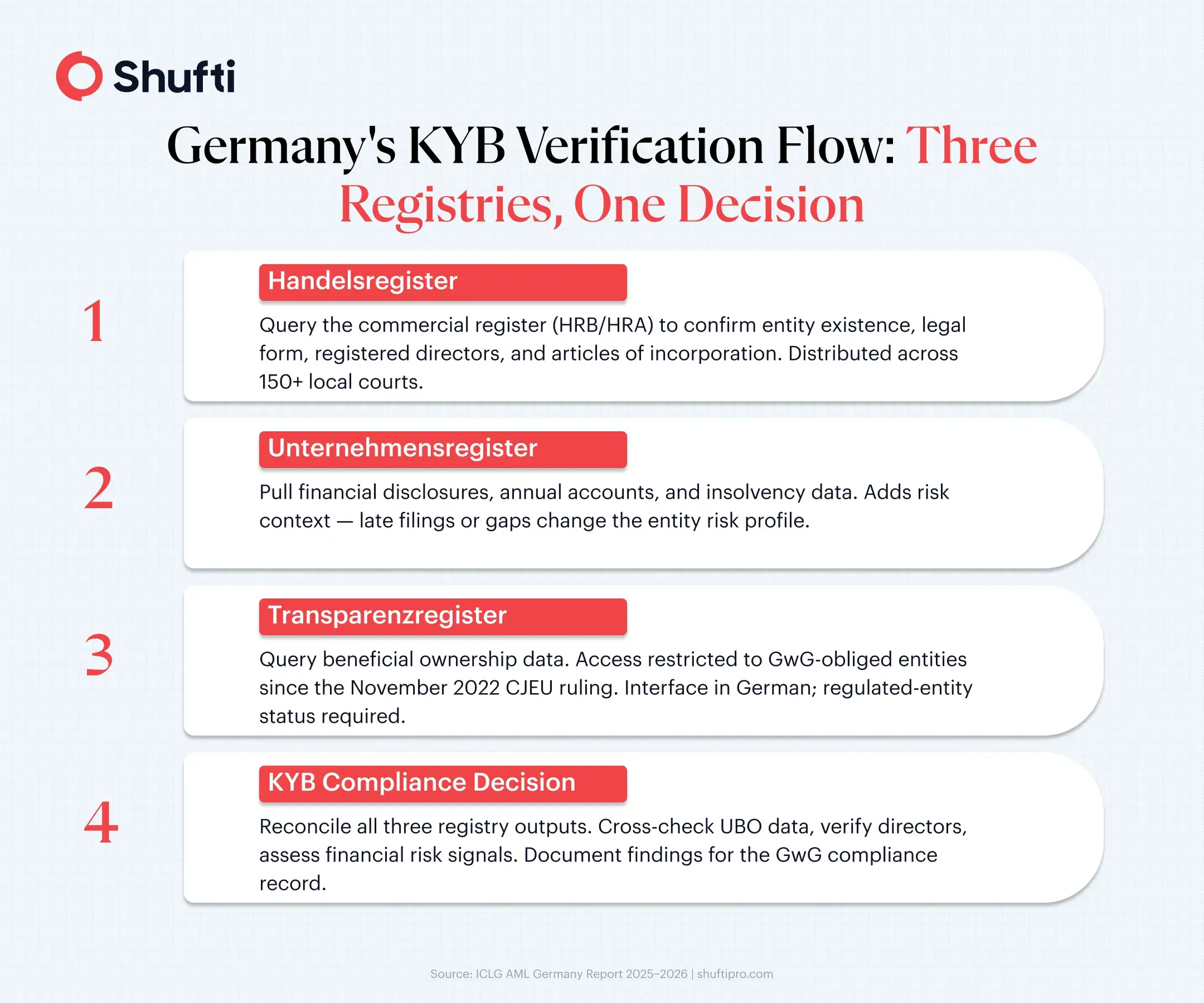
Germany’s unique KYB challenge is structural, not regulatory. Unlike most EU jurisdictions that maintain a single centralised company register, Germany distributes business registration data across three separate systems, each managed by different authorities and each capturing a distinct layer of the corporate picture. Reconciling all three is not optional for compliance teams. Under GwG requirements, it is the minimum threshold for business customer due diligence.
The three-registry architecture
The German Handelsregister business verification system holds records of company existence, legal form, and registered directors, distributed across more than 150 local courts. The Unternehmensregister aggregates financial disclosures, annual reports, and insolvency data filed by German companies. The Transparenzregister Germany KYB system holds beneficial ownership information for German entities, accessible only to GwG-regulated entities and national authorities.
None of these systems link to the others automatically. A compliance team verifying a German business client must query all three independently and then reconcile the outputs. The ICLG AML Germany Report 2025–2026 notes that Germany’s federal structure, with records distributed across more than 150 local courts, produces a registry structure that is fragmented and often slow to reflect recent corporate changes.
The CJEU ruling and restricted UBO access
Before November 2022, Germany’s beneficial ownership registry was partially accessible to the public. A European Court of Justice (CJEU) ruling that month found that unrestricted public access to beneficial ownership data infringed the right to privacy under EU law. Germany subsequently restricted Transparenzregister access to national authorities, GwG-obliged entities, and individuals who can demonstrate a specific legitimate interest.
For firms outside Germany onboarding German business clients remotely, that restriction creates a concrete workflow barrier. The Germany UBO Transparenzregister system now requires firms to confirm their regulated status before querying, and the query interface operates in German. Most cross-border KYB compliance workflows were not designed with that step in mind.
Germany’s three-register problem
The fragmentation across Germany’s three registries creates distinct compliance gaps that surface at different stages of a KYB workflow. Each registry solves one part of the picture and none solves all three. Understanding which question each registry answers, and where each one stops, is the foundation of a workable German KYB process.
The Handelsregister: the starting point, not the endpoint
German Handelsregister business verification confirms that a company exists and identifies its legal form. For Division B (HRB) entities, which include GmbH and AG companies, the register records current managing directors and any amendments to the articles of incorporation. For Division A (HRA) entities such as partnerships operating at commercial scale, it records partners and registered business names.
What the Handelsregister does not provide is beneficial ownership data. A GmbH with five shareholders, one of whom controls a majority through a holding company, will appear correctly in the Handelsregister while revealing nothing about the controlling shareholder without a separate Transparenzregister query. Compliance teams that stop at the Handelsregister have confirmed the entity but not the ownership.
The Unternehmensregister: financial disclosures in a separate silo
The Unternehmensregister aggregates financial disclosures, annual accounts, and insolvency proceedings filed by German companies. For KYB compliance Germany purposes, it adds risk context that the Handelsregister does not carry. A company with multiple years of late or missing filings presents a different risk profile than one with a consistent disclosure history.
The Unternehmensregister is publicly accessible, but it does not link to the Handelsregister’s corporate structure data or to the Transparenzregister’s UBO records. Compliance teams reviewing it have the financial picture without the ownership structure.
The Transparenzregister: access-controlled and slow to update
The Germany beneficial ownership registry requires legal entities to submit UBO entries within a set period of any ownership change. But accuracy depends on the timeliness of those submissions, and enforcement of the obligation has historically been uneven. BaFin’s 2025 guidance introduced an inconsistency notification obligation from 1 January 2026: if a compliance team’s own beneficial ownership checks surface UBO data that differs from the Transparenzregister, they must report that discrepancy. The evidentiary burden sits partly on the obliged entity, not solely on the register’s accuracy.
What BaFin actually requires for KYB
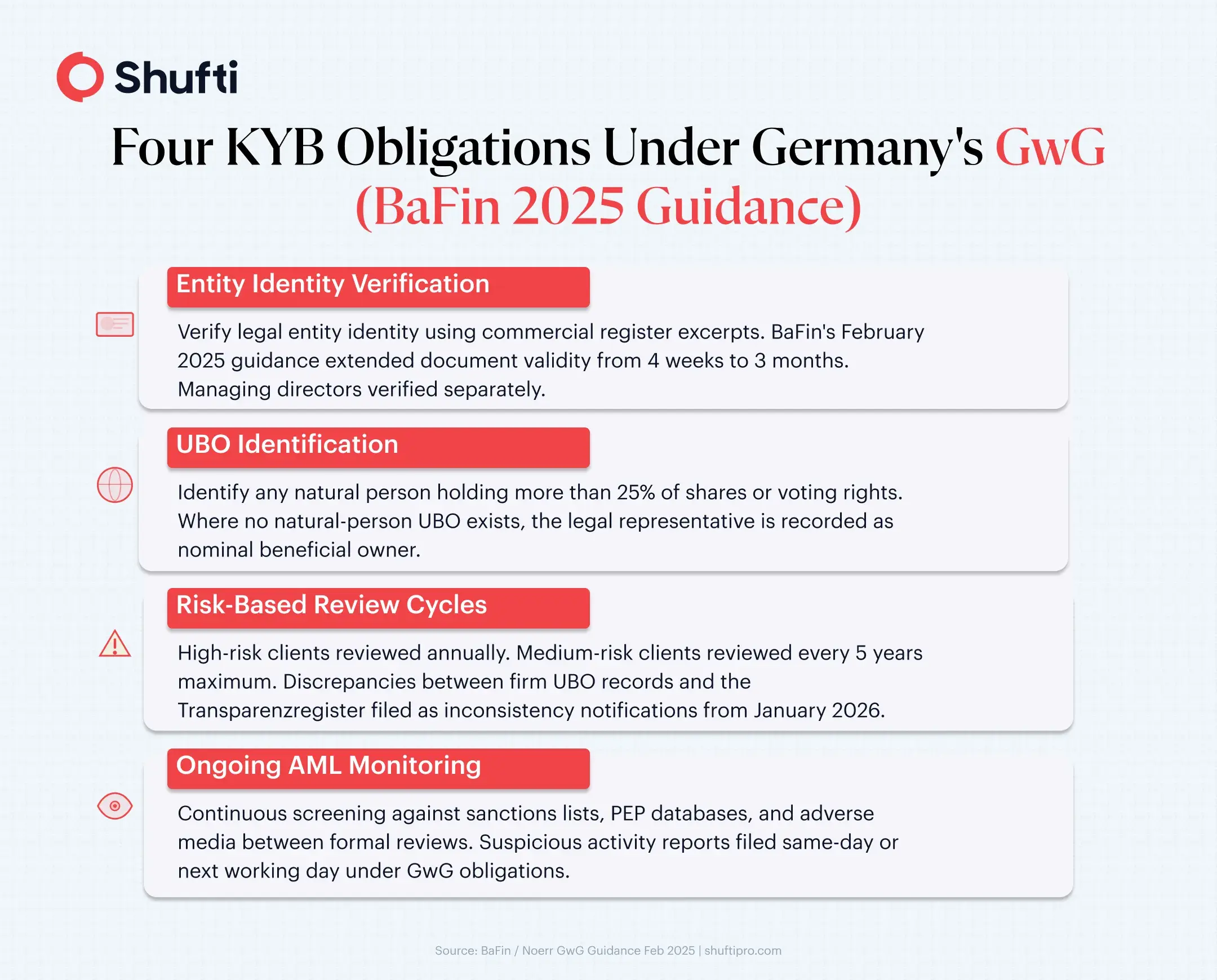
The Germany AML Geldwäschegesetz KYB requirements apply to all GwG-obliged entities. Banks, fintechs, crypto platforms, payment institutions, lawyers, notaries, and accountants operating in Germany all fall within scope. BaFin’s KYB requirements Germany framework is built around four connected obligations that run throughout the business relationship, not just at onboarding.
Entity verification and document standards
Under GwG Section 11, obliged entities must verify a business client’s identity using official documents from the commercial register. BaFin’s February 2025 guidance extended the acceptable age of corporate documents from four weeks to three months, reducing the administrative burden of sourcing fresh register excerpts at every review. Alongside entity-level verification, the identities of managing directors and authorised signatories must be verified separately, which means the KYB workflow does not end when the register excerpt is retrieved.
UBO identification and risk-based review cycles
The GwG defines a beneficial owner as any natural person holding more than 25% of shares or voting rights, or exercising equivalent control by other means. Where no natural-person UBO can be identified through ownership analysis, the legal representative is recorded as the nominal beneficial owner.
BaFin’s 2025 guidance formalised tiered review cycles tied to risk classification. High-risk business clients require annual review. Medium-risk clients face a maximum five-year review cycle. At each review, the Germany beneficial ownership registry must be cross-checked against the firm’s own UBO records, with any discrepancy filed as an inconsistency notification. According to EY’s guidance on Germany’s new UBO obligations, the obligation to notify discrepancies became binding from 1 January 2026. Ongoing AML screening against sanctions lists, PEP databases, and adverse media operates between formal reviews and cannot be treated as a periodic event.
Verifying GmbH, AG, and other German legal forms
Germany has a wide range of legal entity types, and KYB GmbH AG Germany verification behaves differently depending on the form. Not all German businesses carry the same registry footprint, and a significant share falls outside standard registry coverage entirely.
GmbH and AG: the registered core
The GmbH and AG are the most common corporate forms for business clients in financial services, fintech, and B2B platforms. Both must register in Division B of the Handelsregister and maintain UBO entries in the Transparenzregister. For KYB and AML compliance workflows, GmbH and AG are the most accessible German forms to verify, but the three-registry reconciliation still applies in full, and ownership structures involving foreign holding companies often require additional steps to trace the ultimate beneficial owner.
KG, GbR, and sole proprietorships: the gaps in coverage
The Kommanditgesellschaft (KG), civil-law partnerships (Gesellschaft bürgerlichen Rechts, or GbR), and sole proprietorships (Einzelunternehmen) sit in a different position. A GbR is not required to register in the Handelsregister unless it operates at a commercial scale. A GbR with no commercial-scale registration and no Handelsregister entry will not appear in any of the three registries. For automated KYB workflows, this means a meaningful share of smaller German business clients will require direct document collection from the entity and its principals rather than standard registry lookup, and no automated registry check will surface those entities.
AMLD6 Germany business verification: Upcoming Changes
The sixth Anti-Money Laundering Directive (AMLD6) was adopted by the EU on 31 May 2024. It does not replace the GwG directly but sets the framework Germany must follow in updating its national transposition. AMLD6 Germany business verification obligations will require central UBO registers to hold more detailed data and cover a wider range of legal arrangements, including non-EU entities with direct or indirect links to Germany.
Key AMLD6 transposition deadlines
The AMLD6 timeline is phased across three years. Certain beneficial ownership register provisions carry a transposition deadline of 10 July 2025. A broader set of articles relating to register coverage and access rules applies from 10 July 2026. Full directive transposition is required by 10 July 2027. Germany’s inconsistency notification obligation, already binding from January 2026, signals the direction of the broader AMLD6 framework: closer alignment between what the Transparenzregister holds and what regulated entities are required to verify and report.
What this means for compliance teams today
AMLD6 will tighten what Germany’s beneficial ownership register must contain and extend coverage to entity types currently outside scope. For compliance teams that currently reconcile three registries manually, the transition period is the time to assess Germany AML compliance processes and move to automated workflows before the 2027 deadline rather than adapting manual processes that the new rules will stretch further.
How Shufti handles German company verification
Compliance teams running KYB compliance Germany programmes face a specific operational challenge. Three registries that do not communicate with each other, UBO data sitting behind a restricted access layer, and an approaching AMLD6 timeline that progressively tightens the requirements further. Managing that manually, from querying each registry to reconciling outputs, tracking risk-tiered review cycles, and filing inconsistency notifications, creates the kind of backlog that stalls onboarding queues and spreads compliance analysts thin.
Shufti’s business verification platform covers 250+ jurisdictions, including Germany’s multi-registry structure. Registry lookups and UBO traversal across German entity types run automatically. Business AML screening runs against 3,500+ watchlists and 215+ sanctions regimes, with data refreshed every 15 minutes so review cycles stay current without requiring a manual trigger. For German-specific complexity around legal forms such as GmbH, AG, KG, and unregistered GbR partnerships, the workflow adapts to each form’s document requirements rather than applying a single-source lookup that leaves coverage gaps.
See how Shufti’s KYB workflow handles Germany’s three-registry structure on your own client data, book a walkthrough.
Frequently Asked Questions
What is Germany's unique KYB challenge?
Germany's KYB challenge is structural fragmentation. Compliance teams must reconcile data from three separate registries, the Handelsregister, Unternehmensregister, and Transparenzregister, each maintained by different authorities. No single registry source covers company existence, financial disclosures, and beneficial ownership in one place.
What is the Transparenzregister in Germany?
The Transparenzregister is Germany's national beneficial ownership registry, holding UBO data on German legal entities. Since a November 2022 European Court of Justice ruling, access is restricted to GwG-obligated entities, national authorities, and individuals who can demonstrate a specific legitimate interest.
What is the Geldwäschegesetz (GwG)?
The Geldwäschegesetz is Germany's Anti-Money Laundering Act. It implements EU AML directives into national law and sets obligations for regulated entities covering identity verification, UBO identification, risk-based review cycles, and suspicious activity reporting. BaFin supervises GwG compliance across all obliged sectors.
What is BaFin's role in KYB compliance?
BaFin is Germany's Federal Financial Supervisory Authority. It supervises GwG-obligated entities, issues interpretation and application guidance, and can impose administrative fines for compliance failures. BaFin's February 2025 guidance updated review cycle timescales and corporate document validity periods for business customer due diligence.
What is AMLD6 and how does it affect German KYB?
The sixth Anti-Money Laundering Directive, adopted by the EU in May 2024, requires stricter beneficial ownership register coverage and more detailed UBO disclosures. Germany must transpose key provisions by July 2025, 2026, and 2027, progressively tightening what the Transparenz register must contain and what obligated entities must verify.