




 Face Verification
 Address Verification
 Document Verification
 Age Verification
 VideoIdent
 Fast ID
 Docless Verification
 Consent Verification
 NFC Verification
 Business Verification
 Due Diligence
 Investor Verification
 E-Signature

 QES
QES
 AML Screening
 Transaction Monitoring
 Adverse Media
 Business AML Screening
 PEP & RCA
 Sanctions
 Watchlist
 Behavioural Biometrics
 Device Fingerprinting
 Biometric Face Authentication
 MFA
MFA
 Fraud Hub
 Onboarding
 Ongoing Monitoring
 KYC
KYC
 KYB
KYB
 KYI
KYI
 Age Assurance
 Identity Verification
 Workforce IAM
 Candidate Verification
 Compliance
 Fraud prevention
 Trust & safety
 Global expansion
 Product Managers
 Compliance Officers
 Fraud Analysts
 Developers
 Deepfake Detection
 Bonus Abuse / Promotion Abuse
 Account Takeover
 Synthetic Identity Fraud
 Document Fraud
 Impersonation Fraud
 Multi-Accounting
 Fraud Networks
 Chargeback Fraud
 Money Mule Activity
 Party Fraud
 Regulatory & Compliance Risks
 Fintech
 Crypto
 iGaming
 Forex
Forex
 Social Network
 Marketplace
 Banking
 Gig Economy
 Payments
 Ride Hailing
 Adult Content
 Blind Spot Audit
 Deepfake Detector
 Liveness Spoofs
 Document Originality
 Document Deepfake
 Global Trust Platform
 Journey Builder
 Case Management
 Shufti AI
 Fraud Analytics
 Vendor Comparison
 Brand Personalisation
 AI Compliance Co-Pilot
 OCR
OCR
 Secure Capture
 Deployment Options
 Identity Methods
 API Documentation
 Mobile SDKs
 Service Status
 Help Center
 Contact Us
 Technical Support
 Supported Documents
 Supported Countries

 Content library
 Blogs
Blogs
 News
News
 Reports
 Insights
 Knowledgebase
 ROI calculator
 About
About
 Career
 Press Release
 Certifications
 Partnership
 Awards
 Events & Webinar
 Interactive Demo
 Podcast Studio
 Spotlight Studio
The Markets Your KYC Vendor Hopes You Never Expand Into

TL;DR
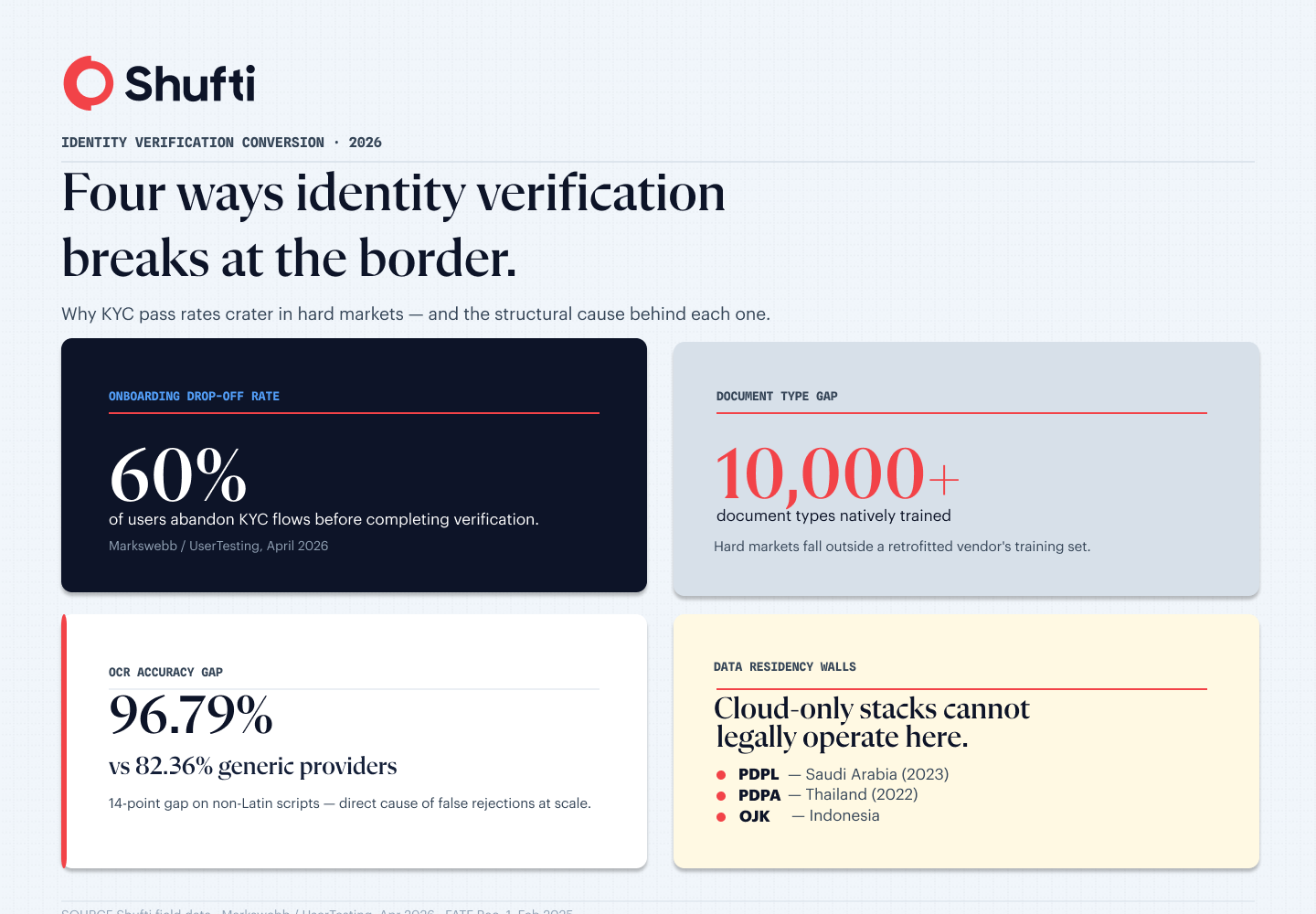
- Up to 60% of users abandon KYC flows before completing identity verification.
- In hard markets, document type gaps and OCR failures push that number even higher.
- Vendors built on Western ID types retrofit non-Latin scripts the difference shows at the border.
- Data residency laws in Saudi Arabia, Thailand, and Indonesia block cloud-only stacks entirely.
- Your KYC conversion rate in APAC or the Gulf reflects your vendor’s training data, not your product.
Your Southeast Asia launch is ready. Licences filed. Marketing live. The product team spent six months localising the UI. Then the first onboarding numbers come in from Jakarta and Ho Chi Minh City, and the drop-off rate is nearly double what you saw in Germany. Support tickets climb. The vendor says it’s a “user education issue.”
It isn’t. It’s a training-data problem that your vendor chose not to surface before you signed the contract.
This pattern plays out every time a fintech or financial services company expands into what the industry calls hard markets Vietnam, Indonesia, Brazil, South Asia, the Gulf and discovers that their identity verification conversion rate, which looked healthy in the West, does not survive the crossing. The failure is not random. It is structural, predictable, and almost entirely a function of how your vendor built their stack. Understanding it before you expand is the difference between a successful market entry and six months of quietly bleeding revenue while your team optimises the wrong variables.
What your KYC conversion rate is actually measuring
KYC conversion rate is the share of users who start an identity verification flow and complete it successfully. Most product teams track completion rate. Fewer track pass rate, the share of users whose documents are accepted on the first attempt. The gap between those two metrics is where hard-market failure hides.
Pass rate vs. completion rate: the metric your vendor conflates
A user who retries their document upload three times before giving up registers as a completion attempt, not a pass. A user who hits a “document not recognised” error on a valid Thai national ID and closes the app registers as a drop-off without explanation. Vendors report completion rate because it looks better. What you actually need to watch is first-attempt pass rate, segmented by document type and issuing country.
The two metrics diverge sharply in markets where the vendor’s document library is thin. A vendor with strong coverage for US driver’s licences and EU passports will show you healthy global numbers until you look at the country-level breakdown. Vietnam, Indonesia, and the Gulf will look different. Sometimes dramatically so.
Where conversion breaks down in a typical verification flow
Identity verification conversion drops at three specific moments: document capture, OCR processing, and biometric match. In Western markets, the most common drop-off point is document capture: lighting, angle, blur. In hard markets, the larger failure is OCR processing, where the model encounters a script or document structure it was not trained on and returns a rejection.
Research published by Markswebb in April 2026, citing UserTesting data, found that up to 60% of users abandon digital account opening flows before completing identity verification. The same research notes that requiring document uploads can reduce conversion by 29% compared to flows that do not. In markets where documents are frequently rejected on the first attempt, these effects compound: you add the rejection friction on top of the baseline abandonment rate, and the result lands well below any reasonable pass-rate target.
Why identity verification breaks at the border
Three structural failure modes account for most of the hard-market KYC conversion loss. None of them is inherent to the market. They are vendor architecture choices.
|
Failure mode |
Root cause |
Markets most affected |
|
Document type gap |
Vendor trained on Western IDs; hard markets fall outside the training set |
Indonesia, Vietnam, South Asia |
|
OCR failure on non-Latin scripts |
Latin-first OCR engine with retrofitted non-Latin support |
MENA, Southeast Asia, LATAM |
|
Data residency walls |
Cloud-only architecture cannot legally process biometric data in-country |
Saudi Arabia, Thailand, Indonesia |
The document type gap
Most identity verification vendors built their document intelligence on a foundation of Western government IDs US driver’s licences, UK passports, German Personalausweis and expanded outward from that base. The result is a library that skews heavily toward document types that were easy to acquire training data for.
A vendor covering 3,000 document types will pass most EU and North American users without incident. That same vendor, deployed in Indonesia, faces over 300 distinct regional ID card variants across the archipelago’s provinces, each with different layouts, security features, and field positions. If those variants are not in the training set, the model rejects documents that regulators and the issuing government recognise as entirely valid.
The failure is invisible in demo environments. Vendors test against their training data. The gap only surfaces at scale, in production, in the specific market you just launched into.
OCR failure on non-Latin scripts
Optical character recognition on non-Latin scripts is a training data problem. Arabic, Thai, Vietnamese diacritics, and Cyrillic all require models that were trained on those specific character forms in the context of identity documents, not on generic text corpora lifted from the web.
Vendors who retrofitted non-Latin OCR onto a Latin-first engine produce models with high accuracy on Latin-script documents and degraded accuracy on everything else. The degradation shows up where it hurts most: name fields that transpose characters, date fields that misread calendar formats, and address fields that fail on diacritic-heavy text.
Shufti’s own field data from emerging market deployments illustrates the gap: proprietary OCR trained natively on non-Latin scripts achieves approximately 96.79% accuracy, compared to 82.36% for generic OCR providers on the same document set. That 14-point difference translates directly into false rejections for legitimate users. At high volume, it compounds into millions of lost onboarding sessions, and millions of dollars in customer acquisition spend that produces no customers.
Data residency walls that make cloud-only stacks illegal
The third failure mode does not show up in pass rates at all, because the vendor’s stack never reaches legal production. Several of the fastest-growing markets require by law that personal data and biometric information stay within their borders during processing.
|
Regulation |
Market |
Active Since |
What it requires |
|
Personal Data Protection Law (PDPL) |
Saudi Arabia |
2023 |
Data localisation for personal data processed in-country |
|
Personal Data Protection Act (PDPA) |
Thailand |
2022 |
Data localisation for biometric data |
|
OJK data regulations |
Indonesia |
Ongoing |
Locally compliant infrastructure for regulated financial institutions |
Saudi Arabia’s Personal Data Protection Law (PDPL), active since 2023, requires data localisation for personal data processed within the Kingdom. Thailand’s Personal Data Protection Act (PDPA), enforced since 2022, applies equivalent requirements to biometric data. Indonesia’s OJK financial services regulator mandates that regulated institutions process customer data through locally compliant infrastructure.
A cloud-only vendor with servers in Ireland or Virginia cannot meet these requirements without building new regional infrastructure or partnering with a local operator. Most do not. The practical result: if you launch in Saudi Arabia or Indonesia with a SaaS-only identity verification stack, your legal and compliance team will eventually discover the architecture is non-compliant, and you will be rearchitecting your verification layer mid-launch, at the worst possible time.
What hard-market expansion failure actually costs
The commercial case against a vendor with hard-market gaps is concrete. Every rejected document is a user who either retries with friction or abandons entirely. Every abandoned session is a customer acquisition cost that produces no customer.
At scale, identity method mismatch compounds the loss further. Users in APAC increasingly rely on national digital identity schemes India’s Aadhaar, Singapore’s Singpass, Thailand’s national e-ID rather than physical document capture. Users in the Gulf hold Emirates ID smart cards with NFC chips that can be verified directly, without a document photo. A verification flow that forces these users into a document-upload path designed for US driver’s licences creates unnecessary friction for people who hold faster, more reliable credentials.
The Financial Action Task Force (FATF) amended Recommendation 1 in February 2025 to strengthen digital identity’s role in financial inclusion, explicitly recognising that rigid document-upload flows exclude legitimate users who hold digital credentials rather than physical IDs. Regulators are moving toward digital-first identity methods. Vendors built around legacy document capture are moving in the opposite direction.
The cost is not just measured in KYC conversion rate. It shows up in customer acquisition efficiency, in lifetime value from high-growth markets that are expanding faster than Western books of business, and in the regulatory exposure that comes with a verification infrastructure that cannot legally operate in markets you are already in. Getting the vendor wrong does not just hurt your onboarding metrics. It costs you the market.
How Shufti handles hard-market expansion
If your users are in Vietnam, Indonesia, Brazil, South Asia, or the Gulf, you have probably already felt the gap this article describes. Most vendors built their document verification on Western training data and retrofitted everything else. The gap shows up exactly where it matters at the moment a legitimate customer presents a valid document and gets rejected.
Shufti’s document intelligence was trained on 10,000+ document types across 220+ countries from the start, with proprietary OCR reading 150+ languages natively and no human fallback for low-confidence reads. Deployment runs as cloud, Local Cloud in-region for GCC and SEA data residency, or fully on-premises for organisations subject to PDPL, PDPA, or OJK requirements, all through a single API integration. Stripe uses Shufti specifically for MENA and APAC documents despite running its own verification capability. Binance relies on Shufti for non-Latin document accuracy across global markets where standard solutions fall short.
One platform. Fully owned technology. Global coverage with real local depth.
See how Shufti’s document intelligence performs on your hard-market documents. Book A Demo
Frequently Asked Questions
What is a good KYC conversion rate?
A healthy KYC conversion rate sits above 85% on a first-attempt basis for your primary markets, though benchmarks vary by document type and jurisdiction. The more useful metric is first-attempt pass rate segmented by issuing country: a global average can mask severe drop-off in specific hard markets while still reading well in aggregate.
Why does identity verification fail more often in Southeast Asia and the Gulf?
The primary cause is document type and OCR training data. Most vendors built their models on Western government IDs and retrofitted non-Latin scripts, producing degraded accuracy on Thai, Arabic, Vietnamese, and Indonesian document variants. Secondary causes include identity method mismatch users with digital IDs or NFC-chip credentials being forced into document-upload flows and data residency requirements that block cloud-only infrastructure from operating legally.
What data residency regulations affect identity verification in APAC and MENA?
The main frameworks are Saudi Arabia's Personal Data Protection Law (PDPL, active since 2023), Thailand's Personal Data Protection Act (PDPA, enforced since 2022), and Indonesia's OJK financial services data regulations. Each requires that personal and biometric data processed in-country remain within approved regional infrastructure. Cloud-only identity verification vendors without local or on-premises deployment options cannot legally serve customers in these jurisdictions.