



 Face Verification
 Address Verification
 Document Verification
 Age Verification
 VideoIdent
 Fast ID
 eIDV
eIDV
 Consent Verification
 NFC Verification
 Business Verification
 Due Diligence
 Investor Verification
 QES
QES
 E-Signature
 AML Screening
 Transaction Monitoring
 PEP & RCA
 Sanctions
 Watchlist
 Adverse Media Screening
 Business AML Screening
 Behavioural Biometrics
 Device Fingerprinting
 1:1 Authentication
 Fraud Hub
 MFA
MFA
 Onboarding
 Ongoing Monitoring
 Age Assurance
 Identity Verification
 KYC
KYC
 KYB
KYB
 KYI
KYI
 Workforce IAM
 Candidate Verification
 Compliance
 Fraud prevention
 Trust & safety
 Global expansion
 Product Managers
 Compliance Officers
 Fraud Analysts
 Developers
 Global Trust Platform
 Case Management
 Journey Builder
 Shufti AI
 Fraud Analytics
 Vendor Comparison
 Brand Personalisation
 IDV Modes
 AI Compliance Co-Pilot
 OCR
OCR
 Secure Capture
 Deployment Options
 Identity Methods
 Banking
 Fintech
 Crypto
 Gaming
 Forex
Forex
 Social Networks
 Marketplace
 Gig Economy
 Payments
 Ride Hailing
 Adult Content
 Blind Spot Audit
 Deepfake Detector
 Liveness Detection
 Document Originality
 Document Deepfake
 Deepfake
 Account Takeover
 Synthetic Identity Fraud
 Document Fraud
 Impersonation Fraud
 Multi-Accounting
 Bonus Abuse / Promotion Abuse
 Fraud Networks
 Chargeback Fraud
 Money Mule Activity
 Party Fraud
 Regulatory & Compliance Risks
 API Documentation
 Mobile SDKs
 Service Status
 Help Center
 Contact Us
 Technical Support
 Supported Documents

 Content library
 Blogs
Blogs
 News
News
 Reports
 Insights
 Knowledgebase
 ROI calculator
 About
About
 Career
 Press Release
 Certifications
 Partnership
 Awards
 Events & Webinar
 Interactive Demo
 Podcast Studio
 Spotlight Studio

A Basic Guide to Smurfing and the Role of AML in Combating It

- 01 Key Takeaways:
- 02 What is Smurfing?
- 03 How Does Smurfing Work?
- 04 What are the differences between smurfing and structuring?
- 05 What is Smurfing in Banking?
- 06 Examples of smurfing
- 07 What is smurfing in gaming?
- 08 How to detect and prevent smurfing
- 09 How Shufti helps financial institutions stop smurfing
Key Takeaways:
- Smurfing breaks large illicit sums into many small transactions to slip below AML reporting thresholds.
- Unlike structuring, smurfing uses multiple people to distribute and move the funds simultaneously.
- Cuckoo smurfing hijacks legitimate international transfers to insert dirty money undetected.
- In gaming, smurfing means creating fake secondary accounts to exploit platforms or rankings.
- Real-time transaction monitoring and behavioural analytics are the frontline defence against smurfing today.
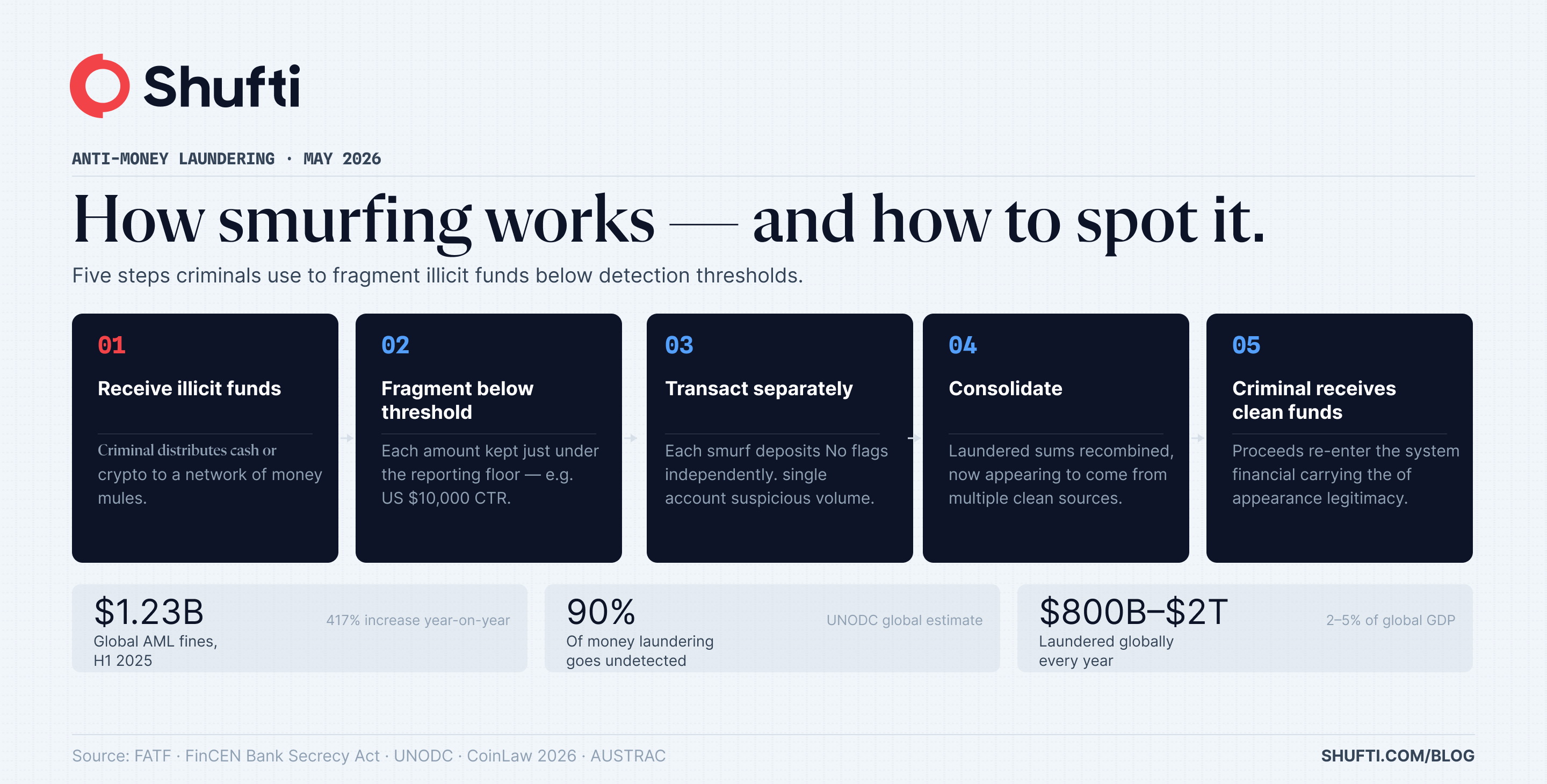
In H1 2025, global AML fines reached $1.23 billion, according to financial crime tracking data. Behind many of those enforcement actions sits a deceptively simple technique: breaking large amounts of illicit money into dozens of smaller transactions, each just below the threshold that would trigger a report. That technique is smurfing, and it remains one of the most common and most misunderstood methods in financial crime.
Not all money laundering involves smurfing, and not all smurfs are career criminals. Some are coerced. Some are simply unaware of what they are facilitating. Understanding what smurfing actually is, how it works, where it shows up, and how it differs from related tactics is the starting point for any compliance team trying to detect and prevent it.
What is Smurfing?
Smurfing meaning: a money laundering technique in which large sums of illicit funds are deliberately broken into multiple smaller transactions, each kept just below a regulatory reporting threshold, and distributed across several individuals or accounts to avoid detection.
The people carrying out these transactions are called “smurfs” a term that entered financial crime terminology in the 1980s and has since become a standard AML typology recognised by the Financial Action Task Force (FATF).
The name itself reflects the tactic. Just as the fictional blue characters operated as a collective of small individuals doing coordinated work, financial smurfs operate in networks each handling a small piece of the total, none of them individually drawing attention.
Smurfing meaning in Financial Crime
In financial crime, smurfing sits at the placement or layering stage of money laundering. In smurfing money laundering, the goal is twofold: keep each individual transaction below reporting thresholds (such as the US $10,000 Currency Transaction Report threshold under the Bank Secrecy Act), and spread the activity across enough accounts and actors to make the pattern hard to spot in any single account’s history.
What separates smurfing from plain structuring is coordination. Structuring is typically done by one person, alone. Smurfing involves a network of individuals, some willing, some recruited, some entirely unaware each handling one slice of the operation.
How Does Smurfing Work?
Step 1: The smurf receives unlawfully acquired funds
A criminal organisation or individual passes illicit cash, crypto, or digital funds to a network of smurfs, also called money mules. Each smurf receives a portion of the total. Some smurfs are willing participants. Others are recruited through romance scams, job offers, or coercion.
Step 2: Funds are divided below detection thresholds
The total sum is fragmented into amounts that fall below the thresholds that trigger automatic reporting. In the US, the trigger is $10,000 for a Currency Transaction Report (CTR). In parts of the EU, the threshold sits at €5,000 for certain transaction types. Smurfs target these floors deliberately; the amounts are set not to maximise efficiency but to minimise the probability of a suspicious activity report (SAR) being filed.
Step 3: Smurfs execute the transactions separately
Each smurf deposits, transfers, or moves their portion independently, treating each smaller amount as a distinct financial event. This fragmentation is what makes smurfing harder to detect than simple structuring: no single account or actor shows a suspicious volume, and the pattern only becomes visible when transactions are aggregated across accounts and actors.
Step 4: Funds are consolidated if necessary
Once laundered through separate channels, the smaller sums can be recombined into a single account now appearing to originate from multiple legitimate-looking sources rather than one large criminal inflow.
Step 5: The criminal receives clean funds
The original criminal receives funds that now carry the appearance of legitimacy, making them easier to spend, invest, or move internationally without triggering further scrutiny.
Modern smurfing has evolved beyond cash deposits. Criminals increasingly spread micro-transactions across digital wallets, prepaid cards, cryptocurrency exchanges, and peer-to-peer payment platforms, each channel adding another layer of distance from the original source.
What are the differences between smurfing and structuring?
Smurfing and structuring are closely related, often confused, and legally distinct. Both involve splitting large sums into smaller transactions. The goal and execution, however, make them different in ways that matter for detection, prosecution, and compliance response.
| Attribute | Smurfing | Structuring |
| Goal | Conceal the origin and nature of illicit funds | Avoid reporting requirements without necessarily hiding the source |
| Who does it | Multiple individuals (smurfs/money mules) acting in coordination | Typically one individual acting alone |
| Legal classification | Money laundering typology under FATF and most national AML laws | A standalone offence under laws such as the US Bank Secrecy Act (31 USC §5324) |
| Detection difficulty | Higher transactions are spread across multiple people and accounts | Lower patterns appear within a single customer’s account history |
| Common channels | Bank deposits, crypto, digital wallets, wire transfers across multiple actors | Cash deposits, ATM withdrawals, money orders at a single institution |
| Regulatory response | SAR + law enforcement referral, often involving network investigation | SAR filing, account restriction, potential prosecution of individual |
The practical consequence for compliance teams: structuring alerts fire at the individual account level; smurfing alerts require cross-account, cross-channel pattern recognition. Static rules catch structuring. Smurfing demands behavioural and network analytics running across your full customer base simultaneously.
What is Smurfing in Banking?
In banking, smurfing surfaces through two primary mechanisms: the use of money mules to execute distributed transactions, and a more sophisticated variant known as cuckoo smurfing. Financial institutions encounter both, and each demands a distinct detection approach.
Money mules and their role in smurfing
Money mules are individuals who allow their personal bank accounts, identities, or payment credentials to be used by criminals for the purpose of moving illicit funds. Some mules are conscious participants paid for their cooperation. Many are recruited unknowingly through fake job postings, social media romance scams, or fraudulent investment schemes and only discover their involvement when law enforcement or their bank contacts them.
In a smurfing network, money mules serve as the operational layer. They open accounts, accept deposits, execute transfers, and withdraw cash each acting on instructions from the criminal coordinator. Because their individual transaction volumes may fall within normal behavioural ranges, they are difficult to distinguish from ordinary customers using standard threshold-based monitoring alone.
What is Cuckoo Smurfing?
Cuckoo smurfing is a specific money laundering technique that exploits legitimate international wire transfer channels to insert illicit funds into the financial system without detection. The name comes from the cuckoo bird’s practice of laying its eggs in another bird’s nest while someone else unknowingly carries the burden.
Here is how it works. A criminal network identifies a legitimate remittance for example, a person in Australia waiting for a wire transfer of A$15,000 from a family member overseas. A corrupt money transfer agent or intermediary intercepts the instruction. Instead of forwarding the legitimate funds, the criminal network deposits the equivalent amount in illicit cash into the recipient’s Australian bank account in small installments, across several transactions. The legitimate sender’s funds are diverted elsewhere. The recipient receives money that appears to be the expected remittance but is actually laundered criminal proceeds.
Australia’s financial intelligence agency, AUSTRAC, has documented cuckoo smurfing extensively and requires financial institutions to file suspicious matter reports when the pattern is identified. Key red flags include multiple cash deposits to a single account from different individuals occurring close together, deposits that closely match an expected inward international transfer, and depositors who have no apparent relationship to the account holder.
Examples of smurfing
Smurfing appears across industries and transaction types. These real-world examples show how the tactic adapts to different environments.
The Hoggan bonus case
In 2016, Kelly Hoggan, the former head of the US Transportation Security Administration, split an improper $90,000 bonus into nine payments of exactly $10,000 each precisely at the Currency Transaction Report threshold to avoid generating a single suspicious transaction alert. Federal investigators identified the pattern and he was removed from his role. The case is now a textbook example of structuring that carries hallmarks of smurfing logic.
Retail banking cash deposits
A drug trafficking network pays street-level couriers to deposit cash into a network of accounts at different bank branches on the same day. Each deposit is under $9,000. No single account shows unusual volume. Aggregated across the network, $500,000 clears the banking system in a week. This is the classic smurfing model that prompted the Bank Secrecy Act’s reporting requirements.
Cryptocurrency Micro-Laundering
Criminal proceeds are broken into hundreds of transactions of under $1,000 each and moved through multiple cryptocurrency wallets across different exchanges before being consolidated into a single wallet and converted to fiat. The FATF’s 2023 report on virtual asset risks identifies this micro-structuring across crypto channels as one of the fastest-growing smurfing typologies.
Trade-Based Smurfing
An import business invoices a foreign counterpart for a consignment of goods at a price slightly below reporting thresholds. Multiple such invoices are raised across multiple shipments. The over- or under-valuation of goods conceals the transfer of value across borders, a form of smurfing that exploits trade documentation rather than direct cash transfers.
What is smurfing in gaming?
Smurfing gaming means creating secondary accounts to compete, participate, or transact at a level that does not reflect your true skill, status, or identity. The term applies across two distinct contexts iGaming (real-money online gambling and betting) and competitive video games or esports with very different implications for platforms and regulators.
Smurfing in iGaming bonus abuse and multi-accounting
In the iGaming sector, which includes online casinos, poker platforms, sports betting, and other real-money gaming environments, smurfing typically takes the form of multi-accounting. A player creates multiple accounts often using different email addresses, payment methods, or identity details to claim first-time deposit bonuses, free spins, or promotional credits repeatedly. Bonus abuse accounts for approximately 64% of all fraud in the iGaming sector, and multi-accounting is its primary mechanism.
Beyond bonus abuse, iGaming smurfs may use secondary accounts for matched betting (placing opposing bets across platforms to guarantee returns), arbitrage (exploiting odds differences between bookmakers), or chip dumping in poker (deliberately losing to a confederate to transfer funds). Most iGaming platforms prohibit multiple accounts per person. Detection relies on device fingerprinting, IP analysis, payment method cross-referencing, and behavioural pattern matching across account clusters.
Unlike smurfing in banking, iGaming smurfing does not typically constitute criminal money laundering. It is, however, a breach of platform terms of service and, depending on jurisdiction, may attract regulatory action under gambling licence conditions.
Smurfing in esports and video games skill manipulation
In competitive multiplayer video games and esports, smurfing refers to skilled players creating alternate accounts to compete against lower-ranked or less experienced opponents. Motivations range from the benign practising a new character or game mode without affecting a main account’s ranking to the harmful: intentionally stomping beginners, selling boosted accounts, or manipulating leaderboards.
This form of smurfing carries no financial crime dimension but does create a poor experience for newer players and has driven several major gaming platforms to implement device-level detection alongside account-level monitoring to identify and link smurf accounts to their primary profile.
How to detect and prevent smurfing
Detecting smurfing requires a shift away from single-account, threshold-based monitoring toward cross-account, behavioural, and network-based analysis. The FATF’s guidance on money laundering typologies consistently identifies static detection rules as insufficient against smurfing specifically because the tactic is designed to defeat them.
Transaction monitoring and threshold alerts
The foundational layer is automated transaction monitoring that aggregates activity across accounts, not just within them. Key alert triggers include high-frequency deposits of amounts just below the reporting threshold; identical or near-identical deposit amounts appearing across multiple accounts within short time windows; transactions occurring outside normal business hours; and inward remittances that are quickly fragmented and moved outward again. Financial institutions in the US are required under the Bank Secrecy Act to file a SAR if they suspect a customer is structuring or smurfing, even if no individual transaction meets the CTR threshold.
Behavioural analytics and pattern detection
Static rules catch known patterns. Behavioural analytics catch deviations from an individual’s or cohort’s established baseline. Modern AML platforms use machine learning to flag accounts whose transaction rhythm, counterparty geography, or value distribution shifts in ways consistent with smurfing even when each individual transaction looks unremarkable in isolation. Network graph analysis links accounts that share device IDs, IP addresses, beneficiary details, or timing clusters, surfacing the coordinated rings that underpin smurfing operations.
KYC and identity verification controls
Strong onboarding controls are the first line of defence. When smurfs open accounts, identity verification that cross-references submitted documents against watchlists, confirms liveness, and screens for adverse media reduces the pool of recruitable accounts criminals can build their networks from. Enhanced due diligence on high-risk customers those with unusual account opening behaviour, mismatched identity signals, or accounts opened in bulk from the same device or IP catches smurf recruiters before the network becomes operational.
SAR filing obligations
When smurfing is identified or suspected, financial institutions in most jurisdictions carry a mandatory obligation to file a suspicious activity report with the relevant Financial Intelligence Unit FinCEN in the US, the NCA in the UK, AUSTRAC in Australia. Filing obligations apply even where no individual transaction breaches a reporting threshold. Failure to file where smurfing is suspected carries its own regulatory risk, separate from the underlying crime.
How Shufti helps financial institutions stop smurfing
Smurfing thrives in the gaps between onboarding and ongoing monitoring where a customer who looked clean at sign-up is later used as a conduit for distributed transactions a compliance team never connects to each other.
Shufti’s AML screening solution addresses both ends of that gap. At onboarding, identity verification cross-references each applicant against sanctions lists, PEP databases, and adverse media across 1,200+ sources reducing the number of smurf accounts that make it into a platform in the first place. In ongoing monitoring, transaction pattern analysis flags the structural signatures of smurfing: near-threshold deposits, unusual frequency, coordinated timing across account clusters, and remittance flows inconsistent with a customer’s verified profile. Decisions are explainable because the models are Shufti’s own compliance teams see the specific signals behind each alert, not a black-box score they cannot defend to a regulator.
| See how Shufti’s AML monitoring detects smurfing patterns across your customer base. Book a demo. |
Frequently Asked Questions
What is smurfing in AML?
In Anti-Money Laundering (AML), smurfing is a technique where large illicit sums are split into many smaller transactions each kept below regulatory reporting thresholds and executed through a network of individuals to conceal the funds' origin. FATF classifies it as a core money laundering typology, and most national AML frameworks require financial institutions to file suspicious activity reports when smurfing patterns are identified.
Why do players use smurf accounts?
Players create smurf accounts primarily to compete against less skilled opponents without affecting their main account's ranking, to practise new characters or strategies anonymously, or to exploit welcome bonuses and promotional offers on gaming and betting platforms. In iGaming, the financial motivation of repeated bonus claiming is the dominant driver. In competitive games, the motivation is typically skill-based, though account selling and rank manipulation are also common secondary uses.
Is smurfing allowed in gaming or iGaming platforms?
Almost universally, no. The vast majority of iGaming operators and competitive gaming platforms explicitly prohibit multiple accounts per user in their terms of service. iGaming platforms that hold gambling licences may face regulatory consequences if multi-accounting is not actively detected and prevented. In esports, repeated smurfing on major platforms typically results in account bans. Unlike smurfing in banking, gaming smurfing is not a criminal offence in most jurisdictions but it is a breach of platform rules and increasingly subject to active enforcement through device fingerprinting and identity verification at sign-up.